


IMF Chief Says Hamas-Israel Conflict Is ‘Darkening the Horizon’ for World Economy

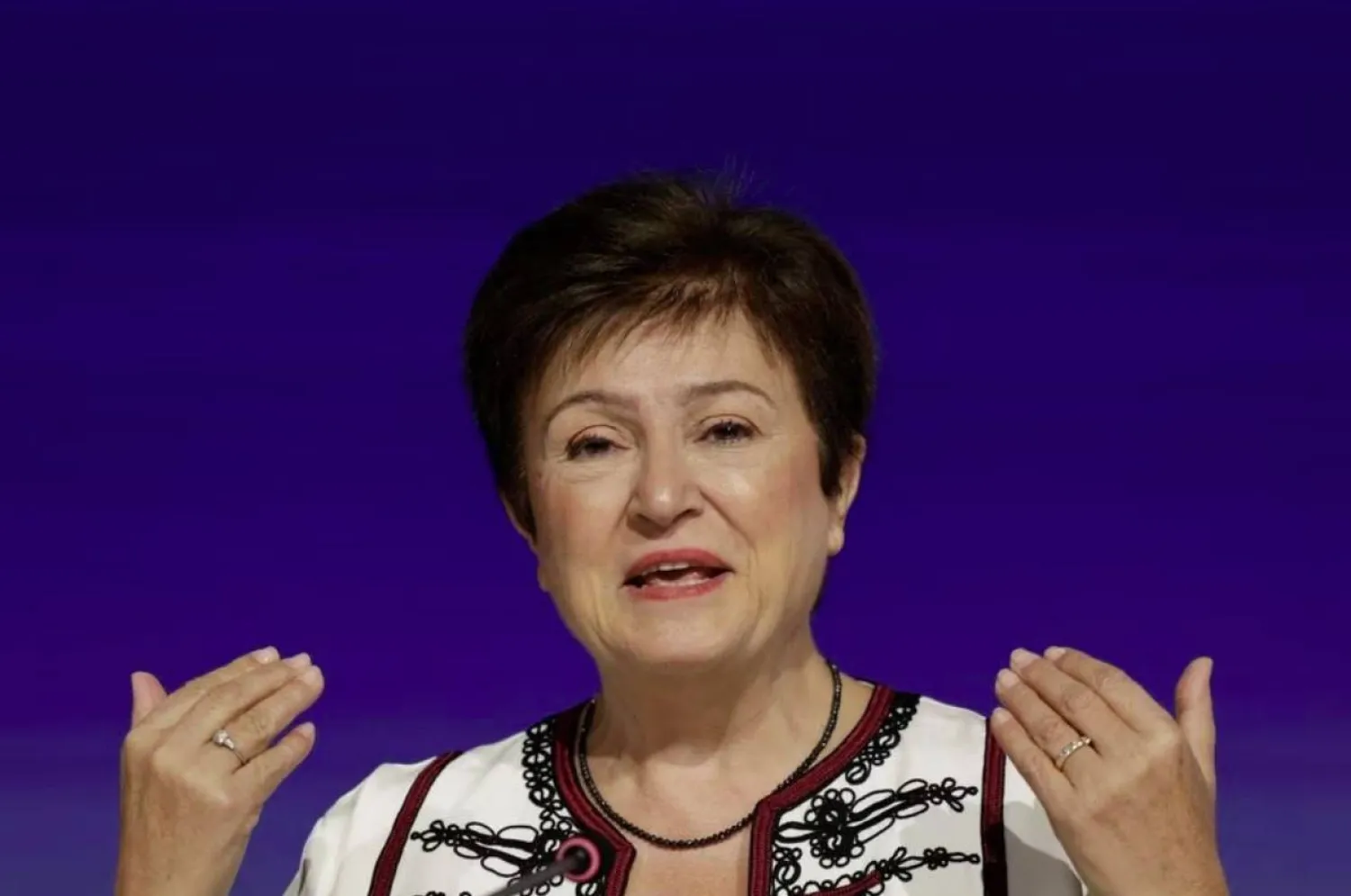
Managing Director of the International Monetary Fund (IMF), Kristalina Georgieva, addresses the media on the fourth day of the annual meeting of the IMF and the World Bank, following last month's deadly earthquake, in Marrakech, Morocco, October 12, 2023. REUTERS/Susana Vera Acquire Licensing Rights
TT

IMF Chief Says Hamas-Israel Conflict Is ‘Darkening the Horizon’ for World Economy

Managing Director of the International Monetary Fund (IMF), Kristalina Georgieva, addresses the media on the fourth day of the annual meeting of the IMF and the World Bank, following last month's deadly earthquake, in Marrakech, Morocco, October 12, 2023. REUTERS/Susana Vera Acquire Licensing Rights

International Monetary Fund managing director Kristalina Georgieva said on Thursday the Israel-Hamas conflict threatened to darken an already murky global economic outlook.

Georgieva said severe shocks were becoming "the new normal" in a global economy characterized by weak growth.

"Very clearly, this is a new cloud on not the safest horizon for the world economy, a new cloud darkening this horizon," she told a news conference at the annual meetings of the IMF and World Bank in Marrakech, Morocco.

The IMF has kept its growth forecast at 3.0 percent for this year but lowered it to 2.9 percent for 2024.

"It's heartbreaking to see innocent civilians dying," an emotional Georgieva told reporters.

"We do need to build our agility in terms of anticipating shocks and being quick to respond," she said.

"We are closely monitoring how the situation evolves, how it is affecting, especially oil markets," Georgieva said. There had been some fluctuations in oil prices and reactions in markets, but it was too early to predict the economic impact, she added.

Jihad Azour, IMF Director of the Middle East and Central Asia Department, said it is difficult to have a ‘clear reading’ about the conflict’s economic impact.

IMF research suggests that if there is something like a 10% increase in oil prices, this would weigh down on global output by about 0.15% in the following year and would increase global inflation by about 0.4 percentage point.

IMF chief economist Pierre-Olivier Gourinchas said it is "too early" to assess its impact on global economic growth.

A financial expert from one of the investment banks, speaking on condition of anonymity, told Asharq Al-Awsat that if this situation continues then prices will increase, including oil prices.

He added that it is impossible to predict any scenarios because they are linked to the updates of the war, like the Russian-Ukrainian war.



S&P Global: UK Consumers Hit by Worries Over War in Iran

A man shops in a supermarket in Chanverrie, France, October 16, 2024. REUTERS/Stephane Mahe
TT

S&P Global: UK Consumers Hit by Worries Over War in Iran

A man shops in a supermarket in Chanverrie, France, October 16, 2024. REUTERS/Stephane Mahe

British consumers have turned their least confident since the start of last year following the outbreak of war in the Middle East, financial data firm S&P Global said on Monday in an early sign of the potential impact of the conflict on the economy.

S&P Global's Consumer Sentiment Index - based on a survey conducted ⁠March 5-9 - dropped ⁠to 44.1 in March from 44.8 in February, its lowest since January 2025.

"A marked deterioration of consumer sentiment in March means we are seeing the first ⁠concrete signs of the war in the Middle East damaging the UK economy," Maryam Baluch, an economist at S&P Global Market Intelligence, said, according to Reuters.

Households were the most downbeat about their financial prospects since December 2023 and the wariest about making big purchases in 14 months, the firm said.

The Bank ⁠of ⁠England, along with private economists, is watching for the impact of the US-Israeli war with Iran on the economy, including any hit to consumer spending as the rise in global energy prices threatens to push up inflation.

The BoE is likely to delay a previously expected interest rate cut on Thursday.


Gold Falls as Inflation Fears Pressure Fed Rate-cut Outlook

AFP_96 Gold bars weighing 1000 grams each are displayed at the Austrian Gold and Silver Refinery _Oegussa_ in Vienna
TT

Gold Falls as Inflation Fears Pressure Fed Rate-cut Outlook

AFP_96 Gold bars weighing 1000 grams each are displayed at the Austrian Gold and Silver Refinery _Oegussa_ in Vienna

Gold prices dipped on Monday, pressured by concerns that surging oil costs could stoke inflation further and prompt a more hawkish policy stance by major central banks including the US Federal Reserve, dulling the appeal of the non-yielding asset.

Spot gold fell 0.7% to $4,983.17 per ounce, as of 0944 GMT. US gold futures for ‌April delivery ‌fell 1.5% to $4,987.30.

"The gold market has moved its ‌focus ⁠from looking at ⁠the implications of the Hormuz trade closure, and towards implications of longer-term inflation," said Bernard Dahdah, an analyst at Natixis.

"Higher oil prices mean higher inflation and this has repercussions on the Fed. The Fed could pivot, stop cutting rates and that puts downward pressure on gold prices."

Oil held above $100 a ⁠barrel, up more than 40% this month ‌to its highest levels since 2022, ‌after US-Israeli strikes on Iran prompted Tehran to halt shipments through ‌the Strait of Hormuz.

US President Donald Trump on Sunday pressed ‌allies to help secure the Strait of Hormuz as Iranian forces continue attacks on the vital waterway amid the US-Israeli war on Iran, now in its third week.

The Fed will meet this week ‌for a two-day policy meeting, where it is widely expected to hold interest rates steady.

Other ⁠central ⁠banks including the European Central Bank, the Bank of England and the Bank of Japan will also meet this week, with the focus on policymakers' assessment of the Iran war on inflation, growth and future policies.

"But we expect central banks to be watchful of inflation risks without making knee-jerk policy rate hikes," UBS said in a note.

"In addition, the longer the US-Iran conflict goes on, the higher the risk of negative economic impacts, which should support hedging demand for gold."

Elsewhere, spot silver fell 2.6% to $78.46 per ounce. Spot platinum held steady at $2,024.85 and palladium slid 0.5% to $1,542.92.


GASTAT: Saudi Consumer Inflation Eased to 1.7% in February

Shoppers are seen at a supermarket in Saudi Arabia. SPA
TT

GASTAT: Saudi Consumer Inflation Eased to 1.7% in February

Shoppers are seen at a supermarket in Saudi Arabia. SPA

Saudi Arabia’s annual inflation rate edged down to 1.7 percent in February, the lowest level since January 2025, according to data from the General Authority for Statistics (GASTAT).

The consumer price index eased from 1.8 percent in January to 1.7 percent, GASTAT said Sunday.

The data further showed that housing, water, electricity, gas, and other fuels rose 4.1 percent in February 2026, mainly driven by a 5.1 percent increase in actual housing rents.

Transport prices also climbed 1.4 percent, supported by a 5.6 percent rise in passenger transport services, while restaurant and accommodation services increased 1.9 percent due to higher accommodation costs.

Personal care, social protection and miscellaneous goods and services surged 8.2 percent, largely reflecting a jump in other personal effects, particularly jewelry and watch prices, which rose 29 percent.

According to GASTAT, prices in recreation, sport and culture climbed 1.8 percent, while education services increased 1.4 percent. As for information and communications prices, they edged up 1.1 percent.

Data showed that prices in the insurance and financial services category rose 1 percent.

As for furnishings, household equipment and routine maintenance, prices declined 0.9 percent, while prices for food and beverages, as well as clothing and footwear, remained largely stable during the period.

GASTAT said that on a monthly basis, the Consumer Price Index last month recorded relative stability compared to January 2026.