Saudi Arabia and Singapore Stress Importance of Cooperation, Sign 7 MoUs

The Saudi Singapore Joint Committee (SPA)
TT

Saudi Arabia and Singapore Stress Importance of Cooperation, Sign 7 MoUs

The Saudi Singapore Joint Committee (SPA)

The Saudi-Singaporean roundtable meeting was held in Riyadh on Wednesday to review the latest updates of Vision 2030 and remarkable achievements, highlighting the unprecedented transformation in the Kingdom.

The meeting was attended by the Prime Minister of Singapore, Lee Hsien Loong, Saudi Minister of Commerce Majid bin al-Qasabi, Minister of Investment Khalid al-Falih, various Saudi ministers, officials, and CEOs of major companies. It also included Saudi and Singaporean representatives of the government and private sectors.

They discussed investment partnership opportunities in the energy, financial, transportation, logistics, and infrastructure sectors.

The meeting also stressed the importance of cooperation in new and innovative projects to support the economic fields in the Kingdom and Singapore and collaboration in renewable energy and green hydrogen.

It addressed increasing the volume of supporting logistics, infrastructure, human capital development, and cooperation in the entertainment industry.

The roundtable meeting aims to enhance the two countries' investment relations, strengthen economic and investment ties between the Kingdom and Singapore, develop qualitative assets for entrepreneurial companies, and support the private sector to take advantage of opportunities.

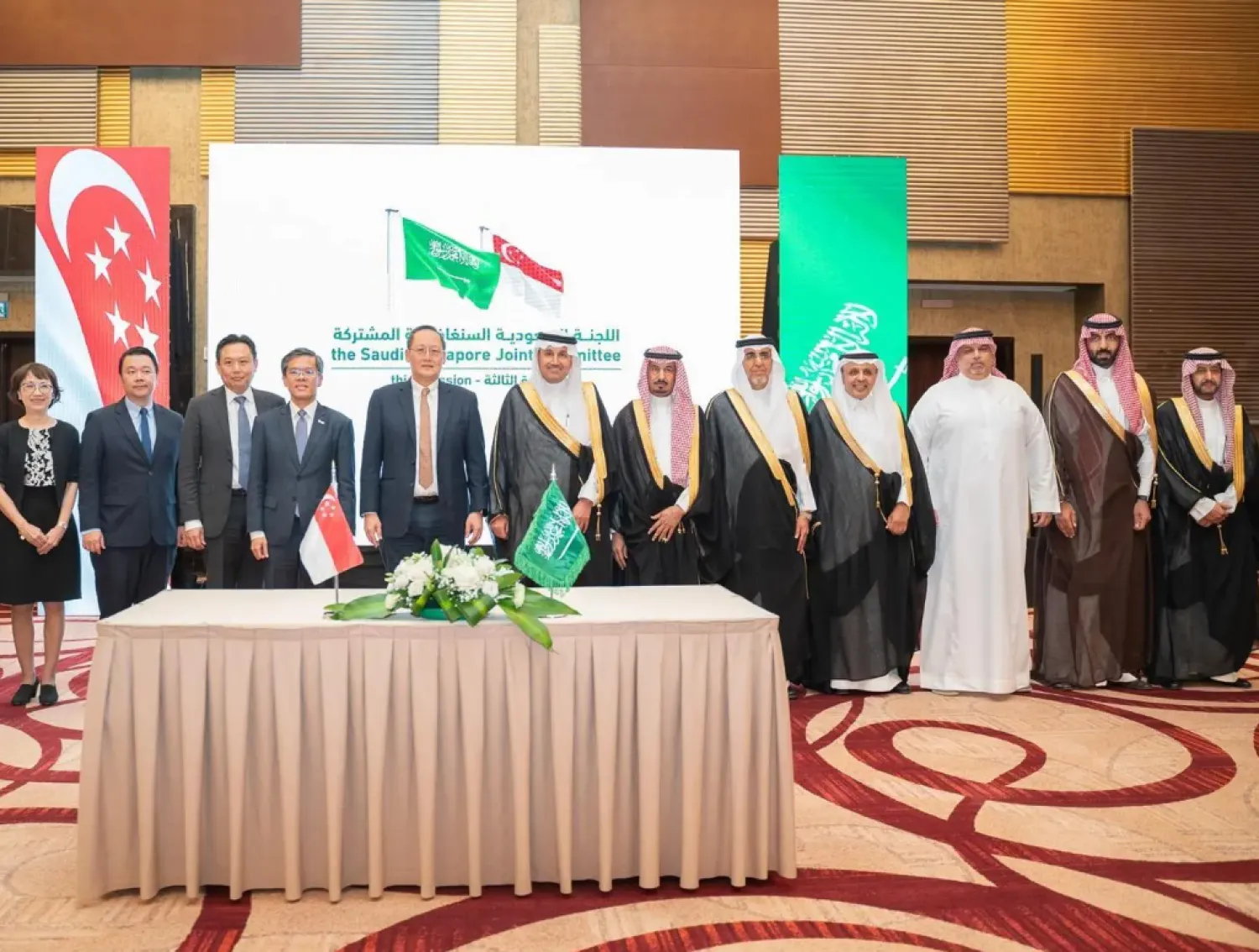
Furthermore, Saudi Arabia and Singapore signed seven MoUs in several fields during Tuesday's third session of the Saudi-Singapore Joint Committee held in Riyadh.

The Saudi Minister of Transport and Logistic Services and Singapore's Minister of Manpower Tan See Leng co-chaired the session.

Speaking at the session, Jasser said the Kingdom and Singapore enjoy a robust bilateral relationship spanning nearly six decades.

He added that the joint committee confirms the strong links between Saudi Arabia and Singapore, reiterating that the efforts have flourished after signing several agreements and MoUs covering various areas.

The Minister noted that these joint efforts have enhanced the investment and trade relations between the two countries at all levels in the public and private sectors.

Jasser highlighted the progress of Saudi-Singaporean cooperation, including in the economic, investment, and commercial fields.

He said the trade volume between the two countries significantly increased by around 50 percent in 2022 compared to the previous year, noting that the meeting continues successful efforts and cooperation.

Jasser underlined the importance of enhancing economic and developmental relations between the two countries, facilitating the movement of imports and exports of goods, and attracting investment opportunities in industry and the digital economy.

He also voiced keenness for enhancing cooperation in various areas, noting that he looks forward to implementing infrastructure development projects to improve transportation and facilitate the movement of passengers and goods between the two countries.

The Minister highlighted the significant transformation the Kingdom is witnessing in all sectors under the leadership of the Custodian of the Two Holy Mosques, King Salman bin Abdulaziz, and Crown Prince Mohammed bin Salman.

Acting Secretary General of the Federation of Saudi Chambers Walid al-Arinan explained that the Saudi and Singaporean economies stimulate cooperation and economic partnership and promising opportunities to double trade and investment in light of the Vision 2030 initiatives.

In addition, the Federation of Saudi Chambers and the Singapore Business Forum signed an MoU, and the Saudi Standards, Metrology, and Quality Organization (SASO) also signed an agreement on standardization and coordination.

Meanwhile, the Ministry of Investment signed an MoU for cooperation and facilitation of investments between Singaporean and Saudi companies.

Also, the MoUs include training and development opportunities in the Kingdom and investment opportunities in the education sector.

The session witnessed the signing of an MoU in ports, transportation, and logistics services and an MoU to develop investment in the industrial sector in Riyadh and the health and fitness sectors.


Gold Slips as Markets Assess Fed Signals, Await US Inflation Data

A salesman presents gold bars at a jewellery shop inside the Gold Market at the Old Souk in Dubai EPA
TT

Gold Slips as Markets Assess Fed Signals, Await US Inflation Data

A salesman presents gold bars at a jewellery shop inside the Gold Market at the Old Souk in Dubai EPA

Gold prices fell on Thursday as investors assessed signals from the Federal Reserve and Chair Kevin Warsh after policymakers left interest rates unchanged, while awaiting key US inflation data later in the day for further clues on the rate outlook.

Spot gold slid 0.7% to $4,037.98 per ounce by 0410 GMT, while ‌US gold futures ‌for December delivery steadied at $4,049.80.

"Today's fall is ‌purely ⁠because of persistent ⁠Middle East uncertainty and markets positioning ahead of today's inflation data," said Ajay Kedia, director at Mumbai-based Kedia Commodities.

The Fed held rates steady on Wednesday, in the 3.75%-4.00% range, as expected, opting to delay any changes to borrowing costs until after next week's US midterm elections while it awaits further data on inflation.

Traders are now pricing ⁠in about a 78% chance of a rate ‌hike in December, compared with 84% ‌before the announcement, according to the CME's FedWatch Tool.

Higher interest rates ‌increase the opportunity cost of holding non-yielding bullion, reducing its ‌appeal to investors.

Markets are awaiting the Personal Consumption Expenditures data due at 1230 GMT, a key gauge closely watched by the Fed as it targets a 2% inflation rate.

Global commodity prices are set to ‌surge 23% in 2026, the World Bank said on Wednesday, citing rising energy prices and disruptions ⁠to cargo ⁠shipping during the Middle East war, grain shipment problems in the Black Sea and high demand for safe-haven assets such as gold.

Elsewhere, China's net gold imports via Hong Kong in September rose more than 28% from August to a five-month high, Hong Kong Census and Statistics Department data showed on Wednesday.

On the geopolitical front, US Vice President JD Vance sent a letter to Iranian Security Council chief Mohsen Rezaei in a bid to revive peace negotiations, the Wall Street Journal reported on Wednesday.

Among other metals, spot silver fell 1.5% to $53.15 per ounce, platinum dropped 1.5% to $1,515.70 and palladium slid 0.6% to $1,004.25.


Oil Prices Fall as Peace Hopes Offset Fears of Growing Middle East Conflict

FILE PHOTO: A general view shows an oil rig used in drilling at the Zubair oilfield in Basra, Iraq, July 5, 2022. REUTERS/Essam Al-Sudani/File Photo
TT

Oil Prices Fall as Peace Hopes Offset Fears of Growing Middle East Conflict

FILE PHOTO: A general view shows an oil rig used in drilling at the Zubair oilfield in Basra, Iraq, July 5, 2022. REUTERS/Essam Al-Sudani/File Photo

Oil prices fell on Thursday, paring gains made a day earlier, as hopes for peace talks took the edge off renewed concerns over Middle East supply disruptions from escalating regional conflict.

Brent crude futures declined $1.22, or 1.1%, to $114.10 a barrel at 0351 GMT. US West Texas Intermediate (WTI) crude futures were down $1.33, or 1.3%, at $101.45.

Brent rose 1.3% and WTI gained 3% on Wednesday, said Reuters.

US Vice President JD Vance sought to revive peace negotiations by sending a letter to Iranian Security Council chief Mohsen Rezaei, the Wall Street Journal said on Wednesday, citing ‌US officials and ‌people familiar with the matter.

"Selling pressure is prevailing amid ‌expectations ⁠that peace talks may ⁠resume," said Yuki Takashima, an economist at Nomura Securities. "However, the decline remains limited."

This was due to concerns over intensified attacks by the Houthis and fears the US may launch an attack on Iran following its midterm elections set for November 3.

The Coalition to Restore Legitimacy in Yemen fighting Houthis said it destroyed a ballistic missile fired by the group towards Saudi Arabia's eastern region early on Thursday, as hostilities between the two sides show no signs of abating.

The Houthis attacked ⁠Aden airport on Wednesday, Yemeni government forces said.

Qatari ‌mediators have presented Iran with a new draft deal to end the war with the US and Israel, an official briefed on the negotiations said, but a senior Iranian official dismissed it as unacceptable ideas that did not amount to an offer.

Iran's foreign minister said on Wednesday Tehran continued to ‌give diplomacy a chance to succeed and flagged the possibility of completing its seven-day plan in less than a week if ⁠adopted.

Some expectations of ⁠rising crude and diesel production from Russia weighed further on market sentiment and prices.

"Since the October 15 strike on the Ryazan refinery, there have been no further confirmed attacks on Russian refining infrastructure," JPMorgan analysts said in a note last night. "The silence has allowed Russian refinery runs to rebound by 350 kbd last week to 4 mbd."

"Higher runs would also allow Russia to lift crude production by a broadly comparable amount, reversing part of the recent decline that pushed output to 8.4 mbd—its lowest level since 2003 ... (but) higher crude production would not necessarily translate into higher crude exports."

The US Energy Information Administration said on Wednesday that energy firms pulled 1.9 million barrels of crude from storage during the week ended October 23, versus analysts' forecast of a 15,000-barrel build in a Reuters poll.

But gasoline stockpiles rose by 3.9 million barrels, against analysts' expectations for a draw of 0.9 million barrels.


Saudi Public-Private Partnership Identifies 20 Challenges to Improving Business Environment

A meeting between a delegation from the Federation of Saudi Chambers and officials from the Asharqia Chamber (Asharqia Chamber)
TT

Saudi Public-Private Partnership Identifies 20 Challenges to Improving Business Environment

A meeting between a delegation from the Federation of Saudi Chambers and officials from the Asharqia Chamber (Asharqia Chamber)

Saudi Arabia's private sector has identified 20 obstacles to implementing the Kingdom's new commercial registration law, Asharq Al-Awsat has learned, highlighting efforts to streamline regulations and sharpen the business sector's competitiveness.

Authorities have resolved four of the challenges, while 12 are being addressed and another four remain under review.

The efforts reflect growing coordination between the public and private sectors to remove regulatory and procedural barriers, ease business operations and support enterprise growth, in line with Vision 2030's drive to make the private sector a key engine of economic growth.

The Ministry of Commerce brought the Commercial Registration and Trade Names laws, along with their implementing regulations, into force on April 3 last year. Related business services resumed after being upgraded to comply with the new legislative framework.

Regulatory hurdles under review

The Studies Department at the Federation of Saudi Chambers, working with the Saudi Labor Market Committee, cataloged the challenges businesses faced following the rollout of the new Commercial Registration Law.

It referred 20 challenges to the Licensing Committee at the Saudi Center for Competitiveness and Business. By the end of the third quarter of this year, four had been resolved, 12 remained under active review and resolution, and four were still being studied.

The two laws form part of Saudi Arabia's broader overhaul of its commercial regulatory framework, aimed at keeping pace with economic and technological developments and advancing the transformation envisioned under Vision 2030.

The Commercial Registration Law seeks to simplify business procedures while strengthening transparency and reliability through accurate, regularly updated registry data that can be easily searched and accessed.

One registration, nationwide

A central reform eliminates the need for multiple commercial registrations. Businesses now need just one registration covering all their activities across Saudi Arabia, replacing separate branch registrations for sole proprietorships and companies and reducing their financial burden.

The law also replaces the traditional renewal process with mandatory electronic confirmation of registration details every 12 months from the date of issuance.

Businesses that fail to confirm their details within 90 days of the deadline face suspension of their registration and related services.

If the suspension remains unresolved for a full year, the registration is automatically canceled unless the business owner applies to lift it, submits the annual confirmation and pays the required fees and penalties.

The law also requires businesses to open bank accounts linked to their commercial entities to strengthen their credibility.

Business owners must secure licenses for activities listed in their commercial registrations within 90 days, unless the relevant licensing authority allows more time.

Existing branch registrations must be brought into compliance within a five-year grace period.

The legislation also introduces alternatives to conventional penalties. These include warnings, orders to take preventive measures against future violations, requirements to remedy the effects of violations and decisions to correct information recorded in the commercial register.