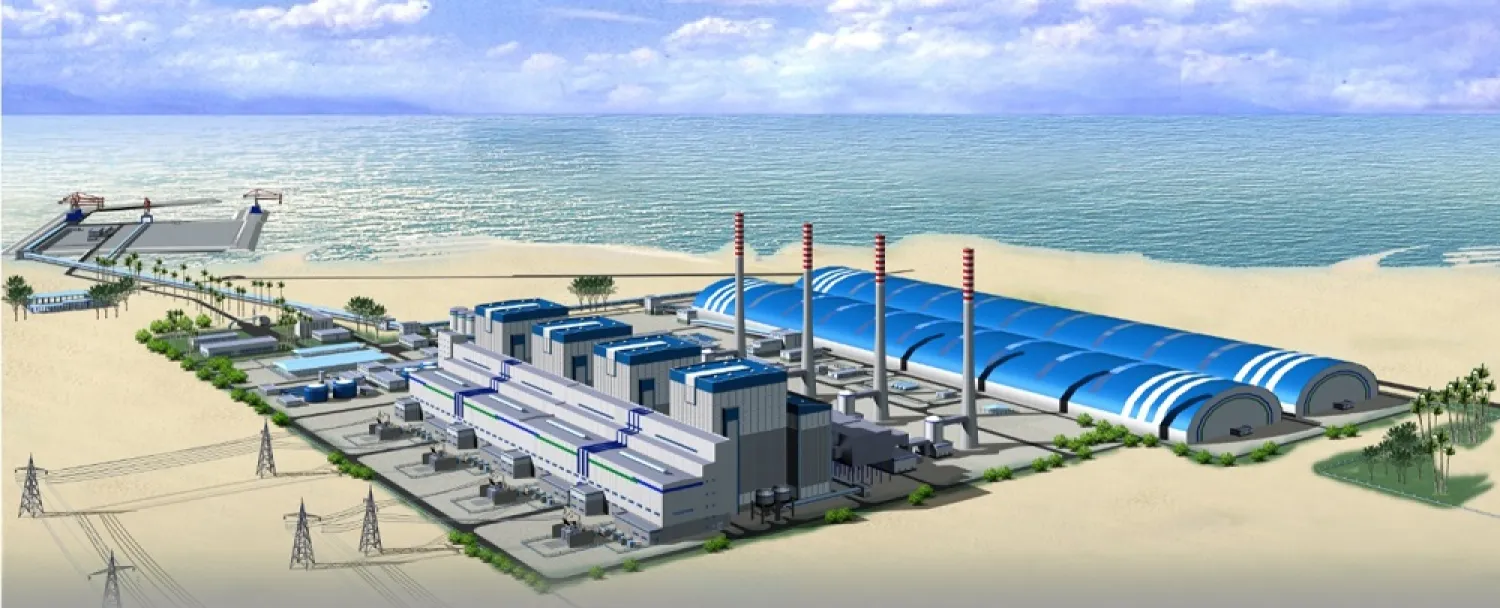
Saudi Arabia's ACWA Power Begins Commercial Operations at Hassyan Power Complex

Model of the Hassyan Power Complex in Dubai. (ACWA power)
TT

Saudi Arabia's ACWA Power Begins Commercial Operations at Hassyan Power Complex

Model of the Hassyan Power Complex in Dubai. (ACWA power)

The Saudi company ACWA Power announced on Sunday the start of commercial operation of the Hassyan Power Complex, which has a capacity of 2,400 megawatts.

In a disclosure published on the Saudi Stock Exchange (Tadawul), the company received the commercial operation certificate from the Dubai Electricity and Water Authority (DEWA).

The last 600 MW power unit followed three other 600 MW units that had previously begun commercial operations.

The Hassyan Power Complex project in Dubai is one of the largest power stations in the region.

The project comprises four GE/Alstom 600 MW power units gross of ultra-supercritical boilers, steam turbines, and generators.

The plant was initially designed to operate on coal, but subsequently, based on a decision by DEWA, the off-taker, with the blessing of the Chairman of the Dubai Supreme Council of Energy on 2nd February 2022, it was switched to operate on natural gas.

It will avoid approximately 30 million tons of CO2 emissions by 2030.

The project specifications require the plant to be constructed carbon capture ready, meaning that the installation of carbon capture equipment in the future should be without the need for any modification to the plant or hinder the plant availability.

ACWA Power owns 26.95 percent of the Hassyan Power Complex.

The company said that the financial impact of operating the project at total operational capacity is expected to become clear starting from the last quarter of this year.


Egypt Signs Preliminary Financing Agreement on $650 Million Solar Project in Upper Egypt

A general view of the Benban plant of photovoltaic solar panels in Aswan, Egypt, November 17, 2019. (Reuters)
TT

Egypt Signs Preliminary Financing Agreement on $650 Million Solar Project in Upper Egypt

A general view of the Benban plant of photovoltaic solar panels in Aswan, Egypt, November 17, 2019. (Reuters)

Egypt has signed a preliminary financing agreement with Norway's Scatec and three multilateral development banks for a $650 million solar power project in the southern province of Qena, the cabinet said on Monday.

Egypt ‌is scaling ‌up renewable energy ‌projects ⁠to reduce its natural ⁠gas import bill, targeting a 42% share of renewable energy in its electricity generation mix by 2030.

The Dandara project in ⁠Nagaa Hammadi city will ‌have generation ‌capacity of 1 gigawatt and ‌battery storage of 200 megawatt ‌hours, the cabinet said.

The European Investment Bank, European Bank for Reconstruction and Development and African ‌Development Bank are participating in the financing arrangements while ⁠the ⁠National Bank of Egypt will take an equity stake in the project company.

The project will be built in two phases, each adding 500 megawatts of solar capacity and 100 megawatt hours of battery storage.


RSNF Launches HMS NEOM Under Second Phase of Sarawat Project

HAZEM, the first Saudi naval combat management system of its kind, is among the project’s most significant outcomes. It was developed through a strategic partnership between Saudi Arabian Military Industries (SAMI) and Spain’s Navantia - SPA
TT

RSNF Launches HMS NEOM Under Second Phase of Sarawat Project

HAZEM, the first Saudi naval combat management system of its kind, is among the project’s most significant outcomes. It was developed through a strategic partnership between Saudi Arabian Military Industries (SAMI) and Spain’s Navantia - SPA

The Royal Saudi Naval Forces (RSNF) launched His Majesty's Ship NEOM (HMS NEOM), the second ship in the second phase of the Sarawat Project, at Navantia’s shipyard in San Fernando, Spain, following the completion of hull construction and assembly.

The outfitting, installation and integration of the ship’s systems will be completed in Saudi Arabia, followed by acceptance trials on Saudi lands and in Saudi waters, supporting technology transfer and the localization of military shipbuilding.

The launching ceremony was attended by Chief of Staff of RSNF Vice Adm. Mohammed bin Abdulrahman Alghuraiby, Saudi Ambassador to Spain Princess Haifa bint Abdulaziz bin Ayyaf Al Muqrin, Navantia Chairman Ricardo Domínguez, Chief Operating Officer at the company Gonzalo Mateo-Guerrero, San Fernando Shipyard Director Alberto Cervantes Sánchez, and senior naval officers from both countries.

Speaking at the ceremony, Vice Adm. Alghuraiby expressed appreciation for the unwavering support extended to the Armed Forces, particularly the RSNF, by Custodian of the Two Holy Mosques King Salman bin Abdulaziz Al Saud, Prince Mohammed bin Salman bin Abdulaziz Al Saud, Crown Prince and Prime Minister, and Minister of Defense Prince Khalid bin Salman bin Abdulaziz. He said this support has helped develop defense capabilities and enhance operational readiness and effectiveness.

He praised the Saudi-Spanish partnership and its role in developing naval capabilities, as well as the efforts of the project’s engineers and technicians in achieving this milestone. He emphasized that the Sarawat Project strengthens naval readiness and develops national expertise through a comprehensive package of logistics support and crew qualification and training, equipping personnel with the knowledge and experience needed to operate and maintain the ships.

The contract for the second phase of the Sarawat Project includes a comprehensive logistics support package, crew training programs and a plan to qualify more than 100 Saudi engineers, alongside the localization of combat systems integration and maintenance.

HAZEM, the first Saudi naval combat management system of its kind, is among the project’s most significant outcomes. It was developed through a strategic partnership between Saudi Arabian Military Industries (SAMI) and Spain’s Navantia.

As the regulator of the military industries sector, the General Authority for Military Industries (GAMI) supported the project through its industrial participation agreement with Navantia. The agreement includes specific targets for localization and the development of domestic capabilities, supporting Saudi Arabia’s military industries, advancing knowledge and technology transfer, and enhancing military readiness.

The second phase of the Sarawat Project comprises three Avante 2200 multirole corvettes: HMS AlMadinah, HMS NEOM and HMS AlUla. It builds on the first phase, which delivered five warships to the Royal Saudi Naval Forces.

The ships feature advanced systems to counter aerial, surface and subsurface threats, strengthening their ability to protect Saudi Arabia’s strategic interests and secure vital sea lanes.


Oil Drops from Near Six-Month Highs on Hopes Iran War Hostilities to Ease

Pumpjacks operating in Kern County, which has a long history of oil production, in California's 22nd Congressional District on October 16, 2026 near Bakersfield, California. (Getty Images/AFP)
TT

Oil Drops from Near Six-Month Highs on Hopes Iran War Hostilities to Ease

Pumpjacks operating in Kern County, which has a long history of oil production, in California's 22nd Congressional District on October 16, 2026 near Bakersfield, California. (Getty Images/AFP)

Oil prices fell on Monday after surging last week to near six-month highs, amid hopes of easing hostilities between the United States and Iran.

US West Texas Intermediate crude futures were down $1.76, or 1.7%, at $101.51 per barrel by 0744 GMT. Brent crude futures were down $1.49, or 1.28%, at $115.23.

On Friday, prices settled nearly $3 higher after Houthi attacks in Saudi Arabia stoked energy supply concerns. Brent finished ‌the week up ‌6% and WTI ended 2.3% higher.

On Sunday, Qatari mediators ‌traveled ⁠to Tehran as ⁠part of an effort to de-escalate regional tensions in coordination with the United States, an official briefed on the situation said.

Also, top officials from Makkah Defense Agreement countries Saudi Arabia, Türkiye and Pakistan are set to meet Iran's leaders in Tehran on Monday in their first high-level contact since attacks by the Iran-backed Houthis joined the regional conflict by launching attacks on Saudi Arabia.

"Concerns over renewed military hostilities in the Middle East, which drove much of last ⁠week’s crude rally, have eased this morning, but the reprieve may ‌prove temporary," said Vandana Hari, founder of oil market ‌analysis provider Vanda Insights.

Hari said US President Donald Trump has not dispelled market expectations that strikes ‌on Iran could still follow after the November 3 midterm elections.

"We therefore expect volatility ‌to remain elevated, with risks still skewed to the upside," she added.

The effects of the US-Israeli war on Iran that began on February 28 continue to reverberate as companies adjust to the disruptions ⁠of commercial shipping ⁠through the key Strait of Hormuz and Bab el-Mandeb Strait caused by the conflict.

On Monday, the energy ministers from Saudi Arabia and Singapore said state-owned oil company Saudi Aramco will start storing crude oil in Singapore from the second half of 2027.

"While supply risks surrounding the Strait of Hormuz remain firmly entrenched, the current pullback appears more reflective of position adjustments and risk management rather than any meaningful improvement in the underlying supply situation," said Priyanka Sachdeva, head of market insight at Phillip Nova.

The head of the International Energy Agency, Fatih Birol, reinforced the concerns about the supply situation, saying on Monday at an industry event in Singapore that he does not expect energy markets in 2027 to return to where they were before the Iran war.