


Container Rates Soar on Concerns of Prolonged Red Sea Disruption

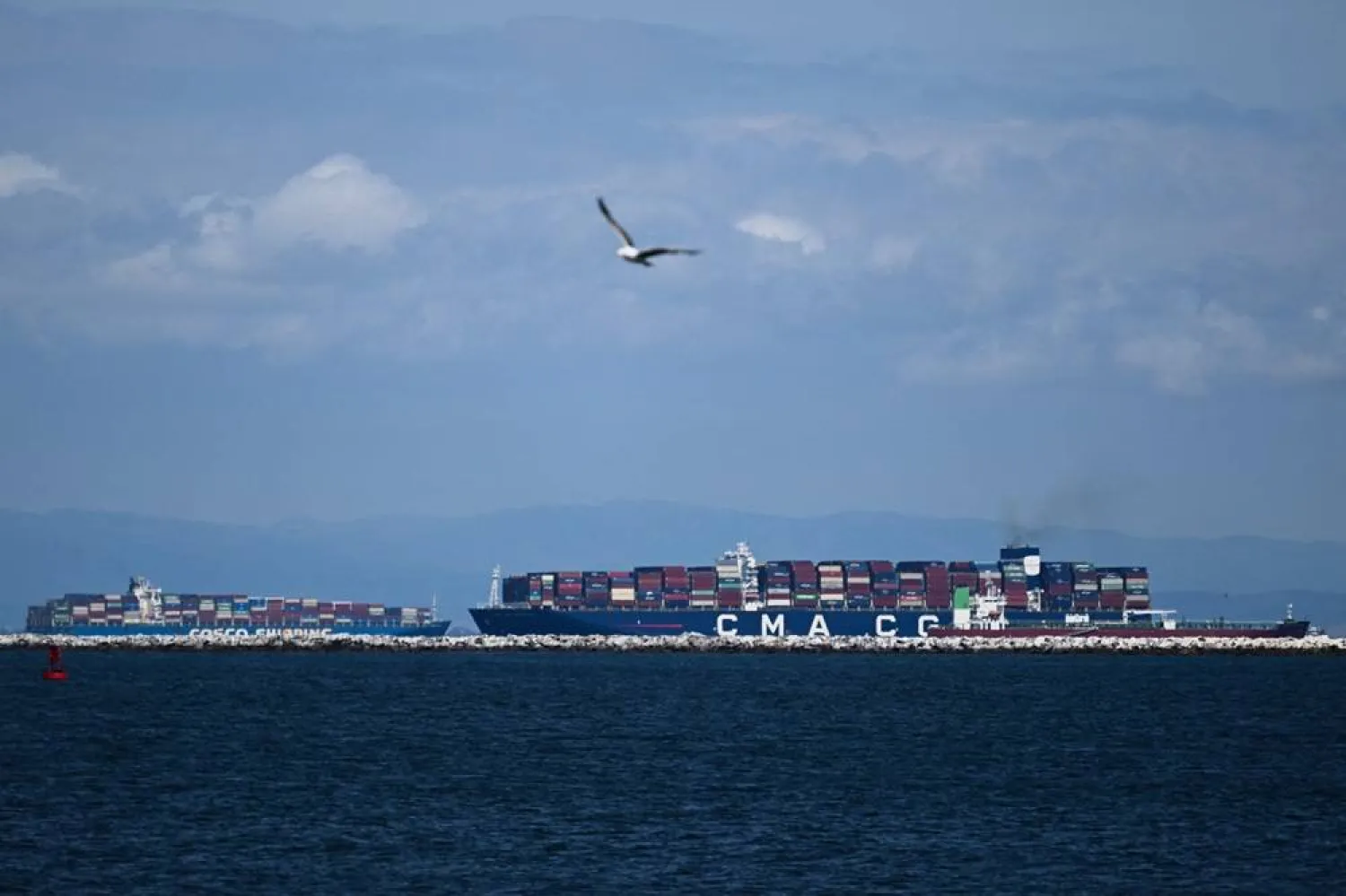
A ship carrying cargo shipping containers sails in the Pacific Ocean outside the Port of Los Angeles in Los Angeles, California on June 7, 2023. (AFP)
TT

Container Rates Soar on Concerns of Prolonged Red Sea Disruption

A ship carrying cargo shipping containers sails in the Pacific Ocean outside the Port of Los Angeles in Los Angeles, California on June 7, 2023. (AFP)

Container shipping rates for key global routes have soared this week, with US and UK air strikes on Yemen stirring concerns of a prolonged disruption to global trade in Red Sea, one of the world's busiest routes, industry officials said on Friday.

US and British warplanes, ships and submarines launched dozens of strikes across Yemen overnight in retaliation against Iran-backed Houthi militias for attacks on Red Sea shipping, widening regional conflict stemming from Israel's war in Gaza.

Most container ships are avoiding the nearby Suez Canal - a shortcut from Asia to Europe for almost one-third container ship cargo. The latest escalation fueled worries that oil tankers and bulk carriers that ferry vital commodities like grain could also avoid the shortcut, risking a new round of global inflation.

The benchmark Shanghai Containerized Freight Index was up over 16% week-on-week to 2,206 points on Friday. The index, which measures non-contract "spot" rates for container shipments out of China's ports, has gained 114% since mid-December.

Rates on the Shanghai-Europe route rose 8.1% to $3,103 per 20-foot container on Friday from a week earlier, while the rate for containers to the unaffected US West Coast soared 43.2% to $3,974 per 40-foot containers week on week, leading ship broker Clarksons said on Friday.

"The longer this crisis goes on, the more disruption it will cause to ocean freight shipping across the globe and costs will continue to rise," Peter Sand, chief analyst at freight platform Xeneta, said on Friday.

"We are looking at months rather than weeks or days before this crisis reaches any kind of resolution," he said, referring to the growing conflict.

Major container ship owners such as Maersk and Hapag-Lloyd have switched Suez Canal-bound ships to the longer route around Africa's Cape of Good Hope. This has disrupted complex vessel schedules, delayed cargo and sent shipping costs sharply higher.

It is likely oil tankers and other types of ships will follow in higher numbers in the near term, Jefferies analyst Omar Nokta said in a note on Friday.

Major importers already are reporting fallout from the Red Sea crisis.

Tesla on Thursday said it would temporarily suspend most car production at its factory near Berlin after Red Sea-related diversions led to a lack of components. Global furniture seller IKEA also warned of potential product delays.

"The price of a vast range of goods threatens to march upwards again," said Susannah Streeter, head of money and markets, Hargreaves Lansdown.

Rerouting a ship around Africa adds roughly $2 million in fuel costs for each Asia-Northern Europe round-trip. Carriers are recouping that and rolling out other surcharges.

Container ship operators are pulling vessels into the most affected European and Mediterranean trade lanes to compensate for longer sailing times on rerouted ships. That is reducing available vessel space for cargo moving on Transpacific and North-South routes and sending costs on those trade lanes higher, Jefferies analyst Nokta said.

At the same time, customers told Reuters vessel operators are rationing less expensive, contract-rate space and forcing a portion of their shipments into the pricier spot market.

Meanwhile, the China Containerized Freight Index had its biggest jump on record on Friday in both nominal and percentage terms. The CCFI, which measures both spot and liner contracts, jumped 21.7% to reach 1,140 points, Nokta said.



Trump Set to Lead Largest-Ever US Delegation to World Economic Forum in Davos Next Week

This photograph shows a sign of the World Economic Forum (WEF) at the Congress center, during the WEF annual meeting in Davos on January 20, 2025. (AFP)
TT

Trump Set to Lead Largest-Ever US Delegation to World Economic Forum in Davos Next Week

This photograph shows a sign of the World Economic Forum (WEF) at the Congress center, during the WEF annual meeting in Davos on January 20, 2025. (AFP)

US President Donald Trump will return to the World Economic Forum's annual meeting of business, political and cultural elites in Davos, Switzerland next week, leading a record-large US delegation, organizers said Tuesday.

The Geneva-based think tank says Trump, whose assertive foreign policy on issues as diverse as Venezuela and Greenland in recent months has stirred concerns among US friends and foes alike, will be accompanied by five Cabinet secretaries and other top officials for the event running from Monday through Jan. 23.

A total of 850 CEOs and chairs of the world's top companies will be among the 3,000 participants from 130 countries expected in the Alpine resort this year, the forum says.

Forum President Borge Brende says six of seven G7 leaders — including Trump — will attend, as well as presidents Volodymyr Zelenskky of Ukraine, Ahmed al-Sharaa of Syria and others. A total of 64 heads of state or government are expected so far — also a record — though that number could increase before the start of the event, he said.

China's delegation will be headed by Vice Premier He Lifeng, Beijing's top trade official, Brende said.

The forum, which held its first annual meeting in 1971, has long been a hub of dialogue, debate and deal-making. Trump has already attended twice while president and was beamed in by video last year just days after being inaugurated for his second term.

Critics call it a venue for the world’s elites to hobnob and do business that sometimes comes at the expense of workers, the impoverished or people on the margins of society. The forum counters that its stated goal is “improving the state of the world” and insists many advocacy groups, academics and cultural leaders have an important role too.


World Bank: Global Economy Shows Resilience Amid Historic Trade, Policy Uncertainty

A woman places coins inside a red wallet in Germany. (dpa)
TT

World Bank: Global Economy Shows Resilience Amid Historic Trade, Policy Uncertainty

A woman places coins inside a red wallet in Germany. (dpa)

The global economy is proving more resilient than anticipated despite persistent trade tensions and policy uncertainty, according to the World Bank’s latest Global Economic Prospects report. Global growth is projected to remain broadly steady over the next two years, easing to 2.6% in 2026 before rising to 2.7% in 2027, an upward revision from the June forecast.

The resilience reflects better-than-expected growth, especially in the United States, which accounts for about two-thirds of the upward revision to the forecast in 2026. Even so, if these forecasts hold, the 2020s are on track to be the weakest decade for global growth since the 1960s. The sluggish pace is widening the gap in living standards across the world, the report finds: at the end of 2025, nearly all advanced economies enjoyed per capita incomes exceeding their 2019 levels, but about one in four developing economies had lower per capita incomes.

In 2025, growth was supported by a surge in trade ahead of policy changes and swift readjustments in global supply chains. These boosts are expected to fade in 2026 as trade and domestic demand soften. However, the easing global financial conditions and fiscal expansion in several large economies should help cushion the slowdown, according to the report. Global inflation is projected to edge down to 2.6% in 2026, reflecting softer labor markets and lower energy prices. Growth is expected to pick up in 2027 as trade flows adjust and policy uncertainty diminishes.

“With each passing year, the global economy has become less capable of generating growth and seemingly more resilient to policy uncertainty,” said Indermit Gill, the World Bank Group’s Chief Economist and Senior Vice President for Development Economics. “But economic dynamism and resilience cannot diverge for long without fracturing public finance and credit markets.”

“Over the coming years, the world economy is set to grow slower than it did in the troubled 1990s, while carrying record levels of public and private debt. To avert stagnation and joblessness, governments in emerging and advanced economies must aggressively liberalize private investment and trade, rein in public consumption, and invest in new technologies and education.”

In 2026, growth in developing economies is expected to slow to 4% from 4.2% in 2025 before edging up to 4.1% in 2027 as trade tensions ease, commodity prices stabilize, financial conditions improve, and investment flows strengthen. Growth is projected to be higher in low-income countries, reaching an average of 5.6% over 2026-27, buoyed by firming domestic demand, recovering exports, and moderating inflation. However, this will not be sufficient to narrow the income gap between developing and advanced economies.

Per capita income growth in developing economies is projected to be 3% in 2026 - about a percentage point below its 2000-2019 average. At this pace, per capita income in developing economies is expected to be only 12% of the level in advanced economies.

These trends could intensify the job-creation challenge confronting developing economies, where 1.2 billion young people will reach working age over the next decade. Overcoming the jobs challenge will require a comprehensive policy effort centered on three pillars.

The first is strengthening physical, digital, and human capital to raise productivity and employability. The second is improving the business environment by enhancing policy credibility and regulatory certainty so firms can expand. The third is mobilizing private capital at scale to support investment. Together, these measures can help shift job creation toward more productive and formal employment, supporting income growth and poverty alleviation.

In addition, developing economies need to bolster their fiscal sustainability, which has been eroded in recent years by overlapping shocks, growing development needs, and rising debt-servicing costs. A special-focus chapter of the report provides a comprehensive analysis of the use of fiscal rules by developing economies, which set clear limits on government borrowing and spending to help manage public finances. These rules are generally linked to stronger growth, higher private investment, more stable financial sectors, and a greater capacity to cope with external shocks.

“With public debt in emerging and developing economies at its highest level in more than half a century, restoring fiscal credibility has become an urgent priority,” said M. Ayhan Kose, the World Bank Group’s Deputy Chief Economist and Director of the Prospects Group.

“Well-designed fiscal rules can help governments stabilize debt, rebuild policy buffers, and respond more effectively to shocks. But rules alone are not enough: credibility, enforcement, and political commitment ultimately determine whether fiscal rules deliver stability and growth.”

More than half of developing economies now have at least one fiscal rule in place. These can include limits on fiscal deficits, public debt, government expenditures, or revenue collection. Developing economies that adopt fiscal rules typically see their budget balance improve by 1.4 percentage points of GDP after five years, once interest payments and the ups and downs of the business cycle are accounted for.

Use of fiscal rules also increases by 9 percentage points the likelihood of a multi-year improvement in budget balances. However, the medium- and long-term benefits of fiscal rules depend heavily on the strength of institutions, the economic context in which the rules are introduced, and how the rules are designed, the report finds.


Saudi Industry Minister Discusses Automotive Manufacturing Cooperation with China's BYD

The Saudi and Chinese delegations meet in Riyadh on Tuesday. (SPA)
TT

Saudi Industry Minister Discusses Automotive Manufacturing Cooperation with China's BYD

The Saudi and Chinese delegations meet in Riyadh on Tuesday. (SPA)

Saudi Minister of Industry and Mineral Resources Bandar Alkhorayef held talks in Riyadh on Tuesday with Chinese company BYD Founder and Chairman Wang Chuanfu to discuss cooperation in automotive manufacturing and the transfer of advanced vehicle technologies to the Kingdom.

They explored ways to strengthen industrial cooperation and expand promising investment opportunities to localize the automotive industry in the Kingdom, with particular focus on electric vehicle manufacturing to meet growing domestic demand and reinforce Saudi Arabia’s position as a leading regional and global hub for automotive production.

Discussions tackled the incentives and enablers offered to investors in high-value industries, including the automotive sector, as well as the Kingdom’s significant investments in electric vehicle charging infrastructure.

The meeting highlighted the objectives of the comprehensive strategy for the mining and mineral industries, which emphasizes support for the electric vehicle ecosystem and the development of local supply chains for battery manufacturing and advanced materials.

These efforts help in localizing the automotive industry and advancing the goals of Saudi Vision 2030 to diversify the national economy.