UAE's ADNOC Gas Signs 10-yr LNG Supply Agreement with India's GAIL

ADNOC Gas said it signed multiple international LNG agreements in 2023. WAM
TT

UAE's ADNOC Gas Signs 10-yr LNG Supply Agreement with India's GAIL

ADNOC Gas said it signed multiple international LNG agreements in 2023. WAM

ADNOC Gas on Tuesday signed a 10-year agreement to supply 0.5 million metric tons per year of liquefied natural gas (LNG) to India's largest Natural Gas Company, GAIL (India) Limited.

"India continues to be a key market for ADNOC Gas, and this latest supply agreement underscores our ongoing dedication to fostering long-term partnerships that promote responsible energy consumption," Ahmed Mohamed Alebri, ADNOC Gas chief executive said.

Gas consumption in India would rise to over 500 million standard cubic meters a day (mmscmd) by 2030 from the present 155 mmscmd, Indian oil minister Hardeep Singh Puri said earlier in January.

ADNOC Gas said it signed multiple international LNG agreements in 2023 worth $9.4 - $12 billion (34.5-44 billion dirhams) with companies including TotalEnergies, Indian Oil Corporation ,and PetroChina International .

ADNOC has said it plans to more than double its LNG production capacity to meet rising global demand through the Ruwais plant.


Airline Ticket Prices Soar on Asia-Europe Routes after Gulf Airport Closures

A Qantas Dreamliner takes off from Sydney Airport, in Sydney, Australia, February 26, 2026. REUTERS/Hollie Adams
TT

Airline Ticket Prices Soar on Asia-Europe Routes after Gulf Airport Closures

A Qantas Dreamliner takes off from Sydney Airport, in Sydney, Australia, February 26, 2026. REUTERS/Hollie Adams

The price of flights between Asia and Europe has soared after the closure of key Middle Eastern hubs due to the US-Israel war against Iran, with airline websites showing tickets on many popular routes booked out for days.

Major Gulf hubs remained closed for a fourth day on Tuesday, slashing capacity on popular routes like Australia to Europe, where Emirates and Qatar Airways normally have a high market share.

Australia's Flight Center Travel Group has experienced a 75% increase in calls to its stores and emergency assistance lines since the crisis began and has teams working around the clock to help disrupted customers, Reuters quoted its Global Managing Director Andrew Stark as saying.

"Australians are very resilient and are already rebooking flights to the UK/Europe via alternative routes via China, Singapore, and other Asian ⁠hubs, as well ⁠as North America via hubs such as Houston," he said.

Carriers that offer non-stop Asia-Europe flights are able to bypass the closed Middle Eastern airspace by flying north via the Caucasus then Afghanistan or south via Egypt then Saudi then Oman.

But it may add to flight times and fuel usage, driving up costs at a time when oil prices have spiked, in a move that could lead to higher fares over the longer term.

"Right now the whole of the Middle East is out of bounds, which is a high price for some airlines," said Subhas Menon, head of the Association ⁠of Asia Pacific Airlines.

"If then Europe can only be served at a high cost, airline profitability will be undermined. At the end of the day, the price to pay is connectivity."

Alton Aviation Consultancy said airlines operating non-stop services or through alternate hubs outside the affected region - including Hong Kong's Cathay Pacific Airways, Singapore Airlines and Turkish Airlines - may see short-term gains.

Reuters' checks of several airlines' websites on Tuesday showed few near-term bookings available and high prices on offer for flights from Asia to London.

Cathay Pacific's website showed no available economy-class seats on the Hong Kong-London route until March 11, with a one-way ticket on that day costing at least HK$21,158 ($2,705.28), falling to a more normal HK$5,054 later in the month.

For flights from Sydney to London, Qantas Airways is not offering any economy-class tickets on flights via its normal Perth and Singapore routings until March 17, when one ⁠is available for A$3,129 ($2,220.03) one-way. ⁠For earlier dates, it has pricey options with non-traditional stopovers such as Los Angeles and Johannesburg.

Thai Airways is experiencing fully booked Europe-bound flights as European tourists opt for direct routes rather than transiting through the Middle East, according to Thailand's Transport Minister Phiphat Ratchakitprakarn.

A search of the Thai Airways site for travel from Bangkok to London showed tickets were sold out until late next week, and then fares were high. An economy-class ticket for a one-way flight was available for 71,190 baht ($2,265) on March 15, with prices dropping to 27,045 baht by March 18.

Taiwan's EVA Airways said bookings for its Europe-bound flights had surged as Asian and European passengers seek alternative routing options.

Mainland Chinese airlines' websites showed fares on China-UK routes have also surged far above normal levels, with economy-class seats largely unavailable on near-term departures.

A return economy-class ticket from Beijing to London typically costs under 10,000 yuan ($1,452.71), but Air China's only option for Wednesday is business class, with a one-way ticket priced at 50,490 yuan.



UAE Airlines to Resume Limited Number of Flights, Mainly for Repatriations

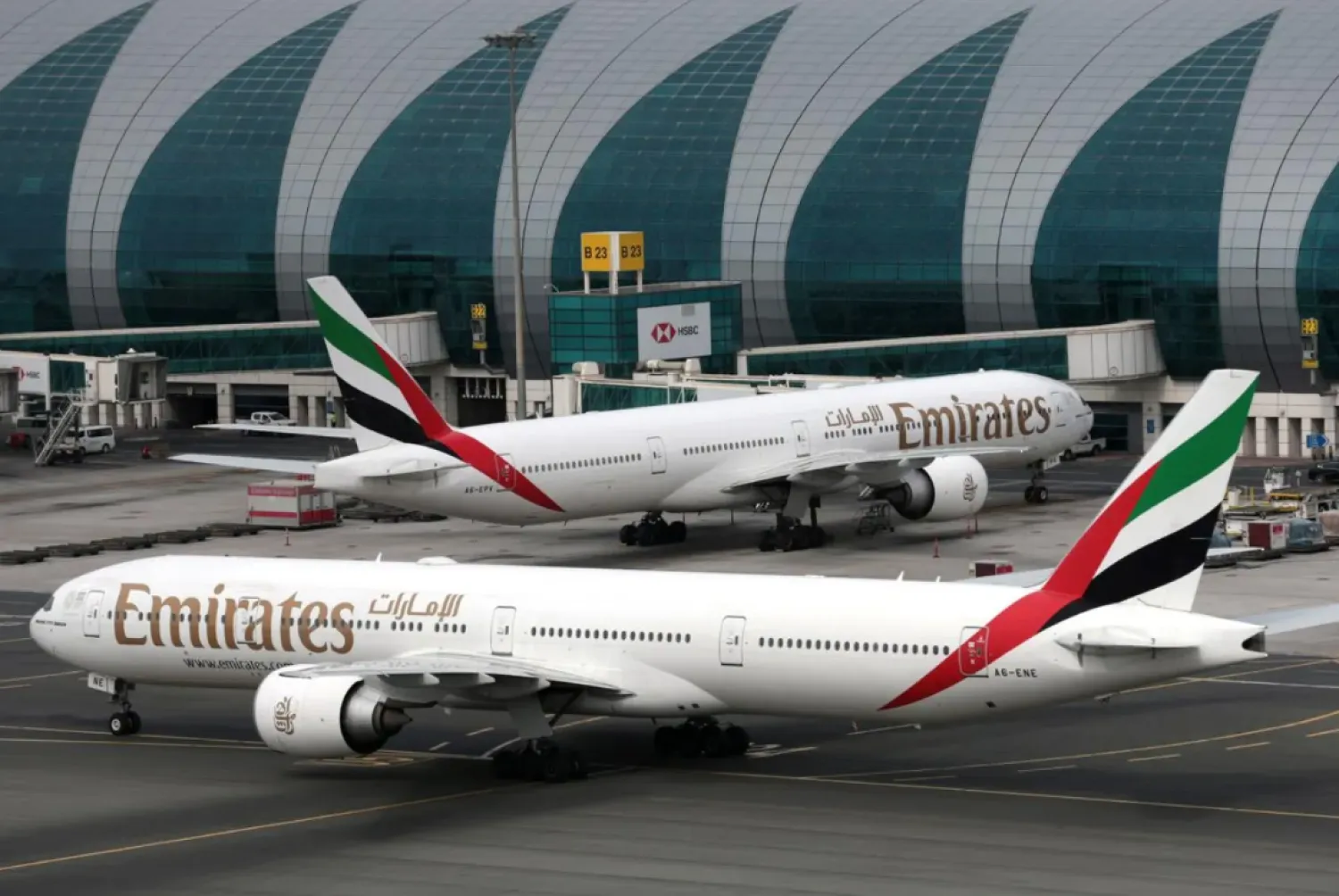
FILE PHOTO - Emirates Airline Boeing 777-300ER planes are seen at Dubai International Airport in Dubai, United Arab Emirates February 15, 2019. REUTERS/Christopher Pike
TT

UAE Airlines to Resume Limited Number of Flights, Mainly for Repatriations

FILE PHOTO - Emirates Airline Boeing 777-300ER planes are seen at Dubai International Airport in Dubai, United Arab Emirates February 15, 2019. REUTERS/Christopher Pike

Emirates, flydubai and Etihad Airways will resume a limited number of flights on Monday, mainly to help repatriate stranded passengers, as global carriers grapple with disruptions from the escalating Iranian conflict. Israeli and US attacks on Iran and Tehran's response forced the closure of airspace across parts of the Middle East, including the United Arab Emirates, and shut key airports such as Dubai and Doha.
he UAE civil aviation authority will begin operating "special flights" across the country's airports, state news agency WAM reported, to help some of the tens of thousands of passengers stranded in the region leave.

Dubai Airports said a limited resumption would begin later on Monday, with a small number of flights permitted from Dubai International (DXB) and Al Maktoum International (DWC). DXB, which handled nearly 100 million passengers last year, sustained minor damage on Sunday after it was hit along with other hubs by Iranian retaliatory attacks that have extended beyond US bases and interests.

Emirates and flydubai said they would resume a small number of flights on Monday evening.

flydubai said four flights to Russian destinations including Kazan would depart from DXB, while services from three Pakistani airports and from Hargeisa in Somaliland were scheduled to return to Dubai.

"Some repositioning, cargo and repatriation flights may operate in coordination with UAE authorities and subject to strict operational and safety approvals," Abu Dhabi-based Etihad said in a statement to Reuters, adding that all scheduled commercial services to and from Abu Dhabi remained cancelled.

The airline's website showed several flights had departed from Abu Dhabi's Zayed International Airport on Monday for destinations including London and Paris, with more scheduled.


QatarEnergy Halts LNG Production over Iran Attacks

QatarEnergy Halts LNG Production over Iran Attacks
TT

QatarEnergy Halts LNG Production over Iran Attacks

QatarEnergy Halts LNG Production over Iran Attacks

Qatar's state-run energy firm said on Monday it had halted liquefied natural gas production following Iranian attacks on facilities at two of its main gas processing bases.

"Due to military attacks on QatarEnergy's operating facilities in Ras Laffan Industrial City and Mesaieed Industrial City in the State of Qatar, QatarEnergy has ceased production of liquefied natural gas (LNG) and associated products," the company said in a statement.

Earlier, Qatar's defense ministry said one Iranian drone "targeted an energy facility in Ras Laffan Industrial City, belonging to QatarEnergy", referring to the firm's onshore gas processing base 80 kilometres (50 miles) north of Doha.

Another "targeted a water tank belonging to a power plant in Mesaieed", the statement said, referring to an area 40 kilometres (25 miles) south of the Qatari capital, which is also a key site for Qatar's natural gas production.

There were no reports of casualties, the defense ministry added.

The Dutch TTF natural gas contract, considered the European benchmark for LNG prices, jumped almost 45 percent to more than 46 euros ($54).

Jamie Ingram, managing editor of Middle East Economic Survey (MEES), said the halt was "an unprecedented development, with Ras Laffan the largest single LNG facility on the planet," warning there was "scope for prices to rise significantly".

He said the move was "made from an abundance of caution rather than one forced by the scale of the drone attack earlier today".

"It's possibly also intended to drum up international support," Ingram added.

Justin Alexander, an economic expert on Gulf issues and director of Khalij Economics, said it was "clearly a precautionary move" given strikes on Ras Laffan and risks to "extremely flammable gas facilities", adding the main market impact was "the closure of Hormuz", blocking nearly a quarter of global supply.

He added that the QatarEnergy suspension "could increase the delay to the resumption of normal supplies once Hormuz reopens".

While Iran has not officially closed the Strait of Hormuz, through which around 20 percent of global seaborne oil passes, its Revolutionary Guards have warned against transiting the waterway, leaving it effectively shut.