

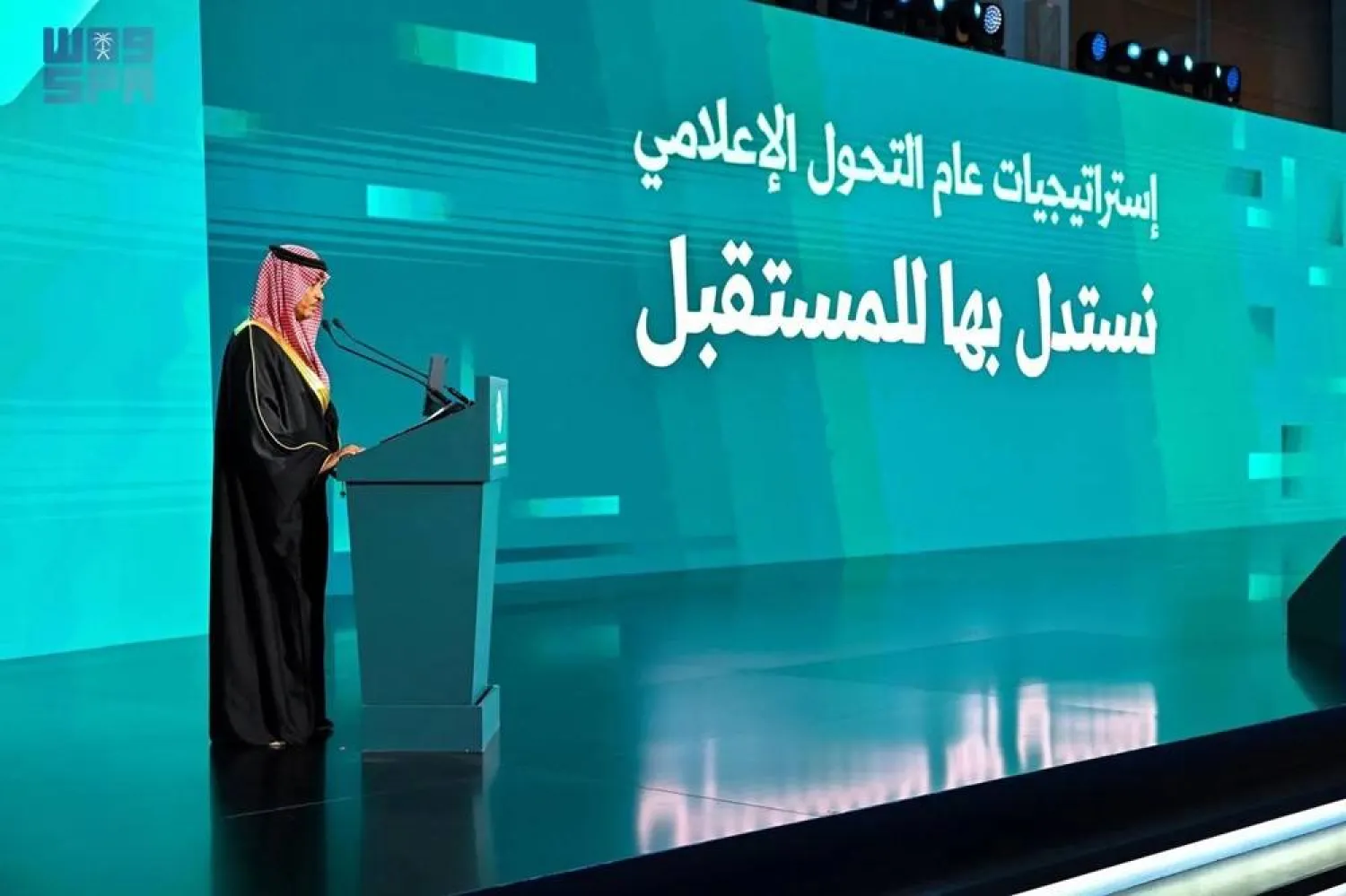

Media Minister: 2024 Marks Year of Media Transformation in Saudi Arabia

Saudi Minister of Media Salman bin Yousef Al-Dosary outlined key strategic aspects of the media system for the upcoming year. (SPA)
TT

Media Minister: 2024 Marks Year of Media Transformation in Saudi Arabia

Saudi Minister of Media Salman bin Yousef Al-Dosary outlined key strategic aspects of the media system for the upcoming year. (SPA)

Saudi Minister of Media Salman bin Yousef Al-Dosary expressed on Tuesday optimism about the future of Saudi media, anticipating numerous achievements and transformations across all sectors.

He outlined key strategic aspects of the media system for the upcoming year, detailing various projects and programs set to bring these features to fruition, while announcing 2024 as the "Year of Media Transformation."

"Today, we unveil the strategies for the Year of Media Transformation in the Kingdom, based on four pillars: figures, indicators, passion, and work, guided by a wise vision from the Custodian of the Two Holy Mosques and led by Crown Prince," said Al-Dosary at the opening session of the Saudi Media Forum 3 in Riyadh.

The event was attended by over 2,000 media outlets from within and outside the Kingdom.

Al-Dosary said the Saudi media industry has contributed SAR14.5 billion to the GDP in 2023, projecting an increase to SAR16 billion this year. He emphasized the industry's investment in human capital, which generated 56,000 employment opportunities last year, with expectations to reach 67,000 this year.

He presented three implemented strategies serving as a roadmap for the future of media, fortifying the sector, increasing investment attractiveness, and improving the effectiveness of national cadres. These strategies involve collaboration with over 30 government institutions, shaping the comprehensive strategic direction of the Kingdom's media system.

Al-Dosary discussed the Saudi Broadcasting Authority’s (SBA) strategy, aiming to expand the Authority, enhance business competitiveness, nurture media professionals and talents, and produce outstanding content for international digital platforms. He also highlighted the Saudi Press Agency's (SPA) strategy, focusing on improving its global network, offices, and correspondents while aligning media content with public expectations and contemporary developments.

Additionally, the minister spotlighted noteworthy projects, including the "Media Oasis" coinciding with the Kingdom's participation in major summits and events. This initiative engaged over 2,600 journalists from 60 countries, providing insights into more than 30 national projects. Initiatives, like the "Mediazone", have completed their work or are in the process of developing new editions to stay aligned with creative advancements in media arts and expertise.

Al-Dosary emphasized the significance of the Hajj and Umrah seasons, highlighting the recent launch of the "Hajj and Umrah Mediathon" project. This initiative encourages interested parties and media professionals to compete in developing media initiatives and projects promoting innovative and creative media coverage.

He also announced the initiation of the "Hajj Media Hub" project, aiming to establish an integrated media community and environment to assist media professionals in their coverage. Additionally, there will be an interactive media exhibition showcasing services during the Hajj season. The minister disclosed an anticipated outreach to more than 2,000 media professionals and international visitors.

Moreover, Al-Dosary announced the establishment of the Saudi Media Academy that aims to empower, develop, and train individuals in future disciplines. It also aims to form early and innovative strategic partnerships with major technology companies and global media platforms such as Google, Huawei, Alibaba, and others.

Following the minister's remarks, President of the Saudi Media Forum and Chairman of the Saudi Broadcasting Authority (SBA) Mohammed Al-Harthi delivered a speech highlighting a comprehensive development renaissance witnessed by the Kingdom at all levels and fields. He emphasized that the media serves as a mirror reflecting global changes.



Turkish Manufacturing Nears Stabilization as PMI Rises in December

An employee works at an assembly line in the Toyota manufacturing plant in Sakarya October 10, 2013. REUTERS/Osman Orsal
TT

Turkish Manufacturing Nears Stabilization as PMI Rises in December

An employee works at an assembly line in the Toyota manufacturing plant in Sakarya October 10, 2013. REUTERS/Osman Orsal

Turkish manufacturing activity shrank at a slower pace in December, marking two consecutive months of improvement, signaling a slight moderation in operating conditions at the end of 2025, a business survey showed on Friday.

The Istanbul Chamber of Industry Turkiye Manufacturing Purchasing Managers' Index (PMI), compiled by S&P Global, rose to a 12-month high of 48.9 from 48.0 in November thanks ‌to softer slowdowns ‌in output, new ‌orders, ⁠employment and purchasing activity.

Readings ‌below 50.0 indicate contractions in overall activity, while figures above that suggest growth, Reuters said.

"With PMI reaching its highest level for a year in December, the manufacturing sector takes some momentum into 2026, giving hope that we will ⁠see growth in the months ahead," said Andrew Harker, ‌Economics Director at S&P ‍Global Market Intelligence.

New ‍orders eased at the slowest pace ‍since March 2024, with some firms noting improvements in customer demand. However, both total new business and new export orders continued to moderate.

Production was scaled back, though at a slower rate than in November. Employment saw ⁠a marginal reduction, while purchasing activity also experienced a softer decline, according to the survey.

Input costs rose sharply, driven by higher raw material prices, leading manufacturers to increase selling prices, the survey said.

"While inflationary pressures rebounded following the recent lows seen in November, rates of increase in input costs and output prices were still comfortably below the highs ‌we have seen at times in recent years," Harker said.


Asia Stocks Make Bright Start to 2026

Stock markets welcomed the New Year with healthy gains. Punit PARANJPE / AFP
TT

Asia Stocks Make Bright Start to 2026

Stock markets welcomed the New Year with healthy gains. Punit PARANJPE / AFP

Asian markets made a bright start to 2026 on Friday but volumes were thin with Tokyo and Shanghai still closed as investors awaited fresh direction from Wall Street.

Stocks had a bumper 2025, with the S&P adding 16.4 percent, the tech-rich Nasdaq 20.4 percent and London's FTSE enjoying its merriest Christmas in 16 years, said AFP.

In Asia, Seoul stocks whooshed 75 percent, while Hong Kong's Hang Seng index bounced 28 percent and Tokyo's Nikkei 225 rocketed more than 26 percent.

"Naturally, the start of the new year comes with the question everyone asks moving from one year to the next: will this continue? The consensus is that, yes, it will," said Kyle Rodda at Australian brokerage Capital.com.

"When it comes to the all important US economy, Wall Street is pricing in growth will accelerate this year while inflation still moderates and interest rates get cut. Meanwhile, analysts predict that corporate fundamentals will improve," Rodda said.

Hong Kong was up 2.2 percent Friday with chip designer Biren Technologies roaring 80 percent higher after its initial public offering.

The Shanghai-based firm's listing raised more than $700 million, suggesting that investor appetite for anything related to artificial intelligence remains insatiable.

Biren "enjoys scarcity value and high market attention", said Kenny Ng, a strategist at China Everbright Securities.

"The industry is in a flourishing stage, with many firms striving for breakthroughs and significant growth potential," Ng said.

Search-engine giant Baidu jumped almost seven percent after saying its AI chip unit Kunlunxin had filed a listing application in Hong Kong.

Taipei, Sydney, Jakarta, Manila and Singapore also advanced while while Seoul's Kospi, which soared 76 percent in 2025 in large part due to AI boom, was up 1.7 percent.

Samsung Electronics added three percent after co-CEO Jun Young Hyun said customers had praised its high-bandwidth memory (HBM) chips, some saying that "Samsung is back", Bloomberg News reported. 

After volatile recent days, following record highs for silver, precious metals started the new year on a bright note with gold up 0.64 percent per ounce and silver 1.5 percent shinier. 


Bulgaria Adopts the Euro, Nearly 20 Years After Joining the EU

 A map of Bulgaria with the EU symbol is projected on the Bulgarian National Bank as people celebrate New Year's Eve and Bulgaria's adoption of the euro in Sofia, Bulgaria, Thursday Jan. 1, 2026. (AP)
A map of Bulgaria with the EU symbol is projected on the Bulgarian National Bank as people celebrate New Year's Eve and Bulgaria's adoption of the euro in Sofia, Bulgaria, Thursday Jan. 1, 2026. (AP)
TT

Bulgaria Adopts the Euro, Nearly 20 Years After Joining the EU

 A map of Bulgaria with the EU symbol is projected on the Bulgarian National Bank as people celebrate New Year's Eve and Bulgaria's adoption of the euro in Sofia, Bulgaria, Thursday Jan. 1, 2026. (AP)
A map of Bulgaria with the EU symbol is projected on the Bulgarian National Bank as people celebrate New Year's Eve and Bulgaria's adoption of the euro in Sofia, Bulgaria, Thursday Jan. 1, 2026. (AP)

Bulgaria became the 21st country to switch to the euro as it entered the New Year on Thursday, a milestone met with both cheers and fears, nearly 20 years after the Balkan nation joined the European Union.

At midnight (2200 GMT Wednesday), Bulgaria gave up the lev currency, which has been in use since the late 19th century, and Bulgarian euro coins were projected onto the central bank's building.

Successive governments in the country of 6.4 million people have advocated joining the euro, hoping that it will boost the economy of the European Union's poorest member, reinforce ties to the West and protect against Russia's influence.

But Bulgarians have long been divided over the switch, with many worrying the introduction could usher in higher prices and add to the political instability rattling the country.

In a speech broadcast shortly before midnight, President Rumen Radev hailed the euro adoption as the "final step" in Bulgaria's EU integration, as thousands of people braved sub-zero temperatures in the capital Sofia to celebrate the New Year.

Radev however voiced regret that Bulgarians had not been consulted by referendum on the adoption.

"This refusal was one of the dramatic symptoms of the deep divide between the political class and the people, confirmed by mass demonstrations across the country."

Anti-corruption protests swept a conservative-led government from office in mid-December, leaving a country anxious about inflation on the verge of its eighth election in five years.

"People are afraid that prices will rise, while salaries will remain the same," a woman in her 40s who declined to give her name told AFP in Sofia.

At one of the city's largest markets, stalls displayed prices of everything from groceries to New Year's Eve essentials like sparklers in both levs and euros.

"The whole of Europe has managed with the euro, we'll manage too," retiree Vlad told AFP.

- Easier trade, travel -

European Commission president Ursula von der Leyen said Wednesday that Bulgaria's move into the eurozone marked "an important milestone" that would bring "practical benefits" to Bulgarians.

"It will make travelling and living abroad easier, boost the transparency and competitiveness of markets, and facilitate trade," she said.

Central bank governor Dimitar Radev said the euro symbolized much more than "just a currency -- it is a sign of belonging".

But according to the latest Eurobarometer survey, 49 percent of Bulgarians are against the switch.

Outgoing prime minister Rossen Jeliazkov sought to reassure the public ahead of the move, saying he was "counting on the tolerance and understanding of citizens and businesses".

He added that inflation in the Black Sea nation, which joined the EU in 2007, was not linked to the euro's adoption.

But the concerns of Bulgarians about inflation are not idle.

Food prices rose by five percent year-on-year in November, more than double the eurozone average, according to the National Statistical Institute.

"Unfortunately, prices no longer correspond to those in levs," pastry shop owner Turgut Ismail, 33, told AFP, saying that prices have already begun surging.

A euro protest campaign earlier this year tapping into a generally negative view of the single currency among much of the population also fanned fears of price hikes.

- Queues and possible disruptions -

Given Bulgaria's ongoing political instability, any problems with euro adoption would be seized on by anti-EU politicians, warned Boryana Dimitrova of the Alpha Research polling institute.

Some people, including business owners, have complained that it has been difficult to get their hands on euros, with shopkeepers saying they haven't received the euro starter packages they ordered.

Banks said there could be some disruption at cash machines in the hours surrounding the switch. Earlier this week, people queued outside the Bulgarian National Bank and several currency exchange offices in Sofia to obtain euros.

The euro was first rolled out in 12 countries on January 1, 2002. Croatia was the latest to join, in 2023.

Bulgaria's accession will bring the number of Europeans using the euro to more than 350 million.