


China’s Central Bank Vows to Prioritize Quality of Credit Over Size

Workers prepare a stall filled with seafood at a market in Beijing on July 10, 2019. (AFP)
TT

China’s Central Bank Vows to Prioritize Quality of Credit Over Size

Workers prepare a stall filled with seafood at a market in Beijing on July 10, 2019. (AFP)

There is still room for China's central bank to take steps to support the economy, but efforts are needed to prevent cash from sloshing around the banking system as real credit demand weakens, senior officials at the bank said on Thursday.

The world's second-biggest economy grew faster than expected in the first quarter, but several March indicators, such as property investment, retail sales and industrial output showed that domestic demand remains frail, weighing down momentum.

The People's Bank of China (PBOC) has pledged to step up policy support for the economy this year and promote a rebound in prices.

“A series of monetary policy measures introduced earlier are gradually taking effect, and the economy continues to rebound with a good start,” Zhu Hexin, a deputy governor of the PBOC, told a news conference on Thursday.

“There is still room for monetary policy going forward, and we will closely watch the policy effectiveness, economic recovery, and achievement of goals, and make good use of reserve tools at the appropriate time.”

China's central bank cautioned on Thursday against a “one-sided” pursuit of credit expansion after data showed a slowdown in bank lending, vowing to prioritize the quality of credit over size and move to revitalizing existing loans.

Zou Lan, head of the PBOC's monetary policy department, told the briefing that efforts should be made to prevent the accumulation of “idle funds” as some banks extend more loans than actually needed and some firms use low-cost loans to buy wealth management products or lend to other firms.

“Credit demand has weakened compared to previous years, and the credit structure is also being optimized and upgraded,” Zou said, adding that China's money supply growth could slow down and people should not simply look at year-on-year growth.

The central bank has in recent weeks delivered modest cuts in banks' reserve requirement ratio (RRR) and interest rates as part of broad measures to support the economy, with more policy easing expected in the coming months.

Real interest rates, when adjusted for producer prices, remain elevated for some industries - including ferrous metal producers, but high borrowing costs will help promote capacity control and inventory reduction among firms, Zou said.

“We should avoid weakening the driving force of structural adjustments and prevent excessively low interest rates,” he said.

New bank lending in China rose less than expected in March from the previous month, while broad credit growth hit a record low, boosting the case for the central bank to roll out more stimulus steps to help achieve an ambitious growth target.

China has set an economic growth target for 2024 of around 5%, which many analysts say will be a challenge to achieve without much more stimulus.

The central bank said 2024 growth of money supply and total social financing - a broad measure of credit and liquidity in the economy - would match expected goals for economic growth and inflation.

Analysts polled by Reuters expected the central bank to cut the banks' reserve requirement ratios (RRR) by 25 basis points (bps) in the third quarter, following a 50-basis point cut earlier this year, which was the biggest in two years.
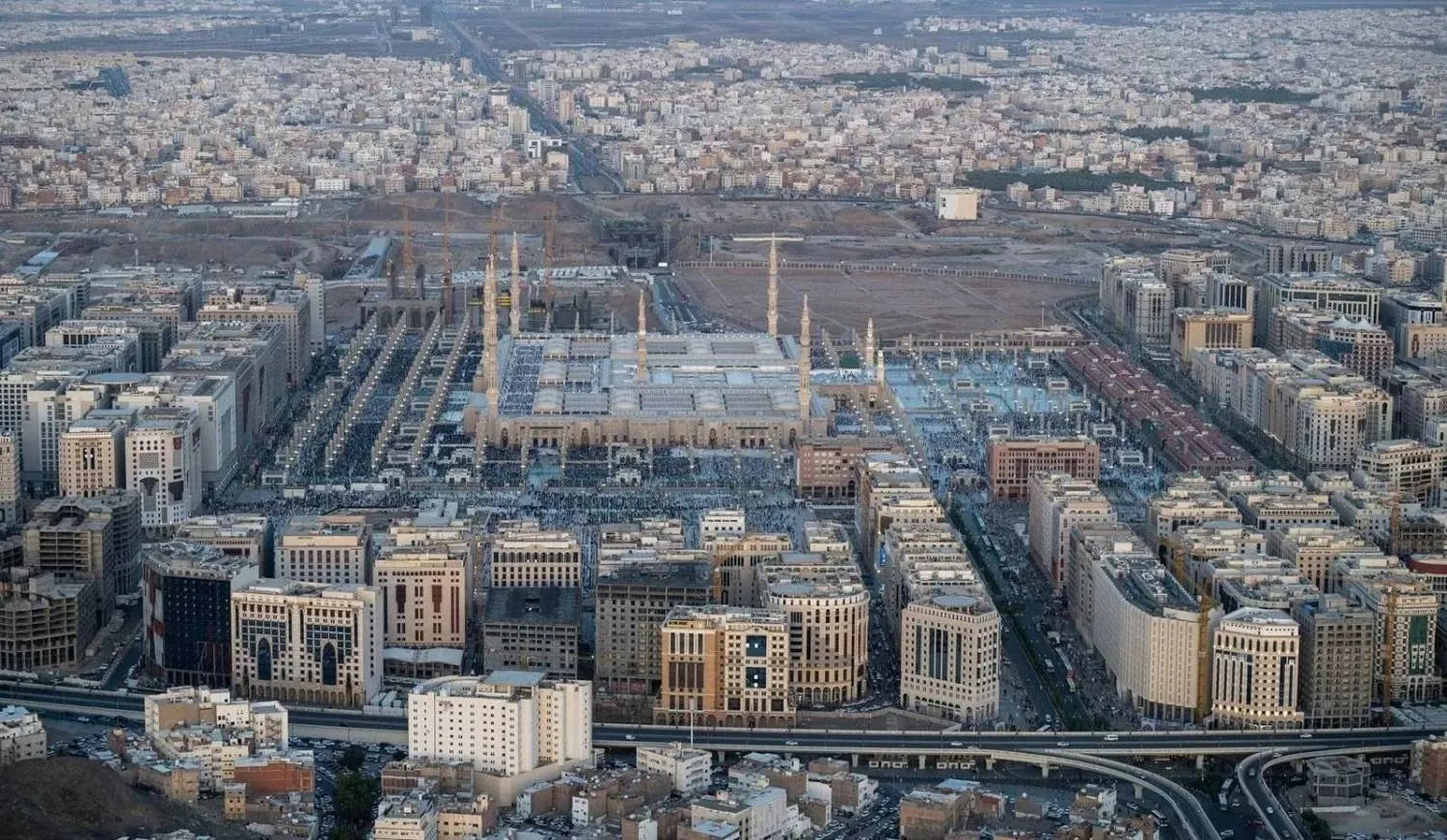



Madinah Sees Tourism Surge Ahead of Ramadan, Spending Tops $13.9 Billion

A cluster of buildings and hotels surrounding the Prophet’s Mosque (SPA). 
TT

Madinah Sees Tourism Surge Ahead of Ramadan, Spending Tops $13.9 Billion

A cluster of buildings and hotels surrounding the Prophet’s Mosque (SPA). 

Saudi Arabia’s Minister of Tourism, Ahmed Al-Khateeb, has toured hospitality facilities and visitor services in Madinah as part of the “Spirit of Ramadan” inspection tour, which also included Jeddah and Makkah.

New data show visitor numbers exceeded 21 million over the past year, a 12 percent increase from 2024, while total tourism spending reached SAR 52 billion (about $13.9 billion), up 22 percent.

The visit focused on assessing the sector’s readiness for the Ramadan season, evaluating service quality, and supporting ongoing and upcoming tourism projects.

Madinah posted strong tourism performance in 2025, driven by higher visitor inflows and expanded hospitality capacity, reinforcing its position as a leading religious destination within Saudi Arabia’s tourism landscape.

Demand growth has been matched by a sharp rise in supply. Licensed hospitality facilities increased to 610, up 35 percent, while the number of licensed rooms surpassed 76,000, a 24 percent gain, strengthening the city’s ability to accommodate during peak seasons such as Ramadan and Hajj.

Travel and tourism offices also grew to more than 240, reflecting a 29 percent expansion in supporting services.

Al-Khateeb said the entry of international hospitality brands and new projects over the past five years underscores both sectoral growth and rising investor confidence in the Kingdom’s tourism ecosystem.

“The landscape today is different. The sector is growing steadily, supported by a system that empowers investors and facilitates their journey, with a promising future ahead,” he said.

To expand hotel capacity, the minister inaugurated the Radisson Hotel Madinah, a project worth more than SAR 39 million (around $10 million) and financed by the Tourism Development Fund.

The 2025 performance signals a shift from traditional seasonal growth toward more sustainable expansion built on diversified offerings, improved service quality, and a stronger contribution to the local economy.


Airbus Planning Record Commercial Aircraft Deliveries in 2026

An Airbus A350-1000 at the Singapore Airshow on February 4. The company said Thursday it aims to deliver a record number of aircraft this year. Roslan RAHMAN / AFP/File
TT

Airbus Planning Record Commercial Aircraft Deliveries in 2026

An Airbus A350-1000 at the Singapore Airshow on February 4. The company said Thursday it aims to deliver a record number of aircraft this year. Roslan RAHMAN / AFP/File

Plane maker Airbus aims to deliver a record number of commercial aircraft this year, the company said Thursday, capitalizing on "strong demand" and a jump in profit in 2025.

"2025 was a landmark year, characterized by very strong demand for our products and services across all businesses," CEO Guillaume Faury said in a press release announcing annual results.

The European manufacturer said it received 1,000 orders for commercial planes in 2025, with net orders of 889 after taking cancellations into account, and 793 delivered.

Last year, its overall profit jumped 23 percent to 5.2 billion euros ($6.1 billion).

The company said it is targeting "around 870 commercial aircraft deliveries" this year.

"As the basis for its 2026 guidance, the Company assumes no additional disruptions to global trade or the world economy, air traffic, the supply chain, its internal operations, and its ability to deliver products and services," it said in its outlook.

Both Airbus and its rival Boeing have struggled to return to pre-pandemic production levels after their entire network of suppliers was disrupted, even as airlines are eager to modernize their fleets with more fuel-efficient aircraft and expand to meet an expected increase in passenger numbers over the coming decades.


Saudi Arabia's Humain Invests $3 Bn in Musk's xAI

The logo of the Saudi company Humain. Asharq Al-Awsat
TT

Saudi Arabia's Humain Invests $3 Bn in Musk's xAI

The logo of the Saudi company Humain. Asharq Al-Awsat

Saudi Arabia's artificial intelligence firm Humain said Wednesday it had invested $3 billion in US billionaire Elon Musk's xAI.

The investment made Humain a "significant minority shareholder,” the company said in a statement.

It added that its xAI holdings would be "converted into SpaceX shares" after the rocket company announced it was taking over the AI start-up earlier this month as Musk pushes to unify his many business interests.

CEO Tareq Amin said the latest investment “reflects Humain’s conviction in transformational AI and our ability to deploy meaningful capital behind exceptional opportunities where long-term vision, technical excellence, and execution converge, xAI’s trajectory, further strengthened by its acquisition by SpaceX, one of the largest technology mergers on record, represents the kind of high-impact platform we seek to support with significant capital.”

Musk's xAI had previously announced in November it was teaming up with Humain to build a 500-megawatt data center in Saudi Arabia.

The Saudi firm also inked a new deal with Nvidia.