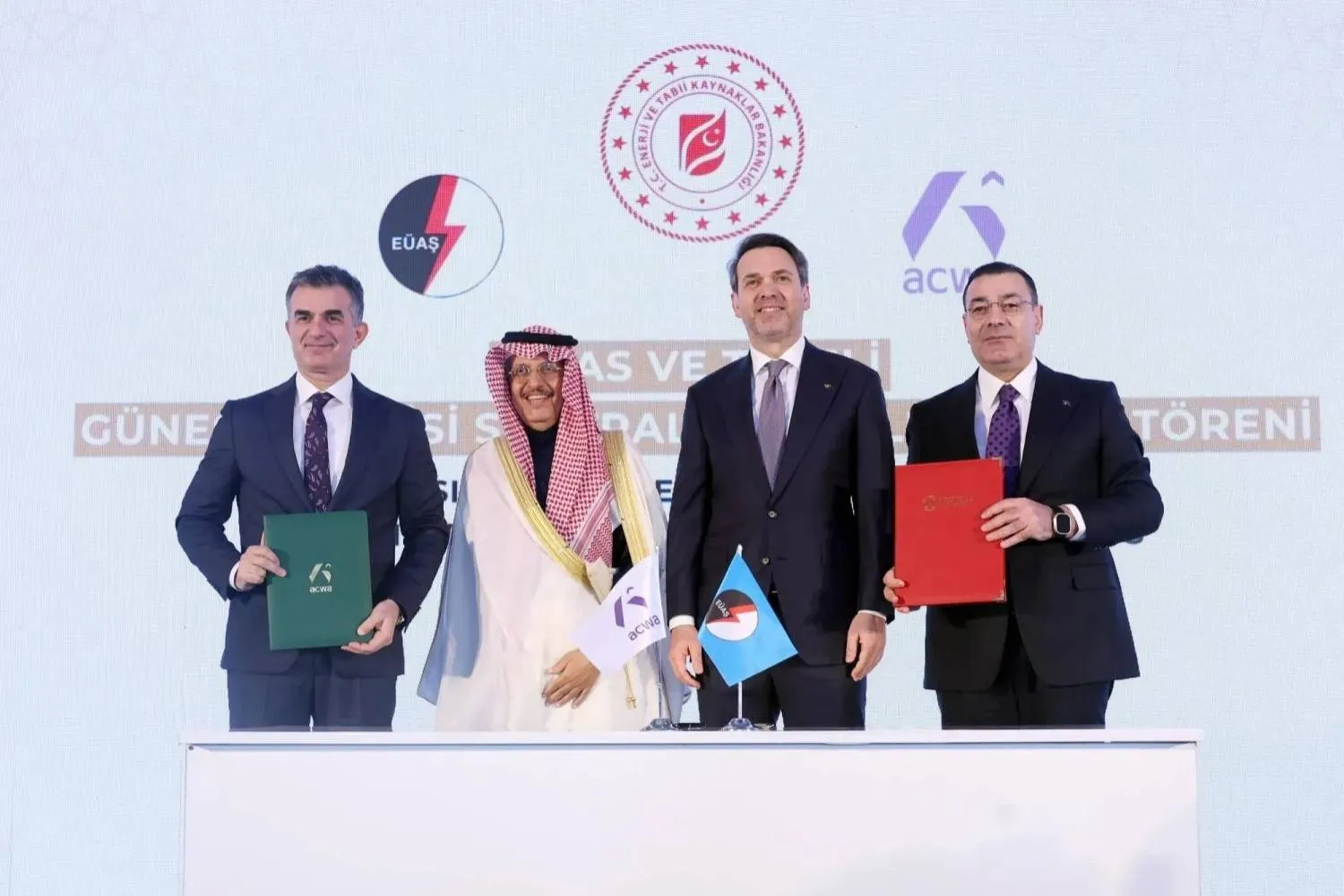
Türkiye’s Energy and Natural Resources Ministry signed a comprehensive power purchase agreement with Saudi energy giant ACWA Power to develop solar power plants and projects in Türkiye with major investments.
The agreement, signed in Istanbul on Friday, was attended by Türkiye’s Energy and Natural Resources Minister Alparslan Bayraktar and Saudi Energy Minister Prince Abdulaziz bin Salman Al Saud.
It includes the construction of two solar power plants in the Turkish provinces of Sivas and Karaman with a combined capacity of 2,000 megawatts and investments totaling $2 billion, as well as the implementation of large-scale solar projects with a total capacity of 5,000 megawatts in Türkiye.
Commenting on the agreement, Bayraktar said: “During our president Recep Tayyip Erdogan’s visit to Riyadh on Feb. 3, we signed an intergovernmental agreement on renewable power plant projects with my Saudi counterpart, HRH Prince Abdulaziz bin Salman Al Saud, which provides for total investments in solar and wind energy in Türkiye of 5,000 megawatts.”
“Today, we reinforced this cooperation by signing the agreement with ACWA Power in Istanbul. In the first phase of the project, two solar power plants with a total capacity of 2,000 megawatts will be built in Sivas and Karaman, with an investment of around $2 billion. This will add capacity to our grid to meet the electricity needs of 2.1 million households,” he added.
Bayraktar said on X that in Sivas, the agreed purchase price is 2.35 euro cents per kilowatt-hour, while in Karaman, electricity will be bought at a fixed price of 1.99 euro cents per kilowatt-hour, the lowest price recorded in Türkiye. The agreed prices will be valid for 25 years.
He said the projects, which are expected to make a significant contribution to the energy sector, require a minimum 50% local content ratio, adding that groundwork is targeted this year, operations are scheduled for 2028, and full production capacity will be reached as soon as possible.
In the second phase of the agreement, with a total capacity of 5,000 megawatts, “we aim to expand our cooperation with additional investments in solar and wind energy amounting to 3,000 megawatts,” Bayraktar said, expressing hope that the move would strengthen confidence in Türkiye’s renewable energy transition and investment climate and benefit the Turkish energy sector.
Two-phase plan
Construction under the first phase of ACWA Power’s investments in Türkiye is scheduled to begin in the first or second quarter of 2027, with electricity supply expected to start by mid-2028.
ACWA Power aims to sign an agreement with Türkiye on the second phase of its renewable energy investments before November.
The first-phase projects offer highly competitive electricity sale prices compared with other renewable power plants in Türkiye. In addition, the plants, valued at about $2 billion, will supply electricity to more than 2 million Turkish households.
A Turkish state-owned company will purchase the electricity generated by the plants for 30 years. During implementation, maximum use will be made of locally sourced equipment and services.
In recent years, Türkiye has sought to attract Gulf investments into its energy sector as it works to raise renewable power generation capacity to 120 gigawatts by 2035. Several previous attempts were not completed due to disagreements over financial valuations and pricing.
ACWA Power announced in June its intention to build two large solar power plants in Türkiye as part of a plan to invest billions of dollars in the Turkish energy sector.
Major investments
While the exact value of ACWA Power’s investment has not been disclosed, Türkiye said two years ago it was in talks with the company over projects worth up to $5 billion.
Türkiye’s Treasury and Finance Minister Mehmet Simsek described the intergovernmental energy agreement signed during Erdogan’s visit to Riyadh as a major boost for foreign direct investment inflows into Türkiye.
He said the pace of foreign direct investment in Türkiye is accelerating, reflecting growing confidence in its economic program, adding that the inflow of $2 billion in foreign direct investment into renewable energy projects through the agreement with Saudi Arabia would accelerate the green transition, strengthen energy security, and structurally reduce dependence on energy imports.
ACWA Power’s portfolio, 44% owned by Saudi Arabia’s Public Investment Fund, includes a gas-fired power plant in Türkiye. The company also expanded its solar energy projects in 2024 in Malaysia, Indonesia, and Uzbekistan.