Oil Climbs on Middle East Escalation Fears, US Fed Rate Cut 

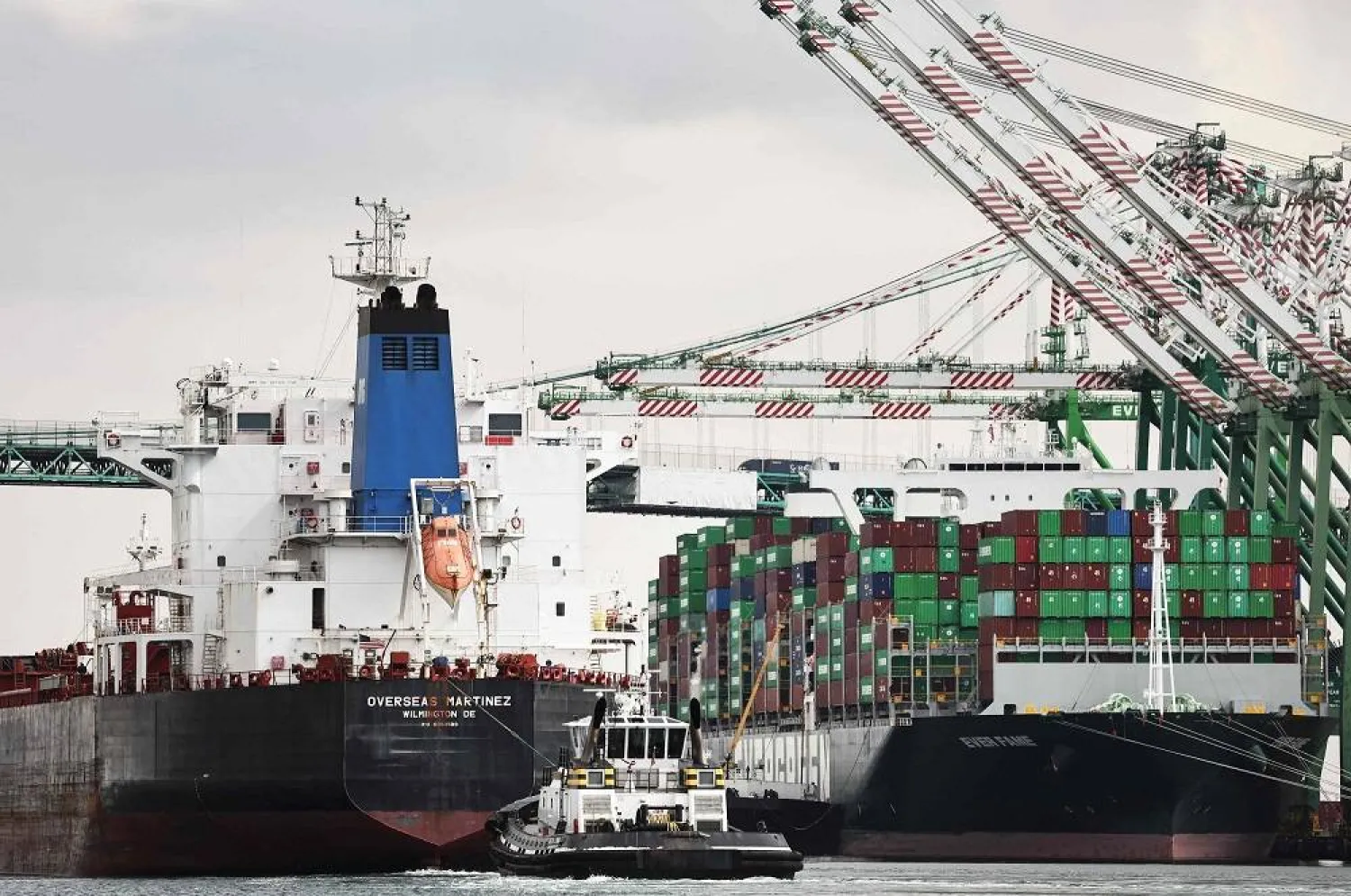
A chemical/oil tanker (L) passes a container ship at the Port of Los Angeles on September 20, 2024 in Los Angeles, California. (Getty Images North America / AFP)
TT

Oil Climbs on Middle East Escalation Fears, US Fed Rate Cut 

A chemical/oil tanker (L) passes a container ship at the Port of Los Angeles on September 20, 2024 in Los Angeles, California. (Getty Images North America / AFP)

Oil prices rose on Monday, buoyed by concerns that heightened conflict in the Middle East may curtail regional supply and expectations last week's outsized US interest rate cut will support demand.

Brent crude futures for November were up 22 cents, or 0.3% at $74.71 a barrel at 0705 GMT. US crude futures for November were up 26 cents, or 0.4%, at $71.26.

Both contracts rose in the previous session on support from the US interest rate cut and a dip in US supply in the aftermath of Hurricane Francine. Oil prices climbed last week for a second week.

A softer economic outlook from top consumers China and the US capped further gains.

"Geopolitical tensions in the Middle East have edged up a notch between Israel and Hezbollah, which could leave oil prices well-supported on the risks of a wider regional conflict," said Yeap Jun Rong, market strategist at IG.

"However, price gains have been somewhat more measured, which may reflect some reservations over the actual impact on oil supplies, given that the Middle East conflict has been dragging for some time now with little disruptions so far."

The Israeli military launched its most widespread wave of air strikes against Iran-backed Hezbollah, simultaneously targeting Lebanon's south, eastern Bekaa valley and northern region near Syria in nearly a year of conflict.

The latest attacks came amid some of the heaviest cross-border exchanges of fire in a conflict raging alongside the war between Israel and Hamas in Gaza.

The conflict has escalated sharply in the past week after thousands of pagers and walkie-talkies used by Hezbollah members exploded. The attack was widely blamed on Israel, which has not confirmed or denied responsibility.

While both oil benchmarks rose more than 4% last week on the back of the US rate cut, weaker demand sentiment in top oil importer China is capping the upswing, said Priyanka Sachdeva, senior market analyst at Phillip Nova, in a note.

"The demand for fuel is still up in the air," she said, adding that the US rate cut "raised concerns that the Fed may have envisioned ailing labor markets".

Last Wednesday, the US Federal Reserve cut interest rates by half a percentage point, a larger decrease in borrowing costs than many expected.

Interest rate cuts typically boost economic activity and energy demand, but analysts and market participants are concerned the central bank may see a slowing job market.


Türkiye Says Iran Gas Pipeline Contract Nearing Expiry, No Talks Yet on Extension

Türkiye's Minister of Energy and Natural Resources Alparslan Bayraktar -  REUTERS/Umit Bektas
Türkiye's Minister of Energy and Natural Resources Alparslan Bayraktar - REUTERS/Umit Bektas
TT

Türkiye Says Iran Gas Pipeline Contract Nearing Expiry, No Talks Yet on Extension

Türkiye's Minister of Energy and Natural Resources Alparslan Bayraktar -  REUTERS/Umit Bektas
Türkiye's Minister of Energy and Natural Resources Alparslan Bayraktar - REUTERS/Umit Bektas

Türkiye's long-term contract for importing natural gas from Iran is due to expire in the coming months, and the two countries could hold talks on a possible extension, though no negotiations are under way yet, Türkiye's energy minister said on Saturday.

The agreement, due to expire in July, provides for delivery of 9.6 billion cubic metres of gas a year, but actual flows have often fallen short, Reuters reported.

Türkiye imported 7.6 bcm from Iran last year, accounting for 13% of total gas imports. Regulator data show the pipeline last hit the contracted volume in 2022.

"According to our forecast, we might need this gas pipeline or the gas flow from Iran for the security of supply of Türkiye. There is no negotiation right now ongoing. I think they are busy with so many other things. But we might sit and discuss a potential extension," Alparslan Bayraktar told reporters on the sidelines of a diplomacy forum in the southern Turkish province of Antalya.

"But we haven't started a negotiation during the current circumstances in the region," Bayraktar said, referring to the Iran war.

Bayraktar also said Türkiye was seeking to diversify natural gas supplies, including through Russian liquefied natural gas.


Iraq Says Oil Exports to Resume from All Fields within Days, State News Agency

Technicians working at the Majnoon oil field in Basra, Iraq. (Reuters)
TT

Iraq Says Oil Exports to Resume from All Fields within Days, State News Agency

Technicians working at the Majnoon oil field in Basra, Iraq. (Reuters)

Iraq's oil ministry said oil exports would resume from all fields within the next few days, the Iraqi state news agency INA reported on Saturday.

Four energy sources said that Iraq resumed southern oil exports on Friday after a halt of more than a month caused by disruptions to shipping through the Strait of Hormuz, with one tanker beginning to load crude.


Al-Jadaan: Ending Conflicts, Securing Peace Are Essential to Sustainable Growth

(L/R) Saudi Arabia's Finance Minister Mohammed Al-Jadaan and IMF Managing Director Kristalina Georgieva
speak during a press briefing following a meeting of the IMFC (International Monetary and Financial Committee) at the 2026 IMF and World Bank Group Spring Meetings in Washington, DC, on April 17, 2026. (Photo by Kent Nishimura / AFP)
(L/R) Saudi Arabia's Finance Minister Mohammed Al-Jadaan and IMF Managing Director Kristalina Georgieva speak during a press briefing following a meeting of the IMFC (International Monetary and Financial Committee) at the 2026 IMF and World Bank Group Spring Meetings in Washington, DC, on April 17, 2026. (Photo by Kent Nishimura / AFP)
TT

Al-Jadaan: Ending Conflicts, Securing Peace Are Essential to Sustainable Growth

(L/R) Saudi Arabia's Finance Minister Mohammed Al-Jadaan and IMF Managing Director Kristalina Georgieva
speak during a press briefing following a meeting of the IMFC (International Monetary and Financial Committee) at the 2026 IMF and World Bank Group Spring Meetings in Washington, DC, on April 17, 2026. (Photo by Kent Nishimura / AFP)
(L/R) Saudi Arabia's Finance Minister Mohammed Al-Jadaan and IMF Managing Director Kristalina Georgieva speak during a press briefing following a meeting of the IMFC (International Monetary and Financial Committee) at the 2026 IMF and World Bank Group Spring Meetings in Washington, DC, on April 17, 2026. (Photo by Kent Nishimura / AFP)

Saudi Finance Minister Mohammed Al-Jadaan said the global economy’s ability to withstand crises depends on adopting a “unified strategic vision and swift reforms,” warning that excessive market optimism may be masking serious geopolitical risks, particularly conflicts that threaten supply security.

Al-Jadaan made the remarks at a joint press conference with Kristalina Georgieva, Managing Director of the International Monetary Fund (IMF), following a meeting of the International Monetary and Financial Committee (IMFC), during the IMF–World Bank Spring Meetings.

The committee concluded its session by adopting the “Diriyah Principles,” described as a landmark framework for IMF quota and governance reform, signaling a renewed phase of multilateral cooperation amid heightened global uncertainty.

Peace as a Foundation for Sustainable Growth

Al-Jadaan said the global economy has faced repeated shocks in recent years driven by wars and conflicts, including the latest escalation in the Middle East.

Beyond the severe humanitarian toll, he said, these shocks have global economic consequences that disproportionately affect the poorest and most vulnerable populations. He cautioned that this is unfolding at a time when policy space has narrowed and international cooperation has weakened.

He emphasized that effective policy responses depend on how shocks transmit through domestic economies, requiring timely and flexible measures supported by credible frameworks and strong international coordination.

Ending wars and securing lasting peace, he said, are indispensable conditions for sustainable growth and long-term stability.

Conflict Risks and Implications for Energy Security

In its statement, the IMFC said the global economy has shown resilience despite repeated shocks, including wars and conflicts. However, it described the Middle East conflict as a significant new global shock, with its economic impact contingent on its duration, intensity, and geographic spread.

The committee noted that damage to infrastructure and disruptions to transportation already pose serious risks to the global economy, despite efforts to sustain energy flows, including rerouting shipping and trade routes to safeguard supply chains.

Members stressed that the impact of the shock varies widely across countries. A prolonged conflict could keep fuel and fertilizer prices elevated, disrupt supplies of key inputs, and intensify risks to energy and food security, global growth, inflation, and external balances.

The statement added that tighter financial conditions and potential spillovers to financial stability could further cloud the outlook. These risks are compounded by deep structural shifts in technology, demographics, and climate-related challenges that are reshaping economies and testing their resilience.

Economic and Financial Policy Priorities

Against this backdrop of heightened uncertainty, the committee said the top priority is to safeguard macroeconomic and financial stability while supporting strong, broad-based growth through credible, timely, and adaptable policies.

Central banks reaffirmed their commitment to price stability, emphasizing that independence and clear communication are essential to maintaining policy credibility and anchoring inflation expectations.

On fiscal policy, the committee said governments should calibrate spending within credible medium-term frameworks to ensure debt sustainability. Where fiscal space permits, temporary and targeted measures can be used to protect vulnerable populations.

Members also reaffirmed their commitment to international standards and to monitoring risks to financial stability. This includes strengthening oversight of systemic risks linked to artificial intelligence, nonbank financial institutions, and digital assets, while leveraging the benefits of technological innovation.

Structural Reforms and International Cooperation

The committee underscored the need to advance structural reforms to encourage private-sector investment, boost productivity, and strengthen energy security.

Members pledged continued cooperation to address excessive global imbalances and trade tensions, build more resilient supply chains, and support a fair and open global economy. They also reaffirmed exchange rate commitments made in April 2021.

The statement welcomed the IMF Managing Director’s Global Policy Agenda and highlighted the IMF’s central role in supporting countries through policy advice, capacity development, and financial assistance in coordination with other international institutions.

Supporting Vulnerable Countries and Addressing Debt

The IMFC reiterated its commitment to supporting countries in promoting stability and growth, with particular focus on low-income and fragile states affected by conflict, especially those facing rising debt pressures.

Members pledged to improve sovereign debt restructuring processes, including under the G20 Common Framework, and to advance work through the Global Sovereign Debt Roundtable.

The committee welcomed the updated “Restructuring Playbook” and called for greater transparency from all stakeholders, including private creditors.

It also urged stronger support for countries with sustainable debt facing short-term liquidity challenges, including faster implementation of the IMF–World Bank “three-pillar approach” and completion of the review of the debt sustainability framework.

Strengthening Surveillance and Lending

The committee backed efforts to enhance IMF surveillance, emphasizing analytical rigor and evenhandedness, and said it looks forward to completing the Comprehensive Surveillance Review and the review of the Financial Sector Assessment Program (FSAP).

Members also supported ongoing work to strengthen the IMF’s lending framework, including the Review of Conditionality and program design, as well as efforts to develop monetary policy frameworks for countries experiencing crises.