Saudi Airports to Expand Global Reach at Routes World 2024 in Bahrain

Saudi airports will participate under the theme "Saudi Arabia the Global Hub" at Routes World 2024 in Bahrain. (SPA)
TT

Saudi Airports to Expand Global Reach at Routes World 2024 in Bahrain

Saudi airports will participate under the theme "Saudi Arabia the Global Hub" at Routes World 2024 in Bahrain. (SPA)

Saudi airports will participate under the theme "Saudi Arabia the Global Hub" at Routes World 2024, which will take place in Bahrain from October 6-8, 2024, the Saudi Press Agency reported on Friday.
The event, considered the aviation industry's premier global gathering, will bring together key players from airlines, airports, and industry stakeholders worldwide to shape the future of air services and promote global economic growth.
The Saudi participation includes some of the kingdom's most important aviation assets: MATARAT Holding, the King Salman International Airport, the Saudi Air Connectivity Program, the Red Sea International Airport, the Riyadh Airports Company, the Jeddah Airports Company, the Dammam Airports Company, and the Airports Cluster 2 Company.
Saudi Arabia's participation aims to transform its aviation sector into a global leader, positioning its airports to handle 330 million passengers and transport 4.5 million tons of cargo by 2030. This ambitious goal, aligned with the objectives of the National Aviation Strategy, is a testament to the industry's potential.
The effort also focuses on creating seamless travel experiences, enhancing customer satisfaction, ensuring safety and promoting environmental sustainability in the aviation industry.
The 29th edition of Routes World will feature panel discussions, workshops, and intensive meetings focused on advancing the regional and global air transport industry.
The sessions will also explore airlines' financial and operational performance, prospects for future growth, and critical issues such as privatization, mergers, sustainability initiatives, and environmental conservation.



Lenovo Chooses Riyadh as Regional Operations Hub

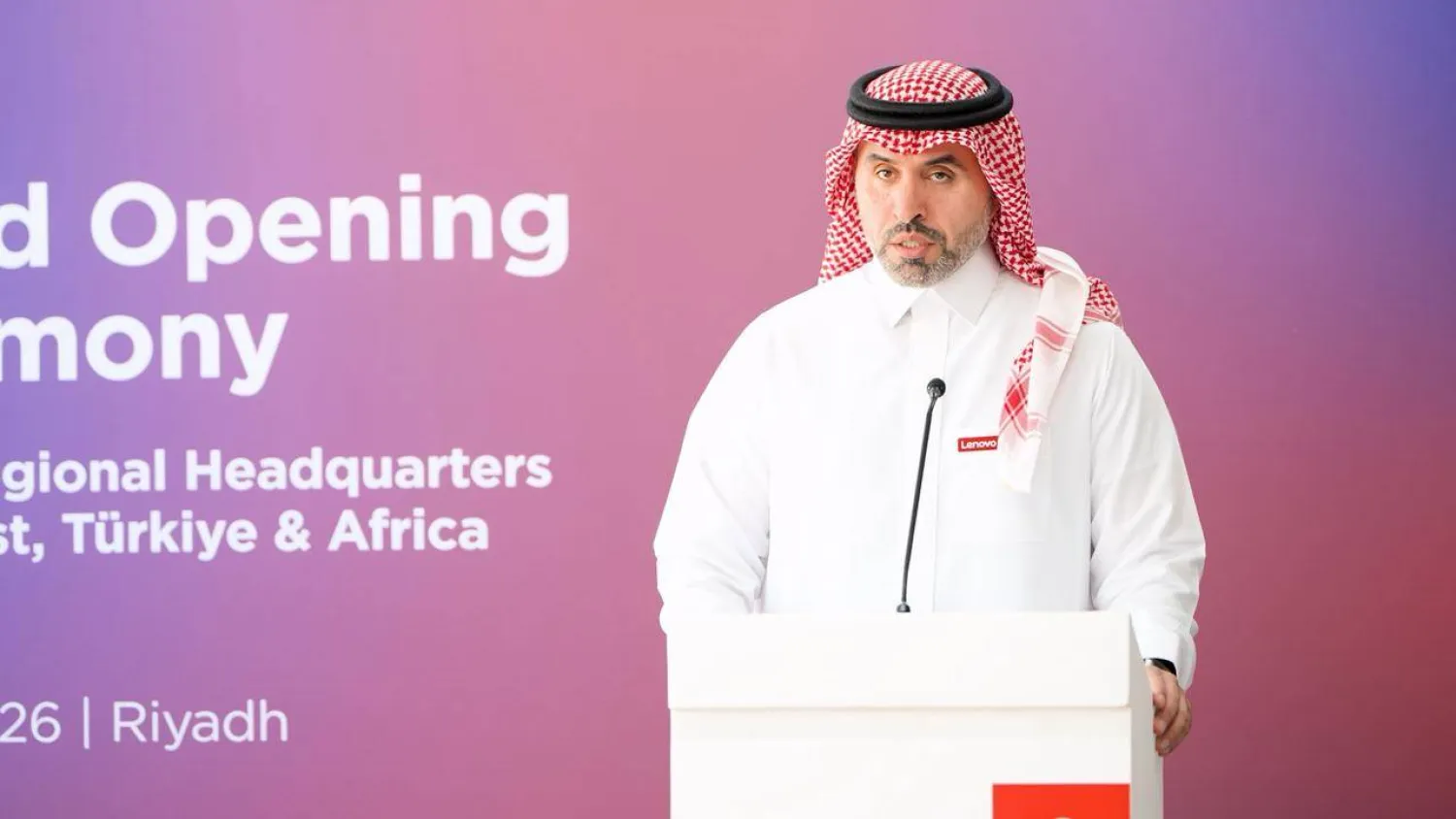
Tareq Alangari, Lenovo Senior Vice President and President for the Middle East, Türkiye and Africa. (Turki Al-Aqail)
TT

Lenovo Chooses Riyadh as Regional Operations Hub

Tareq Alangari, Lenovo Senior Vice President and President for the Middle East, Türkiye and Africa. (Turki Al-Aqail)

Global technology company Lenovo has inaugurated its regional headquarters in Riyadh, after investing more than 2 billion riyals ($532 million) in the Saudi economy, underscoring the Kingdom’s growing role as a regional technology and industrial hub.

The move goes beyond establishing an administrative base. Lenovo plans to build one of its largest integrated manufacturing centers worldwide through a partnership with Alat, a subsidiary of Saudi Arabia’s Public Investment Fund (PIF).

The company aims to reshape regional supply chains and produce devices labeled “Made in Saudi Arabia” for markets across the Middle East, Africa and Türkiye, capitalizing on the Kingdom’s favorable investment environment and rapid economic transformation.

Tareq Alangari, Lenovo Senior Vice President and President for the Middle East, Türkiye and Africa, said Saudi Arabia plays a “significant and strategic role” in the company’s regional strategy.

He told Asharq Al-Awsat that initiatives such as the Regional Headquarters Program, alongside close cooperation with government partners, have created a business environment that supports regional coordination and long-term investment.

Lenovo has invested nearly 2 billion riyals ($532 million) in Saudi Arabia so far, with plans for further expansion.

The investments include the newly opened regional headquarters, a manufacturing facility due for completion by the end of 2026, and plans for a research and development center and a customer experience center. The company is also investing in Saudi talent.

As part of that effort, 28 Saudi engineers have completed training in China under a smart manufacturing graduate program and have returned to take up leadership engineering roles at Lenovo’s local operations.

Alangari said the factory, expected to begin commercial operations by the end of this year, is in the final stages of operational and logistical readiness, including equipment installation, technical testing, and supply chain alignment.

“We will scale up production capacity in phases, in line with operational readiness and market demand,” he stated.

Saudi Investment Minister Fahad Al-Saif, who attended the launch, said Lenovo’s decision reflects the strength of the Saudi economy and the attractiveness of its investment climate.

He described the move as a successful example of the Regional Headquarters Program, which aims to attract multinational companies and enable them to manage and expand regional operations from Saudi Arabia.

Al-Saif said Lenovo is building an integrated presence in the Saudi market in cooperation with national entities, supporting regional growth and meeting global demand through a system that combines decision-making, logistics and an enabling investment environment.

He added that the company’s expansion includes developing research and development programs and skills training, as well as establishing a manufacturing platform with a capacity of up to 8 million units annually. The project is expected to create skilled jobs and support the localization of technology and industry.

Built on a 200,000-square-meter site in Riyadh Integrated and developed in partnership with Alat, the facility will produce millions of devices under the “Made in Saudi Arabia” label.

With total investment reaching $2 billion, the factory will strengthen Lenovo’s global manufacturing network, which includes more than 30 plants worldwide.

The new hub is expected to improve supply chain efficiency and bring Lenovo closer to customers in the Middle East and Africa, enabling faster delivery and reinforcing Saudi Arabia’s position as a regional center for industry and technology.


Pakistan Says Looking at Options to Repay $3.5 Billion UAE Loan

Pakistan Finance Minister Muhammad Aurangzeb speaks during an interview at the International Monetary Fund and World Bank Group’s annual spring meetings in Washington D.C., US, April 13, 2026. REUTERS/Ken Cedeno
TT

Pakistan Says Looking at Options to Repay $3.5 Billion UAE Loan

Pakistan Finance Minister Muhammad Aurangzeb speaks during an interview at the International Monetary Fund and World Bank Group’s annual spring meetings in Washington D.C., US, April 13, 2026. REUTERS/Ken Cedeno

Pakistan is considering Eurobonds, loans from other countries and commercial debt to replace a $3.5 billion facility from the United Arab Emirates (UAE) and manage its foreign reserves, its finance minister said.

Muhammad Aurangzeb also told Reuters the shock from the ongoing war in the Middle East meant that Pakistan must consider a strategic petroleum reserve and a faster switch to renewable energy.

"All options are on the table," Aurangzeb said when asked if the government was in talks with Saudi Arabia for a loan that could replace the UAE facility.

Reuters reported that Pakistan will return a $3.5 billion loan to the UAE this month, putting pressure ⁠on its reserves ⁠and risking breaches of its International Monetary Fund (IMF) program targets.

The South Asian country has been thrust into the international spotlight as it plays the role of a mediator between the US and Iran to end the war in the Middle East.

Aurangzeb, speaking on the sidelines of the IMF/World Bank annual spring meetings, said the country could manage all debt repayments, and that its reserves remained at roughly 2.8 months of import cover. Maintaining at least that ⁠level, he said, would be "an important aspect of our overall macro stability as we go forward."

"We are looking at Eurobond, we are looking at Islamic sukuk, we are looking at dollar-settled rupee-linked bonds," Aurangzeb said, adding that they expected to issue Eurobonds this year and are also exploring commercial loans.

Aurangzeb said while the country had not yet requested any addition or changes to its $7 billion IMF lending program due to the economic shocks of the war in the Middle East, it was a potential option.

"Depending upon how things pan out over the next few weeks, that's something which can be discussed," he said.

The Fund's board is likely to sign off on the latest lending tranche by the end ⁠of this month ⁠or early next month, Aurangzeb said, which would unlock just under $1.3 billion via the Extended Fund Facility and the Resilience and Sustainability Facility.

Pakistan also expects to launch its first-ever Panda bond - debt denominated in Chinese yuan - next month, he said. The $250 million issue, the first of a planned $1 billion program, will be backed by the Asian Development Bank and the Asian Infrastructure Investment Bank.

Aurangzeb said the country's expected GDP growth of close to 4%, remittances of around $41.5 billion and targeted assistance to the poorest citizens could withstand the Iran war shock for this fiscal year, which ends on June 30.

But the price spikes meant the country should focus on establishing strategic reserves of fuels and LPG - rather than simply relying on commercial reserves - and accelerate its move towards renewable energy.

"When you go through a supply shock like this... it sends a very clear view that we need to accelerate these journeys," he said.


IEA Is Ready to Further Tap Global Oil Reserves if Needed, Chief Says

25 January 2019, Switzerland, Davos: Executive Director of the International Energy Agency Fatih Birol speaks during the Annual Meeting 2019 of the World Economic Forum. (Valeriano Di Domenico/World Economic Forum/dpa)
TT

IEA Is Ready to Further Tap Global Oil Reserves if Needed, Chief Says

25 January 2019, Switzerland, Davos: Executive Director of the International Energy Agency Fatih Birol speaks during the Annual Meeting 2019 of the World Economic Forum. (Valeriano Di Domenico/World Economic Forum/dpa)

The head of the International Energy Agency, Fatih Birol, said on Monday he hopes another oil stockpile release is not needed but "we stand ready to act" if the energy shock resulting from the war with Iran requires ‌it.

The 32-member ‌IEA agreed last month ‌to ⁠release 400 million barrels of ⁠oil from reserves, the largest coordinated release ever, in a bid to calm oil markets.

The US, the world's largest oil and gas producer, agreed to release 172 million barrels ⁠from its Strategic Petroleum Reserve.

"I ‌hope, very much ‌hope, we don't need to do ‌it but if it is needed we ‌are ready to act," Birol said.

Birol reiterated at an Atlantic Council event that the war has resulted in the worst ‌global energy disruption ever and said that more than 80 oil ⁠and ⁠gas facilities including production, terminals and refineries across the Middle East have been damaged by war with Iran.

Benchmark oil prices are trading near $100 a barrel.

Due to the vast extent of the production shut-ins and closure of the Strait of Hormuz, the oil releases are "not a solution," Birol said, "it's just reducing the pain."