Russian Gunpowder Factory Attacked, Ukrainian Official Says

A man walks at the site of shelling, which local officials called a Ukrainian military strike, in Donetsk, Russian-controlled Ukraine, on January 10, 2025, amid the ongoing Russian-Ukrainian conflict. (Photo by STRINGER / AFP)
TT

Russian Gunpowder Factory Attacked, Ukrainian Official Says

A man walks at the site of shelling, which local officials called a Ukrainian military strike, in Donetsk, Russian-controlled Ukraine, on January 10, 2025, amid the ongoing Russian-Ukrainian conflict. (Photo by STRINGER / AFP)

A major Russian gunpowder factory in the Tambov region was attacked, a Ukrainian official said on Thursday, without directly claiming Ukrainian responsibility or specifying the consequences of the attack.

"The enterprise is one of the main suppliers of explosive materials for the army of the Russian Federation," Andriy Kovalenko, the head of Ukraine's Centre for Countering Disinformation, wrote on Telegram of the powder factory.

"With the start of the full-scale war in Ukraine, production at the plant increased significantly," he added, Reuters reported.

There was no immediate public comment from Russia on the attack on the factory.

Separately, Ukraine's military said it had hit the Liskinska oil depot in Russia's Voronezh region overnight.

"According to the available information, at least three strike drones hit the target. A large-scale fire broke out at the facility," a military statement on the Telegram app said.

Russian authorities had said earlier that debris from falling Ukrainian drones had caused a fire at the facility.

Ukraine and Russia have regularly attacked military production facilities deep inside each other's territory in the course of their war.


Riyadh Global Medical Biotechnology Summit Opens with Participants from More than 70 Countries

First-day sessions examined opportunities for cooperation among universities, research centers and global companies in biotechnology. (SPA)
TT

Riyadh Global Medical Biotechnology Summit Opens with Participants from More than 70 Countries

First-day sessions examined opportunities for cooperation among universities, research centers and global companies in biotechnology. (SPA)

The Riyadh Global Medical Biotechnology Summit 2026 opened on Monday with participants from more than 70 countries, over 100 speakers and more than 10,000 registered attendees.

The summit features 36 scientific sessions and the unveiling of more than 40 agreements, initiatives and declarations, reflecting the range of cooperation and partnership on offer and the expansion of the biotechnology ecosystem into health, investment, industry, research, data and artificial intelligence.

Chief Executive Officer of the Ministry of National Guard Health Affairs Dr. Bandar Al Knawy said support for the Kingdom of Saudi Arabia's research, innovation and biotechnology sectors was vital, and that the summit comes at a time of rapid and far-reaching discoveries in biotechnology and the development of unprecedented technologies.

Al Knawy said the summit is a platform for advancing the objectives of the National Biotechnology Strategy, launched by Prince Mohammed bin Salman bin Abdulaziz Al Saud, Crown Prince and Prime Minister, in January 2024.

First-day sessions examined opportunities for cooperation among universities, research centers and global companies in biotechnology, and the role of such partnerships in supporting innovation and developing biotechnology applications.

They also addressed the role of artificial intelligence in advancing medical biotechnology, from computational biology to drug development and clinical trials, and its potential to support scientific research and accelerate innovation, with experts from Saudi Arabia, the United States and China taking part.

The summit also widens the link between research and investment through the Life Sciences Innovation Forum (LSIF 2026), a three-day event that brings together specialized biotechnology investment funds and connects investors with promising companies through five competitive investment rounds.


TotalEnergies, Iraq Agree to Start Talks on Energy Projects

TotalEnergies, Iraq Agree to Start Talks on Energy Projects
TT

TotalEnergies, Iraq Agree to Start Talks on Energy Projects

TotalEnergies, Iraq Agree to Start Talks on Energy Projects

TotalEnergies and the Iraqi government have agreed to start discussions on energy projects in the country, while France and Iraq have also agreed on a roadmap regarding future acquisitions ‌of weapons ‌from French companies ‌by the ⁠Iraqi military, according ⁠to a joint French-Iraqi statement on Monday.

TotalEnergies' projects would involve large-scale investments and would be aimed at boosting ⁠Iraqi oil production while contributing ‌to ‌improving energy sovereignty and ‌the country's energy transition, the ‌statement said.

France and Iraq "applauded the signature of a declaration of intent regarding autonomous ‌air defense systems between the French company Harmattan ⁠AI ⁠and the Iraqi defense minister," the statement said.

It also said that Iraq's prime minister had announced his intent to encourage talks involving other French firms and the defense minister regarding various weaponry systems.


Saudi Arabia Outlines 3 Pathways to Explore Uranium Resources Locally

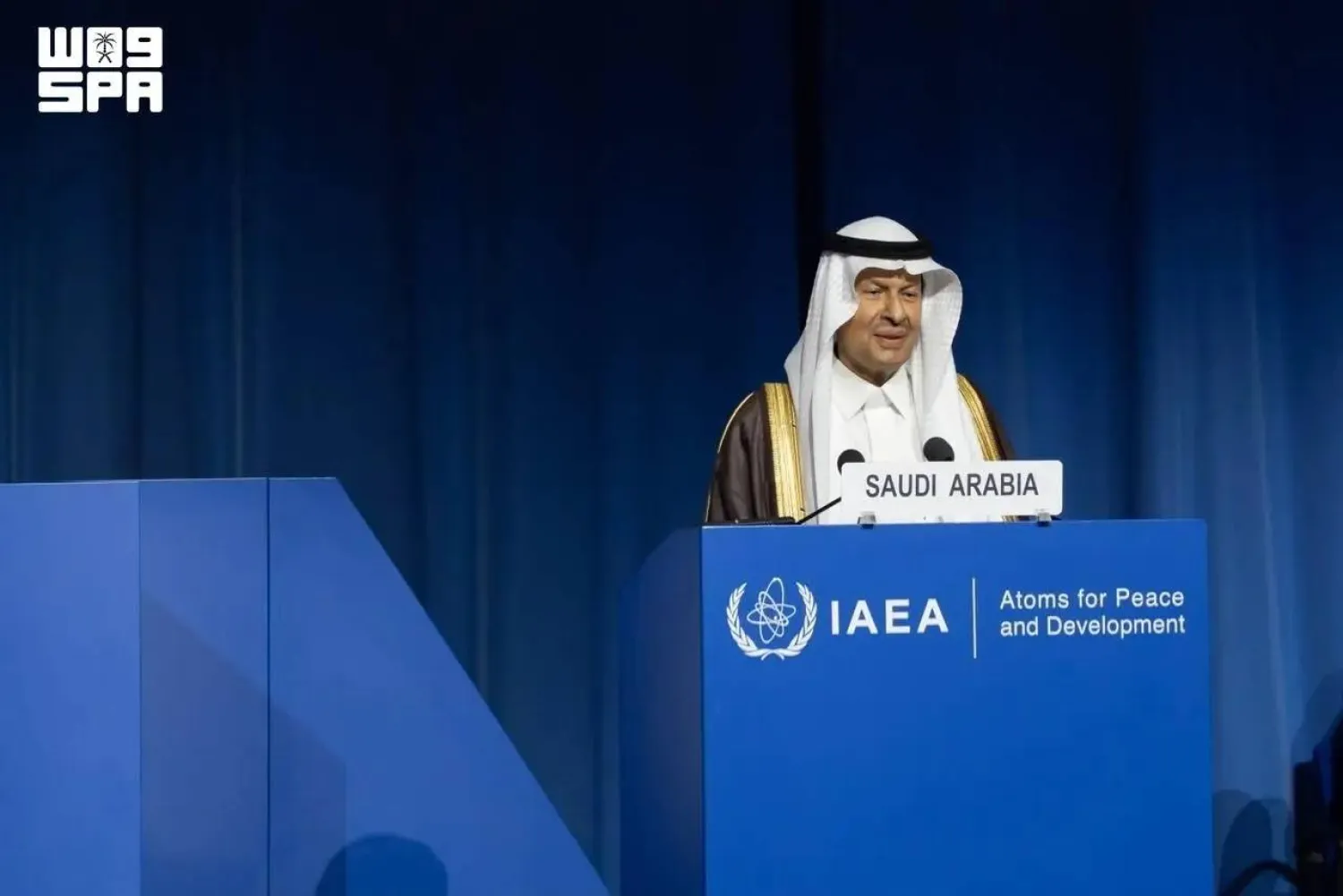
Saudi Minister of Energy, Minister of Industry and Mineral Resources Prince Abdulaziz bin Salman bin Abdulaziz speaks at the IAEA conference in Vienna on Monday. (SPA)
TT

Saudi Arabia Outlines 3 Pathways to Explore Uranium Resources Locally

Saudi Minister of Energy, Minister of Industry and Mineral Resources Prince Abdulaziz bin Salman bin Abdulaziz speaks at the IAEA conference in Vienna on Monday. (SPA)

Saudi Arabia is moving forward with integrating nuclear energy into its national mix while developing its domestic uranium resources and building an integrated mineral value chain.

This chain spans from exploration and mining to processing, separation, refining, and the production of yellowcake, in an approach aimed at maximizing the economic value of its natural resources and boosting security of supply.

Speaking at the 70th General Conference of the International Atomic Energy Agency (IAEA) in Vienna, Saudi Minister of Energy, Minister of Industry and Mineral Resources Prince Abdulaziz bin Salman bin Abdulaziz said: “Over the decades, the Kingdom has established its position as a reliable energy supplier and an active partner in the stability of global energy markets.”

“Along with this role, the Kingdom is moving forward with developing a national energy mix from different energy sources that is more diverse and sustainable, based on integrated economic and development considerations,” he added.

“This includes introducing nuclear energy into this mix, within a well-established regulatory framework and in accordance with the Kingdom's international obligations,” he stressed.

“Our meeting today comes at a time when the world is witnessing rapid growth in energy demand, driven by economic, technological and industrial expansion. Amid these developments, diversifying energy sources and enhancing their reliability and sustainability have become essential to supporting economic growth and ensuring security of supply,” he said.

Prince Abdulaziz bin Salman said that the National Atomic Energy Project is advancing a program to explore uranium resources and assess opportunities for their economic utilization through several interconnected tracks.

The first involves recovering uranium associated with phosphoric acid produced in phosphate fertilizer operations in the north of the Kingdom, taking into account Saudi Arabia's position as the world's second-largest exporter of phosphate fertilizers.

He noted that pilot work carried out in cooperation with the French company Orano has yielded promising economic indicators for uranium recovery from these operations. This cooperation culminated in the signing of a memorandum of understanding during the visit of Prince Mohammed bin Salman, Crown Prince and Prime Minister, to France in August.

“Exploration and geological studies at the Jabal Sayid project in Madinah Region have identified estimated resources of around 114 million tons of ore containing high concentrations of rare earth elements, particularly heavy rare earth elements, alongside promising concentrations of uranium,” revealed Prince Abdulaziz bin Salman.

“This places the project among the most significant rare earth resource sites currently under development globally. This direction gained further momentum during the visit of the Crown Prince to the United States in November 2025, when the two countries signed a framework for cooperation on critical minerals and securing supply chains,” he went on to say.

This was followed by a partnership between the Saudi Arabian Mining Company, Ma'aden, and the American company MP Materials to develop capabilities for the processing and separation of rare earth elements and the production of associated uranium.

Prince Abdulaziz bin Salman stated that the Kingdom is continuing its efforts, through the Sedimentary Cover Survey Initiative, to explore additional uranium ores from conventional sources.

He added that these resources take on particular significance when viewed in the context of the Kingdom's broader advantages. The Kingdom combines promising mineral resources, competitive energy supplies, advanced infrastructure, growing industrial and investment capabilities, a strategic location, and effective international partnerships.

The Kingdom's ambition does not stop at producing raw materials or exporting concentrates, rather it extends to building an integrated economic and industrial value chain for all these minerals, he said.

This begins with exploration and mining and progressing through processing, separation and refining; the production of rare earth oxides; the recovery and purification of associated uranium; and the production of yellowcake and the development of its value chain, subject to economic feasibility, in accordance with the highest standards of transparency and within the framework of the Kingdom's international obligations, he noted.

Prince Abdulaziz bin Salman stressed that the Kingdom's exercise of its choices regarding the peaceful uses of nuclear energy goes hand in hand with the highest levels of responsibility and transparency.

This is consistent with the inherent right of States Parties to the Treaty on the Non-Proliferation of Nuclear Weapons to develop and use nuclear energy for peaceful purposes without discrimination.

He noted that, in exercising these rights, the Kingdom follows a clear approach founded on transparency, openness and international cooperation. It does not seek to develop its peaceful nuclear program in isolation from the international community, nor through activities conducted in secrecy or facilities concealed deep within mountains.

Rather, the Kingdom is developing its capabilities through trusted international partnerships that strengthen confidence and support the nuclear non-proliferation ecosystem, said the minister.

The Kingdom continues to strengthen its national framework and regulatory ecosystems governing nuclear energy and its applications, based on its conviction that confidence rests on strong national institutions, well-established regulatory frameworks and national capabilities said Prince Abdulaziz bin Salman.

The Kingdom also continues to boost its preparedness for nuclear and radiological emergencies, reinforce a culture of nuclear safety and security, and strengthen technical cooperation with the agency and international partners, he stressed.

He reaffirmed the Kingdom's full support for the IAEA and its commitment to continuing constructive cooperation with the agency and its member states in a manner that strengthens international confidence and contributes to a more secure, sustainable and prosperous future for all.

Prince Abdulaziz bin Salman later met IAEA Director General Rafael Mariano Grossi on the sidelines of the conference. 

They discussed cooperation between Saudi Arabia and the IAEA, as well as other issues of mutual interest.