


Trump Announces 30% Tariffs Against EU, Mexico to begin August 1

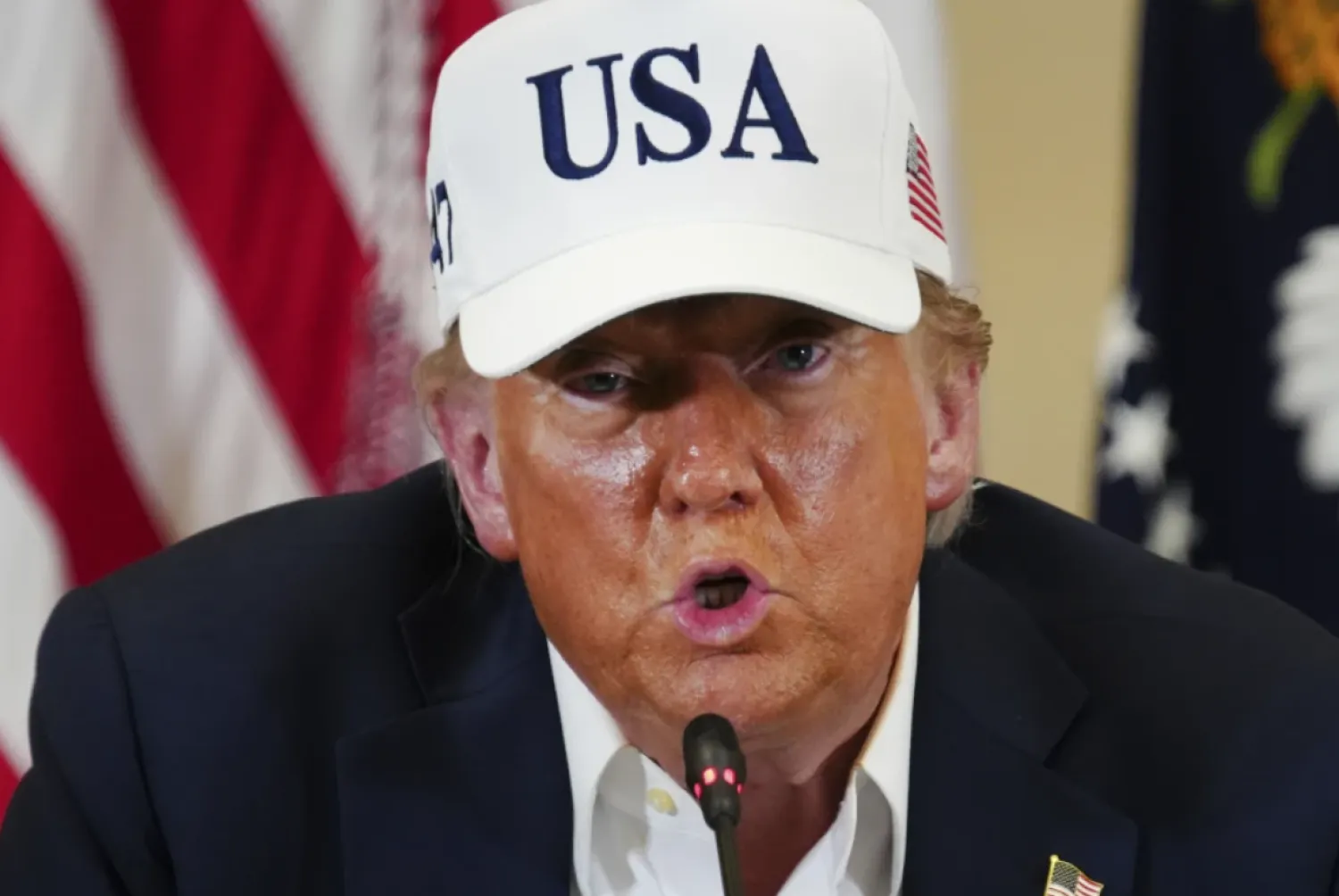
President Donald J. Trump speaks at a roundtable discussion at the Community Emergency Operations Center in Kerrville, Texas, Friday, July 11, 2025. (Ricardo B. Brazziell/Austin American-Statesman via AP)
TT

Trump Announces 30% Tariffs Against EU, Mexico to begin August 1

President Donald J. Trump speaks at a roundtable discussion at the Community Emergency Operations Center in Kerrville, Texas, Friday, July 11, 2025. (Ricardo B. Brazziell/Austin American-Statesman via AP)

President Donald Trump on Saturday announced he's levying tariffs of 30% against the European Union and Mexico.

Trump announced the tariffs on two of the United States' biggest trade partners in letters posted to his social media account.

In his letter to Mexico's leader, Trump acknowledged that the country has been helpful in stemming the flow of undocumented migrants and fentanyl into the United States. But he said the country has not done enough to stop North America from turning into a “Narco-Trafficking Playground.”

“Mexico has been helping me secure the border, BUT, what Mexico has done, is not enough,” Trump added, The AP news reported.

Trump in his letter to the European Union said that the US trade deficit was a national security threat.

“We have had years to discuss our Trading Relationship with The European Union, and we have concluded we must move away from these long-term, large, and persistent, Trade Deficits, engendered by your Tariff, and Non-Tariff, Policies, and Trade Barriers,” Trump wrote in the letter to the EU. “Our relationship has been, unfortunately, far from Reciprocal.”

Trump is in the midst of an announcement blitz of new tariffs with allies and foes alike, a bedrock of his 2024 campaign that he said would set the foundation for reviving a US economy that he claims has been ripped off by other nations for decades.

With the reciprocal tariffs, Trump is effectively blowing up the rules governing world trade. For decades, the United States and most other countries abided by tariff rates set through a series of complex negotiations known as the Uruguay round. Countries could set their own tariffs – but under the “most favored nation’’ approach, they couldn’t charge one country more than they charged another.

With Saturday's letters, Trump has now issued tariff conditions on 24 countries and the 27-member European Union.

The European Union’s chief trade negotiator said earlier this week that a trade deal to avert higher tariffs on European goods imported to the US could be reached “even in the coming days.” Maroš Šefčovič told EU lawmakers in Strasbourg, France on Wednesday that the EU had been spared the increased tariffs contained in the letters Trump sent on Monday, and that an extension of talks would provide “additional space to reach a satisfactory conclusion.”

The bloc collectively sells more to the US than any other country. US goods imports from the EU topped $553 billion in 2022, according to the Office of the US Trade Representative.

Trump on April 2 proposed a 20% tariff for EU goods and then threatened to raise that to 50% after negotiations did not move as fast as he would have liked. Sefcovic did not mention any tariff figures.

The higher tariffs as well as any EU retaliation had been suspended as the two sides negotiate. However the base rate of 10% for most trade partners as well as higher rates of 25% on autos and 50% on steel and aluminum had gone into effect.

Douglas Holtz-Eakin, a former Congressional Budget Office director and president of the center-right American Action Forum, said the letters were evidence that serious trade talks were not taking place over the past three months. He stressed that nations were instead talking amongst themselves about how to minimize their own exposure to the US economy and Trump.

“They’re spending time talking to each other about what the future is going to look like, and we’re left out,” Holtz-Eakin said.

He added that Trump was using the letters to demand attention, but, “In the end, these are letters to other countries about taxes he’s going to levy on his citizens.”



UK Growth Revised Down in Second Quarter 

Shoppers fill the pavement on Regent Street in central London on December 21, 2025. (AFP)
TT

UK Growth Revised Down in Second Quarter 

Shoppers fill the pavement on Regent Street in central London on December 21, 2025. (AFP)

Britain's economy expanded less than initially estimated in the second quarter, according to revised official data released Monday, dealing a fresh setback to the Labour government.

Gross domestic product was revised down to 0.2 percent in the April-June period from a previous estimate of 0.3 percent, the Office for National Statistics said in a statement.

Growth in the third quarter stood at an unrevised 0.1 percent, the ONS said, marking a sustained slowdown from the 0.7 percent expansion recorded in the first three months of the year.

"The economy is still pretty weak and is heading into 2026 with very little momentum," noted Alex Kerr, UK economist at Capital Economics.

Prime Minister Keir Starmer has struggled to revive Britain's sluggish economy since his Labour party came to power in July 2024.

Finance minister Rachel Reeves raised taxes on businesses in her inaugural budget last year -- a decision widely blamed for causing weak UK economic growth and rising unemployment.

She returned in her November budget with fresh tax hikes to bring down government debt, this time hitting workers.

The Bank of England last week cut its key interest rate to 3.75 percent after UK inflation eased faster than expected and as the economy weakens.


Saudi Finance Minister Says New Financial Control System Protects Public Funds

Saudi Minister of Finance Mohammed Al-Jadaan. Asharq Al-Awsat
TT

Saudi Finance Minister Says New Financial Control System Protects Public Funds

Saudi Minister of Finance Mohammed Al-Jadaan. Asharq Al-Awsat

Saudi Minister of Finance Mohammed Al-Jadaan has said that the new Financial Control System constitutes a “fundamental shift” in the control methodology and the improvement of the legislative framework for financial work in government agencies, through a more flexible and comprehensive model that focuses on empowerment and the protection of public funds.

Speaking at the 1st edition of the Financial Supervision Forum held at the General Court of Audit in Riyadh on Sunday, Al-Jadaan said the Kingdom must invest in national talent alongside regulatory reforms to build a modern financial oversight system.

He stressed the importance of enhancing institutional integration between the relevant authorities, especially between the Finance Ministry and the General Court of Audit, which contributes to unifying oversight efforts and reducing duplication.

According to Al-Jadaan, the success of this transformation depends on concerted efforts between regulatory authorities on the one hand, and authorities dealing with public money on the other hand, in a way that maximizes the impact in protecting public money and enhancing the efficiency of financial oversight.

President of the General Court of Audit Hussam Alangari also said that organizing the forum in partnership with the Finance Ministry comes within the qualitative transformation that Saudi Arabia is witnessing in financial oversight during an era in which the country holds a leading global position in the management of public finances, characterized by governance, responsibility, and a high level of transparency.

He told the forum that the General Court of Audit has had strong foundations that have strengthened its role and independence as the supreme authority for public financial oversight and auditing.

Alangari pledged to strengthen the “deep partnership” with the Finance Ministry, describing it as a partnership cemented by trust and built on the foundations of cooperation across various fields.

The partnership has resulted in qualitative leaps, most notably what has been achieved in the exchange of information through full technical integration between the Etimad and Shamel platforms, he said.


Trump Shook up Global Trade This Year; Some Uncertainty May Persist in 2026 

Containers are seen at the port in Shanghai, China, Oct. 13, 2025. (AFP)
TT

Trump Shook up Global Trade This Year; Some Uncertainty May Persist in 2026 

Containers are seen at the port in Shanghai, China, Oct. 13, 2025. (AFP)

President Donald Trump's return to the White House in 2025 kicked off a frenetic year for global trade, with waves of tariffs on US trading partners that lifted import taxes to their highest since the Great Depression, roiled financial markets and sparked rounds of negotiations over trade and investment deals.

His trade policies - and the global reaction to them - will remain front and center in 2026, but face some hefty challenges.

WHAT HAPPENED IN 2025

Trump's moves, aimed broadly at reviving a declining manufacturing base, lifted the average tariff rate to nearly 17% from less than 3% at the end of 2024, according to Yale Budget Lab, and the levies are now generating roughly $30 billion a month of revenue for the US Treasury.

They brought world leaders scrambling to Washington seeking deals for lower rates, often in return for pledges of billions of dollars in US investments. Framework deals were struck with a host of major trading partners, including the European Union, the United Kingdom, Switzerland, Japan, South Korea, Vietnam and others, but notably a final agreement with China remains on the undone list despite multiple rounds of talks and a face-to-face meeting between Trump and Chinese leader Xi Jinping.

The EU was criticized by many for its deal for a 15% tariff on its exports and a vague ‌commitment to big ‌US investments. France's prime minister at the time, Francois Bayrou, called it an act of submission ‌and ⁠a "somber day" for the ‌bloc. Others shrugged that it was the "least bad" deal on offer.

Since then, European exporters and economies have broadly coped with the new tariff rate, thanks to various exemptions and their ability to find markets elsewhere. French bank Societe Generale estimated the total direct impact of the tariffs was equivalent to just 0.37% of the region's GDP.

Meanwhile, China's trade surplus defied Trump's tariffs to surpass $1 trillion as it succeeded in diversifying away from the US, moved its manufacturing sector up the value chain, and used the leverage it has gained in rare earth minerals - crucial inputs into the West's security scaffolding - to push back against pressure from the US or Europe to curb its surplus.

What notably did not happen was the economic calamity and high inflation that legions ⁠of economists predicted would unfold from Trump's tariffs.

The US economy suffered a modest contraction in the first quarter amid a scramble to import goods before tariffs took effect, but quickly rebounded and ‌continues to grow at an above-trend pace thanks to a massive artificial intelligence investment boom ‍and resilient consumer spending. The International Monetary Fund, in fact, twice ‍lifted its global growth outlook in the months following Trump's "Liberation Day" tariffs announcement in April as uncertainty ebbed and deals were struck to reduce ‍the originally announced rates.

And while US inflation remains somewhat elevated in part because of tariffs, economists and policymakers now expect the effects to be more mild and short-lived than feared, with cost sharing of the import taxes occurring across the supply chain among producers, importers, retailers and consumers.

WHAT TO LOOK FOR IN 2026 AND WHY IT MATTERS

A big unknown for 2026 is whether many of Trump's tariffs are allowed to stand. A challenge to the novel legal premise for what he branded as "reciprocal" tariffs on goods from individual countries and for levies imposed on China, Canada and Mexico tied to the flow of fentanyl into the US was argued before the US Supreme Court in late 2025, ⁠and a decision is expected in early 2026.

The Trump administration insists it can shift to other, more-established legal authorities to keep tariffs in place should it lose. But those are more cumbersome and often limited in scope, so a loss at the high court for the administration might prompt renegotiations of the deals struck so far or usher in a new era of uncertainty about where the tariffs will end up.

Arguably just as important for Europe is what is happening with its trading relationship with China, for years a reliable destination for its exporters. The depreciation of the yuan and the gradual move up the value chain for Chinese companies have helped China's exporters. Europe's companies meanwhile have struggled to make further inroads into the slowing domestic Chinese market. One of the key questions for 2026 is whether Europe finally uses tariffs or other measures to address what some of its officials are starting to call the "imbalances" in the China-EU trading ties.

Efforts to finally cement a US-China deal loom large as well. A shaky detente reached in this year's talks will expire in the second half of 2026, and Trump and Xi are tentatively set to meet twice over the course of the ‌year.

And lastly, the free trade deal with the two largest US trading partners - Canada and Mexico - is up for review in 2026 amid uncertainty over whether Trump will let the pact expire or try to retool it more to his liking.