

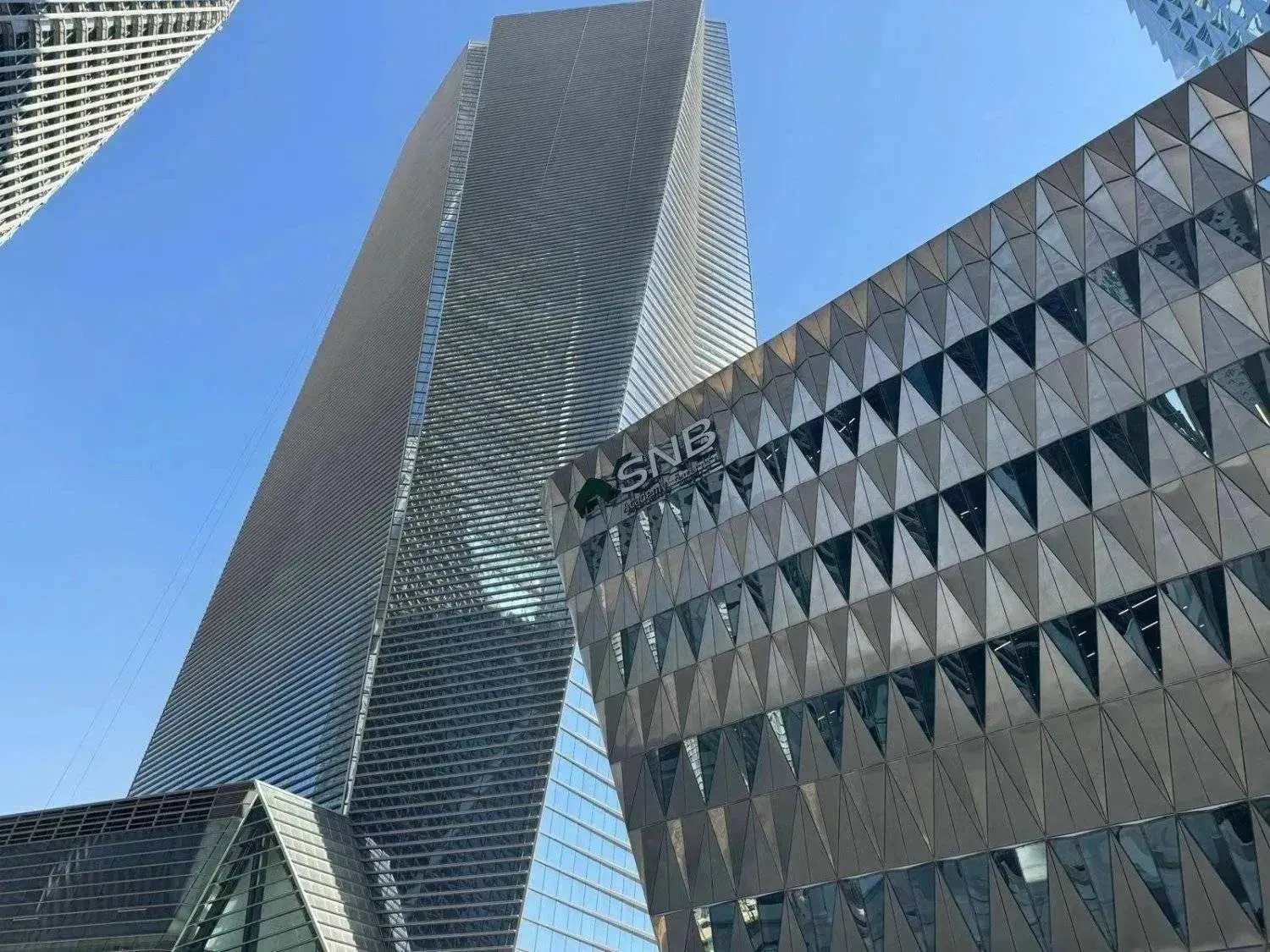

Dollar Sukuk: Saudi Banks’ Strategy to Attract Foreign Investors

The Saudi National Bank building in the Financial District of Riyadh (Asharq Al-Awsat)
TT

Dollar Sukuk: Saudi Banks’ Strategy to Attract Foreign Investors

The Saudi National Bank building in the Financial District of Riyadh (Asharq Al-Awsat)

Saudi banks are witnessing an unprecedented surge in sukuk issuances this year, with volumes soaring 98 percent compared to the same period in 2024. From January through last Wednesday, issuances reached $10.5 billion, nearly doubling last year’s $5.3 billion. Analysts predict total issuances could exceed $30 billion by year-end, marking a record-breaking pace.

Experts attribute this sharp rise to a combination of economic, structural, and regulatory factors. Financial analysts told Asharq Al-Awsat that the momentum is largely expected, particularly as the US Federal Reserve moves toward interest rate cuts later this year and into 2026. With loan growth consistently outpacing deposit inflows, sukuk are emerging as the optimal tool for banks to bridge liquidity gaps.

According to Mohamed Hamdi Omar, CEO of G-World for Economic Studies, several forces are driving this trend.

“The continued growth in lending demand, outstripping deposit growth, has created a liquidity shortfall, pushing banks to seek alternative funding sources. Sukuk are the best-fit solution,” he explained.

He also pointed to compliance with international standards such as Basel III, which require capital instruments that bolster regulatory capital without compromising liquidity efficiency. Added to this are the massive financing needs of Saudi Arabia’s Vision 2030 projects - including infrastructure, housing, and preparations for global events such as Expo Riyadh 2030 and the FIFA World Cup 2034 - requiring flexible and large-scale funding inflows.

Beyond liquidity, sukuk are proving highly attractive to investors. Offering returns of 6 to 6.5 percent this year, they present a stable and appealing choice in a volatile financial landscape. Expanding into dollar-denominated sukuk also broadens Saudi banks’ access to international markets, deepening the local debt market and diversifying funding sources.

Addressing concerns of a liquidity crisis, Omar stressed that “banks are not in distress; they are managing challenges proactively.”

With loan-to-deposit ratios now exceeding 100 percent, financing pressures are evident. Yet, Saudi banks’ robust solvency provides a strong cushion. Sukuk also enhance profitability in the short term: banks posted solid Q1 earnings, with returns on assets climbing to 2.3 percent. Compared with traditional bonds, sukuk offer greater flexibility in funding operations.

Nonetheless, Omar cautioned that an overreliance on debt instruments carries risks if issuance levels compromise capital quality or increase costs, particularly if investor appetite shifts or global interest rates rise abruptly. The rapid expansion, he noted, underscores banks’ adaptability but also necessitates prudent management of liquidity and capital risks amid Saudi Arabia’s ambitious growth drive.

Analysts agree that the surge in sukuk issuance is a pre-emptive move by Saudi banks in anticipation of Fed decisions. Financial analyst Tareq Al-Ateeq explained that banks are preparing for potential deposit withdrawals once US rates are lowered, compensating for the outflow through sukuk. He noted that Saudi banks’ loan portfolios, totaling around SAR 3.36 trillion, already outstrip deposits of SAR 2.86 trillion, with the gap covered by a mix of long-term debt instruments, chiefly sukuk.

Looking ahead, Al-Ateeq expects issuances of dollar-denominated sukuk to accelerate in the final quarter of the year, targeting rising demand from foreign investors, especially global funds and institutions. This strategy, he said, also supports banks’ international commitments such as trade finance and credit facilities, areas where deposits remain insufficient to match funding demand.


IMF Upgrades Outlook for Surprisingly Resilient World Economy to 3.3% Growth this Year

FILE PHOTO: A view of the International Monetary Fund (IMF) logo at its headquarters in Washington, D.C., US, November 24, 2024. REUTERS/Benoit Tessier//File Photo/File Photo
TT

IMF Upgrades Outlook for Surprisingly Resilient World Economy to 3.3% Growth this Year

FILE PHOTO: A view of the International Monetary Fund (IMF) logo at its headquarters in Washington, D.C., US, November 24, 2024. REUTERS/Benoit Tessier//File Photo/File Photo

An unexpectedly sturdy world economy is likely to shrug off President Donald Trump's protectionist trade policies this year, thanks partly to a surge of investment in artificial intelligence in North America and Asia, the International Monetary Fund said in a report out Monday.

The 191-nation lending organization expects that global growth will come in at 3.3% this year, same as in 2025 but up from the 3.1% it had forecast for 2026 back in October, The Associated Press reported.

The world economy "continues to show notable resilience despite significant US-led trade disruptions and heightened uncertainty,'' IMF chief economist Pierre-Olivier Gourinchas and his colleague Tobias Adrian wrote in a blog post accompanying the latest update to the fund's World Economic Outlook.

The US economy, benefiting from the strongest pace of technology investment since 2001, is forecast to expand 2.4% this year, an upgrade on the fund's October forecast and on expected 2025 growth — both 2.1%.

China — the world's second-largest economy — is forecast to see 4.5% growth, an improvement on the 4.2% the IMF had predicted October, partly because a trade truce with the United States has reduced American tariffs on Chinese exports.

India, which has supplanted China as the world's fastest-growing major economy, is expected to see growth decelerate from 7.3% last year (when it was juiced by an unexpectedly strong second half) to a still-healthy 6.4% in 2026.


France Says Still Loyal to Syria Kurds, Hails Ceasefire

Syrian army personnel celebrate as government forces enter Raqqa city following the withdrawal of Syrian Democratic Forces, in Raqqa, Syria, January 18, 2026. REUTERS/Karam al-Masri
TT

France Says Still Loyal to Syria Kurds, Hails Ceasefire

Syrian army personnel celebrate as government forces enter Raqqa city following the withdrawal of Syrian Democratic Forces, in Raqqa, Syria, January 18, 2026. REUTERS/Karam al-Masri

France on Monday welcomed a ceasefire between the Syrian government and Kurdish-led forces and stressed it remained loyal to the latter who spearheaded the battle against the ISIS group.

"France is faithful to its allies," the foreign ministry said, urging all sides to respect the ceasefire deal, which will also see the Kurdish administration and forces integrate into the state after months of stalled negotiations.


Lucid in 2026: 'Made in Saudi Arabia' Label Goes Global

Mark Winterhoff, interim CEO of Lucid (Company) 
TT

Lucid in 2026: 'Made in Saudi Arabia' Label Goes Global

Mark Winterhoff, interim CEO of Lucid (Company) 

Saudi Arabia is positioning itself as a global launchpad for Lucid, the electric-vehicle manufacturer, not merely as a consumer market, but as a manufacturing and export hub serving markets worldwide.

Speaking from Riyadh during his participation in the Future Minerals Forum, Mark Winterhoff, interim chief executive officer of Lucid — whose largest shareholder is Saudi Arabia’s Public Investment Fund (PIF) — outlined the company’s next phase, which focuses on disciplined expansion, resilient supply chains, and a strategic shift from ultra-luxury vehicles toward a broader consumer segment.

In remarks to Asharq Al-Awsat, Winterhoff described the forum as a critical platform for the electric-vehicle industry, given its heavy reliance on minerals and rare earth elements, particularly those used in magnets. He praised Saudi Arabia’s leadership in this area, noting its direct impact on multiple industrial sectors. Winterhoff oversees the execution of Lucid’s strategy and leads teams responsible for product design, engineering, and manufacturing efficiency.

Saudi Arabia as an Export Base

Winterhoff said Lucid’s Saudi factory - the company’s first manufacturing facility outside the United States - was designed from the outset as a major export platform, not solely to meet domestic demand.

Under current plans, only 13 to 15 percent of production will be allocated to Gulf Cooperation Council (GCC) markets, with the majority destined for export. He confirmed that Lucid remains on track to begin production at the facility by the end of this year, specifically in December.

In January 2025, Lucid joined the “Made in Saudi Arabia” program, enabling it to use the national manufacturing label on vehicles produced locally. The company is the first automotive original equipment manufacturer (OEM) to receive the designation, reflecting Saudi Arabia’s push to localize advanced industries, deepen partnerships with global manufacturers, and establish itself as a hub for electric-vehicle production and exports.

Strong Growth Momentum

Winterhoff said Lucid posted strong growth in both production and deliveries in 2025. Annual production more than doubled, while deliveries rose 55 percent year-on-year. The fourth quarter recorded particularly strong results in the United States and the Middle East, especially Saudi Arabia.

He noted that Lucid was the only electric-vehicle manufacturer in the US to report higher deliveries in the fourth quarter of 2025, at a time when many competitors saw sharp declines.

According to company figures, Lucid produced about 18,378 vehicles in 2025, up 104 percent from 2024, while deliveries reached 15,841 vehicles. In the fourth quarter alone, production climbed to 8,412 vehicles — up 116 percent from the previous quarter — while deliveries rose 31 percent to 5,345 vehicles.

While Lucid currently operates in the luxury segment, its most significant strategic shift involves developing a mid-size vehicle priced at around $50,000. Winterhoff said this model, aimed at a much wider consumer base, will form the backbone of production at the Saudi plant and enable the facility to reach its targeted maximum capacity.

Supply Chain Challenges and Outlook

Winterhoff identified supply chains - particularly for minerals, rare earth elements, and semiconductors - as ongoing challenges for the industry. He said Lucid faced repeated difficulties over the past year in sourcing magnets and securing stable semiconductor supplies. Forums such as the Future Minerals Forum, he added, are part of the solution, helping build a more stable and sustainable resource ecosystem.

Looking ahead, Winterhoff expressed confidence in Lucid’s trajectory. The company currently leads US electric-vehicle sales in the luxury sedan segment and ranks third when internal combustion vehicles are included. With the launch of its mid-priced model, Lucid expects higher production volumes and, in 2026, plans to enter the autonomous robotaxi market, an emerging sector it views as a key source of future growth.
