


Saudi Energy Minister: Kingdom Forging Ahead Fully with its Nuclear Program 

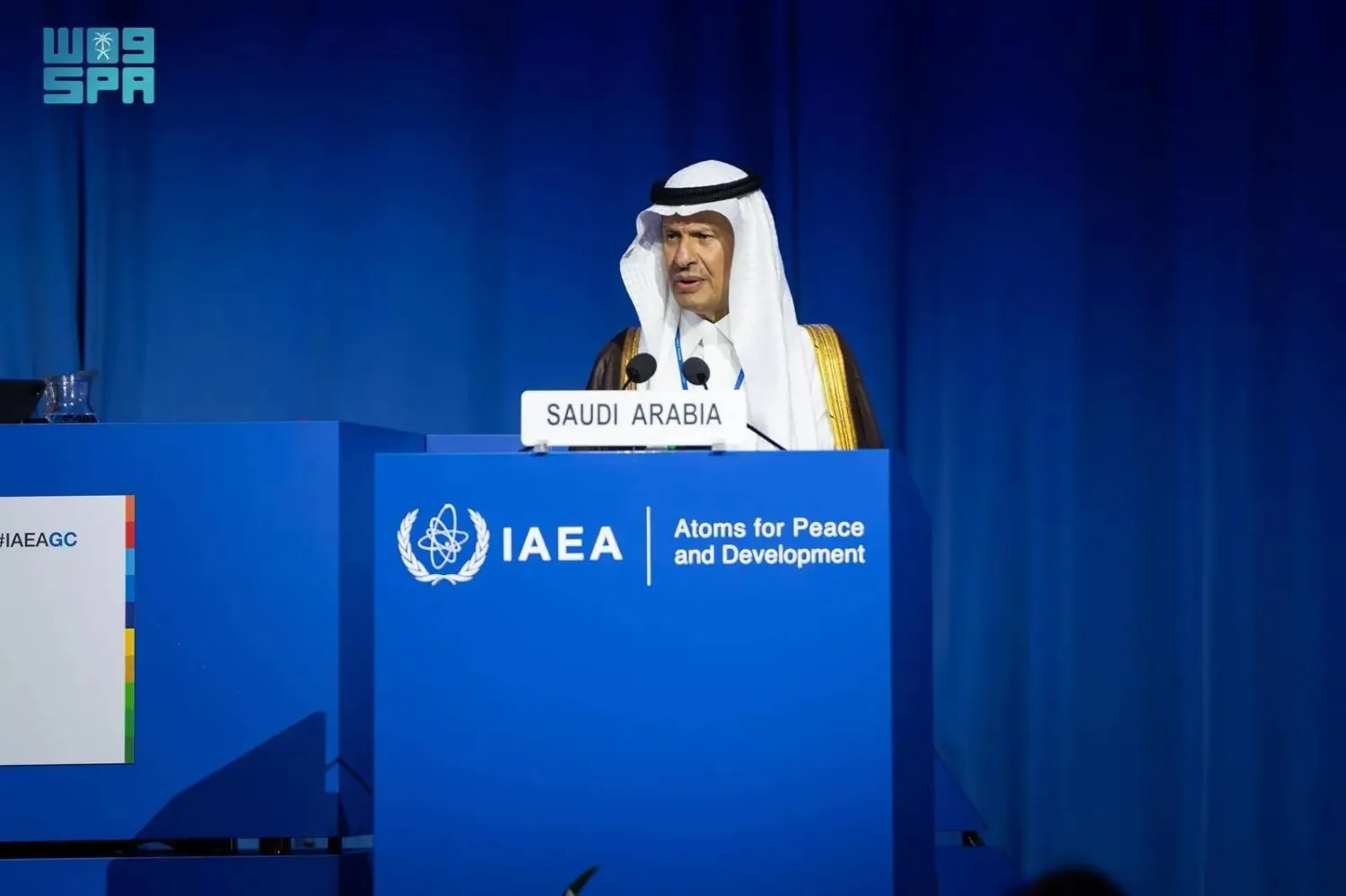
Saudi Minister of Energy Prince Abdulaziz bin Salman bin Abdulaziz speaks at the 69th session of the International Atomic Energy Agency (IAEA) General Conference in Vienna on Monday. (SPA)
TT

Saudi Energy Minister: Kingdom Forging Ahead Fully with its Nuclear Program 

Saudi Minister of Energy Prince Abdulaziz bin Salman bin Abdulaziz speaks at the 69th session of the International Atomic Energy Agency (IAEA) General Conference in Vienna on Monday. (SPA)

Saudi Minister of Energy, Chairman of the Board of King Abdullah City for Atomic and Renewable Energy, and Chairman of the Nuclear and Radiological Regulatory Commission Prince Abdulaziz bin Salman bin Abdulaziz said on Monday the Kingdom was forging ahead in developing its nuclear program.

Speaking at the 69th session of the International Atomic Energy Agency (IAEA) General Conference in Vienna, he stressed: “Given the importance of nuclear energy in socioeconomic development, the Kingdom has moved towards utilizing nuclear energy for peaceful purposes.”

“The Kingdom, in cooperation with the IAEA, is continuing to implement its national nuclear energy project in all its components, including the construction of the first nuclear power plant in Saudi Arabia, to achieve multiple objectives: contributing to the diversification of the national energy mix, enhancing the security of supply chains, and advancing sustainable development,” he went on to say.

These efforts are being pursued in line with the Kingdom’s national requirements and within the framework of international obligations, he added.

The Kingdom is committed to ensuring its national program promotes knowledge and technology transfer and supports the development of national human and technical capabilities in line with international best practices, said Prince Abdulaziz.

The minister further noted that Saudi Arabia has completed the essential administrative preparations to rescind the Small Quantities Protocol in cooperation with the IAEA and has fully implemented the Comprehensive Safeguards Agreement, as of early 2025.

Moreover, he said the Kingdom underlines the importance of strengthening nuclear and radiological emergency preparedness and response capabilities at the national and international levels.

International cooperation and knowledge-sharing boost the effectiveness of the nuclear and radiological emergency response systems to ensure people’s safety and environmental protection, he remarked.

The minister praised the IAEA’s efforts, under the leadership of Director General Rafael Grossi, to advance initiatives that support member states in building national systems, developing human capabilities in nuclear technology, and bolstering oversight of nuclear and radiological practices.

The conference underscores the agency’s key role in advancing international cooperation to harness atomic energy for peace and sustainable development, he noted.

Looking ahead, Prince Abdulaziz announced that the Kingdom will host the International Conference on Nuclear and Radiological Emergencies in Riyadh from December 1 to 4. The event will be organized by the IAEA.

Reaffirming Saudi Arabia’s investment in human capital, Prince Abdulaziz stressed that investing in national talent is key to maximizing the benefits of peaceful nuclear applications.

He underlined the Kingdom’s cooperation with the IAEA in supporting programs that develop and equip young professionals in the nuclear field to support national goals and achieve sustainable development.

The minister also highlighted Saudi Arabia’s support for the IAEA’s efforts to encourage member states to join multilateral nuclear safety agreements, noting that the Kingdom recently hosted a regional workshop in Riyadh to promote the Joint Convention on spent fuel and radioactive waste management in collaboration with the IAEA.

Prince Abdulaziz reiterated the Kingdom’s determination to deepen cooperation with the IAEA and advance the peaceful use of atomic energy in support of national development goals and in line with international obligations.



French Economy Likely to Grow at Least 0.8% in 2025, Finance Minister Says

French Minister for Economy, Finance, and Industrial, Energy and Digital Sovereignty Roland Lescure attends the 7th formal meeting of the Franco-Chinese Business Council in Beijing on December 4, 2025. (Reuters)
TT

French Economy Likely to Grow at Least 0.8% in 2025, Finance Minister Says

French Minister for Economy, Finance, and Industrial, Energy and Digital Sovereignty Roland Lescure attends the 7th formal meeting of the Franco-Chinese Business Council in Beijing on December 4, 2025. (Reuters)

Unless there is a sharp reversal in the final three months of the year, the French economy is likely to grow by at least 0.8% in 2025, outpacing the 0.7% that the government had anticipated, Finance Minister Roland Lescure said on Sunday.

"We will most likely exceed the government's growth forecast for this year. We had predicted 0.7%, but I think we will have at least 0.8%. That's good news," Lescure told LCI television.

"So we would really need to have a bad fourth quarter, which I don't believe will happen, for us to be below 0.8%, so 0.8% is within reach," he added.

France's economy grew 0.5% in the third quarter, final data from statistics office INSEE showed in November, reflecting resilience in the euro zone's second-largest economy.


Saudi Real Estate Shifts from Temporary Upswing to Operational Maturity

Real estate projects in Riyadh (SPA) 
TT

Saudi Real Estate Shifts from Temporary Upswing to Operational Maturity

Real estate projects in Riyadh (SPA) 

Saudi Arabia’s listed real estate sector recorded an exceptional and unprecedented transformation in the third quarter of 2025, with profits surging more than sixfold. Total earnings jumped 633.6 percent to $496 million (SAR 1.86 billion), compared with $67.5 million a year earlier, an indication that the industry has entered a phase of sustained operational maturity rather than a short-term cyclical rebound.

The sharp rise reflects the companies’ success in restructuring their product portfolios, enhancing cash flows, and shifting from “paper growth” to revenue-driven expansion supported by project deliveries and operational income.

Sector analysts attributed the leap in profitability to the rollout of major real estate projects in large cities, higher project quality, improved financing conditions, and stronger liquidity.

They noted that the leap aligns with the rapid expansion of Saudi Arabia’s non-oil economy, which now contributes about 56 percent of GDP. This has strengthened demand across residential, commercial, industrial, and office real estate, supporting profit growth alongside recent regulatory reforms.

During the first nine months of 2025, listed real estate firms achieved combined profits of $1.44 billion (SAR 5.4 billion), led by Cenomi Centers, Jabal Omar, and Masar (Umm Al-Qura for Development and Construction) - a 244 percent increase from the same period in 2024.

Financial disclosures show that nine out of sixteen listed developers reported higher profits in Q3, while four companies returned to profitability. Masar topped the sector in Q3 with SAR 516.6 million in earnings, up 341.9 percent year-on-year. Cenomi Centers ranked second with SAR 499.8 million, a rise of 52.2 percent, followed by Dar Al-Arkan, whose profits climbed 89 percent to SAR 255.6 million.

Real estate specialist Abdullah Al-Mousa told Asharq Al-Awsat that the historic profit surge confirms the sector has “entered a stage of operational maturity,” reflecting companies’ improved efficiency, stronger recurring revenues, and the successful transition to asset-operation models.

He identified three key drivers: higher-quality projects and stronger occupancy across income-generating assets; improved financing conditions amid stabilizing interest rates; and the completion of major projects, particularly in Riyadh and Makkah.

Al-Mousa expects continued positive performance in coming quarters, though at a more moderate pace, supported by new strategic projects entering operation, sustained housing demand, rising commercial activity in Riyadh, and ongoing regulatory reforms that reduce risk and attract institutional investment.

Real estate analyst Salman Saeed said the strength of the non-oil economy has sharply boosted demand in housing, retail, industrial, and office markets. He highlighted reforms such as the expansion of the white-land tax and rental-regulation measures, along with significant government support for homeownership, which has raised the share of Saudi citizens owning homes.

Saeed noted that rising demand for commercial and office space, driven by multinational companies relocating to Riyadh, has lifted occupancy rates and diversified developers’ income streams. Some firms also improved results through land sales and divestment of non-core assets, enhancing operational efficiency.


Qatar’s Energy Minister: AI Will Secure Future Demand for LNG

Al-Kaabi speaks at a panel discussion at the Doha Forum 2025. (X)
TT

Qatar’s Energy Minister: AI Will Secure Future Demand for LNG

Al-Kaabi speaks at a panel discussion at the Doha Forum 2025. (X)

Statements by Qatar’s Minister of State for Energy Affairs Saad Al-Kaabi became a focal point at the Doha Forum 2025, opened by Emir Sheikh Tamim bin Hamad Al Thani under the theme “Anchoring Justice: From Promises to Tangible Reality.”

Al-Kaabi delivered an upbeat assessment of the gas sector’s future, insisting he has “no concern whatsoever” about long-term demand thanks to the soaring power needs of artificial intelligence data centers.

Al-Kaabi said global demand for natural gas will remain robust as AI-driven energy consumption accelerates, forecasting that liquefied natural gas (LNG) demand will reach 600–700 million tons annually by 2035. He warned, however, that insufficient investment could constrain future LNG and gas supplies.

“I have absolutely no worries about future gas demand,” he said, adding that AI-related power consumption will be a key driver.

Once fully operational, Qatar’s North Field expansion is expected to produce 126 million metric tons of LNG a year by 2027 - an 85 percent increase from today’s 77 million tons.

He also noted that the first train of the Golden Pass LNG project, a joint venture with ExxonMobil in Texas, is scheduled to begin operations in the first quarter of 2026.

Al-Kaabi argued that oil prices between $70 and $80 per barrel would generate sufficient revenue for companies to invest in future energy needs, while prices above $90 would be “too high.”

He separately cautioned that the Gulf region is witnessing an “excess of real-estate construction,” raising the risk of a property bubble.

The minister hoped that the European Union will address corporate concerns over new sustainability regulations by the end of December.

Gulf Cooperation Council states voiced deep concern on Friday about two proposed EU directives, which tackle corporate sustainability due diligence and sustainability reporting, recently amended by the European Parliament for trilogue negotiations.

The GCC warned that the measures would effectively compel major European and international companies to adopt the EU’s sustainability model, comply with additional human rights and environmental obligations, submit climate-transition plans beyond existing global accords, file detailed sustainability reports, and face penalties for non-compliance.

Qatar has also criticized the due-diligence directive and has threatened to halt gas supplies. The dispute centers on potential fines of up to 5 percent of a company’s global revenue.

Al-Kaabi has repeatedly stated that Qatar will not meet net-zero emissions targets under such conditions.