Iraq's Kurdistan Oil Flows to Türkiye Running at 150,000-160,000 bpd

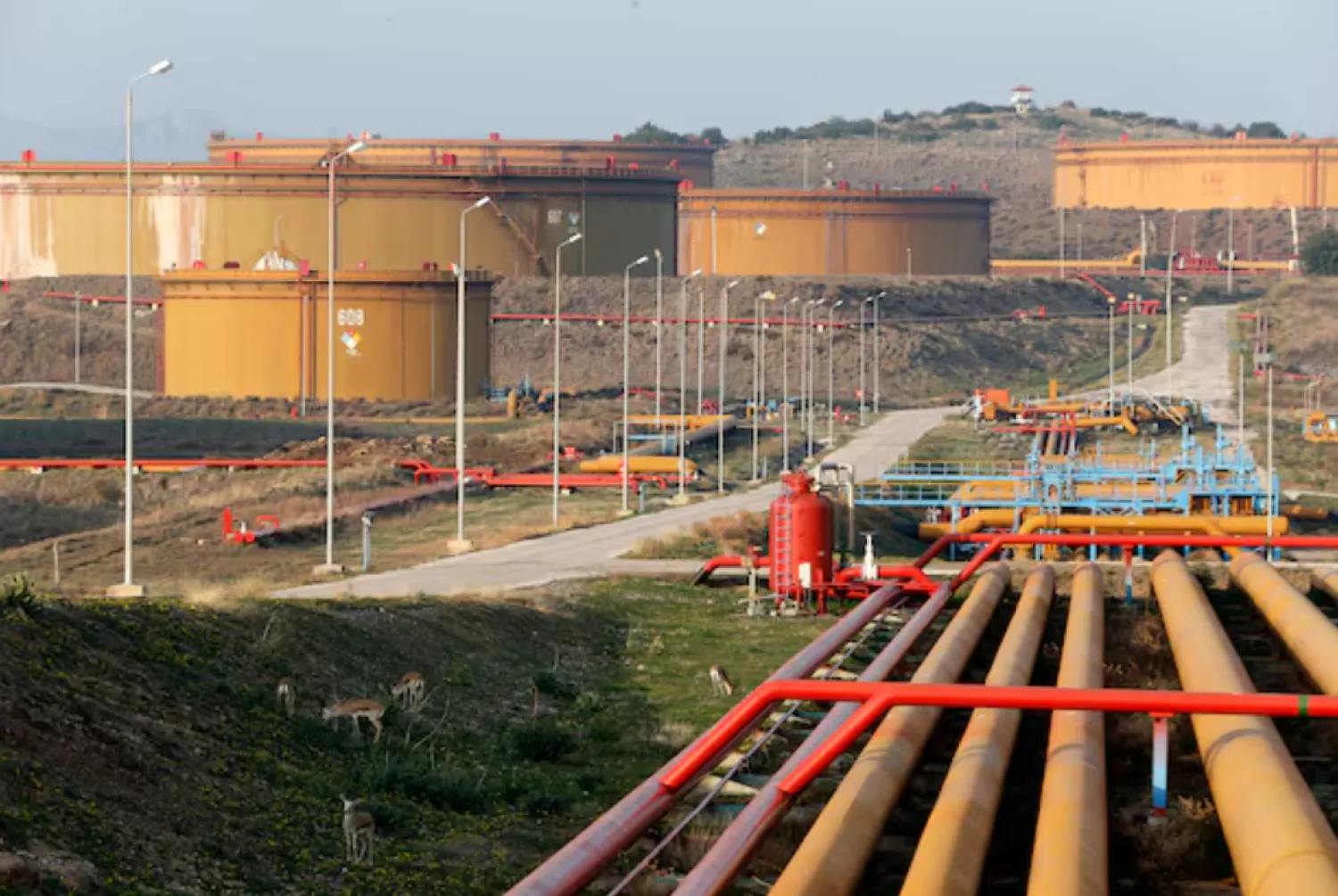
A general view of oil tanks at Turkish Mediterranean port of Ceyhan, February 19, 2014. REUTERS/Umit Bektas/File Photo
TT

Iraq's Kurdistan Oil Flows to Türkiye Running at 150,000-160,000 bpd

A general view of oil tanks at Turkish Mediterranean port of Ceyhan, February 19, 2014. REUTERS/Umit Bektas/File Photo

Oil flows from Iraq’s Kurdistan region to Türkiye's Ceyhan port are running at 150,000-160,000 barrels per day after their resumption on September 27, two industry sources told Reuters.

Iraq's oil ministry undersecretary Bassem Mohamed earlier said that the resumption of Kurdish oil flows will help raise the country's exports to nearly 3.6 million bpd in the coming days.

Iraq's production and export levels will remain within its OPEC quota of 4.2 million bpd, he said.

Iraq, the group's largest overproducer, was among states that submitted updated plans to OPEC in April to make further oil output cuts to compensate for pumping above agreed quotas.

Flows through the Kirkuk-Ceyhan pipeline were halted in March 2023 when the International Chamber of Commerce ordered Türkiye to pay Iraq $1.5 billion in damages for unauthorised exports by the Kurdish regional authorities.


World Bank Praises Saudi Arabia’s Experience in Data Governance and AI Development

General view of Riyadh, Saudi Arabia. (SPA)
TT

World Bank Praises Saudi Arabia’s Experience in Data Governance and AI Development

General view of Riyadh, Saudi Arabia. (SPA)

In its regional economic report for the Middle East and North Africa, the World Bank highlighted the Kingdom of Saudi Arabia’s experience in data governance and the development of national infrastructure supporting artificial intelligence (AI).

The report —released in October 2026 and titled "From Gap to Opportunity: AI, Jobs, and Growth"— underscored the Kingdom's progress in developing AI models and computing capabilities, as well as in technology investments, the Saudi Press Agency reported Friday.

The bank commended the Kingdom's progress—represented by the Saudi Data and AI Authority (SDAIA)—in building a national data and AI ecosystem. It regarded the Saudi experience as a benchmark for developing institutional models for data and AI governance, while highlighting the role of institutional integration and national support in accelerating capacity building in this field.

The World Bank dedicated a standalone case study to SDAIA’s experience. The study examined the authority's role in governing the national data ecosystem and accelerating the adoption of AI technologies through the National Data Management Office, the National Center for Artificial Intelligence, and the National Information Center, as well as the regulatory, developmental, and technical roles it plays in supporting the Kingdom’s digital transformation.

The World Bank highlighted the Kingdom's progress in adopting AI technologies, noting that the adoption rate among Saudi enterprises reached approximately 28% in 2024—surpassing the 20% average recorded by OECD countries in 2025—with the highest adoption rates observed in the telecommunications, information technology, finance, and insurance activities.

The report also presented findings from an International Finance Corporation (IFC) study showing a 100% AI adoption rate among companies headquartered in the Kingdom.

The report also highlighted the Kingdom's advancement in the Stanford University AI Index, recognizing it as a global leader in developing cutting-edge AI models—a field in which the Kingdom was among the region's first to innovate.

It also commended SDAIA's efforts to develop national data infrastructure—specifically through the Data Bank—and its role in fostering data integration and exchange among entities, while minimizing data duplication and fragmentation to support reliable AI applications.

Regarding governance, the report highlighted the Kingdom's progress in establishing regulatory frameworks for data governance and protection. This includes SDAIA’s role in implementing the Personal Data Protection Law and developing national controls and standards, alongside the National Data Index—which monitors government entities' compliance with data management and governance controls—and the National AI Index, which measures government entities' readiness to adopt AI technologies and tracks their progress in this field.

The World Bank highlighted the Kingdom's efforts to build AI human capacity, citing SDAIA's "SAMA" initiative. This initiative exceeded its target by training over 1.2 million people in AI skills—reflecting the Kingdom's commitment to expanding AI knowledge and making these skills accessible to broad segments of society.

The report underscored the Kingdom's experience in establishing robust national foundations for data and artificial intelligence. It noted that effective data governance is a cornerstone of digital transformation, fosters innovation, and supports safe, responsible AI applications, adding that the Saudi model offers a valuable reference for nations seeking to build their own national ecosystems in this field.



Council of Economic and Development Affairs Stresses Saudi Economy’s Resilience

A previous CEDA meeting chaired by the Saudi Crown Prince. SPA
TT

Council of Economic and Development Affairs Stresses Saudi Economy’s Resilience

A previous CEDA meeting chaired by the Saudi Crown Prince. SPA

The Saudi Council of Economic and Development Affairs (CEDA) has discussed during a virtual meeting developments in the global economy amid rapidly changing geopolitical conditions and their effects on the national economy with the Kingdom’s Purchasing Managers’ Index (PMI) rising to 53.8 in August 2026 from 53.1 in July.

CEDA discussed the Ministry of Economy and Planning’s monthly report and examined developments in the global economy, including rising inflationary pressures and tighter monetary policies adopted by major central banks, the Saudi Press Agency reported on Thursday.

It also discussed the implications for Saudi Arabia, highlighting the national economy’s resilience and ability to navigate regional and international challenges while identifying opportunities arising from the changing economic environment.

The report showed that the Kingdom’s Purchasing Managers’ Index (PMI) rose to 53.8 in August 2026 from 53.1 in July, marking the fifth consecutive month of growth.

The Business Confidence Index also increased to 56.7, up 0.2 points from the previous month, reflecting continued confidence in the outlook for the Saudi economy.

The council reviewed a separate report from its Strategic Management Office on the performance of Saudi Vision 2030 programs and national strategies during the second quarter of 2026.

The report highlighted the transformation achieved over the past decade and outlined the next phase of Vision 2030, focused on maximizing impact, consolidating gains and sustaining progress across its three pillars: a vibrant society, a thriving economy and an ambitious nation.

The council also examined the Quality of Life Program Center’s 2025 annual report, which showed that the program’s initiatives contributed 44% in local content by the end of 2025, exceeding the target of 37%.

The initiatives contributed SR78 billion ($20.8 billion) to gross domestic product, surpassing the target of SR77.1 billion ($20.6 billion).

In addition, the council reviewed the 2025 annual report of the Citizen Account Program.
The council also discussed a second-quarter report from the National Center for Performance Measurement (Adaa), covering government agencies’ performance and progress toward Vision 2030 targets.

The report outlined efforts to improve government performance through strategic reviews, performance monitoring, addressing implementation challenges and identifying opportunities for improvement.

The council also discussed a second-quarter report from the National Center for Performance Measurement (Adaa), covering government agencies’ performance and progress toward Vision 2030 targets.

The report outlined efforts to improve government performance through strategic reviews, performance monitoring, addressing implementation challenges and identifying opportunities for improvement.


US Stocks Pull Back on Oil, Iran War Worries

A trader works on the trading floor at the New York Stock Exchange (NYSE) in Manhattan, New York City, US, November 11, 2022. REUTERS/Andrew Kelly/File Photo
TT

US Stocks Pull Back on Oil, Iran War Worries

A trader works on the trading floor at the New York Stock Exchange (NYSE) in Manhattan, New York City, US, November 11, 2022. REUTERS/Andrew Kelly/File Photo

Wall Street stocks slipped early Thursday, after oil prices soared on reports that the United States could launch fresh attacks on Iran before key midterm elections.

The Dow Jones Industrial Average dipped 0.2 percent to 51,074.31, while the broad-based S&P 500 Index lost 0.3 percent to 7,776.28.

The tech-focused Nasdaq Composite Index retreated 0.5 percent to 27,405.11, AFP reported.

The gloomier start was "based on two factors that have been haunting the market: both oil prices rising sharply and also (bond) yields that are returning to yesterday's peak levels," said Peter Cardillo of Spartan Capital Securities.

He told AFP that these will be an "ongoing problem for the market in the near term."

Cardillo said that oil prices have jumped as US President Donald Trump said he did not want to deal with Iran.

"And now it looks as though there's been a shift in strategy from an economic squeeze on the Iranian economy to a new round of massive bombing," he warned.

After reports that Washington could open new attacks against Iran, international benchmark Brent North Sea crude rallied to $105.46 per barrel.

The main US contract, West Texas Intermediate rose to $92.82 per barrel before cooling slightly.

Meanwhile, the yield on the 10-year Treasury note advanced to 5.3 percent and that on the 30-year note was at 5.7 percent.