



Canadian Ambassador to Saudi Arabia: Efforts Underway to Link G7 Presidency with Vision 2030 Agenda

Canada’s Ambassador to Saudi Arabia, Oman, Bahrain, and Yemen participating in the Saudi-Canadian Innovation Day at King Abdulaziz City for Science and Technology (X).
TT

Canadian Ambassador to Saudi Arabia: Efforts Underway to Link G7 Presidency with Vision 2030 Agenda

Canada’s Ambassador to Saudi Arabia, Oman, Bahrain, and Yemen participating in the Saudi-Canadian Innovation Day at King Abdulaziz City for Science and Technology (X).

A high-level Canadian delegation, backed by the government, kicked off a three-day visit to Saudi Arabia on Monday. The visit aims at linking Canada’s G7 Presidency priorities on responsible artificial intelligence and digital governance with the Kingdom’s Vision 2030 reform plan. The goal is to move strategic talks into joint projects serving both countries.

Speaking to Asharq Al-Awsat, Jean-Philippe Linteau, Ambassador of Canada to the Kingdom of Saudi Arabia and the Republic of Yemen, and Ambassador to the Kingdom of Bahrain and the Sultanate of Oman, emphasized the significance of Saudi-Canadian ties in this regard.

He explained: “Canada and Saudi Arabia collaborate on many levels. Both countries are partners in advancing peace and stability in the region, as demonstrated through our respective contributions, for example most recently at the United Nations, including at the Two-State Solution Conference. Saudi Arabia is Canada’s largest partners in the Gulf. Our two countries are expanding trade, which now stands at 4.1 billion dollars in 2024, with growth in both directions.”

Ambassador Linteau added that cooperation is deepening into vital sectors.

“Our cooperation is evolving towards technology, research, investment, and skills. Today we are working together in areas like artificial intelligence, digital transformation, health and life sciences, advanced communications, sustainable finance, and education. These are the building blocks of Vision 2030, and they are also the strengths of Canada’s innovation ecosystem.”
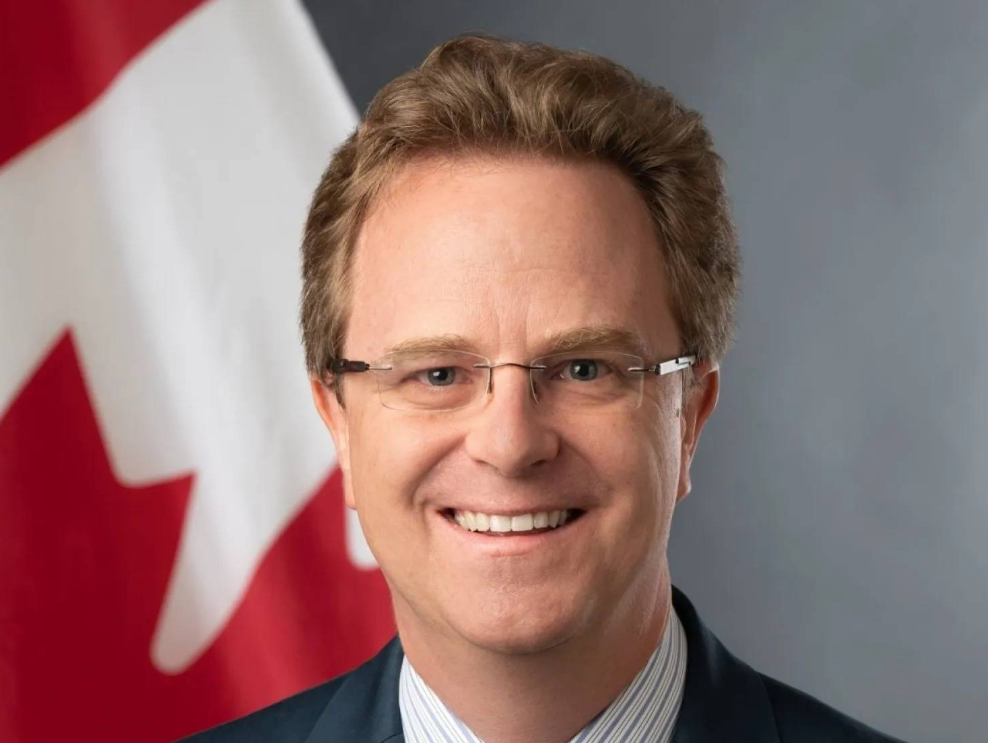
Canada’s Ambassador to Saudi Arabia, Oman, Bahrain, and Yemen (Asharq Al-Awsat)

On the objectives of the Canadian delegation’s visit to Saudi Arabia, the ambassador explained: “The purpose of this delegation is about building practical partnerships. Our Canadian companies and research institutions are here to connect with Saudi ministries, investors, and innovators. They want to explore opportunities for co-developing new technologies, to pilot solutions in areas like AI, health, and mobility, and to create long-term investment relationships.”

He continued: “This visit is also about linking Canada’s G7 Presidency priorities, responsible AI and digital governance, with Saudi Arabia’s Vision 2030 agenda. Together, we want to turn conversations into concrete projects that serve both our countries.”

This comes as part of Canada’s aspirations to strengthen a comprehensive strategic partnership with Saudi Arabia across diverse fields, especially clean technology, while exploring new opportunities in the Kingdom. Many Canadian companies are looking to establish offices in Saudi Arabia to benefit from its significant business potential, as well as opportunities across traditional and emerging sectors such as culture, tourism, and sustainable innovation.

Both countries are also witnessing increasing educational exchanges between Saudi and Canadian youth, helping pave the way for new partnerships and opportunities, while building on reforms that empower women and young people and support prosperity, economic growth, and expanded trade and investment.



Dollar Set for Weekly Gain on Stalled US-Iran Talks and Middle East Uncertainty

US dollar banknotes (Reuters)
TT

Dollar Set for Weekly Gain on Stalled US-Iran Talks and Middle East Uncertainty

US dollar banknotes (Reuters)

The dollar was on track for its first weekly gain in three weeks on Friday in broadly muted trading, as stalled peace negotiations between the US and Iran dampened hopes for an immediate easing of Middle East tensions.

While Lebanon and Israel extended their ceasefire for three weeks ahead of its expiration on Sunday, Iran showed off its control over the Strait of Hormuz by releasing footage of its commandos storming a huge cargo ship, leaving the timing of the reopening of the world's most important shipping corridor uncertain and keeping oil prices elevated.

The dollar index, which measures the greenback against a basket of currencies including the yen and the euro, slipped 0.1% to 98.75 but remained on track for a weekly gain of 0.5%. The euro was 0.1% higher at $1.169, Reuters reported.

Sterling edged 0.1% higher, with stronger-than-expected UK retail sales for March barely moving the needle.

"If you look at the last week the major theme is just that there's no real progression with peace talks. For markets, it's difficult when there's no deadline," said Tommy Von Brömsen, FX strategist at Handelsbanken in Stockholm.

Brent crude futures rose 1.5% to $106.60 a barrel.

The dollar has drawn safe-haven demand amid the uncertainty. It gained ground in March as concerns over the conflict deepened, but gave back some of those gains this month as optimism over a potential resolution grew.

"Oil and the dollar are still moving pretty closely together, and with crude creeping back up ... I'd say the dollar is still staying fairly firm," said Sho Suzuki, a market analyst at Matsui Securities.

Meanwhile, the yen was steady after four days of losses, rising 0.1% to 159.7 per dollar.

CENBANK BONANZA LOOMS

Traders are looking ahead to a central-bank-heavy week next week, with the Bank of Japan, European Central Bank, Bank of England and Federal Reserve among those due to deliver policy decisions.

"The main message from the central banks is that they are - so far at least - in a kind of 'wait-and-see' approach," said Handelsbanken's Von Bromsen.

He said the focus will be on communication and guidance, as market watchers assess how policymakers are digesting not just higher energy prices but the second-round effects of potentially higher inflation.

The European Central Bank will hold its deposit rate on April 30 but hike it in June, according to just over half of economists polled by Reuters, in a bid to protect a war-induced energy shock from knocking the euro zone economy off balance.

Meanwhile in Japan core consumer inflation slowed below the central bank's 2% target for a second straight month in March. Analysts, though, expect inflation to accelerate back above the Bank of Japan's target in coming months, as companies begin to pass on higher fuel costs from the Middle East conflict.

The BOJ is set to hold its two-day policy meeting ending on Tuesday. Reuters reported the bank is likely to hold off raising interest rates next week as fading prospects of a near-term end to the Middle East war keep the country's economic and price outlook highly uncertain. The BOJ is still expected to signal its readiness to hike to counter mounting price pressures.

Japanese Finance Minister Satsuki Katayama reiterated her verbal warning on intervention on Friday that authorities can take "decisive" action against speculative moves in the foreign exchange market, a day after saying Japan has a "free hand" to intervene and that past interventions had been effective.

The Australian dollar rose 0.1% versus the greenback to $0.7135. New Zealand's kiwi rose 0.1% to $0.5859.

In cryptocurrencies, bitcoin was little changed at $77,895.85.


Gold on Track for First Weekly Decline in Five as Iran War Drags On

One of two gold bracelets is displayed during a media presentation at the National History Museum of Romania in Bucharest, Romania, 21 April 2026.EPA/ROBERT GHEMENT
TT

Gold on Track for First Weekly Decline in Five as Iran War Drags On

One of two gold bracelets is displayed during a media presentation at the National History Museum of Romania in Bucharest, Romania, 21 April 2026.EPA/ROBERT GHEMENT

Gold prices fell on Friday and were on course for their first weekly decline after a four-week winning streak, as a US-Iran deadlock kept oil prices elevated and inflation concerns in focus.

Spot gold was down 0.2% at $4,683.23 per ounce at 0938 GMT, having hit its lowest point since April 13. It is down almost 3% so far this week. US gold futures for June delivery fell 0.5% to $4,699.

"Oil is going to be a pinch point in the Strait of Hormuz. It's going to remain elevated. And for sure, the decline in gold has mirrored the rally in oil," said independent analyst Ross Norman.

"The reality is gold is struggling to get upside momentum. When you can't breach the upside, you tend to attack the downside, and I think that's probably where we're at right now," Norman added.

Brent crude prices have risen about 18% so far this week and held above $105 a barrel, on concerns of a renewed military escalation in the Middle East and a lack of progress in re-opening the key waterway.

Higher crude oil prices can stoke inflation, increasing the likelihood that interest rates stay higher for longer.

While gold is often seen as an inflation hedge, elevated rates make yield-bearing assets more attractive, weighing on demand for non-yielding bullion, according to Reuters.

US President Donald Trump said he was in no rush to reach a peace agreement with Iran and wanted it to be "everlasting," while continuing to assert that the US had a clear upper hand in the naval stand-off in the strait.

Meanwhile, the dollar was on track for its first weekly gain in three weeks, while the benchmark 10-year US Treasury yields gained 2% this week.

On the physical demand side, gold premiums in India climbed to their highest in over two-and-a-half months this week, as supplies tightened, while buying interest picked up in China.

Spot silver fell 0.7% to $74.88 per ounce, platinum lost 1.4% to $1,978.84 and palladium gained 0.4% at $1,475.35.


Hapag-Lloyd Says One Ship Has Crossed Strait of Hormuz

Hapag-Lloyd employees monitor the status of cargo ships in the Strait of Hormuz on a screen, in Hamburg, Germany, Wednesday, April 15, 2026. (AP Photo/Ebrahim Noroozi)
TT

Hapag-Lloyd Says One Ship Has Crossed Strait of Hormuz

Hapag-Lloyd employees monitor the status of cargo ships in the Strait of Hormuz on a screen, in Hamburg, Germany, Wednesday, April 15, 2026. (AP Photo/Ebrahim Noroozi)

Container shipping group Hapag-Lloyd said on Friday that one of its ships has crossed the Strait of Hormuz but did not have any information on the circumstances or timing.

Four out of initially six ships remain in the Gulf, after one ship's charter agreement expired, meaning it no longer belongs to the Hapag-Lloyd fleet, a spokesperson added.

The four ⁠Hapag ships remaining ⁠in the Gulf are staffed with 100 crew, who are well-supplied with food and water, Reuters quoted him as saying.

Scores of tankers and other vessels remain stuck in the Gulf as the United States is ⁠struggling to keep control of the Strait of Hormuz, one of the world's busiest shipping corridors.

The Iran war, launched by the US and Israel on February 28, has been paused since a ceasefire on April 8.

The US and Iran met in Pakistan in an attempt to end hostilities, but talks ended without agreement and ⁠a ⁠second round has yet to take place.

Tehran says it will not consider opening the strait until the US lifts its blockade of Iran's shipping, which Washington imposed during the ceasefire and Tehran calls a violation of that truce.

This week, Iran flaunted its grip over the strait with a video of commandos in a speedboat storming a huge cargo ship.