


World Food Prices Dip as Falls in Sugar and Dairy Offset New High for Meat 

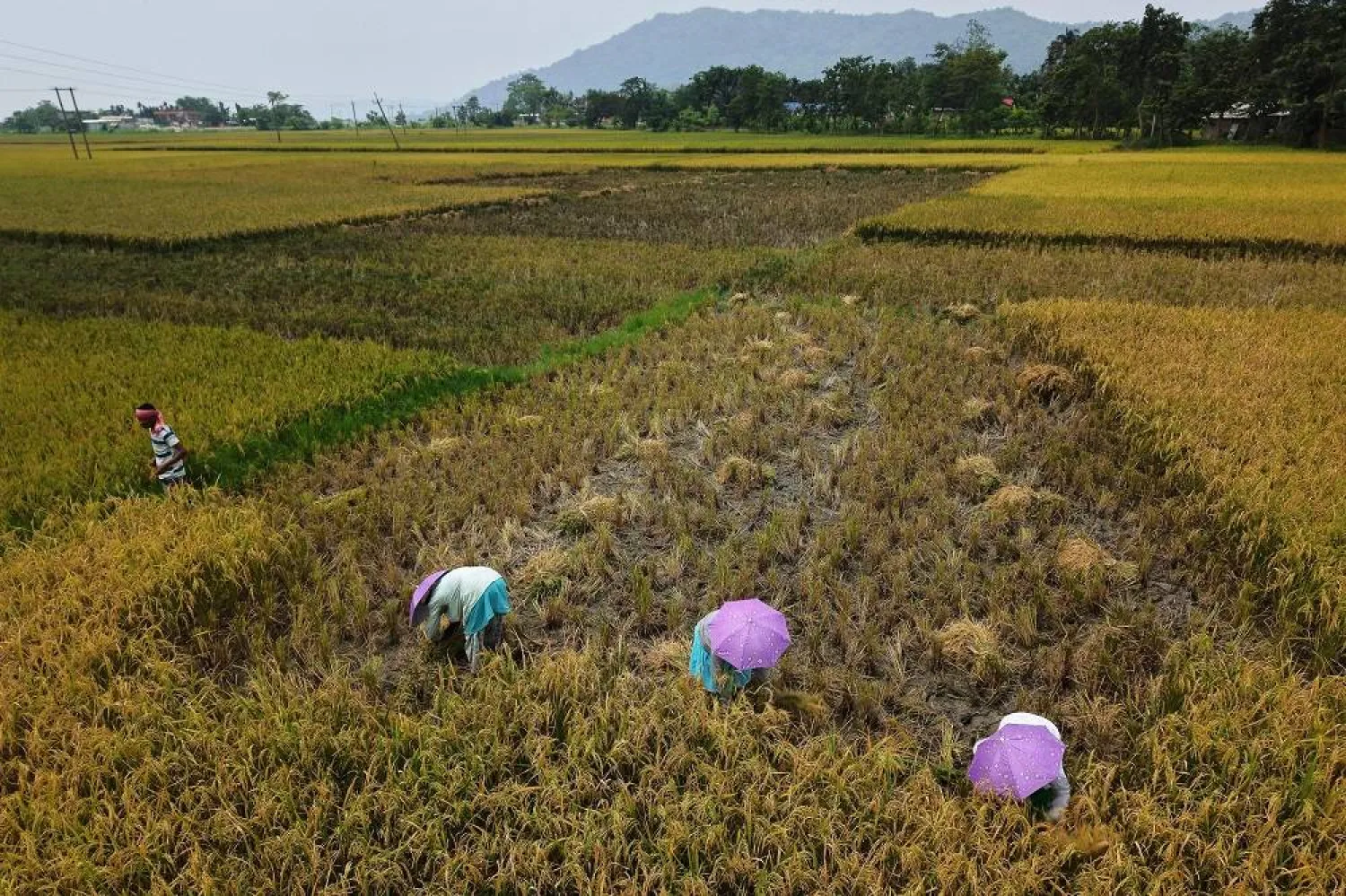
 Farmers harvest rice crop in a paddy field on the outskirts of Guwahati, India, May 24, 2025. (AP)
Farmers harvest rice crop in a paddy field on the outskirts of Guwahati, India, May 24, 2025. (AP)
TT

World Food Prices Dip as Falls in Sugar and Dairy Offset New High for Meat 

 Farmers harvest rice crop in a paddy field on the outskirts of Guwahati, India, May 24, 2025. (AP)
Farmers harvest rice crop in a paddy field on the outskirts of Guwahati, India, May 24, 2025. (AP)

Global food commodity prices dipped in September as declines in sugar and dairy offset a new peak for meat prices, the United Nations' Food and Agriculture Organization said on Friday.

The FAO Food Price Index, which tracks a basket of internationally traded food commodities, averaged 128.8 points in September, down from a revised 129.7 in August.

The index was up 3.4% on the same month last year, though nearly 20% down from a record level in March 2022 following Russia's full-scale invasion of Ukraine.

LOWEST SUGAR PRICES SINCE MARCH 2021

The indicator, which had climbed to a two-year peak in July before stabilizing in August, was curbed last month by a 4.1% drop for FAO's sugar price index, which reached its lowest since March 2021.

The fall for sugar reflected an improving supply outlook, with higher than expected production in Brazil and favorable harvest prospects in India and Thailand, FAO said.

The agency's dairy price index slipped 2.6% month on month, driven in turn by a sharp decline in butter prices amid increased production prospects in Oceania.

FAO's cereal benchmark saw a 0.6% decline from August, with wheat prices dropping for a third straight month due to large harvests and subdued international demand.

Maize prices also decreased, partly pressured by a temporary suspension of export taxes in Argentina.

The agency's rice index also showed a monthly fall as reduced orders by buyers in the Philippines and Africa weighed.

US BEEF MARKET DRIVES RECORD MEAT PRICES

Vegetable oil prices fell by 0.7% as lower palm and soybean oil quotations offset increases for sunflower and rapeseed oil.

In contrast, FAO's meat price indicator rose by 0.7% to a new record high as beef and sheep meat quotations rose.

Beef prices also reached a new peak, supported by strong demand in the US amid limited domestic supply.

In a separate report, the FAO increased its forecast for global cereal production in 2025 to 2.971 billion metric tons from 2.961 billion tons projected last month.

The latest outlook was up 3.8% from 2024 output, marking the largest annual increase since 2013, it said.

The upward revision was attributed to higher production prospects for wheat, maize and rice.


Asian Airlines Trim Schedules and Carry Extra Fuel as Supplies Tighten

AirAsia planes stand on the tarmac at Kuala Lumpur International Airport Terminal 2 (KLIA2) in Sepang, Malaysia, January 21, 2026. (Reuters)
TT

Asian Airlines Trim Schedules and Carry Extra Fuel as Supplies Tighten

AirAsia planes stand on the tarmac at Kuala Lumpur International Airport Terminal 2 (KLIA2) in Sepang, Malaysia, January 21, 2026. (Reuters)

Airlines across Asia are cutting flights, carrying extra fuel from home airports and adding refueling stops as the Middle East conflict squeezes jet fuel supply in some countries, adding to pressure on an industry already hit by a sharp jump in fuel costs.

European carriers are bracing for similar disruption after Iran's closure of the Strait of Hormuz cut off nearly 21% of global seaborne jet fuel supply, according to Kpler.

Previous oil shocks mainly drove up prices, but this one is also constraining physical supply, forcing governments, airlines and airports to consider rationing.

"In my conversation with airlines, they are very concerned about what the future looks like, because we do not know when the war will end and we don't know when the supply chain, the feedstock, will come from the Gulf area," said Shukor Yusof, founder of aviation consultancy Endau Analytics.

Asia, Europe and Africa are most exposed, analysts say, because the US has ample domestic supplies.

Within Asia, the pain has so far been sharpest in lower-income, import-dependent markets such as Vietnam, Myanmar and Pakistan after China and Thailand halted jet fuel exports and South ‌Korea capped them at ‌last year’s levels.

Budget airline AirAsia X is now loading extra fuel in Malaysia before flying to Vietnamese ‌airports, ⁠CEO Bo Lingam told ⁠reporters on Monday.

"Not to say that they are not giving us fuel, but they limit the amount of fuel," he said of Vietnam.

JET FUEL RATIONING

Past temporary jet fuel shortages at airports due to shipment disruptions or contamination have usually led to rationing rather than complete outages.

Airlines have typically responded by loading extra fuel at home airports, adding refueling stops on longer routes or carrying less cargo.

For a more prolonged crisis, another solution is cutting flights, Ryanair CEO Michael O'Leary said last week when he expressed concerns the Middle Eastern conflict may not end this month.

"If there's a risk to 10% or 20% of the fuel supply in June or July or August, then we and other airlines will have to start looking at cancelling some flights or taking some capacity out," he told reporters.

Asia, which has a ⁠thinner supply cushion than Europe and is more dependent on Hormuz flows, has been hit more quickly.

Vietnam Airlines ‌has cut 23 domestic flights per week to conserve fuel, according to the country's aviation authority.

Airlines based ‌in Myanmar suspended domestic flights for part of March due to jet fuel shortages, its transport ministry said, and some of its carriers have also cut capacity in ‌April, according to aviation data provider Cirium.

Air India is making refueling stops in Kolkata on its return from Yangon to Delhi due to fuel ‌shortages at Yangon airport, according to a source familiar with the matter.

In the South Pacific, Tahiti International Airport has restricted refueling for international flights to quantities essential for flight operations due to the Middle Eastern crisis, a notice to pilots shows.

In Pakistan, pilots are being advised to carry maximum fuel from abroad.

That practice, known as "tankering", is costly because carrying extra fuel increases fuel burn.

"Some countries are in better shape than others," said Brendan Sobie, a Singapore-based independent aviation analyst. "Some may be limiting (fuel for) foreign airlines, which ‌then leads to the tankering. This could be proactive as some countries fear they could run out."

DEMAND DESTRUCTION

A more than doubling of jet fuel prices since the start of the Iran war has pushed some airlines ⁠to cut capacity, while others have hiked ⁠fares and imposed fuel surcharges.

In one of the starkest examples, Batik Air Malaysia has slashed domestic capacity by 36%, with CEO Chandran Rama Muthy describing the cuts as a necessary and proactive response to a "crisis-mode" environment.

"If we were to continue operating without making adjustments, it could further expose the company to operational and financial risk," he said.

Gulf carriers such as Emirates and Qatar Airways have been operating well below normal capacity due to the conflict, while other global airlines have also cut flights as fare increases needed to cover fuel costs deter price-sensitive travellers.

Even with flight cuts, airline demand is not falling fast enough to match the drop in jet fuel supply, analysts said.

At least 400,000 barrels per day of jet fuel that normally is produced in the Asia-Pacific region via crude that transits the Strait of Hormuz have been affected since the crisis started, according to Reuters' calculations.

"There is no easy way to replace the lost volumes, especially as Asian supply will start to tighten as refiners cut runs," said Alex Yap, senior oil products analyst at Energy Aspects.

Industry sources estimate flight cancellations have lowered April demand in Asia specifically by only about 50,000 to 100,000 barrels per day, suggesting deeper cuts may be needed.

"We're only just at the start of that cycle (of flight cuts) as demand from passengers seems to be resilient, but I think any oil-spike induced economic slowdown could hit demand in the second half of the year," said Cirium's Asia editor, Ellis Taylor.


China’s Xi Urges Faster Development of New Energy System as Middle East War Continues

Chinese President Xi Jinping. (AFP file)
TT

China’s Xi Urges Faster Development of New Energy System as Middle East War Continues

Chinese President Xi Jinping. (AFP file)

Chinese President Xi Jinping has called for accelerated planning and construction of a new energy system to safeguard the country's energy security, weeks into the Iran war that has triggered global energy shocks.

The leader of the world's second-largest economy also emphasized hydropower development and ecological protection, while urging the safe and orderly expansion of nuclear power, according to state broadcaster CCTV on Monday.

"The Party Central Committee has gained a profound ‌grasp of global energy ‌development trends and made major decisions by advancing the ‌new ⁠energy security strategy ⁠in depth," he said, referring to the ruling Communist Party's center of authority.

Xi did not directly mention the war in his remarks cited by CCTV. The United States and Iran have been weighing a Pakistani-brokered plan that could end their five-week-old conflict, even as Tehran pushed back against pressure to swiftly reopen the Strait of Hormuz.

Analysts have pointed out that ⁠China is relatively better-positioned to absorb the higher oil prices. ‌Coal accounts for more than half of ‌its energy mix, while it has ample oil stockpiles and imports via the Strait ‌of Hormuz represent only around 5% of total energy consumption.

"The path we ‌took in being the first to develop wind and solar power has now proven to be forward-looking. At the same time, coal-fired power remains the foundation of our energy system and must continue to play its supporting role," Xi said.

China operates ‌more than half of the world's coal-fired power capacity, making it the top carbon emitter, which Western-led climate initiatives ⁠have long contended ⁠with. The country continues to position coal power as a reliability backbone and flexible backup system, even as it accelerates renewables.

Although he underscored the role of coal in China's energy mix, the president said the country—the world's largest consumer of coal—must stay committed to clean, low-carbon development.

"A greener, more diversified and resilient new energy system will provide a strong guarantee for China's energy security and economic development," CCTV said. Last July, China began construction of what will be the world's largest hydropower dam on the eastern rim of the Tibetan Plateau.

Construction on a solar thermal power plant by China General Nuclear Power Group at an altitude of 4,550 meters in Tibet has also begun on Monday, according to state Xinhua News Agency.


Gold Ticks Down as Trump's Iran Deadline Keeps Markets Cautious

A vendor displays gold bracelets at a shop in the Grand Bazaar in Istanbul (AFP)
TT

Gold Ticks Down as Trump's Iran Deadline Keeps Markets Cautious

A vendor displays gold bracelets at a shop in the Grand Bazaar in Istanbul (AFP)

Gold ticked down on Tuesday as investors stayed cautious ahead of a deadline set by US President Donald Trump for Iran to reopen the Strait of Hormuz.

Spot gold edged 0.2% lower to $4,638.30 per ounce by 0539 GMT, while US gold futures for June delivery fell 0.4% to $4,664, said Reuters.

"Everyone is in a mode where we're ‌waiting for ‌whatever the outcome is of this diatribe that ‌the ⁠president has been ⁠on for the past several days," said Ilya Spivak, head of global macro at Tastylive, a financial derivatives trading platform.

Iran and Israel traded attacks as Tehran defiantly refused to reopen the Strait of Hormuz and accept a ceasefire deal on the eve of Trump's deadline to agree to his demands ⁠or get "taken out."

Oil prices extended gains, holding ‌above $110 a barrel as Trump raised ‌his rhetoric against Iran.

The surge in oil prices has fueled inflation ‌concerns. While gold typically benefits during periods of inflationary pressure, higher ‌interest rates reduce its appeal as a non-yielding asset.

Cleveland Federal Reserve President Beth Hammack and Chicago Fed President Austan Goolsbee both see inflation as a far bigger problem than employment, underscoring their support ‌for maintaining tighter monetary policy.

Markets widely see no chance of a Fed rate cut this ⁠year, according to ⁠CME's FedWatch tool.

Investors now await minutes of the Fed's March policy meeting on Wednesday, as well as US inflation indicators, including the Personal Consumption Expenditures (PCE) and Consumer Price Index (CPI) data later this week.

"Last year, gold went off on its own and became its own speculative narrative. We're likely to see that re-emerge this year after whatever sort of risk washes off here... ultimately by the end of the year, we could end up closer to $5,500 and $6,000," Spivak said.

Spot silver fell 0.8% to $72.19 per ounce, platinum shed 1% to $1,959.82 and palladium slid 0.6% to $1,475.93.
