


Fall in China’s Exports of Rare Earth Magnets Stokes Supply Chain Fears 

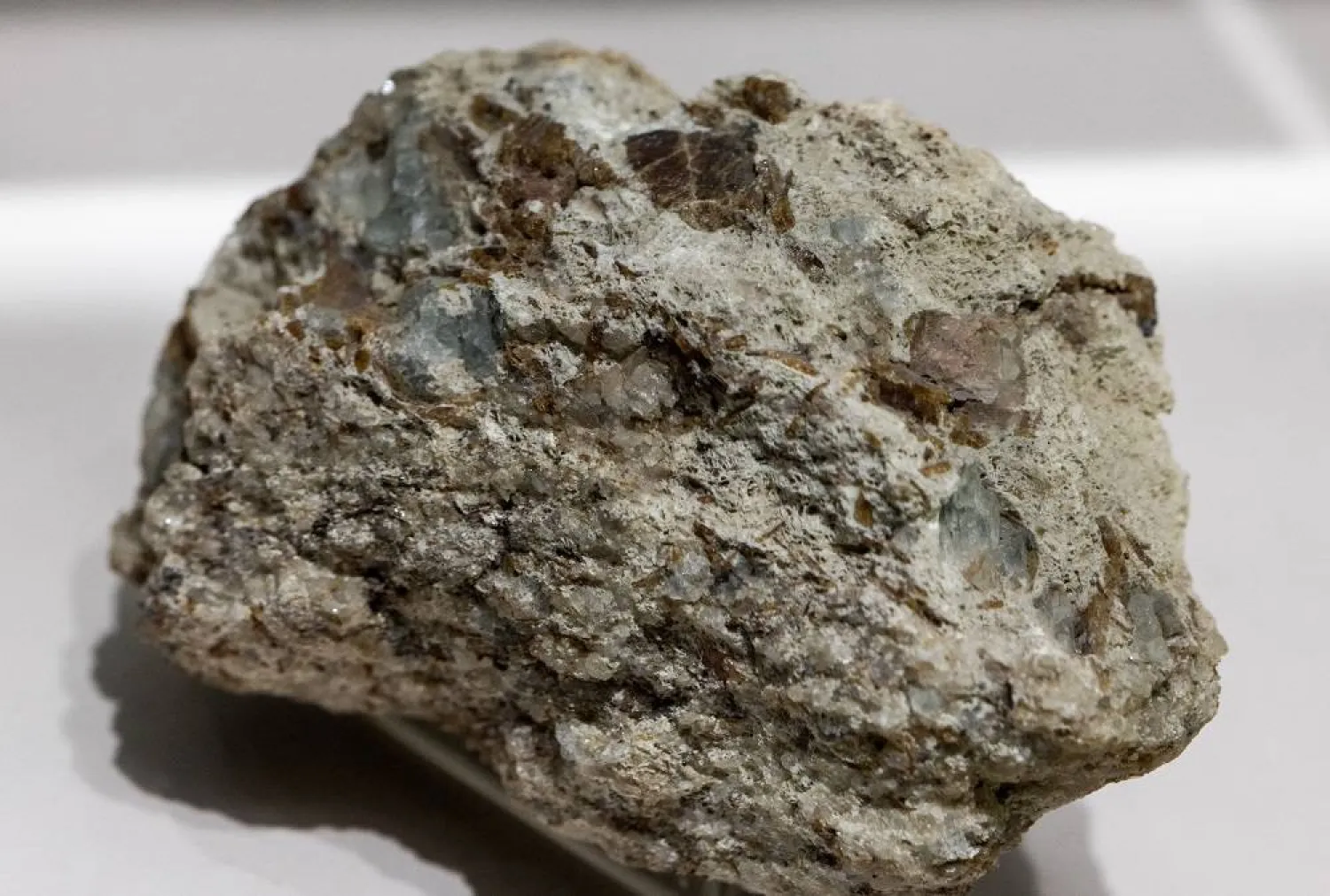
A sample of bastnaesite ore, a mineral used in the rare earth industry to extract elements such as cerium, lanthanum, and neodymium, is displayed at the Geological Museum of China in Beijing, China, October 14, 2025. (Reuters)
TT

Fall in China’s Exports of Rare Earth Magnets Stokes Supply Chain Fears 

A sample of bastnaesite ore, a mineral used in the rare earth industry to extract elements such as cerium, lanthanum, and neodymium, is displayed at the Geological Museum of China in Beijing, China, October 14, 2025. (Reuters)

China's exports of rare earth magnets fell in September, reigniting fears that the world's top supplier could wield its dominance over a component key for US defense firms and makers of items from cars to smartphones as leverage in trade talks.

In April and May, Beijing squeezed global automakers with export curbs on a range of rare earths items and related magnets, while negotiators faced off over triple-digit US tariffs on goods from the world's second-largest economy.

Four months on, after Washington and Beijing unexpectedly reprised threats of fresh tariffs and rare earth export curbs, worry is growing that China could return to the same playbook.

That would mean it reneges on a June deal with the United States to ease the flow of critical minerals.

China's shipments of rare earth magnets fell 6.1% in September from August, customs data showed on Monday, ending three months of gains, and dropping even before Beijing unveiled a dramatic expansion of its export licensing regime this month.

"The sharp swings in rare earth magnet exports show that China knows it holds a key card in international trade talks," said Chim Lee, senior analyst at the Economist Intelligence Unit.

EXPORTS FALL FROM AUGUST'S SEVEN-MONTH HIGH

The September fall to 5,774 tons from a seven-month high of 6,146 tons in August aligns with reports that China is already making it harder for firms to secure licenses for exports of rare earth magnets.

Its commerce ministry is applying scrutiny similar to that seen in April, at the height of the trade war.

On an annual basis, September shipments rose 17.5%.

Last week, China's commerce ministry accused the United States of stoking global panic over its rare earth controls by deliberately misunderstanding the curbs, and said it would approve export licenses intended for civilian use.

Still, analysts worry China could once again entangle civilian commercial users in curbs aimed at choking US defense firms' access to critical materials.

"China's ability to throttle rare earth exports is an exceptionally powerful tool," said Dan Wang, China director at Eurasia Group.

Apart from disrupting production, such measures would fuel insecurity over access to critical industrial inputs and growing reliance on China, she added.

"The world has to adjust to its management style," she said, adding that Western countries are not used to complying with a monopolistic control of critical resources from countries on "the other side".

By country, Germany, South Korea, Vietnam, the United States and Mexico were the top five export destinations for Chinese rare earth magnets by volume last month.

Over the nine months of the year, exports of such magnets totaled 39,817 tons, a fall of 7.5% from the corresponding 2024 period.

NO SIGN OF BEIJING BACKING DOWN

Shipments to the United States fell 28.7% in September on the month, the data showed, while exports to Vietnam rose 57.5% over the same period.

The Netherlands processed 109% more rare earth magnets than in August, though the figure is skewed by the huge Rotterdam port, a major transit hub for Europe-bound trade.

Just before the release of the data, President Donald Trump told reporters aboard Air Force One that he did not want China to "play the rare earth game with us".

He suggested he might hold off on raising tariffs back to levels in excess of 100% if the world's top agricultural buyer committed to purchasing US soybeans.

But Beijing shows no sign of backing down, adamant that its new wider curbs, set to take effect just days before the November 10 expiry of the latest 90-day tariff truce with the United States, are consistent with measures in other major economies.

President Xi Jinping is set to meet Trump in South Korea later this month, but economists warn that trade friction between the two biggest economies may be the new normal.

"The surge in exports during the third quarter came after it (China) eased export controls earlier in the year, but that's likely to drop again following the tighter restrictions introduced recently," added EIU analyst Chim Lee.



Mawani, Arabian Chemical Terminals Sign Land Lease for Jubail Port Storage Tanks

Mawani, Arabian Chemical Terminals Sign Land Lease for Jubail Port Storage Tanks
TT

Mawani, Arabian Chemical Terminals Sign Land Lease for Jubail Port Storage Tanks

Mawani, Arabian Chemical Terminals Sign Land Lease for Jubail Port Storage Tanks

The Saudi Ports Authority (Mawani) signed a contract with Arabian Chemical Terminals Ltd. to establish storage tanks for chemical and petrochemical materials at Jubail Commercial Port, with an investment exceeding SAR500 million on an area of 49,000 square meters.

The project will contribute to enhancing operational efficiency and increasing handling capacity in line with the objectives of the National Transport and Logistics Strategy to consolidate the Kingdom’s position as a global logistics hub, SPA reported.

This step is part of Mawani’s efforts to strengthen the role of the private sector in supporting the gross domestic product and to reinforce the position of Jubail Commercial Port as a driver of commercial activity. The project’s storage capacity will reach 70,000 cubic tons, boosting the competitiveness of the Kingdom’s ports at both regional and international levels.

The project aims to develop and expand storage capacity and the export of chemical and petrochemical materials in accordance with the highest international standards while supporting supply chains. It includes the establishment and development of specialized facilities for storing and exporting chemical and petrochemical products, as well as the provision of storage and distribution services for local and international import and export of chemicals in line with global quality and safety standards.

The project will contribute to supporting national supply chains, boosting the Kingdom’s chemical logistics capabilities, and raising operational efficiency and capacity, thereby improving customer competitiveness. It also supports the achievement of Saudi Vision 2030 objectives by promoting the development of infrastructure to advance the energy, industry, and supply chain sectors in the Kingdom.


Oil Prices Stable as Investors Seek Clarity on Russia-Ukraine Talks

A view shows the crude oil terminal Kozmino on the shore of Nakhodka Bay near the port city of Nakhodka, Russia August 12, 2022. REUTERS/Tatiana Meel
TT

Oil Prices Stable as Investors Seek Clarity on Russia-Ukraine Talks

A view shows the crude oil terminal Kozmino on the shore of Nakhodka Bay near the port city of Nakhodka, Russia August 12, 2022. REUTERS/Tatiana Meel

Oil prices were little changed on Tuesday as investors took stock of ​dented hopes of a Russia-Ukraine peace deal and rising geopolitical tensions in the Middle East around Yemen, Reuters reported.

Brent crude futures for February delivery, which expire on Tuesday, were up 15 cents at $62.09 a barrel as of 0918 GMT. The more active March contract was at $61.61, up 12 cents.

US West Texas Intermediate ‌crude gained 14 ‌cents to $58.22.

The Brent and ‌WTI ⁠benchmarks ​settled ‌more than 2% higher in the previous session as Saudi Arabia launched airstrikes against Yemen and after Moscow accused Kyiv of targeting Putin's residence, denting hopes of a peace deal.

Kyiv dismissed Moscow's accusation as baseless and designed to undermine peace negotiations. After a phone call ⁠with Putin, US President Donald Trump said he was angered by details ‌of the alleged attack.

"I think the ‍markets are sensing that ‍a deal is going to be very hard ‍to come by," said Marex analyst Ed Meir.

Traders also watched other Middle East developments after Trump said the United States could support another major strike on Iran were Tehran to resume rebuilding its ballistic missile or nuclear weapons programs.

Despite renewed fears of potential supply disruptions, perceptions of an oversupplied global market remain and could cap prices, analysts say.

Marex's Meir said prices would trend downwards in the first quarter of 2026 due to ‌a "growing oil glut".


Meta Buys China-founded AI Agent Manus

FILE PHOTO: The logo of Meta is seen at Porte de Versailles exhibition center in Paris, France, June 11, 2025. REUTERS/Gonzalo Fuentes/File Photo/File Photo
TT

Meta Buys China-founded AI Agent Manus

FILE PHOTO: The logo of Meta is seen at Porte de Versailles exhibition center in Paris, France, June 11, 2025. REUTERS/Gonzalo Fuentes/File Photo/File Photo

Facebook owner Meta has agreed to acquire Manus, an artificial intelligence agent created by a company founded in China but now based in Singapore, the two firms said.

However, analysts warned the deal could fall foul of regulators at a time of fierce technological rivalry between Washington and Beijing.

Exceeding the capabilities of AI chatbots like ChatGPT, AI agents can autonomously perform complex tasks for users, and are seen as having huge potential.

Manus, created by startup Butterfly Effect, can for example sift through and summarize resumes or create a stock analysis website, according to its website.

Meta said Monday that the deal -- the financial details of which were not disclosed -- will "bring a leading agent to billions of people and unlock opportunities for businesses across our products".

"The era of AI that doesn't just talk, but acts, creates, and delivers, is only beginning," Manus chief executive Xiao Hong said on X.

"And now (with Meta), we get to build it at a scale we never could have imagined."

Meta CEO Mark Zuckerberg is making a huge push into AI, spending billions of dollars on acquisitions, hiring engineers and building data centers.

Bloomberg Intelligence analysts said the purchase is likely aimed at expanding Meta's AI agent task capabilities, and that it could be worth more than $2 billion.

However, "it could draw regulatory scrutiny given that Singapore-based Manus was founded in China", the analysts said.