

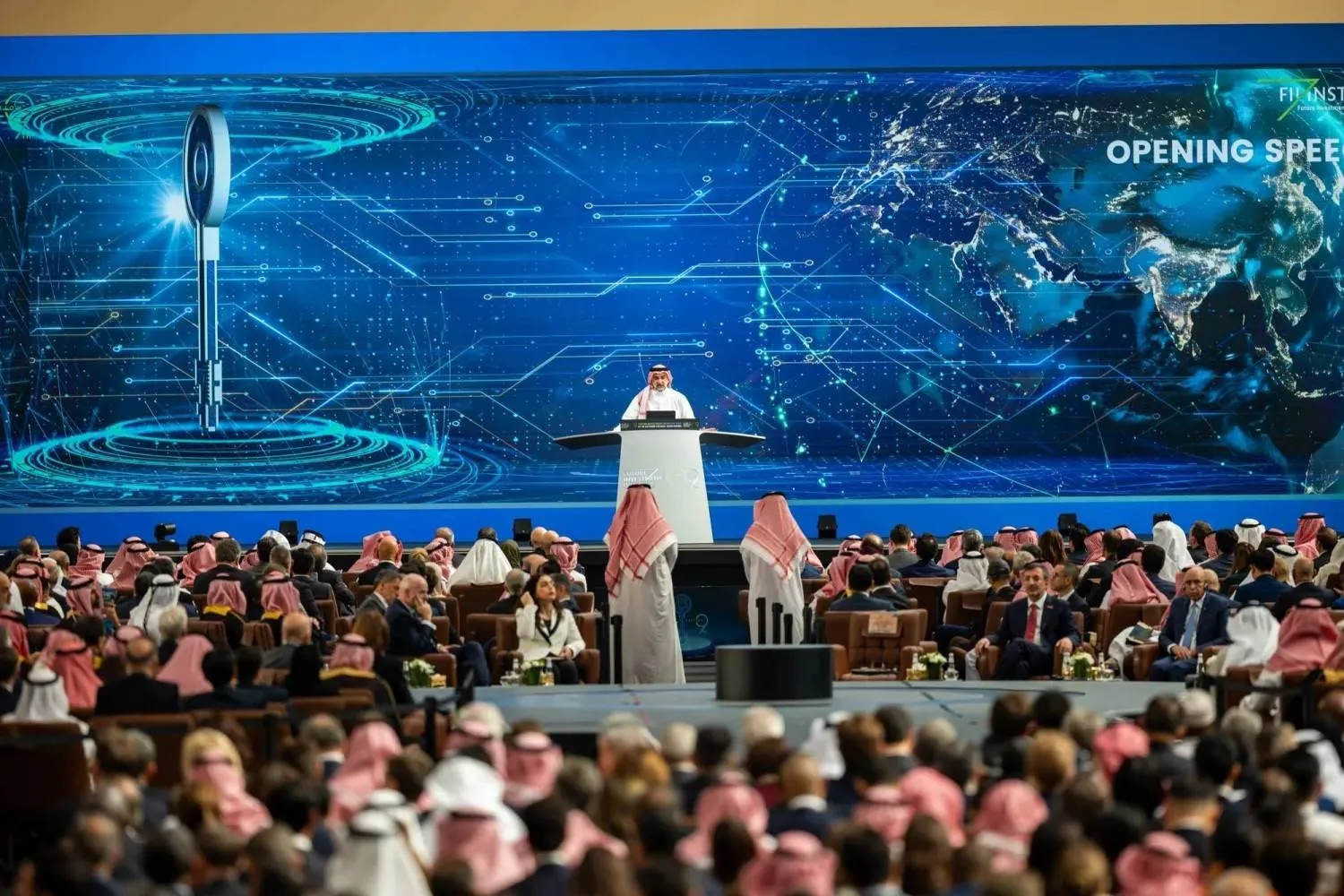

As FII Ends, Riyadh Emerges as Global Lab Steering the Economy

Public Investment Fund (PIF) Governor Yasir Al-Rumayyan speaks during his opening address at the conference (Asharq Al-Awsat)
TT

As FII Ends, Riyadh Emerges as Global Lab Steering the Economy

Public Investment Fund (PIF) Governor Yasir Al-Rumayyan speaks during his opening address at the conference (Asharq Al-Awsat)

The 2025 Future Investment Initiative (FII) wrapped up in Riyadh with a global consensus taking shape: Saudi Arabia has moved beyond the role of host to become a driving force redefining the very concept of economic summits.

Over three intensive days, the Saudi capital did more than welcome thousands of leaders, investors and decision-makers, it transformed into a global command center for finance, gathering some of the world’s most influential investment minds under one roof.

The event’s atmosphere became a living model of how global wealth flows and takes shape, a scene usually reserved for capitals that set and steer the world’s economic future.

With more than 9,000 international participants attending this ninth edition, the scale of engagement underscored the conference’s unprecedented strength. The halls transcended their role as venues for official sessions, evolving into a live “laboratory” for reshaping and liberating the global economy.

The power of side discussions

The true value of FII extended beyond its main stages to the sidelines, where candid, high-level exchanges proved equally vital. In moments of frank, in-depth dialogue, barriers of competition among industry giants dissolved.

Within this rare “knowledge fusion,” months of research and market analysis were distilled into direct exchanges between major investors and financial leaders.

These visionary conversations covered crucial themes from market performance, interest rate forecasts and inflation, to the Federal Reserve’s independence and its impact on Wall Street, as well as the implications of complex tariff policies.

More significantly, there was a strong focus on artificial intelligence and how it is redefining investment decisions, offering asset managers a “true mirror” to assess their strategies amid a collective outlook shaped by global leaders.

This is the inherent strength of FII: its ability to turn individual perspectives into strategic consensus, where every opinion voiced carries real influence over massive portfolios and contributes to shaping regional and global capital flows.

Saudi Arabia as an investment benchmark

The gathering succeeded in rising above geopolitical and economic complexities, positioning itself as a compass directing global capital toward the most ambitious and profitable opportunities.

Its success was most evident in its ability to translate promises into immediate deals and strategic partnerships, by creating an ideal environment for swift and effective investment decisions.

This momentum was reflected in the overwhelming demand for investment in Saudi Arabia, a sentiment shared by global financial heavyweights.

Public Investment Fund (PIF) Governor Yasir Al-Rumayyan described this success as “a global benchmark for a national vision” that has opened doors to opportunities spanning generations.

He summed up the transformation in a powerful phrase: “Saudi Arabia no longer presents itself to the world - the world now comes to it,” citing the Kingdom’s hosting of major global events such as the Future Investment Initiative, Expo 2030, and the 2034 FIFA World Cup.

Investing in technological sovereignty

Artificial intelligence dominated this year’s FII agenda, underscoring that Saudi Arabia is not only positioning itself as a financial hub but also as a global power in technology and innovation.

Discussions moved beyond potential to action, with the announcement of major investment commitments aimed at achieving technological sovereignty.

One highlight was the unveiling of a strategic plan to deploy up to 400,000 AI chips in Saudi Arabia by 2030, an investment designed to build the computing capacity needed to fuel the Kingdom’s AI revolution.

A landmark partnership was announced between Humain, a PIF portfolio company, and Qualcomm Technologies of the United States, to establish an advanced AI infrastructure in the Kingdom.

In a move signaling the sector’s strategic weight, Saudi Aramco and the Public Investment Fund agreed on acquiring a significant stake in Humain, with Aramco reaffirming AI’s critical role in its future operations.

This deep focus reflects a shared conviction among Saudi leaders that AI infrastructure is the “key to prosperity,” the bridge connecting ambitious visions to tangible economic realities. The Kingdom is betting that artificial intelligence will spark transformative change across all sectors.

So, the Future Investment Initiative has evolved beyond an annual event. It has become a global arena for anyone seeking to take part in shaping the future of investment worldwide.



Saudi Industry Ministry Signs MoUs to Advance Manufacturing Empowerment

The agreements were signed during the "Industrial Transformation Saudi Arabia 2025” Exhibition. SPA
TT

Saudi Industry Ministry Signs MoUs to Advance Manufacturing Empowerment

The agreements were signed during the "Industrial Transformation Saudi Arabia 2025” Exhibition. SPA

The Ministry of Industry and Mineral Resources has signed a number of memoranda of understanding (MoUs) with leading local and international companies to advance advanced manufacturing, support local content, and strengthen national supply chains, enhancing the regional and global competitiveness of Saudi industry.

The agreements were signed during the "Industrial Transformation Saudi Arabia 2025” Exhibition, organized by the ministry in partnership with Deutsche Messe and Riyadh Exhibitions Company Ltd.

The ministry signed two memoranda to provide innovative financing solutions for industrial establishments, strengthen national supply chains, and support local content.

Additionally, the ministry's National Center for Advanced Manufacturing and Production signed several memoranda of understanding with local and international industrial and advisory companies to support the path of advanced manufacturing, develop supply chains, enhance technological innovation, and boost the competitiveness of national factories, in line with the National Industrial Strategy and Saudi Vision 2030.

These strategic partnerships are part of the ministry's ongoing efforts to develop the Kingdom's industrial ecosystem, enable manufacturers to access the latest industrial solutions, support supply chain development, and stimulate innovation, contributing to the building of a sustainable industrial sector that competes regionally and globally.


China Says Working on Streamlining Rare Earth Export Licenses

FILE PHOTO: Workers transport soil containing rare earth elements for export at a port in Lianyungang, Jiangsu province, China October 31, 2010. REUTERS/Stringer/File Photo
TT

China Says Working on Streamlining Rare Earth Export Licenses

FILE PHOTO: Workers transport soil containing rare earth elements for export at a port in Lianyungang, Jiangsu province, China October 31, 2010. REUTERS/Stringer/File Photo

China said on Thursday it is working on streamlining rare earth export licenses - a key promised outcome after a meeting between US President Donald Trump and his counterpart Xi Jinping.

"The government is actively adapting," Commerce Ministry spokesman He Yadong told reporters at a weekly briefing, adding that authorities "were aligning themselves with general license mechanisms".

Reuters reported on Tuesday that at least three Chinese rare earth magnet makers had secured licenses enabling them to accelerate exports to some customers.

He did not say if new licenses had been issued.

China began designing the new rare earth licensing regime following a late October meeting between Trump and Xi that eased trade tensions between the two countries.


Saudi Aramco's Jafurah Gas Plant Begins Output with 450 Million Cubic Feet Per Day

The resources at Jafurah are now estimated at 229 trillion standard cu ft of gas and 75 billion barrels of condensates. (Saudi Aramco)
TT

Saudi Aramco's Jafurah Gas Plant Begins Output with 450 Million Cubic Feet Per Day

The resources at Jafurah are now estimated at 229 trillion standard cu ft of gas and 75 billion barrels of condensates. (Saudi Aramco)

The first phase of oil giant Aramco's Jafurah gas plant is complete and production has begun with a capacity of 450 million cubic feet per day, the Saudi finance ministry said on Tuesday.

The finance ministry, in its 2026 budget statement, listed the milestone as an achievement reached in 2025.

Jafurah's gas output will be used for domestic power generation, freeing up crude for export that is currently used for power in the kingdom.

Aramco has said its unconventional gas program at peak production is expected to generate electricity equivalent to displacing 500,000 barrels per day of oil.

The $100 billion Jafurah project, estimated to contain 229 trillion standard cubic feet of raw gas, is central to Aramco's ambitions to become a major global player in natural gas and boost its gas production capacity.

Aramco's gas production was 12.6 billion cubic feet per day at the end of September, up from 12 bcfd a year earlier.

Aramco last month said it was boosting its gas growth target to 80% above 2021 levels from a previous targeted growth of 60%.

In its 2021 annual report, Aramco said it reached a single-day record gas output at the time of 10.8 bcfd.

Aramco CEO Amin Nasser, who has called Jafurah a crown jewel in the company's portfolio, said during an earnings call last month the first phase was on track for completion by the end of this year.