


Delta CEO: Atlanta-Riyadh Route Links Two Dynamic Economies

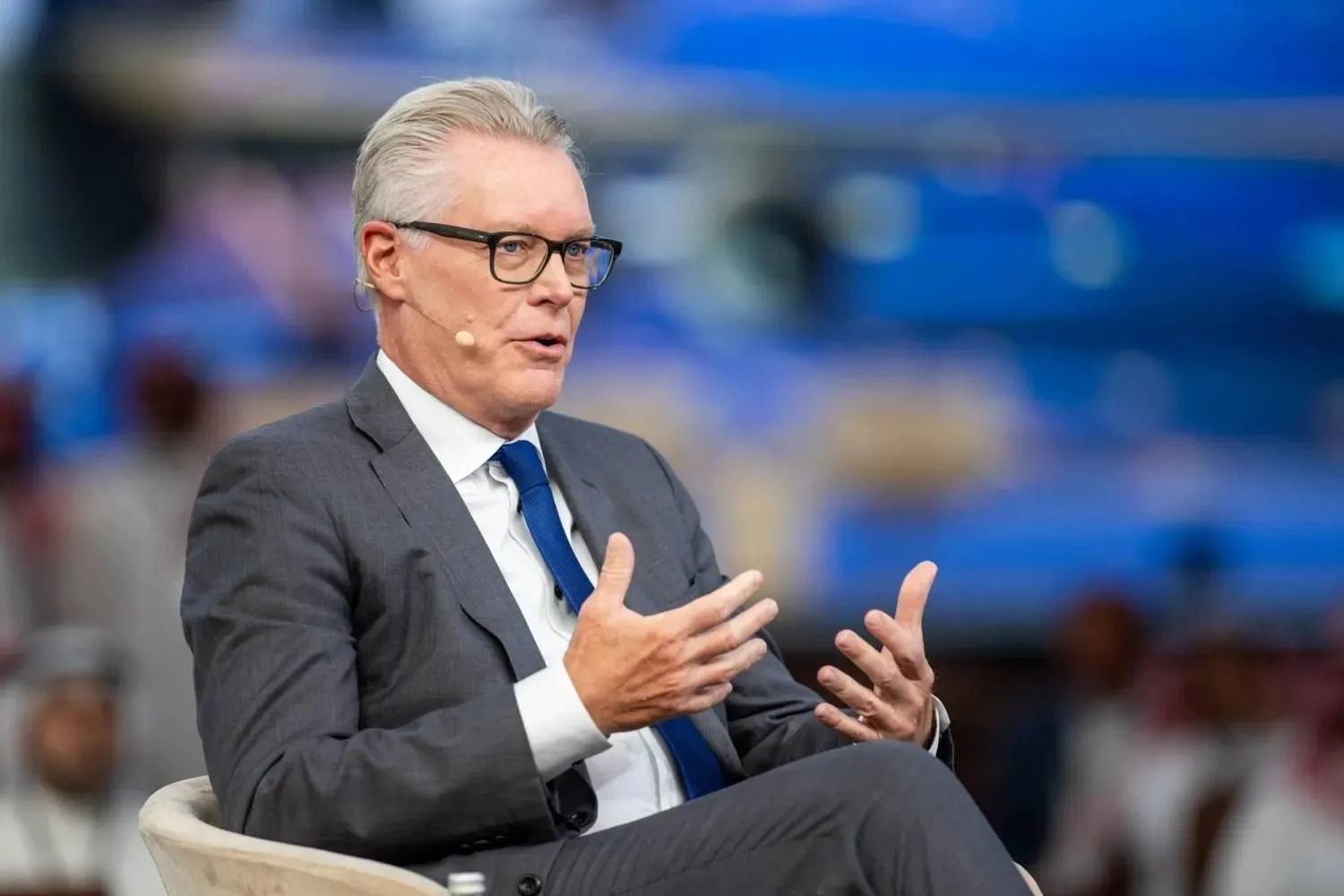
Delta Air Lines CEO Ed Bastian speaks at a session during the Future Investment Initiative conference (Asharq Al-Awsat)
TT

Delta CEO: Atlanta-Riyadh Route Links Two Dynamic Economies

Delta Air Lines CEO Ed Bastian speaks at a session during the Future Investment Initiative conference (Asharq Al-Awsat)

Delta Air Lines Chief Executive Ed Bastian said that launching direct flights between Atlanta and Riyadh marks a strategic step that will open a new air corridor for business and investment between two dynamic economies and cultures, underscoring that the move will boost cross-sector partnerships and support multinational companies and their regional headquarters in Saudi Arabia under Vision 2030.

Speaking to Asharq Al-Awsat on the sidelines of the Future Investment Initiative (FII) in Riyadh, Bastian’s remarks came days after Delta announced plans to operate direct flights to Saudi Arabia, making it the first US carrier to operate nonstop routes to the Kingdom.

Bastian said the new route, driven by strong demand from business, tourism, and conference travel, reflects Delta’s full confidence in the Saudi market and serves as a key link connecting the financial and innovation ecosystems of the United States and the Kingdom.

He said Delta aims to establish broader network connectivity through an expected partnership with Riyadh Air, noting that the tie-up would bring together two forward-looking carriers offering seamless connectivity and shared loyalty benefits.

Bastian said Delta is proud to be the first US airline to announce direct flights to the Saudi capital, adding that the expansion aligns with Delta’s global connectivity strategy and its drive to grow in emerging markets. He said it is backed by investments in a modern fleet, digital transformation, and artificial intelligence to enhance efficiency and cut emissions.

Launch timeline and onboard experience

Bastian said the Atlanta–Riyadh service represents a strategic, opportunity-driven expansion, with Riyadh’s growth and ambition making it an attractive destination. The route is set to begin in October 2026, operating three times weekly using an Airbus A350-900 with four cabin classes.

While Riyadh is the starting point, he said the airline is open to future expansion in the Kingdom.

He expects strong US passenger demand for travel to what he described as a rising global hub, adding that Riyadh’s growth and ambition make it a compelling destination and that the new route will open new horizons for both business and leisure travelers.

Delta’s participation in FII

Highlighting Delta’s presence at the FII forum, Bastian said the company is proud to be the first US carrier to announce direct service to Riyadh. He described the city as vibrant and fast-growing, adding that Delta’s presence in the Kingdom reflects its commitment to global connectivity and support for the transformation underway under Vision 2030.

With the new Atlanta–Riyadh route, Bastian said Delta is taking a leading role in building a strategic bridge connecting two dynamic economies and cultures.

Expanding footprint in the Middle East

Bastian said Delta is entering an entirely new phase in the Middle East. He said this marks Delta’s first steps in Saudi Arabia and the start of a new chapter in its international expansion.

As Delta approaches the close of its first century, Bastian said the company wants its second century to be defined by global growth. Through strategic partnerships, including with Riyadh Air, Delta aims to build the foundation for long-term success based on connectivity, innovation, and premium service. The goal, he added, is to deepen its presence and deliver lasting value across the region.

Competing with Gulf carriers

Bastian said Delta competes in a region dominated by strong Gulf airlines through its core strengths—exceptional service, reliability, and customer care.

He described the expected partnership with Riyadh Air as a unique competitive proposition that unites two forward-looking carriers to offer seamless connectivity, shared loyalty benefits, and innovative experiences blending Delta’s long heritage with Riyadh Air’s digital-first approach.

Growing US-Middle East travel demand

Bastian said international travel demand has rebounded strongly since the pandemic, driven by growing interest across generations. He said the transformation taking place in Saudi Arabia is creating significant new reasons to visit, adding that Delta is preparing to meet that demand with premium service and smooth connections, particularly amid rising business travel expected to deepen cultural and economic exchange.

Financial and operational performance

On financial performance, Bastian said Delta posted record third-quarter revenue of $15.2 billion, with strong margins and diversified growth across premium travel and loyalty segments.

He said the carrier’s international expansion remains on a solid trajectory, with emerging markets such as Riyadh, Sardinia, and Hong Kong offering promising growth opportunities.

Industry outlook and technology

Looking ahead, Bastian said airfares are likely to stabilize at levels higher than before COVID-19 as travelers increasingly value premium experiences and view travel as a form of personal enrichment.

He said artificial intelligence is central to Delta’s innovation efforts, used in predictive technologies to enhance operations. The company has launched the Delta Concierge digital assistant to support personalized travel experiences.

Bastian said AI enhances human decision-making and does not replace the human touch of Delta’s more than 100,000 employees.

Efficiency and cost reduction

On cost control, Bastian said Delta is cutting seat costs by renewing its fleet with next-generation aircraft such as the A350-1000, which are up to 20% more fuel-efficient. He also cited digital transformation and improved crew productivity as key efficiency drivers.

He added that new aircraft deliveries—both narrow- and wide-body—will expand capacity and efficiency while larger jets deliver savings on maintenance and crew costs. Tools such as Delta’s internal Carbon Council and digital platforms are improving operations and reducing waste, lowering costs and supporting sustainability goals.

Bastian said Delta is managing delivery delays from Airbus and Boeing by optimizing its current fleet and maintaining flexibility in its order strategy.

He said the planned partnership with Riyadh Air extends beyond network connectivity to include broad cooperation in maintenance, training, and operational services, evolving into a long-term strategic alliance to support both carriers’ growth.



Saudia to Launch Riyadh-Kozhikode Flights in February

Saudi Arabian Airlines plane, is seen at the airport of the Red Sea resort of Sharm el-Sheikh, Egypt, August 9, 2021. Picture taken through a window. REUTERS/Mohamed Abd El Ghany/File Photo
TT

Saudia to Launch Riyadh-Kozhikode Flights in February

Saudi Arabian Airlines plane, is seen at the airport of the Red Sea resort of Sharm el-Sheikh, Egypt, August 9, 2021. Picture taken through a window. REUTERS/Mohamed Abd El Ghany/File Photo

Saudia Airlines has added Kozhikode, India, to its network of scheduled international destinations, marking its seventh destination in the country alongside Bangalore, Mumbai, Kochi, Delhi, Hyderabad, and Lucknow, as part of the airline’s strategy to reach new international markets, connect the Kingdom to the world through its modern fleet, and strengthen its global competitive position, SPA reported.

Flights to Kozhikode will begin on February 1, 2026, with four weekly departures from King Khalid International Airport in Riyadh.

Reservations are available through the airline’s website and mobile applications.

The addition of Kozhikode further expands Saudia's growing operational network, which now covers over 100 destinations across four continents and operates more than 550 domestic and international flights daily.


Egypt Signs Renewable Energy Deals Worth $1.8 Billion

The Wolf Moon, the first supermoon of 2026, lights up the night sky in Cairo, Egypt, January 3, 2026. REUTERS/Mohamed Abd El Ghany
TT

Egypt Signs Renewable Energy Deals Worth $1.8 Billion

The Wolf Moon, the first supermoon of 2026, lights up the night sky in Cairo, Egypt, January 3, 2026. REUTERS/Mohamed Abd El Ghany

Egypt has signed renewable energy deals worth a combined $1.8 billion, state TV reported on Sunday.

Among the deals were contracts with Norwegian renewable energy developer Scatec and China's Sungrow.

Egypt hopes to have renewable energy reach 42% of its electricity generation mix by 2030, but officials say the goal will be ⁠at risk without more international support.

The first project will be the construction by Scatec of a solar energy plant to generate electricity and energy storage stations in Upper Egypt's Minya, ⁠an Egyptian cabinet statement said.

It would have a generation capacity of 1.7 gigawatts supported by battery storage systems with total capacity of 4 gigawatt hours.

A second project will be a Sungrow factory to manufacture energy storage batteries at the Suez Canal Economic Zone. A share of the factory's output ⁠would be supplied to the first project, the cabinet said.

The deals also include power purchase agreements, with Scatec signing a deal for total capacity of 1.95 gigawatts and 3.9 gigawatt hours of battery storage systems, the Norwegian company said in a statement.


Iraq Says Gas Flaring to Reach Zero by End-2028

Iraq’s Prime Minister Mohammed Shia al-Sudani inspects the electricity ministry pavilion at the Iraq Energy Exhibition and Conference
TT

Iraq Says Gas Flaring to Reach Zero by End-2028

Iraq’s Prime Minister Mohammed Shia al-Sudani inspects the electricity ministry pavilion at the Iraq Energy Exhibition and Conference

Iraq’s Prime Minister Mohammed Shia al-Sudani stated on Saturday that the government is moving forward with the development of clean and renewable energy sectors.

Speaking at the opening of the Iraq Energy Exhibition and Conference, al-Sudani said Iraq has made significant progress in capturing associated gas, with the rate of flaring reduced by more than 72%.

He said flaring will be fully eliminated by the end of 2028.

“We have infrastructure projects at the level of the Ministry of Oil that ensure export capacity and the diversification of export outlets,” al-Sudani said, according to the Iraqi News Agency.

He added that Iraq is holding talks with international companies to invest in associated gas and free gas in oil fields and exploration blocks, expressing hope that the conference would help reinforce this direction. He said the government has also moved toward establishing a permanent platform to secure Iraq’s gas needs through imports or future exports.

Al-Sudani stated that the Ministry of Electricity is working to increase power generation under an ambitious plan that exceeds 57,000 megawatts through the Siemens and GE project.

He added that the ministry is also advancing renewable energy projects, both large and small, with a plan at the district and subdistrict levels in Baghdad and other provinces to transition to renewable energy, which is expected to be implemented by next summer.

He said the government is placing strong emphasis on both conventional and renewable energy in a way that ensures sustainable development.

Al-Sudani stated that the exhibition showcases Iraq’s position as a promising market with significant opportunities in the energy sector, through various projects, partnerships, and investment opportunities.

He said the government has made significant progress in boosting energy production through major oil projects in partnership with global companies, including TotalEnergies and BP, adding that talks are ongoing with ExxonMobil, Chevron, and other international firms.

Talks with Chevron

Iraq’s Oil Minister Hayan Abdul Ghani said talks are underway with Chevron regarding the West Qurna 2 oil field, which is operated by Lukoil and represents the company’s largest foreign asset.

Chevron and Exxon Mobil are among the potential bidders for Lukoil’s overseas assets following the imposition of US sanctions on the Russian oil producer.

Speaking to reporters after the opening of the energy exhibition and conference, Abdul Ghani stated that negotiations with Chevron over the West Qurna 2 field in Basra province are ongoing.

He added that Basra Oil Company, the second partner in the field, has not yet taken over operations following Lukoil’s withdrawal.

Al-Sudani opened the 11th edition of the Iraq Energy Exhibition and Conference in Baghdad on Saturday, with the participation of more than 450 local, Arab, and international companies specializing in energy and investment.

The event runs for three days.

The Iraqi Company for Exhibitions and Commercial Services said the conference, held at the Baghdad International Fairgrounds from Jan. 10 to 12, will feature panel discussions, specialized workshops, and meetings aimed at supporting the energy sector and expanding partnership and investment opportunities, with participation from more than 450 companies.

Iranian gas

Iraq’s Ministry of Electricity said there are no indications that Iranian gas supplies will resume soon.

A ministry spokesperson stated that media outlets were notified via a message from Iran on Telegram, which indicated that gas supplies had been halted due to low temperatures and Tehran’s domestic gas needs.

Iraq announced in December that Iranian gas supplies had ceased, resulting in the shutdown of some power generation units and load reductions at others. The Ministry of Electricity said the grid lost between 4,000 and 4,500 megawatts as a result.

Iran supplies between 30% and 40% of Iraq’s gas and electricity needs.

Electricity ministry officials previously stated that peak winter demand in Iraq reaches approximately 48,000 megawatts, while domestic production stands at around 27,000 megawatts, forcing the country to rely on imports to bridge the gap.