


APEC Leaders Agree in Joint Declaration to Enhance Global Trade

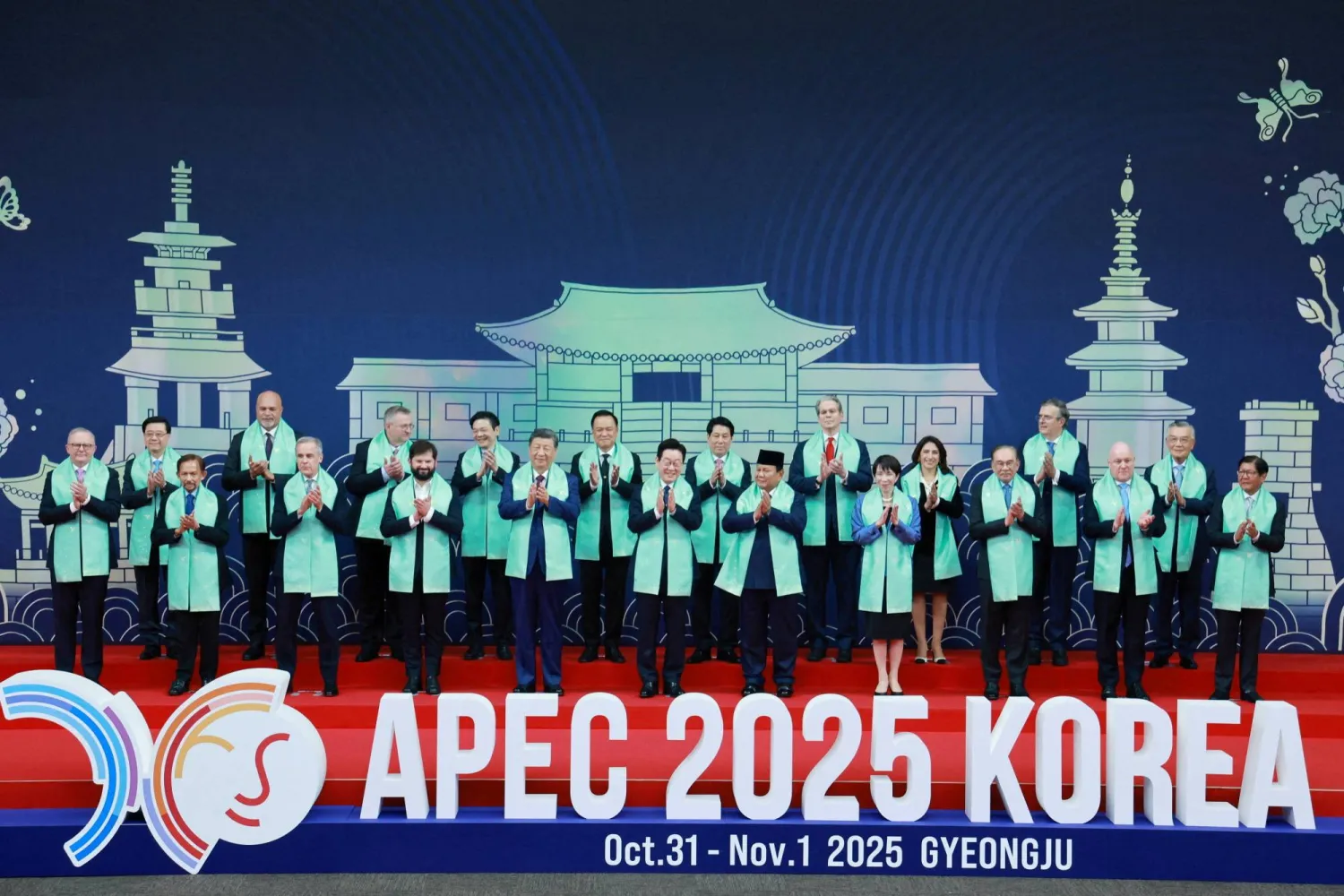
World leaders pose for a group photo during the Asia-Pacific Economic Cooperation (APEC) summit in Gyeongju, South Korea, November 1, 2025. Yonhap via REUTERS
TT

APEC Leaders Agree in Joint Declaration to Enhance Global Trade

World leaders pose for a group photo during the Asia-Pacific Economic Cooperation (APEC) summit in Gyeongju, South Korea, November 1, 2025. Yonhap via REUTERS

Asia-Pacific leaders on Saturday agreed that trade and investment should advance in a way that brings benefits to all, a joint declaration showed, following their regional forum meetings.

At the Asia-Pacific Economic Cooperation (APEC), the leaders adopted the joint Declaration as they concluded the two-day gathering that brought together the 21 APEC members in the city of Gyeongju, according to South Korea’s Yonhap news agency.

During the meeting held under the theme “Building a Sustainable Tomorrow,” the leaders have advanced their shared objectives through three priorities — Connect, Innovate, Prosper.

The declaration, for the first time, recognizes cultural and creative industries as a new growth driver for the Asia-Pacific region and reflects the member economies' shared understanding and commitment to cooperation on AI and demographic changes, the South Korean presidential office said.

Alongside the declaration, the leaders also adopted two separate documents on an AI initiative and responding to demographic changes.

Chinese President Xi Jinping sat down with South Korean counterpart Lee Jae Myung on Saturday, capping an Asian summit at which Beijing emerged as an economic force in the absence of US President Donald Trump.

The Chinese President held direct talks with Trump ahead of the APEC summit South Korea on Thursday, in the first meeting between the two men since 2019.

The Presidents agreed to a temporary trade war truce, in which the US agreed to lower some tariffs in return for China's commitment to lift certain rare earth export restrictions and resume purchases of US goods.

After sealing the trade war pause with Xi in South Korea, Trump promptly jetted home on Thursday.

His swift exit allowed the Chinese leader to take center stage at the Asia-Pacific Economic Cooperation summit, where Beijing sought to position itself as a steady advocate of free and open trade, a role the US had dominated for decades. Also, China will host APEC in Shenzhen in 2026, President Xi Jinping announced.

The President met Canadian Prime Minister Mark Carney on the sidelines of the event on Friday, the first formal talks between the two countries' leaders since 2017.

Xi told the Liberal leader he was determined to work together to get relations back on the “right track” and invited Carney to visit China.

For his part, Carney described the meeting as a “turning point” in ties between Ottawa and Beijing.

Xi also sat down on Friday with Japan's new premier Sanae Takaichi, long seen as a China hawk.

She told Xi she wanted a “strategic and mutually beneficial relationship.”

But Takaichi told reporters that she also raised a number of thorny issues with the Chinese leader, saying that it was “important for us to engage in direct, candid dialogue.”

The Chinese leader then turned his attention to the South Korean President and their first sit-down meeting since Lee’s election in June.

Lee to ‘reassure’ Beijing
Seoul has long trodden a fine line between top trading partner China and defense guarantor the United States.

Relations with China soured in 2016 after Seoul agreed to deploy the US-made THAAD missile defense system.

Beijing hit back with sweeping economic retaliation, restricting South Korean businesses and banning group tours.

Cultural spats, including China’s claims over the origins of the Korean staple dish Kimchi, have also soured public opinion against Beijing.

“Public opinion matters in foreign policy,” Gi-Wook Shin, a Korea expert and sociology professor at Stanford University, told AFP.

“Public perception of China in South Korea is highly negative. I suppose the Chinese view of South Korea is not favourable either,” he said.

South Korea, which this week also agreed a multibillion dollar economic deal with the United States, remains heavily dependent on trade with its vast Asian neighbor.

Lee will likely try to “reassure Beijing that South Korea’s alignment with the United States does not preclude pragmatic economic engagement with China,” Seong-Hyon Lee, a scholar at the Harvard University Asia Center.

The South Korean leader is keen to “seek a measure of economic stability and a more predictable floor in bilateral relations,” he told AFP.

Also hanging over relations are Beijing’s close ties with North Korea, which remains technically at war with the South.

Lee plans to raise the issue of “denuclearization” with the Chinese leader, as well as broader peace efforts on the peninsula, Seoul’s presidential office said.

Indian Minister to Asharq Al-Awsat: We Expect Steady Growth in Tourism Between New Delhi and Riyadh

Saudi Minister of Culture Prince Badr bin Abdullah bin Farhan holding talks with India’s Minister of Tourism and Culture Gajendra Singh Shekhawat,X)
TT

Indian Minister to Asharq Al-Awsat: We Expect Steady Growth in Tourism Between New Delhi and Riyadh

Saudi Minister of Culture Prince Badr bin Abdullah bin Farhan holding talks with India’s Minister of Tourism and Culture Gajendra Singh Shekhawat,X)

India’s Minister of Tourism and Culture Gajendra Singh Shekhawat said he was optimistic about the future of tourism ties between his country and Saudi Arabia, saying that many young Saudis choose India as a favored tourist destination, while a good number of Indian tourists traveled to Saudi Arabia last year, expecting further steady growth in this movement over the coming years.

Building on this, he affirmed his country’s commitment to establishing broad practical cooperation with Riyadh, covering key sectors including economy, culture, and tourism. He also highlighted a set of challenges facing the global tourism sector, calling for joint governmental efforts to strengthen its resilience and adopt sustainability principles.

Speaking to Asharq Al-Awsat on the sidelines of the UN Tourism 26th General Assembly in Riyadh, the Indian minister said that global tourism is undergoing a major transformation that requires “stronger collaboration between governments and industry to enhance resilience, embrace sustainability, and ensure benefits are shared widely.” He looked forward to launching future joint production projects and initiatives with Saudi Arabia.

On this occasion, he congratulated Saudi Arabia for their successful hosting of the Assembly this year, noting that he had seized the opportunity to interact with his counterpart Ministers in Tourism and Culture during the visit, and to visit some prominent historical and cultural sites in the Kingdom.

Challenges Facing the Sector

The Indian minister acknowledged that the global tourism sector is going under a period of adjustment and facing multiple interconnected challenges, while international travel has rebounded post-pandemic, with many destinations still suffering from staff shortages, limited air connectivity, and uneven business recovery.

He added that climate change continues to pressure the sector to adopt sustainable practices, while geopolitical tensions and safety concerns affect traveler confidence. Tourists increasingly seek meaningful, tech-driven, and eco-conscious experiences, prompting destinations to rethink their travel offerings. Popular destinations face over-tourism, whereas emerging ones often lack the infrastructure for responsible growth. Persistent issues also include skills shortages, slow digital adoption among smaller operators, and the need for more inclusive and accessible tourism.

Tourism’s Economic Contribution

Regarding the size and economic contribution of tourism in India, and the steps taken by the Indian government to attract more foreign tourists, Shekhawat said that India is a prominent tourist destination and has shown consistent growth over the last few years.

He added that tourism contributes about 5% of the total GDP and supports close to 80 million direct and indirect jobs, serving as a principal source of foreign exchange earnings.

Shekhawat noted that his government has launched comprehensive reforms and focused investments to grow the tourism sector, including visa reforms, destination development, emphasis on healthcare and wellness tourism, and international partnerships.

He confirmed that India has opened the e-visa process where Saudi nationals can apply online and receive tourism visa within 72 hours.

India–Saudi Cooperation

Shekhawat emphasized that India and Saudi Arabia share deep-rooted cultural and historical ties based on centuries of exchange, trade, and people-to-people connections, stressing that cultural and tourism cooperation remain key pillars of our strategic partnership.

He said: “To further strengthen this bond, a Ministerial Committee on Tourism and Cultural Cooperation was established under the India–Saudi Arabia Strategic Partnership Council during the State Visit of Hon’ble Prime Minister of India to the Kingdom in April 2025.”

The Minister added: “During my current visit, I had a fruitful meeting with Saudi Minister of Culture, HH Prince Badr bin Abdullah bin Farhan Al-Saud and we also signed an MoU on Cultural Cooperation between our two countries. We discussed ways to enhance our cultural ties, promote exchanges between our cultural institutions, and intensify participation in each other’s cultural events and festival.”

Shekhawat concluded: “Many young Saudis choose India as a favored tourist destination, and a good number of Indian tourists traveled to Saudi Arabia last year. We expect these numbers to grow steadily over the coming years.”


Saudi Industrial Production Index Increases by 9.3% in September

GASTAT said Saudi Arabia’s Industrial Production Index for September 2025 rose by 9.3%. SPA
TT

Saudi Industrial Production Index Increases by 9.3% in September

GASTAT said Saudi Arabia’s Industrial Production Index for September 2025 rose by 9.3%. SPA

The General Authority for Statistics (GASTAT) announced on Monday that Saudi Arabia’s Industrial Production Index for September 2025 rose by 9.3% compared to the same month last year.

Compared to September 2024, the sub-indices for mining and quarrying and for manufacturing activities rose by 11.0% and 6.3%, respectively.

The sub-index for electricity, gas, steam, and air conditioning supply increased by 12.6%, while the sub-index for water supply, sewerage, waste management, and remediation activities grew by 9.2%.

The oil activities index increased by 10.1%, while the non-oil activities index rose by 7.3% compared to September 2024.


Riyadh, Ottawa Launch Foreign Investment Agreement and Reactivate Joint Commission

The Saudi Minister of Investment meets with the Canadian Minister of Trade. Asharq A-Awsat
TT

Riyadh, Ottawa Launch Foreign Investment Agreement and Reactivate Joint Commission

The Saudi Minister of Investment meets with the Canadian Minister of Trade. Asharq A-Awsat

Saudi Arabia and Canada have launched negotiations on a Foreign Investment and Protection Agreement in the Canadian capital, Ottawa, a move reflecting the shared commitment to strengthening bilateral economic relations.

The talks coincided with a visit by a high-level Saudi delegation led by the Minister of Investment, Eng. Khalid Al-Falih, during which both sides announced the reactivation of the Joint Economic Commission.

These developments are gaining significant momentum, supported by Canada’s endorsement of Saudi Vision 2030 and the two countries’ willingness to expand their economic partnership across vital and non-oil sectors.

The Canadian Ambassador to Saudi Arabia, Jean-Philippe Linteau, told Asharq Al-Awsat that Canada was thrilled to welcome Al-Falih.

“His meetings with Prime Minister Mark Carney, Minister of Trade Maninder Sidhu and Foreign Minister Anita Anand, as well as with senior Canadian business leaders, were a clear illustration of Canada’s desire to grow the economic partnership between Saudi Arabia and Canada,” said Linteau.

The diplomat added that “there is growing momentum because of Canada’s support for the Kingdom’s Vision 2030 goals and the visit helped advance key engagement on trade and investment as well as partnerships in sectors such as education, mining, AI and infrastructure.”

In 2024, Saudi Arabia was Canada’s largest merchandise trading partner in the Middle East. Two-way merchandise trade between the two countries in 2024 was valued at approximately $4.1 billion.

Over 150 Canadian companies are active in Saudi Arabia, offering competitive solutions in artificial intelligence and frontier technology, healthcare, infrastructure, mining, defense products, and creative industries.

During their meeting in Ottawa, Sidhu and Al-Falih announced the launch of negotiations for a Foreign Investment and Protection Agreement between Canada and Saudi Arabia. They also announced the reactivation of the Joint Economic Commission, a treaty-based mechanism to promote trade and economic initiatives of mutual benefit.

Sidhu and Al-Falih welcomed the October 23 signing of a memorandum of understanding between Export Development Canada and the Saudi EXIM Bank.

The increased partnership between Canada and Saudi Arabia will boost business opportunities, increase bilateral trade and unlock export opportunities and investments in Canadian and Saudi Arabian companies alike.

The two ministers also discussed future strategic sector partnerships between Canadian and Saudi Arabian companies, including in the areas of artificial intelligence and frontier technologies, healthcare, infrastructure, mining, defense, and creative industries.

They also met with business leaders and industry stakeholders, participated in a business round table with Invest in Canada and focused on deepening Canada-Saudi relations by highlighting commercial success stories between Canadian and Saudi companies.

“Saudi Arabia is an important market for Canada as our largest bilateral merchandise trading partner in the Middle East. We’re committed to advancing economic cooperation and mutually beneficial investment opportunities to foster greater commercial prosperity for Canadians and Saudis,” Sidhu said in a statement.

“I look forward to strengthening the relationship between our two countries and promoting continued cooperation for our businesses, industries and workers,” he added.
