


International Finance Corporation Announces New Investments in Lebanon

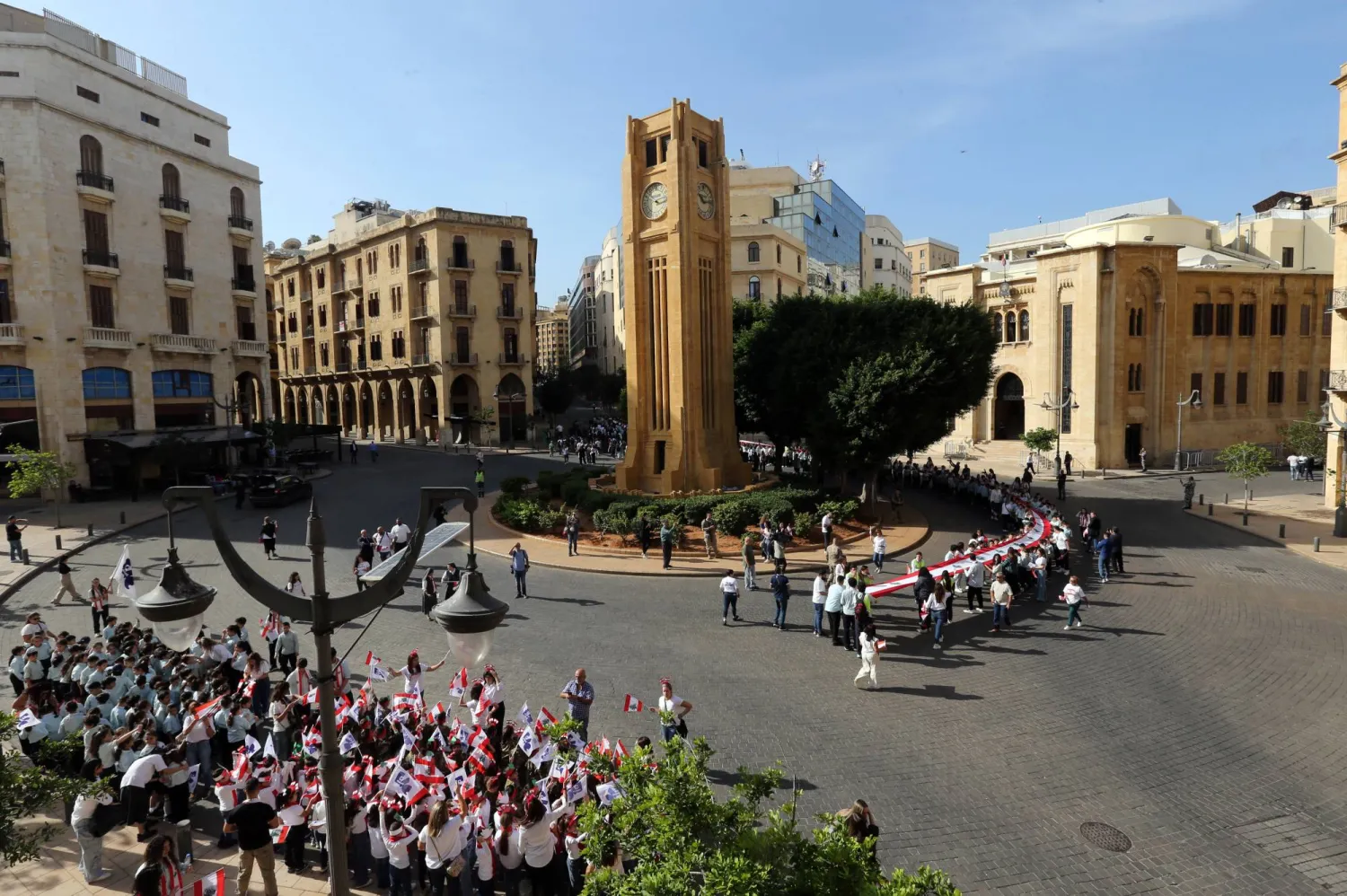
School students carry a huge Lebanese flag on the occasion of Lebanon's 82nd Independence Day anniversary to be celebrated on 22 November, outside the Parliament building in downtown Beirut, Lebanon, 20 November 2025. EPA/WAEL HAMZEH
TT

International Finance Corporation Announces New Investments in Lebanon

School students carry a huge Lebanese flag on the occasion of Lebanon's 82nd Independence Day anniversary to be celebrated on 22 November, outside the Parliament building in downtown Beirut, Lebanon, 20 November 2025. EPA/WAEL HAMZEH

The International Finance Corporation (IFC), a member of the World Bank Group, announced on Thursday new investments and engagements to expand access to finance and energy, support the growth of the manufacturing sector, and create jobs across Lebanon.

The new initiatives are part of the World Bank Group’s (WBG) broader strategy to support the country’s reconstruction and recovery and are fully aligned with the new economic vision of Prime Minister Nawaf Salam’s government, IFC said in a statement.

“IFC’s new engagements aim to fuel private sector development and drive a sustainable, inclusive recovery, and create much-needed jobs,” said IFC’s Regional Director for the Middle East, Afghanistan, and Pakistan Aftab Ahmed.

The new initiatives seek to expand access to reliable energy. In close coordination with the WBG’s International Bank for Reconstruction and Development, IFC will serve as the lead transaction advisor to the Lebanese government, working closely with the High Council for Privatization and PPPs and the Ministry of Energy and Water to promote efficient power generation by structuring and implementing a gas-to-power project under a public-private partnership model, the statement said.

The agreement supports the development of a floating storage and regasification unit to import, store, and convert liquefied natural gas into fuel; and the modernization of the 465-megawatt Deir Ammar I power plant into a cleaner, more efficient, higher-capacity independent power producer.

It also includes the construction of a new 825-megawatt combined-cycle gas turbine plant, Deir Ammar II, to boost generation capacity.

Once completed, the projects will expand access to reliable electricity, support the country’s shift to more renewable energy, improve the efficiency of Lebanon’s electricity sector, reduce its reliance on diesel, and cut down the cost of electricity generation.

As part of supporting financial inclusion, the IFC said it will provide a $10 million financing package divided equally between two leading microfinance institutions in Lebanon to expand access to finance to micro and small and medium enterprises (MSMEs) and women entrepreneurs with a focus on forcibly displaced persons and host communities. The loans will help preserve and create jobs while supporting Lebanon’s long-term recovery and development plans.

The financing package includes a first-loss guarantee of up to $5 million provided through a blended finance facility under the Prospects Partnership (PROSPECTS), a program spearheaded by the Dutch government.

PROSPECTS aims to improve access to education, social protection, and decent employment for host communities and forcibly displaced populations across East Africa and the Middle East. These investments align with ongoing efforts by the Ministry of Social Affairs to promote economic inclusion among vulnerable populations through its national programs, including the AMAN Social Safety Net Program under the World Bank Group’s International Bank for Reconstruction and Development support to the social protection agenda in Lebanon.

In order to promote sustainable manufacturing, IFC is also partnering with BCI Holding S.A. (BCI) to provide a loan of up to $40 million to support the company’s expansion in Lebanon and across the Middle East.

The funds will enable BCI, a leading regional producer of polyester polyols, polyurethane systems, flexible packaging, and specialty adhesives, to drive job creation and small and medium enterprise (SME) development.

As part of this growth, BCI will establish a dedicated R&D and Innovation Center in Lebanon and develop a back-office operations hub to strengthen its regional capabilities. Through tailored chemical formulations, specialty adhesives, and technical support, BCI will help SMEs improve quality, reduce waste, and innovate to enhance competitiveness.

To boost industrial development, IFC will be partnering with Matelec, a leading regional manufacturer of power-machinery and electrical infrastructure solutions headquartered in Lebanon, with an investment of up to $30 million to support the company's upcoming infrastructure projects in Lebanon and the broader Middle East and North Africa region.

The partnership will reinforce Matelec’s contribution to industrial development and job creation, while enhancing the availability of high-quality electrical infrastructure solutions for municipal and industrial sectors across local and international markets.



Saudi Cabinet Approves Operating Framework for National Minerals Program

Custodian of the Two Holy Mosques King Salman bin Abdulaziz chairs the cabinet meeting on Tuesday (SPA)
TT

Saudi Cabinet Approves Operating Framework for National Minerals Program

Custodian of the Two Holy Mosques King Salman bin Abdulaziz chairs the cabinet meeting on Tuesday (SPA)

The Saudi Cabinet approved on Tuesday the draft regulations and operating procedures of the National Minerals Program, which was authorized for establishment in July 2024.

The program focuses on boosting the efficiency and adequacy of current and future mineral supply chains and operates under the supervision of the Ministry of Industry and Mineral Resources, as part of the Kingdom’s broader efforts to maximize value from the mining sector and strengthen the continuity of mineral supply chains at both regional and global levels.

The initiative aligns with Saudi Arabia’s strategic push to develop its mining industry as a key pillar of economic diversification.

Minister of Industry and Mineral Resources Bandar Alkhorayef had previously said the program would serve as a powerful enabling tool to bolster the quality and reliability of mineral supply chains, ensure sustained supplies for local industries and major projects, support the development of national infrastructure, and help achieve the goals of Vision 2030.

The program would play an active role in driving growth in the minerals sector and unlocking the Kingdom’s significant mineral resources, he added.

The program is designed to unify key roles among relevant stakeholders, address existing gaps to ensure uninterrupted mineral supply chains, build local capabilities in the sector, contribute to exploration activities, and secure industrial supplies for domestic industries and large-scale projects.

In a related development, Riyadh will host the fifth edition of the International Mining Conference from Jan. 13-15, under the patronage of Custodian of the Two Holy Mosques King Salman bin Abdulaziz.

The event aims to further cement Saudi Arabia’s leadership in the global mining sector, with expectations that around 200 exhibiting and sponsoring entities will participate. Around 150 memorandums of understanding and strategic agreements will be signed to support global mineral supply chains.


Saudi Arabia, Syria Discuss Opportunities for Development Cooperation

The Saudi and Syrian officials discussed opportunities for development cooperation to support various sectors in Syria. (SPA)
TT

Saudi Arabia, Syria Discuss Opportunities for Development Cooperation

The Saudi and Syrian officials discussed opportunities for development cooperation to support various sectors in Syria. (SPA)

Saudi Fund for Development (SFD) Chief Executive Sultan Al-Marshad held talks in Damascus on Tuesday with Syrian Minister of Finance Mohammed Yusr Barniyeh, Minister of Health Dr. Musab Al-Ali, and Minister of Education Dr. Mohammed Abdulrahman Turko.

They discussed opportunities for development cooperation to support various sectors in Syria.

The Saudi delegation's visit to Syria underscores the importance of development cooperation between the two countries in helping achieve Sustainable Development Goals and supporting development initiatives in Syria.

Since its establishment in 1974, the SFD has provided development contributions to more than 100 developing countries around the world, supporting and financing over 800 development projects and programs across various sectors, with a total value exceeding $22 billion.


Standard Chartered: Fiscal Deficit a Catalyst of Transformation in Saudi Arabia

A general view of Riyadh. (SPA)
TT

Standard Chartered: Fiscal Deficit a Catalyst of Transformation in Saudi Arabia

A general view of Riyadh. (SPA)

Standard Chartered Global Research said on Tuesday it believes the recent fiscal deficits in Saudi Arabia have not been a setback, but rather a catalyst of structural macroeconomic transformation.

In its latest Global Focus report, SC Global Research expects Saudi policy makers to continue their efforts in diversifying funding sources in 2026, seeking to attract greater foreign direct investment alongside stronger foreign investor participation in domestic debt markets.

The report said increased capital flows are likely to support the Kingdom’s capital market momentum, notably thanks to greater inclusion in leading investment indices.

SC Global Research expects Saudi Arabia to continue delivering robust GDP growth of 4.5% in 2026, outperforming the 3.4% growth rate for the global economy.

It attributed the Kingdom’s economic resilience to sustained momentum in the oil sector.

“The hydrocarbon industry has returned to growth, as OPEC+ eased the production cuts that had been in place since 2023,” it noted.

Meanwhile, the non-oil sector is also expected to grow steadily at 4.5%, driven by investment and consumption, and will continue supporting the economy.

Saudi Arabia is forecasting real GDP growth of 4.6% in 2026, supported by an expected increase in the output of non-oil activities, led by tourism, entertainment, logistics, and technology.

Mazen Bunyan, CEO of Standard Chartered Saudi Arabia, said: “Continued non-oil sector growth will ensure sustained financial stability whilst diversifying growth sources across the Kingdom.”

In its report, SC Global Research forecasts the Kingdom’s public debt-to-GDP to increase to 36% by end-2026, from 26% at end-2024, taking it closer to the Kingdom’s self-imposed 40% ceiling.

Even so, it believes that recent fiscal deficits have not been a setback, but rather a catalyst of structural macroeconomic transformation.