


China’s Deflationary Strains Persist Even as Consumer Inflation Hits 21-Month High 

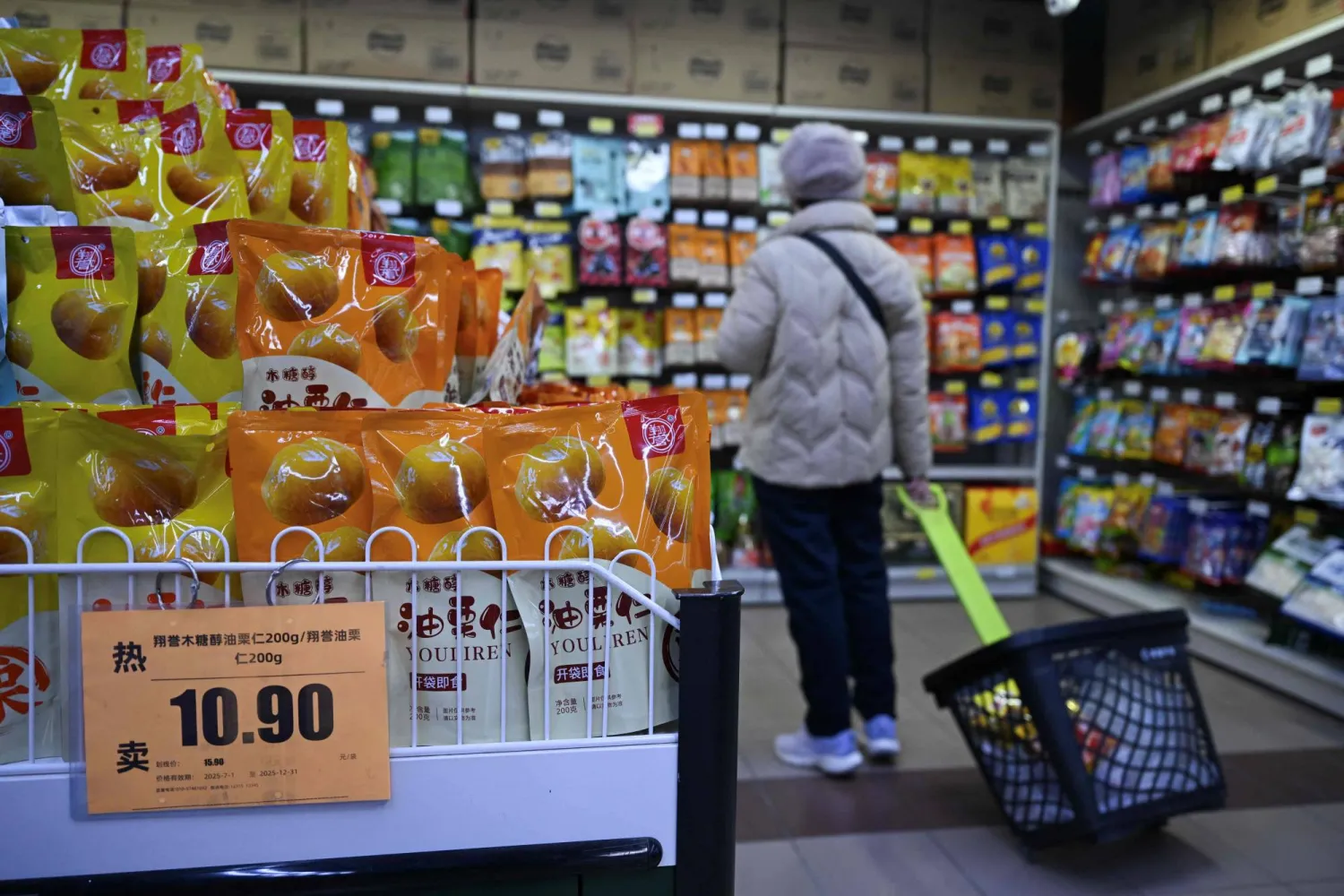
A shopper browses past shelves at a supermarket in Beijing on December 10, 2025. (AFP)
TT

China’s Deflationary Strains Persist Even as Consumer Inflation Hits 21-Month High 

A shopper browses past shelves at a supermarket in Beijing on December 10, 2025. (AFP)

China's annual consumer inflation accelerated to a 21-month peak in November, mainly driven by food prices, while factory-gate deflation deepened, with underlying trends suggesting domestic demand remains weak and unlikely to recover in the near term.

The $19 trillion economy is on course to meet Beijing's growth target of "around 5%" for the year, buoyed by policy support and resilient goods exports. But economic imbalances have worsened this year as US President Donald Trump's global trade war has added to persistently soft consumer demand, putting the onus on policymakers to step up stimulus measures.

The consumer price index (CPI) rose 0.7% from a year earlier, National Bureau of Statistics data showed on Wednesday, matching a 0.7% expansion in a Reuters poll of economists. It had increased 0.2% in October.

The pickup in consumer inflation was mainly driven by rising food prices, which increased 0.2% year-on-year after dropping 2.9% in October.

But annual core inflation, which excludes volatile prices of food and fuel, was unchanged at 1.2% last month. On a monthly basis, CPI dipped 0.1% versus a 0.2% rise in October and a forecast gain of 0.2%.

Factory-gate deflation has also dragged on for three years in China, hobbling the world's second-biggest economy, even as the government has stepped up a campaign to curb industrial overcapacity and made calls on key sectors to scale back cut-throat competition. The latest data showed few signs of a recovery in the deflationary impulse.

The producer price index (PPI) fell 2.2% year-on-year in November, compared with a 2.1% fall in October and worse than the forecast for a 2.0% drop. The index was up 0.1% from October.

"China’s latest inflation figures indicate an economy that is warming up on the surface but is still battling deep-seated deflationary pressures underneath," said Zavier Wong, market analyst at investment firm eToro.

'WAVE OF POLICY SUPPORT' EXPECTED TO BOOST DEMAND

Most analysts expect deflationary pressures to linger next year.

Falling prices of everyday items underlined the challenge authorities face as firms, hobbled by low demand, try to lure buyers with discounts.

Total spending on fast-moving consumer goods such as packaged food and drinks, toilet paper and toothpaste in China grew 1.3% year-to-date, supported by a 2.4% decline in average selling price, according to a report by Bain & Co on Tuesday.

Analysts say the government needs to stabilize the faltering property sector, lower the youth unemployment rate and build a better social safety net to encourage spending to foster sustainable longer-term growth.

In the near term, however, more policy support is required to inject confidence, they said.

The country's top leaders have pledged to better balance supply and demand and signaled a shift toward supporting household consumption and restructuring the economy over the next five years.

The Politburo, a top decision-making body of the ruling Communist Party, vowed on Monday to keep expanding domestic demand and support the broader economy with more proactive policies in 2026.

"With recent attention being placed on getting 2026, the first year of the next five-year plan period, off to a good start, this will likely necessitate another wave of policy support in the early months of next year," said Lynn Song, chief economist for Greater China at ING.

The economist penciled in 20 basis points of rate cuts in 2026.


IMF Board to Review Staff-level $8.1 Bln Agreement for Ukraine

The city's downtown on a frosty winter day, amid Russia's attack on Ukraine, in Kyiv, Ukraine February 19, 2026. REUTERS/Alina Smutko
TT

IMF Board to Review Staff-level $8.1 Bln Agreement for Ukraine

The city's downtown on a frosty winter day, amid Russia's attack on Ukraine, in Kyiv, Ukraine February 19, 2026. REUTERS/Alina Smutko

The International Monetary Fund on Thursday said its board ​would review a staff-level agreement for a new $8.1 billion lending program for Ukraine in coming days.

IMF spokeswoman Jule Kozack told reporters that Ukrainian authorities had completed the prior actions needed to move forward with the request ⁠of a new ⁠IMF program, including submission of a draft law on the labor code and adoption of a budget.

She said Ukraine's economic growth in 2025 ⁠was likely under 2%. After four years of war, the country's economy had settled into a slower growth path with larger fiscal and current account balances, she said, noting that the IMF continues to monitor the situation closely.

"Russia's invasion continues to take a ⁠heavy ⁠toll on Ukraine's people and its economy," Kozack said. Intensified aerial attacks by Russia had damaged critical energy and logistics infrastructure, causing disruptions to economic activity, Reuters quoted her as saying.

As of January, she said, 5 million Ukrainian refugees remained in Europe and 3.7 million Ukrainians were displaced inside the country.


US Stocks Fall as Iran Angst Lifts Oil Prices

A screen displays a stock chart at a work station on the floor of the New York Stock Exchange (NYSE) in New York City, US, April 6, 2022. REUTERS/Brendan McDermid
TT

US Stocks Fall as Iran Angst Lifts Oil Prices

A screen displays a stock chart at a work station on the floor of the New York Stock Exchange (NYSE) in New York City, US, April 6, 2022. REUTERS/Brendan McDermid

Wall Street stocks retreated early Thursday as worries over US-Iran tensions lifted oil prices while markets digested mixed results from Walmart.

US oil futures rose to a six-month high as Iran's atomic energy chief Mohammad Eslami said no country can deprive the Islamic republic of its right to nuclear enrichment, after US President Donald Trump again hinted at military action following talks in Geneva.

"We'd call this an undercurrent of concern that is bubbling up in oil prices," Briefing.com analyst Patrick O'Hare said of the "geopolitical angst."

About 10 minutes into trading, the Dow Jones Industrial Average was down 0.6 percent at 49,379.46, AFP reported.

The broad-based S&P 500 fell 0.5 percent to 6,849.35, while the tech-rich Nasdaq Composite Index declined 0.6 percent to 22,621.38.

Among individual companies, Walmart rose 1.7 percent after reporting solid results but offering forecasts that missed analyst expectations.

Shares of the retail giant initially fell, but pushed higher after Walmart executives talked up artificial intelligence investments on a conference call with analysts.

The US trade deficit in goods expanded to a new record in 2025, government data showed, despite sweeping tariffs that Trump imposed during his first year back in the White House.


Gold Advances on US–Iran Tensions as Markets Weigh Fed Policy Path

UK gold bars and gold Sovereign coins are displayed at Baird & Co in Hatton Garden in London, Britain, October 8, 2025. REUTERS/Hiba Kola/File Photo
TT

Gold Advances on US–Iran Tensions as Markets Weigh Fed Policy Path

UK gold bars and gold Sovereign coins are displayed at Baird & Co in Hatton Garden in London, Britain, October 8, 2025. REUTERS/Hiba Kola/File Photo

Gold prices extended gains on Thursday after rising more than 2% in the previous session, as lingering tensions between the United States and Iran prompted a flight to safety, while investors evaluated the Federal Reserve's monetary policy path.

Spot gold rose 0.2% to $4,989.09 per ounce by 1227 GMT. US gold futures for April delivery held steady at $5,008.60.

"Geopolitical concerns are front and centre with reports that, if the US were to take military action against Iran, it could go on for several weeks," said Jamie Dutta, market analyst at Nemo.money, Reuters reported.

Some progress was made during Iran talks this week in Geneva but distance remained on some issues, the White House said on Wednesday.

FED LARGELY UNITED

Top US national security advisers met in the White House Situation Room on Wednesday to discuss Iran and were told all US military forces deployed to the region should be in place by mid-March.

Meanwhile, the Fed's January minutes showed it largely united on holding interest rates steady, but divided over what comes next, with "several" open to rate hikes if inflation remains elevated, while others were inclined to support further cuts if inflation recedes.

The weekly jobless claims data, due later in the day, and Friday's Personal Consumption Expenditures report, the Fed’s preferred inflation gauge, will provide further clues on the central bank's policy trajectory.

Markets currently expect this year's first interest rate cut to be in June, according to CME's FedWatch Tool.

Non-yielding bullion tends to do well in low-interest-rate environments.

Spot silver rose 0.9% to $77.87 per ounce after climbing more than 5% on Wednesday.

Silver is "supported by tight supply and low COMEX stock levels ahead of the delivery period of the March contract. However, given the extent of the historic correction earlier this month, silver is not back on safer ground until it trades back above $86," said Ole Hansen, head of commodity strategy at Saxo Bank.

Spot platinum fell 0.6% to $2,059.55 per ounce, while palladium lost 1.7% to $1,686.47.
