

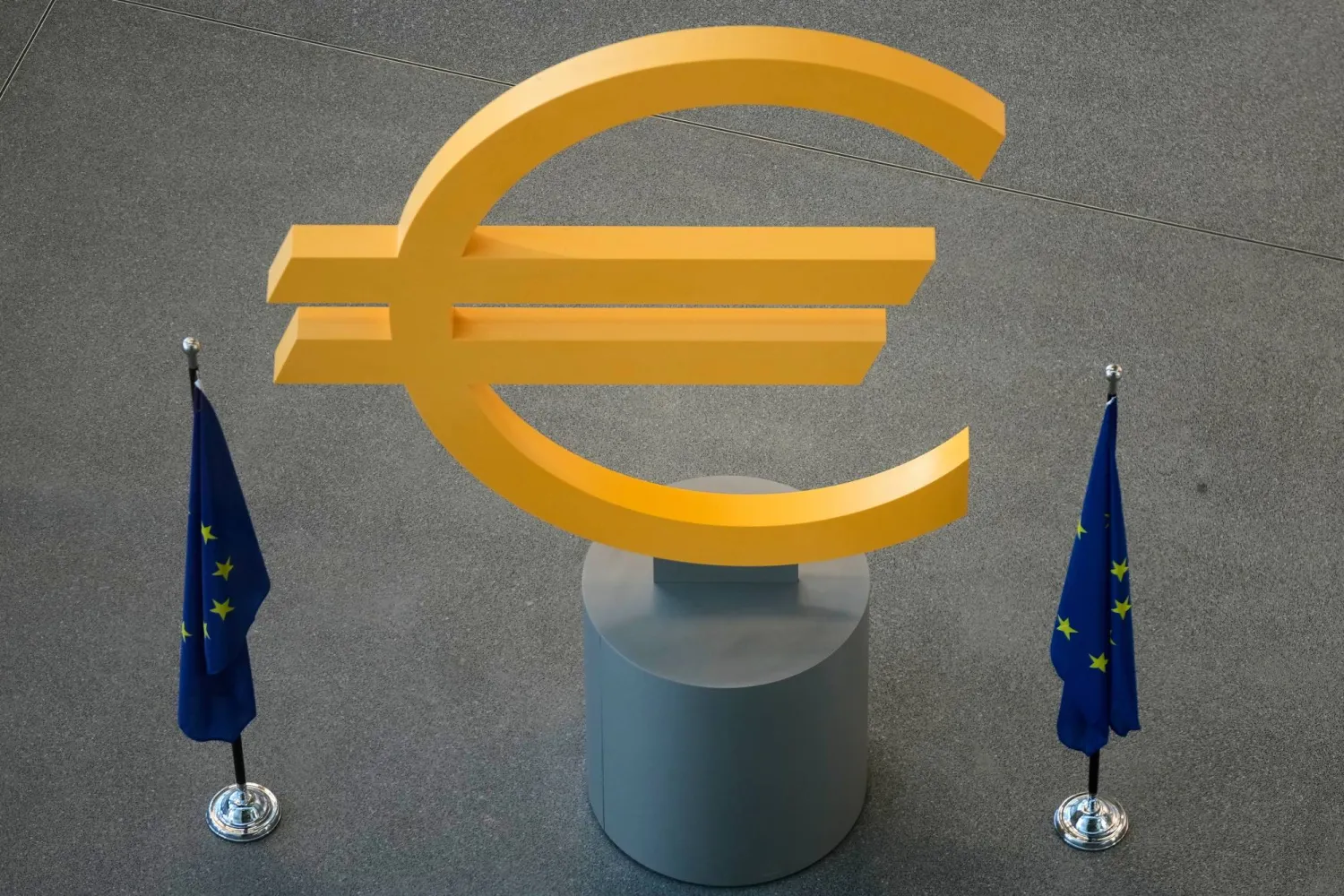

European Central Bank Leaves Rates Unchanged with Economy Showing Signs of Modest Growth

The Euro currency symbol is seen prior to a press conference after an ECB's governing council meeting in Frankfurt, Germany, Thursday, Dec. 18, 2025. (AP Photo/Michael Probst)
TT

European Central Bank Leaves Rates Unchanged with Economy Showing Signs of Modest Growth

The Euro currency symbol is seen prior to a press conference after an ECB's governing council meeting in Frankfurt, Germany, Thursday, Dec. 18, 2025. (AP Photo/Michael Probst)

The European Central Bank left interest rates unchanged Thursday for the fourth meeting in a row as the economy in the 20 countries that use the euro increasingly looks strong enough to get by without the stimulus of lower borrowing costs for businesses and consumers.

Bank President Christine Lagarde said that while the economy had remained “resilient,” there was too much uncertainty over trade and international conflicts to give any hints about future moves.

“We reconfirmed that we are in a good place” with interest rates, she said. “Which does not mean that we are static.”

Instead, the bank's rate setting council would take things meeting by meeting, starting with the next gathering in February. There is “no set date for any move,” she said. “There are lots of factors that that are in play and that will evolve over the course of '26.”

The council left the benchmark deposit rate unchanged at 2%, where it has been since a rate cut in June. Economists now think the rate could stay there for months - and possibly into 2027.

That’s because the ECB remains poised between inflation that’s just a bit too persistent and growth that’s underwhelming but steady after a trade deal with the US remove some of the uncertainty that had held back business planning. Higher rates fight inflation while cuts support growth.

The bank said in its decision statement that economic growth “is expected to be stronger” than in the bank's last projections in September, while inflation in services businesses was declining more slowly, even as overall inflation was expected to stabilize at the bank's 2% target.

Surveys of purchasing managers by S&P Global slipped slightly for December but still showed business activity expanding as the year comes to an end, reinforcing expectations that the 20 countries using the euro currency will continue to see growth of around 0.3% per quarter over the previous quarter.

That outcome is better than feared during turbulent trade negotiations with the United States over the summer, which finally settled with a 15% tariff, or import tax, imposed on European goods by US President Donald Trump.

Trump had threatened higher rates and the deal struck with the European Union's executive commission appears to have removed uncertainty and made it easier for businesses to make decisions. So the economy can get by without the added boost from a cut, analysts say.

“The haze of economic uncertainty has somewhat lifted, especially regarding trade,” The Associated Press quoted economist Lorenzo Codogno as saying.

On top of that, inflationary pressures remain too high for the ECB to contemplate a cut. The headline rate of 2.1% for annual inflation in November is roughly in line with the bank's goal of 2%, thanks in part to a drop in volatile energy prices. But inflation was higher at 3.5% in the services sector, which encompasses much of the economy from hairdressers and hotels to concert tickets and medical services.

While the ECB stood pat, the Bank of England on Thursday cut its key interest rate for the first time in four months as stubbornly high inflation starts to ease.

Policymakers voted 5-4 to reduce the base rate by a quarter of a percentage point to 3.75% on Thursday. Consumer price inflation slowed to 3.2% in the 12 months through November, from 3.6% a month earlier.

Central bank rate cuts can support growth because they strongly influence borrowing rates throughout the economy, lowering credit costs and promoting credit sensitive purchases such as new homes by consumers or new production facilities by businesses. Higher rates have the opposite effect and are used to contain inflation by dampening demand for goods.



Saudi Crown Prince’s Directives Cut Riyadh Property Prices by 3%

A general view of Riyadh, Saudi Arabia. (SPA)
TT

Saudi Crown Prince’s Directives Cut Riyadh Property Prices by 3%

A general view of Riyadh, Saudi Arabia. (SPA)

Real estate prices in Saudi Arabia’s capital fell 3% in the final quarter of last year, reversing a 1% rise in the previous quarter, in a shift that highlights the on-the-ground impact of policy moves ordered by Prince Mohammed bin Salman bin Abdulaziz, Crown Prince and Prime Minister, to rein in soaring property costs across the Kingdom, particularly in Riyadh.

According to an index issued by the General Authority for Statistics on Tuesday, the real estate price index in Saudi Arabia fell 0.7% in the fourth quarter of last year compared with the same period of 2024.

The decline was driven mainly by weaker performance in the residential sector, which carries the most significant weight in the index, as its annual rate of change fell 2.2%.

The commercial sector continued to see a slight slowdown in growth momentum, while maintaining positive annual growth of 3.6%.

A real balance

Real estate specialists told Asharq Al-Awsat that the Crown Prince’s directives have become evident on the ground after property prices in Riyadh surged to unprecedented levels, prompting government intervention to curb the increases and enable citizens to own their first homes without excessive financial burdens.

Real estate analyst Khaled Al-Mobid said the 0.7 % decline in the real estate price index in the fourth quarter of 2025 reflects the market’s entry into a phase of real balance after years of rapid price increases, describing it as a healthy indicator that supports, rather than weakens, market sustainability.

“What we are witnessing today is not a loss in value, but a logical price correction, particularly in the residential sector, due to increased supply, improved regulation, and greater awareness among market participants, whether buyers or investors,” Al-Mobid told Asharq Al-Awsat.

He added that this balance creates better opportunities for end users, redirects investment toward appropriate products at fair prices, and curbs short-term speculation, serving the real estate economy over the medium and long term.

Housing stability

Real estate specialist Ahmed Omar Basudan told Asharq Al-Awsat that the sector has seen declines in many regions of the Kingdom, as buyers await the effects of government decisions issued under the Crown Prince’s direction.

He cited recent measures, including the announcement of the names of beneficiaries of subsidized land grants in northern Riyadh, located in some of the area’s best neighborhoods.

Basudan said the decision to fix residential rental prices in Riyadh for five years also contributed to the decline in the capital’s real estate market, as tenants are experiencing a period of housing stability, reducing demand for purchases at this stage.

He added that recent amendments to fees on undeveloped land and vacant properties, which have been implemented and are now being collected, also played a role, prompting landowners to move quickly to sell some plots at competitive prices to avoid bearing those fees.

Data from the General Authority for Statistics showed that residential real estate prices fell in the fourth quarter of last year compared with the same quarter of 2024, with the sector declining 2.2%. The drop was driven by a 2.4% fall in residential land prices, a 2.5% decline in apartment prices, a 1.3% decrease in villa prices, and a 0.2% drop in residential floor prices.

Quarterly comparison

The real estate price index fell 0.4% in the fourth quarter of last year, at a slower pace than in the third quarter.

The index was affected by a 0.4% decline in the residential sector, driven by a 0.7% drop in residential land prices, a 0.4% fall in apartment prices, and a 0.2% decrease in residential floor prices, while villa prices rose 0.8%.

At the regional level, the annual real estate price index fell 0.7% nationwide in the fourth quarter of last year, with Riyadh recording a 3% decline, compared with a 1% increase in the third quarter.

The Eastern Province posted the highest real estate price increase at 4%, followed by Makkah at 2.5%, Tabuk and Jazan at 1.1% each, and Al-Jawf at 0.4%.

By contrast, Hail, the Northern Borders region, and Madinah recorded the steepest declines, at 8.9%, 6.8%, and 6.1%, respectively.


Saudi Industry Minister Meets with Global Leaders at World Economic Forum to Advance Partnerships

Saudi Minister of Industry and Mineral Resources Bandar Alkhorayef held a series of high-level meetings with government officials and global business leaders at the World Economic Forum. (SPA)
TT

Saudi Industry Minister Meets with Global Leaders at World Economic Forum to Advance Partnerships

Saudi Minister of Industry and Mineral Resources Bandar Alkhorayef held a series of high-level meetings with government officials and global business leaders at the World Economic Forum. (SPA)

Saudi Minister of Industry and Mineral Resources Bandar Alkhorayef held on Tuesday a series of high-level meetings with government officials and global business leaders on the sidelines of the Kingdom's participation in the 2026 World Economic Forum in Davos.

As part of the Saudi delegation, Alkhorayef participated in a meeting with Swiss President Guy Parmelin. The meeting reviewed the robust strategic partnership between their nations and explored avenues to deepen cooperation in the industrial and mining sectors, aiming to expand bilateral ties to serve mutual interests.

Alkhorayef met with CEO of BlackRock Larry Fink, and President and CEO of the World Economic Forum Børge Brende. Talks focused on boosting the partnership between the Kingdom and the forum, exploring new cooperation in advanced manufacturing and critical minerals, and strengthening joint efforts to fortify industrial and mining supply chains.

In a series of bilateral meetings, Alkhorayef met with leaders of major global firms, including CEO of Capgemini Aiman Ezzat, Senior Partner at Bain & Company Dr. Jörg Gnamm, and CEO of Copa-Data Stefan Reuther. The meetings focused on unlocking opportunities for collaboration in advanced manufacturing, digital solutions, industrial automation, and smart systems. The officials emphasized leveraging global consulting expertise to boost factory efficiency, accelerate the Kingdom's industrial transformation, and bolster the competitiveness of its industrial and mining sectors.


Saudi-US Trade and Investment Council Meetings Kick Off in Riyadh

Chaired by the GAFT, the Saudi-US Trade and Investment Council aims to strengthen economic cooperation between the two countries by reviewing trade and investment policies, addressing barriers, and supporting technical dialogue among relevant entities. (SPA)
TT

Saudi-US Trade and Investment Council Meetings Kick Off in Riyadh

Chaired by the GAFT, the Saudi-US Trade and Investment Council aims to strengthen economic cooperation between the two countries by reviewing trade and investment policies, addressing barriers, and supporting technical dialogue among relevant entities. (SPA)

Technical team meetings of the Saudi-US Trade and Investment Council (TIFA) kicked off in Riyadh on Tuesday.

Held under the theme “A Platform for Dialogue, Partnership, and Economic Growth,” the meetings were attended by Deputy Governor of the General Authority of Foreign Trade (GAFT) for International Relations Abdulaziz Alsakran, Assistant United States Trade Representative for Europe and the Middle East Bryant Trick, with the participation of 20 entities from both sides.

Chaired by the GAFT, the Saudi-US Trade and Investment Council aims to strengthen economic cooperation between the two countries by reviewing trade and investment policies, addressing barriers, and supporting technical dialogue among relevant entities.

The council focuses on five main objectives: developing trade and investment policies; facilitating trade and addressing technical and regulatory barriers; supporting cooperation on sanitary and phytosanitary measures and agricultural products; enhancing intellectual property protection; and advancing digital trade, innovation, and emerging technologies.

Saudi government entities participating in the council work to develop initiatives and activities that help elevate cooperation between the two countries and achieve its objectives, serving mutual interests.

Over the past ten years, trade exchange between Saudi Arabia and the United States has reached $500 billion, making the United States the Kingdom’s second-largest import partner. Trade exchange since 2020 has recorded a growth rate exceeding 50%, reflecting the depth and strength of economic relations between the two countries.