Hong Kong Expects 3.2% Growth this Year, Seeks to Maintain Momentum

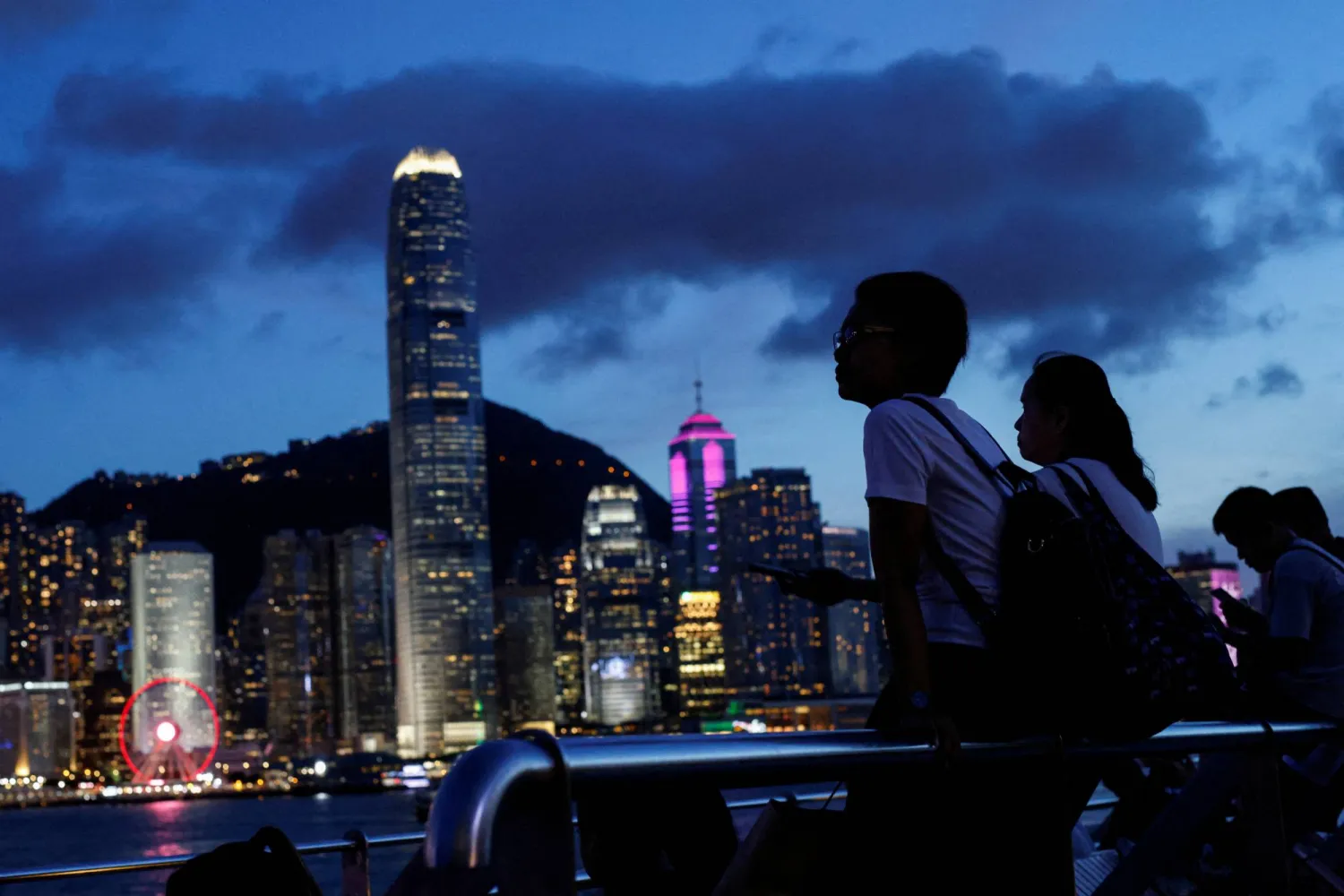
FILE PHOTO: Tourists relax on the waterfront in front of Victoria Harbour, with the iconic skyline buildings as a backdrop, in Hong Kong, China June 28, 2023. REUTERS/Tyrone Siu/File Photo
TT

Hong Kong Expects 3.2% Growth this Year, Seeks to Maintain Momentum

FILE PHOTO: Tourists relax on the waterfront in front of Victoria Harbour, with the iconic skyline buildings as a backdrop, in Hong Kong, China June 28, 2023. REUTERS/Tyrone Siu/File Photo

Hong Kong Financial Secretary Paul Chan raised his 2025 economic growth forecast to 3.2% on Sunday, saying the city would bolster its role as a financial center, innovation hub and trade center to maintain the momentum.

In February, Chan had forecast growth of between 2% and 3%.

Hong Kong, the world's biggest venue for initial public offerings this year, will lure more listings from companies in areas such as Southeast Asia and the Middle East and will actively promote internationalization ⁠of China's yuan currency, Chan said in a blog post.

The city will also focus on developing artificial intelligence and biotech to lead the global race in technology and will strengthen its role as a trade hub by helping more Chinese companies expand overseas, Reuters quoted him as saying.

"Looking into ⁠next year, Hong Kong's economy is expected to keep the good trend of growth," Chan said. "Finance, tech innovation and trade will be Hong Kong's key engines of growth as the city actively embraces China's development strategy."

Hong Kong has one of the world's best-performing stock markets this year, with the Hang Seng Index up 30%.

Resilient exports, brisk fixed-asset investment and recovering consumption have helped Hong Kong's growth beat forecast, Chan said.

To ⁠bolster its status as a financial center, Hong Kong will strengthen the competitiveness of its stock market and develop areas including bonds, money market, fintech, commodities and gold trading, he said.

In terms of innovation, Hong Kong will develop AI into a "core industry,” as the technology will define economies' competitiveness and reshape the global economic landscape, he said.

The city is also establishing a center for cross-border supply chain management and trade finance, to better help Chinese companies expand offshore, Chan said.


Nissan Says Gulf Strategy Unchanged Despite Geopolitical Challenges

Cartier during a presentation at a company event (Asharq Al-Awsat)
TT

Nissan Says Gulf Strategy Unchanged Despite Geopolitical Challenges

Cartier during a presentation at a company event (Asharq Al-Awsat)

Nissan Motor Co.’s Chief Performance Officer Guillaume Cartier said the Gulf and Middle East remain central to the company’s growth and profitability despite recent geopolitical challenges, adding that investment plans in the region remain unchanged.

Cartier told Asharq Al-Awsat that the automaker is securing supply chains through alternative logistics routes to ensure the continued flow of vehicles and spare parts, as it seeks to sustain operations in one of its key global markets.

He said Nissan has rerouted shipments in recent weeks to alternative ports, including Jeddah in Saudi Arabia and Fujairah in the United Arab Emirates, while using transit hubs in Sri Lanka and Singapore.

The steps have secured supplies for the next four months, he said, amid continued uncertainty over regional demand.

Cartier described current geopolitical pressures as temporary and said Nissan’s strategic direction in Saudi Arabia and the Gulf remains steady.

He added that the company remains confident in the region’s long-term outlook and will continue executing its plans.

New strategy

Cartier said Nissan’s new strategy hinges on tight alignment across product, market and technology execution.

He said cutting models from 56 to 45 is aimed at boosting efficiency, not reducing market presence.

The strategy focuses on placing the right product in the right market and channeling investment into higher-return models to drive sales volumes.

Customer acceptance of new technologies will be decisive, he said.

Performance and outlook

Cartier said the “Re:Nissan” plan will run through 2026, with a final review in 2027, adding that performance is very positive and ahead of plan following the restructuring that improved efficiency and profitability.

He described Gulf markets, led by Saudi Arabia, as a “golden jewel” among high-value markets, citing Nissan’s strong presence and broad customer base.

The expansion strategy centers on a broad lineup across segments, including SUVs such as Patrol, Pathfinder and X-Trail, alongside models sourced from Japan, China and India.

Saudi Arabia is the region’s largest market, where Nissan already posts strong performance, and the diversified lineup is expected to support further growth, he said.

Regional push

Cartier said Nissan is expanding beyond the Gulf, strengthening its presence in Syria and broadening operations in Iraq as part of a push to widen its regional footprint and tap emerging opportunities.

The move reflects a focus on markets with future growth potential despite challenges, he added.

US, China targets

Nissan aims to sell more than one million vehicles annually in both the United States and China by 2030 by delivering the right product with the right technology, Cartier said.

He said the US strategy will focus on SUVs and hybrid V6 vehicles, while China will see a faster rollout of electric and hybrid models and broader market coverage.

2030 vision

Cartier said Nissan is working toward a distinct global identity by 2030 built on innovation and boldness, integrating technology and design into a new brand promise.

The company is developing vehicles designed to stand out from competitors by combining performance with advanced technologies, he added.

Hybrids and AI

Cartier said Nissan is stepping up investment in its third-generation e-Power hybrid technology, improving fuel consumption, emissions and noise levels.

He said slower-than-expected electric vehicle adoption in some regions makes hybrids a practical option for now, especially in markets such as Saudi Arabia, where infrastructure is still developing.

Artificial intelligence is a core pillar of Nissan’s strategy, with plans to expand advanced driver assistance systems such as ProPILOT to around 90% of production in the future, he said.

The aim is to deliver technology at scale in a practical way that improves customer experience and safety.



Trump Auto Tariff Hike Could Cost Germany Nearly $18 Billion in Output

A worker wears a protective mask at the Volkswagen assembly line in Wolfsburg, Germany, April 27, 2020. (Swen Pfoertner/Reuters)
TT

Trump Auto Tariff Hike Could Cost Germany Nearly $18 Billion in Output

A worker wears a protective mask at the Volkswagen assembly line in Wolfsburg, Germany, April 27, 2020. (Swen Pfoertner/Reuters)

The tariff hike on cars and trucks from the European Union announced by US President Donald Trump could cost Germany nearly 15 billion euros ($17.58 billion) in output, an economic institute told Reuters on Saturday.

The estimate from the Kiel Institute for the World Economy (IfW) highlights the exposure of the EU's largest economy to US import tariffs, which have already cost the German automotive industry billions.

"The effects would be substantial," IfW President Moritz Schularick said, ⁠with output losses ⁠rising to around 30 billion euros over the longer term, according to the institute's analysis.

Trump said on Friday he would increase the auto tariffs to 25% next week from a previously agreed 15%, saying the bloc had not complied ⁠with its trade deal with Washington.

"Germany's already sluggish growth rate would be hit hard," IfW economist Julian Hinz said.

The institute currently expects the German economy to grow by 0.8% this year.

Other European economies with significant automotive sectors - including Italy, Slovakia, and Sweden - are also likely to suffer significant losses, it added.

The German economy minister's chief adviser advised caution towards Trump.

"The EU should ⁠simply ⁠wait and see for now," Jens Suedekum told Reuters.

"It is well known that Trump is quick to suspend or withdraw his grandiose tariff threats."

The president must explain why he thinks the EU is not complying with the existing trade agreement, Suedekum said, adding that it was also not clear whether there was a legal basis for the latest tariff threat.

"It all seems quite impulsive," the adviser said.


Barclays Raises Oil Price Forecast to $100 Per Barrel in 2026

Petroleum pump jacks are pictured in an oil field in California (Reuters)
TT

Barclays Raises Oil Price Forecast to $100 Per Barrel in 2026

Petroleum pump jacks are pictured in an oil field in California (Reuters)

Barclays has raised its 2026 Brent crude forecast to $100 per barrel, signaling that prices could rise further if the impasse in the Strait of Hormuz continues longer than expected.

The bank cautioned that the longer the disruption lasts, the bigger and more persistent ⁠the price shock will be, stressing that $100 a barrel should not be seen as a level at which supply and demand have found a new balance.

According to Barclays, the oil market is running a deficit of around 6.6 million barrels per day that is likely to widen as the supply shock continues.

It added that if disruptions persist through the end of May, prices could reprice towards $110 a barrel.

An Iranian proposal on negotiations with the US sent crude oil futures diving on Friday, but prices remained on track for weekly gains, with Tehran still blocking the Strait of Hormuz and the US Navy blocking exports of Iranian crude.

Brent crude futures for July settled at $108.17, down $2.23 a barrel, or 2.02%. West Texas Intermediate futures finished at $101.94 a barrel, down $3.13, or 2.98%.

Oil prices have been on the rise since the US and Israel attacked Iran at the end of February, resulting in the closure of the Strait of Hormuz and the disruption of shipments of about a fifth of the world’s oil and liquefied natural gas supply.

A ceasefire has been in place since April 8.

A senior official of Iran's Revolutionary Guards had threatened on Thursday “long and painful strikes” on US positions if Washington renewed attacks on Iran, pushing oil prices to intraday peaks before retreating.

Marshall Islands-flagged tanker Sarv Shakti, loaded with 46,313 metric tons of liquefied petroleum gas for India, crossed the Strait of ⁠Hormuz on Saturday, ⁠India's shipping ministry said.

The vessels with 20 crew ⁠members on board, 18 of them Indian, is expected to arrive at the Indian port of Visakhapatnam on May 13, ⁠it said ⁠in a statement said.

If the tanker completes the journey, it would become the first known Indian vessel to successfully cross the Strait of Hormuz since the US intensified its crackdown on ships tied to Iran weeks ago, a move that had pushed traffic through the crucial corridor to near-zero.