

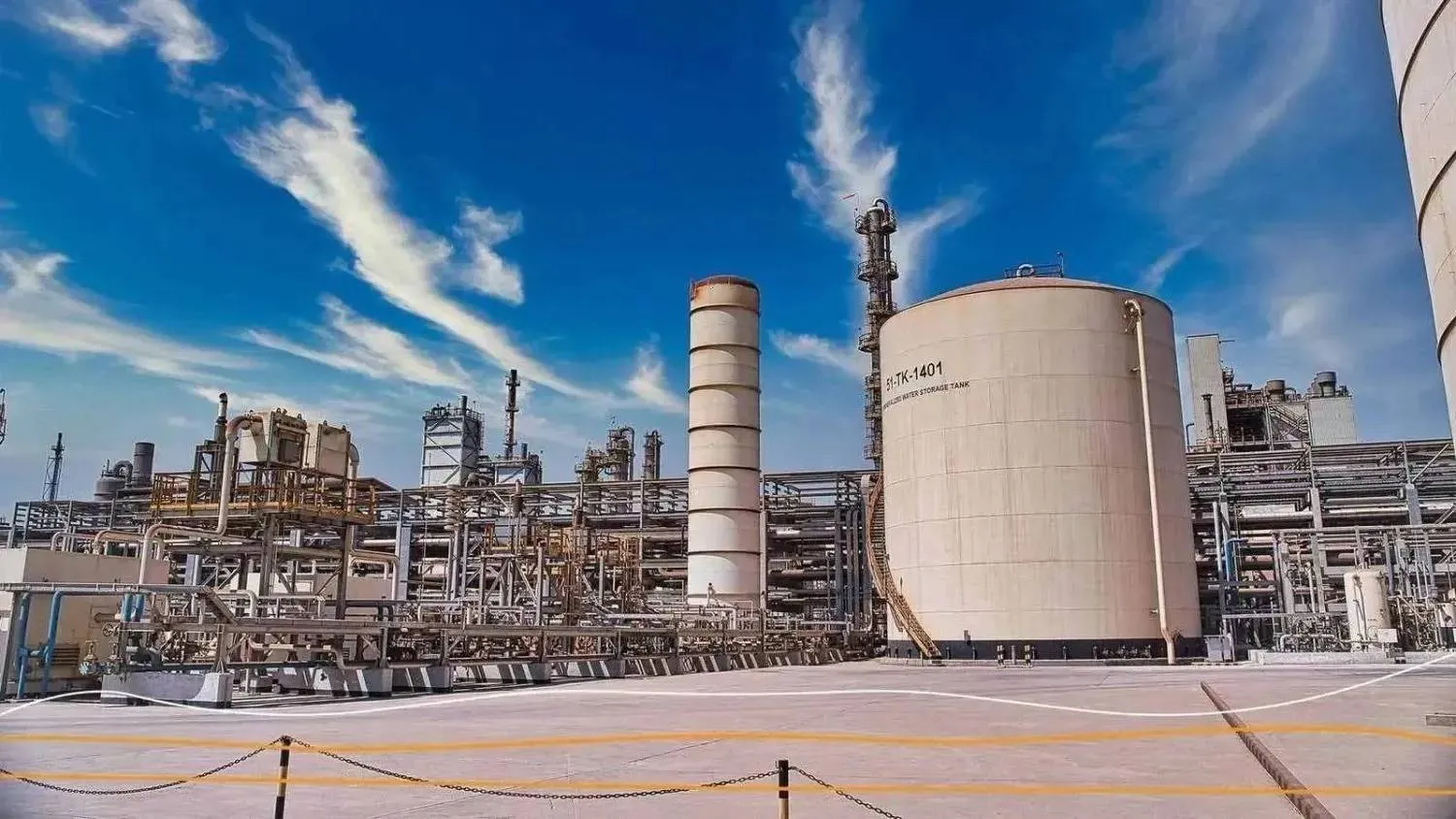

Saudi Industrial Production Index Records Highest Growth Since Early 2023

A facility operated by the Saudi International Petrochemical Company (Sipchem). (Sipchem)
TT

Saudi Industrial Production Index Records Highest Growth Since Early 2023

A facility operated by the Saudi International Petrochemical Company (Sipchem). (Sipchem)

Saudi Arabia’s Industrial Production Index posted a year-on-year increase of 10.4 percent in November 2025, compared with the same month a year earlier, marking its highest growth rate since the beginning of 2023, according to preliminary data. On a monthly basis, however, the index declined by 0.7 percent.

Data released by the General Authority for Statistics on Sunday showed that the index for oil-related activities rose by 12.9 percent year on year in November, while the index for non-oil activities increased by 4.4 percent compared with the same month of the previous year.

Month on month, the index for oil activities recorded a rise of 0.5 percent, while the non-oil activities index fell by 3.4 percent compared with October 2025.

In November, the sub-index for mining and quarrying activities climbed 12.6 percent year on year, driven by higher oil production during the month. Saudi oil output rose to 10.1 million barrels per day, compared with 8.9 million barrels per day in November last year.

On a monthly basis, the mining and quarrying sub-index also increased by 0.5 percent.

The manufacturing sub-index recorded an annual rise of 8.1 percent, supported by a 14.5 percent increase in the manufacture of coke and refined petroleum products, as well as a 10.9 percent rise in the manufacture of chemicals and chemical products.

In monthly terms, preliminary results showed the manufacturing sub-index edged up by 0.3 percent, buoyed by a 0.3 percent increase in the manufacture of coke and refined petroleum products and a 1.0 percent rise in the manufacture of chemicals and chemical products.

As for other activities, the sub-index for electricity, gas, steam and air-conditioning supply fell by 4.3 percent year on year. In contrast, the sub-index for water supply, sewerage, waste management and remediation activities rose by 10.2 percent compared with November last year.

Compared with October 2025, the electricity, gas, steam and air-conditioning supply sub-index dropped sharply by 28.6 percent, while the water supply, sewerage, waste management and remediation activities sub-index declined by 3.1 percent.



Saudi Arabia Consolidates Its Position Among the World’s Top 20 Economies in 2026

Riyadh, Saudi Arabia (Reuters) 
TT

Saudi Arabia Consolidates Its Position Among the World’s Top 20 Economies in 2026

Riyadh, Saudi Arabia (Reuters) 

As the global financial landscape is reshaped by accelerating geopolitical shifts, economic data show that Saudi Arabia has firmly consolidated its place among the world’s 20 largest economies in 2026.

This standing reflects the success of Vision 2030 in diversifying income sources and expanding gross domestic product. The Kingdom ranks 19th globally, outperforming several long-established economies, with GDP projected at $1.316 trillion.

According to data based on International Monetary Fund reports released in October 2025, the global economy is expected to reach $123.6 trillion in 2026. Economic power remains highly concentrated, with the world’s five largest economies accounting for more than 55 percent of total global output:

United States: Continues to lead with GDP of $31.8 trillion, supported by a resilient labor market and sustained consumer spending, with real growth projected at 2.1 percent.

China: Ranks second with an estimated GDP of $20.7 trillion, despite demographic challenges and its transition toward advanced manufacturing.

Germany: Retains Europe’s top position in third place with GDP of $5.3 trillion, despite pressure from high energy costs.

India: The “rising star,” securing fourth place globally with GDP of $4.5 trillion and posting the fastest growth among major economies at 6.2 percent.

Japan: Slips to fifth place with GDP of $4.4 trillion, facing demographic headwinds despite strengths in robotics and automotive industries.

Linked to recent IMF assessments, Saudi Arabia stands out as a key pillar in what experts describe as a new “economic geography.” While many emerging markets have struggled with interest-rate volatility and inflation distortions in advanced economies - particularly the United States - the Kingdom has demonstrated a strong ability to absorb external shocks.

The IMF views Saudi Arabia’s large-scale investments in high-potential sectors not merely as a driver of domestic growth, but as part of a broader global shift in capital flows toward destinations offering stability and long-term attractiveness.

The data also underscore the strong performance of other economies on the list. Brazil ranks 11th with GDP exceeding $2.2 trillion, while Türkiye and Indonesia continue to compete closely in 16th and 17th place, respectively.


India and Germany Sign Deals to Deepen Economic and Security Ties

German Chancellor Friedrich Merz, left, shakes hands with Indian Prime Minister Narendra Modi following a joint statement to the media in Gandhinagar, India, Monday, Jan. 12, 2026. (AP)
TT

India and Germany Sign Deals to Deepen Economic and Security Ties

German Chancellor Friedrich Merz, left, shakes hands with Indian Prime Minister Narendra Modi following a joint statement to the media in Gandhinagar, India, Monday, Jan. 12, 2026. (AP)

Indian Prime Minister Narendra Modi and German Chancellor Friedrich Merz met on Monday in western Gujarat state to push for deeper economic and security ties between the South Asian nation and Europe’s largest economy.

Modi and Merz held talks in the city of Gandhinagar, where the two countries signed various agreements to enhance cooperation in the defense sector, skill development, health and education, as both nations seek to reduce dependence on China and bolster economic ties.

After the bilateral talks, Modi noted that Germany is India’s most important trading partner in the European Union and said both leaders were seeking to expand those ties.

He said the two countries are pursuing new projects in areas such as climate action, energy and mining of rare earth elements, and have also agreed on a road map to boost cooperation between their defense industries for joint development and production.

“We want to elevate the relations between India and Germany to an even higher level,” Modi said.

Germany has not traditionally had close defense ties with India, but the two sides have been trying to boost cooperation in the sector. Germany’s Thyssenkrupp is expected to partner with Indian firms to build six advanced conventional submarines in India, part of New Delhi’s ongoing efforts to modernize its naval capabilities.

Merz said India and Germany share “tremendous economic potential,” and the two countries are working together to strengthen ties in the field of security policy and defense cooperation.

“India is a desired partner, a partner of choice for Germany,” Merz said, according to a live official translation. He added that negotiations on a free trade agreement between India and the EU need to be concluded to fully realize the potential of economic ties between the two countries.

The two sides also signed an agreement that makes it easier for Indians to work in Germany's health care sector.

Merz’s visit to India — also his first to an Asian country since he took office last year — comes ahead of a planned India-EU summit later this month, where leaders hope to make progress on a long-pending free trade agreement. India hopes to deepen economic engagement with Europe in the face of US tariff rates of 50%.

During his visit, Merz toured the Sabarmati Ashram, once home to independence leader Mahatma Gandhi, and attended the International Kite Festival at the Sabarmati riverfront. Modi and Merz flew kites during the event.


Japan Aims to Dig Deep-sea Rare Earths to Reduce China Dependence

Japan's deep-sea drilling vessel, Chikyu is anchored at a pier in Shimizu port, Shizuoka prefecture on September 11, 2013. TOSHIFUMI KITAMURA / AFP/File
TT

Japan Aims to Dig Deep-sea Rare Earths to Reduce China Dependence

Japan's deep-sea drilling vessel, Chikyu is anchored at a pier in Shimizu port, Shizuoka prefecture on September 11, 2013. TOSHIFUMI KITAMURA / AFP/File

A Japanese research vessel on Monday began a historic voyage to attempt to dig deep-sea rare earths at a depth of 6,000 meters to curb dependence on China.

Scientific drilling boat called the Chikyu left Shimizu Port in Shizuoka around 9:00 am (0000 GMT) for the remote island of Minami Torishima in the Pacific, where surrounding waters are believed to contain a rich trove of valuable minerals.

The test cruise comes as China -- by far the world's biggest supplier of rare earths -- ramps up pressure on its neighbor after Prime Minister Sanae Takaichi suggested in November that Tokyo could react militarily to an attack on Taiwan.

Beijing claims self-ruled Taiwan as part of its territory and has vowed to seize it by force if necessary.

China has long used its dominance in rare earths for geopolitical leverage, including in its trade war with US President Donald Trump's administration.

Chikyu's voyage, delayed by one day due to bad weather, could lead to domestic production of rare earths, said Shoichi Ishii, program director at the Cabinet Office.

"We are considering diversifying our procurement sources and avoiding excessive reliance on specific countries," he told reporters at the port as the ship prepared to leave.

"One approach I believe could be pursued is establishing a process to achieve domestic production of rare earths," he said.

Rare earths -- 17 metals difficult to extract from the Earth's crust -- are used in everything from electric vehicles to hard drives, wind turbines and missiles.

The Japan Agency for Marine-Earth Science and Technology (JAMSTEC) has touted the test as the world's first at such depths.

The area around Minami Torishima, which is in Japan's economic waters, is estimated to contain more than 16 million tons of rare earths, which the Nikkei business daily says is the third-largest reserve globally.

These rich deposits contain an estimated 730 years' worth of dysprosium, used in high-strength magnets in phones and electric cars, and 780 years' worth of yttrium, used in lasers, Nikkei said.

"If Japan could successfully extract rare earths around Minami Torishima constantly, it will secure domestic supply chain for key industries," Takahiro Kamisuna, research associate at The International Institute for Strategic Studies (IISS), told AFP.

"Likewise, it will be a key strategic asset for Takaichi's government to significantly reduce the supply chain dependence on China."

The cruise is scheduled to last until February 14.

Recent media reports said Beijing was delaying Japanese imports as well as rare-earth exports to Tokyo, as their two-month-old spat escalates.

China this month blocked exports to Japan of "dual-use" items with potential military uses, fueling worries in Japan that Beijing could choke supplies of rare earths, some of which are included in China's list of dual-use goods.