
Global Unemployment ‘Stable’ in 2026, but Decent Jobs Lacking

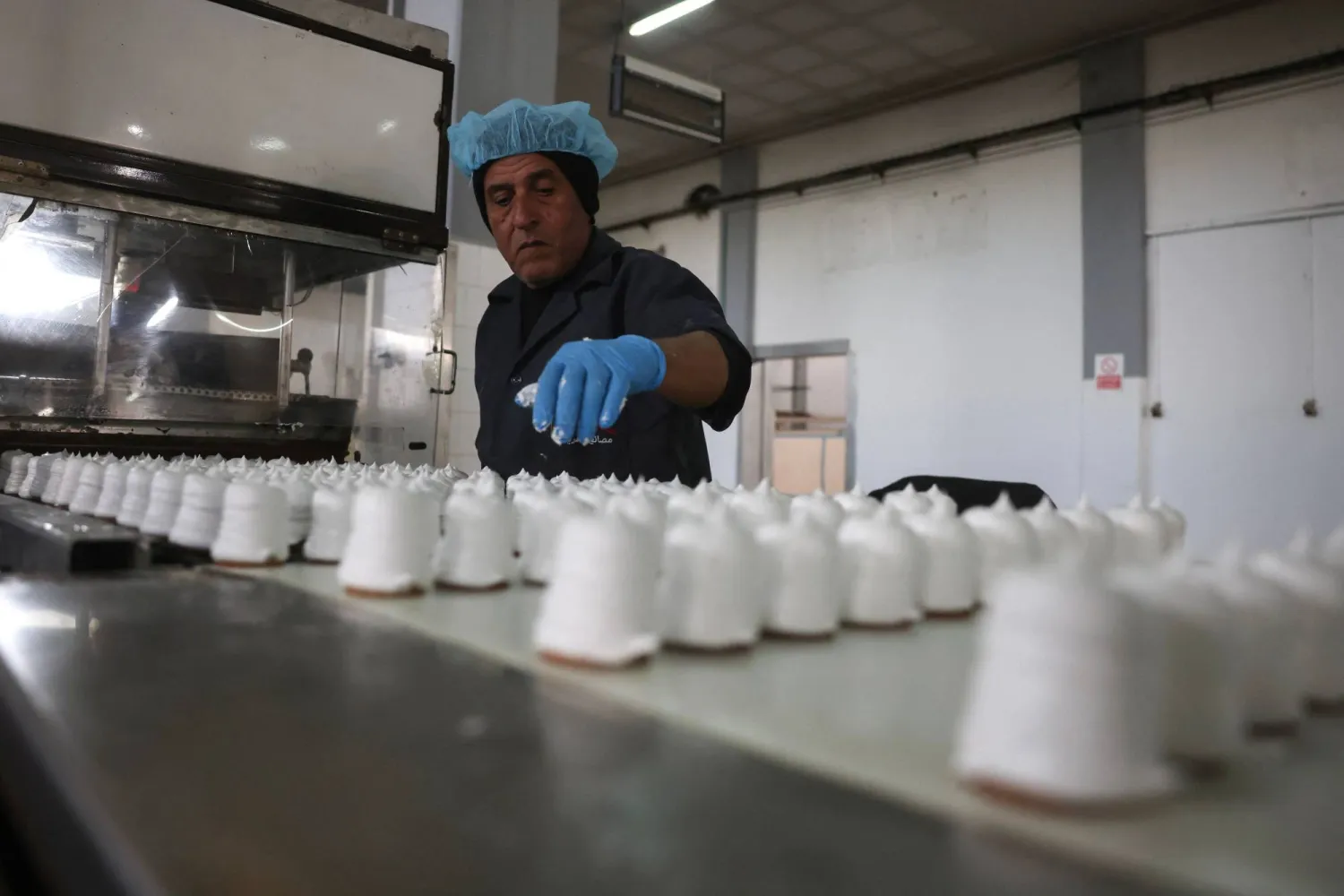
A Palestinian employee inspects sweet locally known as "al-Shatwi" (Winter) Crimbo sweets, as the Al-Arees factory gradually resumes operations after a hiatus caused by the Gaza war which led to shortages of raw materials used in their products, in Deir al-Balah, in the central Gaza Strip on January 12, 2026, following a US-brokered truce that halted the two-year war. (AFP)
TT

Global Unemployment ‘Stable’ in 2026, but Decent Jobs Lacking

A Palestinian employee inspects sweet locally known as "al-Shatwi" (Winter) Crimbo sweets, as the Al-Arees factory gradually resumes operations after a hiatus caused by the Gaza war which led to shortages of raw materials used in their products, in Deir al-Balah, in the central Gaza Strip on January 12, 2026, following a US-brokered truce that halted the two-year war. (AFP)

The global unemployment rate is expected to hold steady in 2026, the United Nations said Wednesday, but cautioned the labor market's seeming stability belies a dire shortage of decent jobs.

The UN's International Labor Organization said the global economy and labor market appeared to have weathered recent economic shocks better than expected.

But the ILO warned that efforts to improve global job quality had stagnated, leaving hundreds of millions of workers wallowing in poverty, even as trade uncertainty risked cutting into workers wages.

The global unemployment rate was estimated at 4.9 percent last year and the year before, and is now projected to remain at a similar level until 2027, a report from the UN labor agency said.

That amounts to 186 million people out of work this year, it said.

"Global labor markets look stable, but that stability is quite fragile," Caroline Fredrickson, head of the ILO's research department, told reporters, cautioning that the "apparent calm masks deeper and unresolved problems".

At a time when US President Donald Trump has slapped towering tariffs on friends and foes alike, the report cautioned that "disruptions caused by trade uncertainty, combined with ongoing long-term transformations in global trade, could significantly affect labor market outcomes".

Going forward, the ILO said its modelling suggested that a moderate increase in trade policy uncertainty "may reduce returns to labor and, as a consequence, real wages for both skilled and unskilled workers across all sectors", especially in Southeast Asia, Southern Asia and Europe.

The potential of trade to generate new employment opportunities was also being challenged by the ongoing disruptions, the report said, pointing out that 465 million jobs globally depended on foreign demand through exports of goods and services and related supply chains in 2024.

- Extreme poverty -

Another major concern highlighted by the ILO was the quality of jobs available.

"Resilient growth and stable unemployment figures should not distract us from the deeper reality: hundreds of millions of workers remain trapped in poverty, informality, and exclusion," ILO chief Gilbert Houngbo said in a statement.

Nearly 300 million workers continue to live in extreme poverty, earning less than $3 a day, Wednesday's report found.

At the same time, some 2.1 billion workers are expected to hold informal jobs this year, with limited access to social protection, labor rights and job security.

Young people remain particularly vulnerable, with unemployment among 15- to 24-year-olds projected to reach 12.4 percent for 2025, with around 260 million young people not engaged in education, employment or training, ILO said.

It warned that artificial intelligence and automation could exacerbate challenges, particularly for educated young people in wealthier countries seeking their first high-skill jobs.

"While the full impact of AI on youth employment remains uncertain, its potential magnitude warrants close monitoring," the report said.

The ILO also highlighted "entrenched gender inequalities", pointing out that women still account for just two-fifths of global employment.

"Stable labor markets are not necessarily healthy," Fredrickson said, stressing the growing need for "domestic policy choices to strengthen decent work outcomes".

"Without decisive action, today's stability risks giving way to deeper inequalities."


G7 Energy Ministers Confirm Readiness to Release Oil Stockpiles

Out of service signs are pictured on unleaded petrol and diesel fuel pumps at a petrol service station in Cambridge, eastern England on March 09, 2026. (Photo by Paul ELLIS / AFP)
TT

G7 Energy Ministers Confirm Readiness to Release Oil Stockpiles

Out of service signs are pictured on unleaded petrol and diesel fuel pumps at a petrol service station in Cambridge, eastern England on March 09, 2026. (Photo by Paul ELLIS / AFP)

Energy ministers from the Group of Seven nations confirmed readiness to ⁠take necessary steps to support ⁠global energy supplies, ⁠including possible joint release of strategic oil stockpiles, Japan's Industry Minister Ryosei Akazawa told a ⁠briefing on ⁠Tuesday.

The International Energy Agency (IEA) hosted a meeting of G7 energy ministers at its headquarters in Paris, chaired by Minister Roland Lescure of France, which holds the G7 presidency.

At the virtual meeting, the agency provided an update on its view of the situation in global oil and gas markets, which have been significantly affected by the conflict in the Middle East.

Lescure said the group is prepared to release emergency stockpiles if required.

“We are ready to take the necessary measures, including drawing on strategic reserves to stabilize the market,” Lescure said.

“We are not there yet,” he told reporters in Brussels, after hosting a meeting of G7 finance ministers.

“We are monitoring the markets, the impact on the macroeconomy but also on our citizens,” he said, adding that coordination among major economies remains central to the response.

“Everyone is willing to take measures to stabilize the market, including the US,” Lescure said.

“We have asked the IEA to elaborate scenarios for a potential oil stock release, we need to be ready to act at any moment,” he added.

For its part, the agency said in a statement, “We discussed all the available options, including making IEA emergency oil stocks available to the market. IEA Member countries currently hold over 1.2 billion barrels of public emergency oil stocks, with a further 600 million barrels of industry stocks held under government obligation.”

European governments are on edge about the prospect of a repeat of the energy crisis they faced in 2022 after Russia ⁠invaded Ukraine, when prices surged to record peaks, forcing some industries to shut down operations.

The EU imports more than 90% of its oil and around 80% of its gas, making European countries highly ⁠exposed to fluctuations in global oil and gas prices.

European Commission chief Ursula von der Leyen is due to propose measures to tackle the politically sensitive issue at an EU summit next week.

Being “completely dependent on expensive and volatile imports” of fossil fuels puts Europe at a disadvantage to other regions, von der Leyen said in a speech.

“Developments in the Middle East remind us once again of the risks of relying still too much on fossil fuels,” von der Leyen said, adding that reducing Europe's nuclear energy sector was a “strategic mistake.”

On Tuesday, the EU called on member states to help consumers and businesses by lowering taxes on energy where possible, as war in the Middle East saw oil and gas prices surge.

“If you are at all able to lower taxes on energy, especially on electricity, there is a huge potential” to reduce consumer bills, EU's energy chief Dan Jorgensen said at Parliament in Strasbourg on Tuesday.

Jorgensen said cutting taxes could help ease the financial burden on households as rising energy costs continue to affect consumers across the union.

According to the European Commission Joint Research Center, around 48 million people in Europe, roughly one in ten, cannot afford to heat their homes adequately.


CEO: Exxon Evacuated Non-essential Middle East Staff

An Exxon gas station sign in Dallas, Friday, March 6, 2026. (AP Photo/Tony Gutierrez)
TT

CEO: Exxon Evacuated Non-essential Middle East Staff

An Exxon gas station sign in Dallas, Friday, March 6, 2026. (AP Photo/Tony Gutierrez)

Exxon Mobil has evacuated non-essential employees from its operations in the Middle East, CEO Darren Woods said in an interview on Tuesday, as the US-Israel war on Iran continues.

Some operations have been scaled back to manage oil inventory levels as traffic through the Strait of Hormuz has been challenged, he said. ⁠Exxon is a ⁠minority partner in oil and gas projects in the UAE, Qatar and Saudi Arabia.

"Our first and highest priority is making sure our people remain safe, and we evacuated folks who weren't critical or essential to the operations that we were providing support for," Reuters quoted Woods as saying.

Traffic ⁠through the Strait of Hormuz, an important waterway between Iran and Oman that sees one-fifth of the world's oil supply pass through it, has effectively halted after Iran threatened to attack tankers that attempt to pass.

US President Donald Trump on Monday threatened to escalate the war with Iran if it blocked oil shipments from the Middle East, even as he predicted a quick end to the conflict.

With exports strained, oil producers have ⁠cut output ⁠at some oilfields as storage capacity runs out.

"The ability to manage ... inventory becomes very challenged, and many of the operations are pulling back simply to manage inventory levels as the logistics in the supply chain and the flow through the Strait get worked (through) with time," Woods said.

About 20% of Exxon's oil and gas production is in the Middle East, according to analysts from Jefferies. Nearly 60% of the US oil major's liquefied natural gas business is concentrated in the region, according to TD Cowen.


EU Opposes Removing Oil Sanctions on Russia to Cool Energy Prices

Pumpjacks operated by Aera Energy work the wells at the Midway-Sunset field near Taft in Kern County, California, on March 8, 2026. (Photo by Frederic J. BROWN / AFP)
TT

EU Opposes Removing Oil Sanctions on Russia to Cool Energy Prices

Pumpjacks operated by Aera Energy work the wells at the Midway-Sunset field near Taft in Kern County, California, on March 8, 2026. (Photo by Frederic J. BROWN / AFP)

EU economy chief Valdis Dombrovskis said Tuesday the European Union did not support removing sanctions on Russian oil despite soaring energy prices, AFP reported.

"We must continue to exert maximum pressure on Russia," he said when asked about US President Donald Trump's announcement he will waive some sanctions on oil, warning easing restrictions would "reinforce Russia's capacity to wage war, undermining Ukraine".