


Gold Eyes $5,600 on Flight to Safety; Silver Tops $120

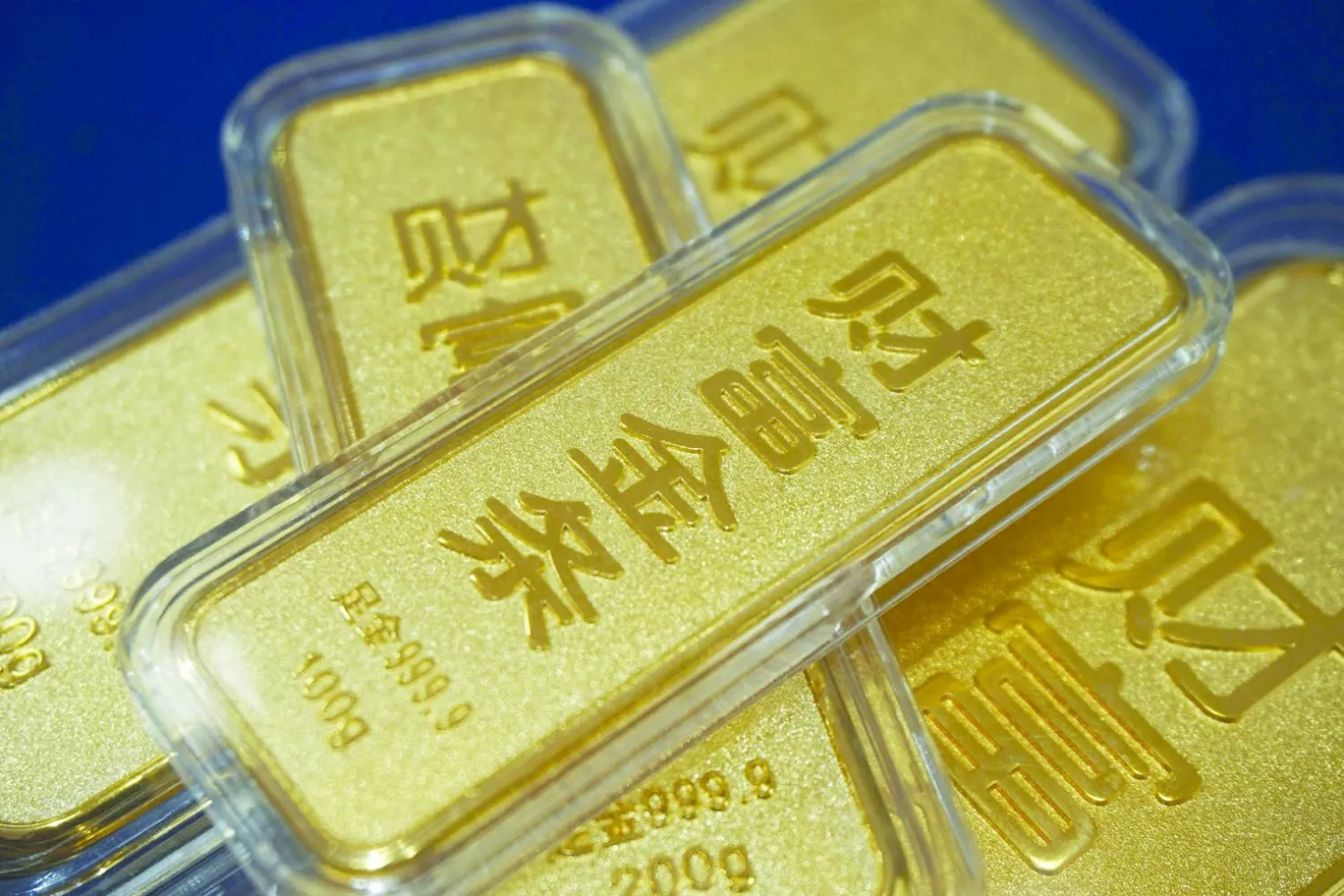
Gold bars with Chinese characters reading “Fortune Gold” are seen at a gold shop in Hangzhou, in China’s eastern Zhejiang province on January 26, 2026.  (Photo by AFP) / China OUT
Gold bars with Chinese characters reading “Fortune Gold” are seen at a gold shop in Hangzhou, in China’s eastern Zhejiang province on January 26, 2026. (Photo by AFP) / China OUT
TT

Gold Eyes $5,600 on Flight to Safety; Silver Tops $120

Gold bars with Chinese characters reading “Fortune Gold” are seen at a gold shop in Hangzhou, in China’s eastern Zhejiang province on January 26, 2026.  (Photo by AFP) / China OUT
Gold bars with Chinese characters reading “Fortune Gold” are seen at a gold shop in Hangzhou, in China’s eastern Zhejiang province on January 26, 2026. (Photo by AFP) / China OUT

Gold marched ahead on Thursday, hovering just shy of $5,600 an ounce as investors rushed into safe havens amid geopolitical and economic unease, while silver vaulted past $120.

Spot gold shot up 3% to $5,560.07 an ounce by 0557 GMT, after hitting a record $5,594.82 earlier in the day. The metal has hit record-highs for nine straight sessions, Reuters said.

"Gold prices are (rising on) safe-haven demand because of the strange geopolitical situation and even the political situation in the US, (which is) not looking great. There are concerns around Fed independence. And when that happens, investor trust in ‌the financial system ‌gets shaken up," said ANZ analyst Soni Kumari.

Investors are ‌worried ⁠about the US ‌Federal Reserve's independence amid the Trump administration's criminal investigation into Chair Jerome Powell, efforts to fire Fed Governor Lisa Cook, and the looming nomination of Powell's replacement in May.

"Growing US debt and uncertainty created by signs that the global trade system is splintering into regional blocs as opposed to a US-centric model (are leading investors to pile into gold)," said Marex analyst Edward Meir.

The yellow metal jumped past the $5,000 mark for the first time on Monday and ⁠has gained more than 10% so far this week, with strong safe-haven demand, firm central bank buying, and ‌a weaker dollar, all driving prices higher.

Gold has already ‍gained more than 27% this year, ‍following a 64% jump in 2025.

"Although the parabolic nature of the rally suggests ‍a pullback is not far away, the underlying fundamentals are expected to remain supportive throughout 2026, positioning any dips as attractive buying opportunities," IG market analyst Tony Sycamore said.

US President Donald Trump urged Iran on Wednesday to come to the table and strike a deal on nuclear weapons. He warned that any future US attack would be far more severe than the one last year when Iranian nuclear sites were struck.

Tehran responded ⁠with a threat to strike back against the US, Israel, and those who support them.

Meanwhile, the Fed left rates unchanged on Wednesday, as widely expected. Powell said inflation in December was likely still well above the central bank's 2% target.

With elevated gold prices, customers have been flocking to precious metal traders in Shanghai and Hong Kong, with some betting it could rise even further.

Elsewhere, spot silver was up 1.4% at $118.25 an ounce after hitting a record high of $120.45 earlier. Demand from investors looking for cheaper alternatives to gold, along with supply shortages and momentum buying, helped the white metal, which has already jumped more than 60% thus far in 2026.

Spot platinum climbed 2.8% to $2,770.49 an ounce, after hitting ‌a record high of $2,918.80 on Monday, while palladium rose 1.6% to $2,107.37.


Saudi Arabia Concludes Privatization Program

The Saudi capital (Reuters)
TT

Saudi Arabia Concludes Privatization Program

The Saudi capital (Reuters)

Saudi Arabia’s Council of Economic and Development Affairs (CEDA) has approved the conclusion of the Kingdom’s Privatization Program after its implementation and objectives were fully completed, in line with the roadmap established when the initiative was launched in 2018.

The decision was taken during a meeting held via videoconference on Wednesday, during which the council also reviewed key developments in the domestic and global economic landscape.

The council highlighted the strong competitive capabilities of the Saudi economy in confronting expected global shifts in 2026, noting that current financial indicators reflect an upward trajectory driven by robust growth in non-oil sectors, alongside the recovery of petroleum activities and the expansion of the national industrial base.

Launched in 2018, the Privatization Program aimed to support national economic growth, strengthen the role of the private sector, and identify government assets, services, and resources suitable for privatization across multiple sectors. The program sought to improve the quality and efficiency of public services while reducing their cost for individuals and businesses.

At the start of its virtual meeting, the council reviewed the monthly report submitted by the Ministry of Economy and Planning, which addressed recent developments in the global economy and growth prospects for 2026 amid ongoing challenges, as well as their potential impact on the national economy and its ability to adapt to global economic changes.

The report underscored the positive trend reflected in various economic and financial indicators, including GDP growth driven by continued expansion in non-oil activities, the recovery of oil-related sectors, rising industrial output, and stable inflation, supported by government measures to regulate real estate prices and maintain balance in the property market.

The conclusion of the Privatization Program marks a transition from a foundational phase to a new phase focused on implementation and maximizing impact. This shift will be guided by the National Privatization Strategy, which has reviewed targets, developed new opportunities, and established a comprehensive national framework for prioritizing initiatives across key sectors.


Saudi Arabia Exempts High-Growth Sectors from Franchise Experience Rule

One of the franchising roadshows organized by the General Authority for Small and Medium Enterprises to support entrepreneurs (SPA)
TT

Saudi Arabia Exempts High-Growth Sectors from Franchise Experience Rule

One of the franchising roadshows organized by the General Authority for Small and Medium Enterprises to support entrepreneurs (SPA)

Saudi Arabia will allow selected high-growth and innovative sectors to offer franchises without meeting a long-standing operational experience requirement, in a move aimed at accelerating investment and broadening entrepreneurship.

The decision aligns with Vision 2030's goals to expand opportunities in sectors that support national economic growth and meet local market demand.

According to the information, the Council of Ministers approved the non-application of Article Five of the Franchise Law to certain franchisors. The article required businesses to operate for at least 1 year through at least two outlets before offering franchises.

The exemption targets key sectors, including transport and logistics, aviation and defense, entertainment and tourism, sports, healthcare, mining, and renewable energy.

The move is intended to strengthen the local economy’s regional and global competitiveness by creating a flexible environment that allows innovative projects to expand rapidly through franchising, without waiting for traditional establishment periods.

Franchisors must, however, present a clear and detailed business model, including a feasibility study and guarantees of success.

Strict criteria to protect franchisees

To ensure investment quality, the government has set specific conditions for benefiting from the exemption, including:

Franchisors must submit a clear, detailed business model that includes operational guidelines and a market analysis, serving as a practical manual supported by a feasibility study that underpins success.

The franchised activity must be innovative or offer a product or service that contributes to national economic development or meets local market demand. Applications will be assessed based on innovation, economic impact, or responsiveness to market needs.

The exemption also requires that franchisors not charge franchisees any consideration before operations begin. Fees may be collected only after revenues are generated, as defined in the agreement, to reduce operational risks for franchisees and link payments to actual performance.

Specialized committee

To ensure governance, the information revealed the formation of a specialized committee, chaired by the Ministry of Commerce, with members from the Ministries of Investment, Economy, and Planning.

The committee will evaluate exemption applications based on economic impact and the quality of the proposed business model.

A modern system for a secure investment environment

Saudi Arabia’s Franchise Law, approved in 2019, is considered a cornerstone of the Kingdom’s modern commercial regulatory framework. It aims to enhance transparency and clarity in the relationship between franchisors and franchisees, while providing legal protection for both sides.

The law promotes franchising activity in the Kingdom by establishing a clear regulatory framework governing the relationship between franchisors and franchisees, reinforcing transparency and clarity.

It provides necessary protections for both parties and enables informed investment decisions that help raise the quality of goods and services offered in Saudi Arabia.

The provisions of the Franchise Law apply to any franchise agreement implemented within the Kingdom. The law sets a minimum experience requirement for franchisors, regulates the contractual relationship between the parties, and defines their rights and obligations.

It also requires franchisors to disclose key risks, rights, and obligations associated with franchise opportunities, and governs the renewal, termination, or transfer of franchise agreements.


Bessent Says Disappointed by EU-India Deal; South Korea Must Ratify Trade Deal

 Treasury Secretary Scott Bessent speaks during an event at Carnegie Mellon Auditorium, Wednesday, Jan. 28, 2026, in Washington. (AP)
Treasury Secretary Scott Bessent speaks during an event at Carnegie Mellon Auditorium, Wednesday, Jan. 28, 2026, in Washington. (AP)
TT

Bessent Says Disappointed by EU-India Deal; South Korea Must Ratify Trade Deal

 Treasury Secretary Scott Bessent speaks during an event at Carnegie Mellon Auditorium, Wednesday, Jan. 28, 2026, in Washington. (AP)
Treasury Secretary Scott Bessent speaks during an event at Carnegie Mellon Auditorium, Wednesday, Jan. 28, 2026, in Washington. (AP)

US Treasury Secretary Scott Bessent said on Wednesday he was disappointed by Europe's decision to strike a major trade agreement with India, saying it showed Europe put trade ahead of the interests of the Ukrainian people.

Bessent told CNBC that Europe had been buying refined products made in India with sanctioned Russian oil supplies, and had been unwilling to match higher US tariffs on Indian goods because they were separately negotiating a trade agreement.

The European Union on Tuesday finalized a long-delayed trade deal with India that aims to boost two-way trade and reduce the bloc's reliance on the United States amid growing ‌global trade tensions.

The deal ‌is expected to double EU exports to India ‌by ⁠2032 by eliminating or ‌reducing tariffs on 96.6% of traded goods by value, and will lead to savings of 4 billion euros ($4.8 billion) in duties for European companies, the EU said.

Asked whether this deal and others among countries excluding the United States would threaten the US, Bessent said: "They should do what's best for themselves, but I will tell you, I found, I find the Europeans very disappointing."

He said the deal made it clear why Brussels had balked ⁠at joining Washington's decision to impose 25% tariffs on India last year as part of a push to reduce ‌its purchases of Russian oil.

"The Europeans were unwilling to join ‍us, and it turns out, because they ‍wanted to do this trade deal," he said. "So, every time you hear a ‍European talk about the importance of the Ukrainian people, remember that they put trade ahead of the Ukrainian people."

Bessent last week had signaled the potential removal of the 25% additional US tariffs on India following a sharp reduction in Indian imports of Russian oil.

Bessent's disparaging comments about Europe came amid heightened tensions after President Donald Trump threatened to raise tariffs on imports from certain European countries over their opposition to his pursuit ⁠of Greenland. That tariff threat was later dropped, but it left many Europeans unsettled and anxious about the future of Transatlantic trade.

US officials remain frustrated that the EU has not enacted the tariff reductions it promised as part of a framework trade deal reached with Washington in July.

Those concerns were heightened this week when Trump raised duties on imports from South Korea to 25% from 15%, citing slow moves by the country's parliament to implement a framework trade agreement reached with Washington last year.

Bessent defended Trump's action, saying it was "helpful to get things moved along", adding that the South Korean parliament needed to ratify the trade deal.

Trump on Tuesday said he expected the United States and South Korea to ‌work out a solution, but he did not elaborate.

South Korean officials are due to arrive in Washington on Wednesday for talks with trade officials.
