


Could Egypt’s ‘SUMED’ Pipeline Temporarily Replace the Strait of Hormuz?

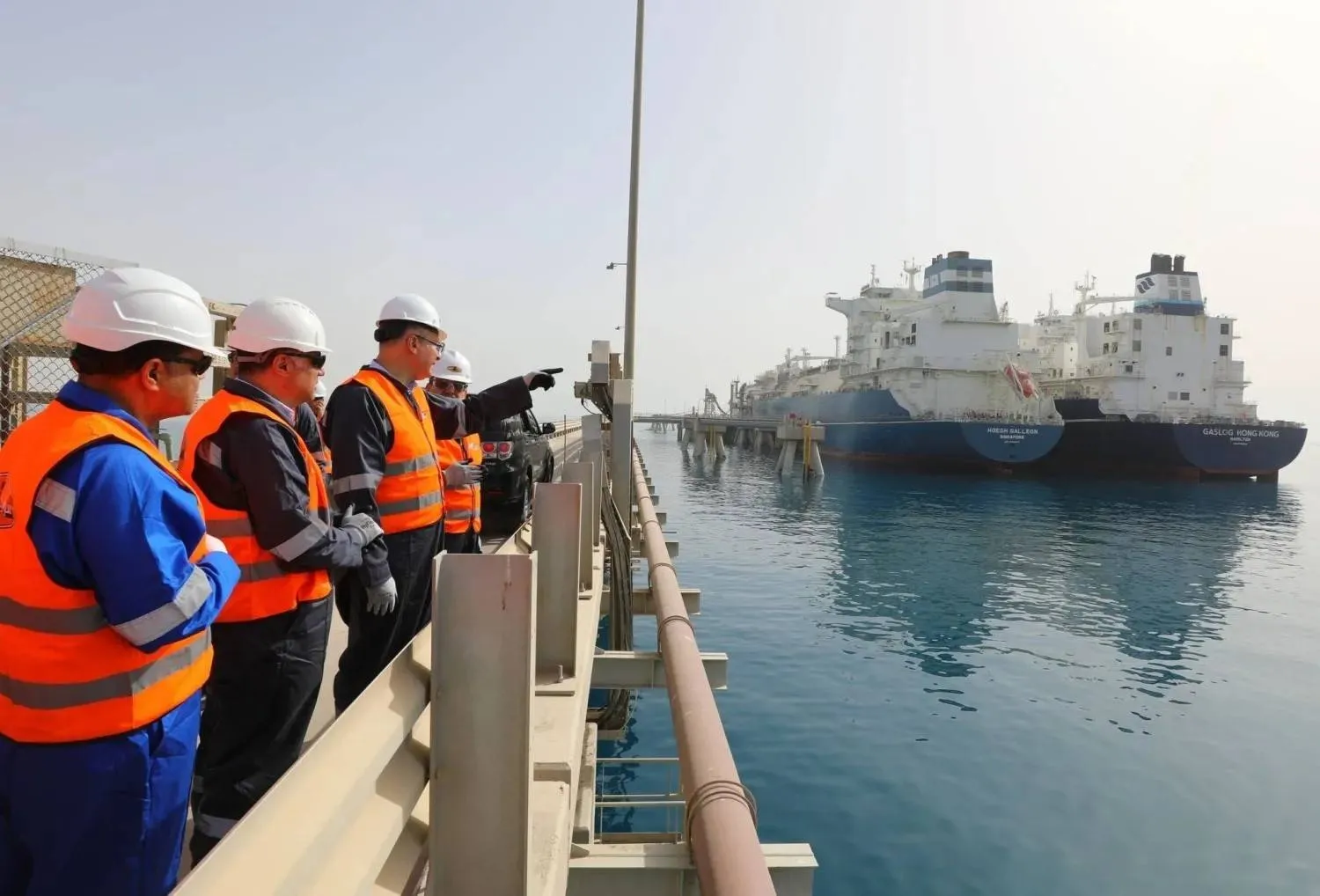
Egypt’s Petroleum Minister Karim Badawi during an inspection tour of SUMED port (Egyptian Petroleum Ministry)
TT

Could Egypt’s ‘SUMED’ Pipeline Temporarily Replace the Strait of Hormuz?

Egypt’s Petroleum Minister Karim Badawi during an inspection tour of SUMED port (Egyptian Petroleum Ministry)

Amid the ongoing Iran war and Tehran’s announcement of the closure of the Strait of Hormuz, a key artery for global energy supplies, Egypt has begun highlighting the SUMED pipeline linking the Red Sea and the Mediterranean as a potential temporary alternative for oil transport.

The move has raised questions about whether the pipeline, a vital connection between the two seas, could help offset disruptions to the volatile waterway.

Egypt’s Minister of Petroleum and Mineral Resources Karim Badawi addressed the issue during a government press conference on Tuesday, saying Egypt “has sufficient technical and logistical capabilities to support this strategic route.”

He said the SUMED pipeline enhances the flexibility of oil supply flows in the region and confirmed Egypt’s readiness to cooperate with Gulf states to facilitate oil transport from the Red Sea to the Mediterranean through the line.

Energy experts who spoke to Asharq Al-Awsat agreed that the pipeline could help ease the current energy crisis amid the absence of any political solution to end the war, noting the line was originally designed as an alternative route when oil shipments face obstacles passing through the Suez Canal.

SUMED pipeline

The pipeline is owned by the Arab Petroleum Pipelines Company (SUMED), an Arab joint venture led by Egypt, with a 50% stake held by the Egyptian General Petroleum Corporation, alongside partners from Gulf states.

The pipeline runs across Egypt from Ain Sokhna on the Gulf of Suez to Sidi Kerir on the Mediterranean coast, with a capacity of about 2.8 million barrels per day.

According to Egypt’s petroleum ministry, the pipeline transported about 24.9 billion barrels of crude oil and more than 730 million barrels of petroleum products from its launch in 1974 through 2024.

Ahmed Kandil, head of Energy Studies Program at the Al-Ahram Center for Political and Strategic Studies, said the line’s importance lies in easing disruptions to oil trade following Tehran’s declaration that it had closed the Strait of Hormuz.

He told Asharq Al-Awsat that oil shipments could reach the pipeline via tankers transporting crude from Saudi Arabia’s Yanbu port to Egypt’s Ain Sokhna port, from where it would move through the pipeline to the Mediterranean and onward to Europe.

He said coordination with Gulf states is underway to contain concerns over energy supplies, particularly among European consumers.

Kandil added that the arrival of part of Gulf exports to European markets is highly important, helping limit spikes in Brent crude prices, which have already surpassed $80 per barrel.

“The growing importance of the Egyptian pipeline comes amid the absence of a political horizon, which means the current conflict could be prolonged,” he said.

Storage capacity

According to the US Energy Information Administration, the main reason for building the SUMED pipeline at this location is that very large crude carriers — capable of transporting about 2.2 million barrels — cannot pass through the Suez Canal due to their excessive weight and width, which could risk grounding.

Instead, they offload their cargo at Ain Sokhna, where the oil is transported through the pipeline to the other side of Egypt. Smaller vessels then reload the crude at Sidi Kerir and sail to Europe and the United States.

Energy markets expert Ramadan Abu Al-Ala said the Egyptian pipeline serves as an alternative to the Suez Canal and could temporarily ease the crisis caused by the closure of the Strait of Hormuz.

He noted that the pipeline is particularly effective for oil tankers arriving from Saudi Arabia, Oman, Bahrain and the United Arab Emirates, which can unload at Ain Sokhna before the crude is transported to the Mediterranean and European markets.

Abu Al-Ala expects SUMED to become even more important for Gulf oil exports to Europe if the war drags on, increasing reliance on the pipeline. However, he said this would require enhanced security measures for oil tankers operating in the Red Sea.

Energy market experts also highlighted another advantage: the pipeline’s large storage capacity. SUMED operates storage tanks with a total capacity of 40 million barrels of oil.

In February 2019, Saudi Aramco signed two agreements with the company to provide storage capacity for diesel and fuel oil.



Saudi Arabia’s Operating Revenue Index Climbs 12.2% in September

The King Abdullah Financial District (KAFD) in Riyadh. (Royal Commission for Riyadh City)
TT

Saudi Arabia’s Operating Revenue Index Climbs 12.2% in September

The King Abdullah Financial District (KAFD) in Riyadh. (Royal Commission for Riyadh City)

Saudi Arabia’s operating revenue index rose 12.2% year-on-year in September 2026 and gained 6.6% from August, according to data from the General Authority for Statistics (GASTAT).

The annual growth was driven by a 27.5% surge in mining and quarrying activities and a 15% rise in manufacturing. Financial and insurance activities expanded 19.3%, while wholesale and retail trade and motor vehicle repair activities grew 2.1%. Construction activities edged up 0.4%.

On a monthly basis, the index was bolstered by a 37.3% jump in mining and quarrying, a 3.5% gain in manufacturing and 4% growth in financial and insurance activities.

Human health and social work activities also advanced 3.5%, while professional, scientific and technical activities rose 1.2%.

Saudi Arabia’s employee compensation index climbed 6.8% year-on-year in September, supported by growth across several economic sectors.

Manufacturing activities recorded an 8.4% gain, followed by wholesale and retail trade and motor vehicle repair activities at 8.2%, financial and insurance activities at 5.6%, mining and quarrying at 5.2%, and construction at 2%.

On a monthly basis, the index edged up 0.5%, driven by gains of 1% each in financial and insurance activities and transportation and storage.

Construction activities advanced 0.8%, manufacturing grew 0.3%, and mining and quarrying rose 0.2%.

The number of building permits issued in Saudi Arabia jumped 14.6% year-on-year in September 2026 to 6,092, compared with 5,317 in the same month of 2025.

On a monthly basis, the number of permits issued grew 8.4% from 5,621 in August 2026.


Saudi Real Estate Firms Earn $1.1 Billion Despite Mixed Results

Saudi Arabia’s real estate market is seeing an expansion in development projects and an increase in property supply. (SPA)
TT

Saudi Real Estate Firms Earn $1.1 Billion Despite Mixed Results

Saudi Arabia’s real estate market is seeing an expansion in development projects and an increase in property supply. (SPA)

Saudi Arabia’s listed real estate companies reported a 7% decline in combined net profits during the first nine months of 2026, reflecting uneven performance as expanding property supply and intensifying competition put greater emphasis on operational efficiency, financing and liquidity management.

Combined net profits of property management and development companies fell to SAR 4.11 billion ($1.1 billion), from SAR 4.42 billion ($1.18 billion) a year earlier, a decline of approximately SAR 310 million ($82.7 million).

While several major companies posted earnings growth, weaker results and losses at others weighed on the sector’s overall performance.

The figures highlight differences in companies’ ability to capitalize on market growth and development projects, particularly as property supply expands in Riyadh. Capital management, project execution and the ability to generate sustainable cash flows are becoming increasingly important determinants of profitability.

Most profitable companies

Cenomi Centers topped the sector with net profits of SAR 993.1 million ($264.8 million), despite a 16.6% year-on-year decline from SAR 1.19 billion ($317.3 million).

Masar, the listed Umm Al Qura for Development and Construction Co., ranked second with SAR 927.95 million ($247.5 million), up 1.7%. Dar Al Arkan Real Estate Development came third, reporting a 12.1% increase in profits to SAR 789 million ($210.4 million), from SAR 703.6 million ($187.6 million).

The rankings reflect differences in revenue sources. Companies operating income-generating properties and shopping centers rely more heavily on recurring operating income, while developers’ earnings fluctuate according to land and unit sales, project handovers and revenue recognition.

Saudi Real Estate Company (Al Akaria) recorded one of the strongest increases, with net profits surging 127.2% to SAR 609.9 million ($162.6 million), from SAR 268.5 million ($71.6 million).

However, revenue fell 27.3% to approximately SAR 1.1 billion ($293.3 million), from SAR 1.53 billion ($408 million), alongside a decline in operating profit. The earnings increase was partly driven by nonrecurring gains recorded in the first quarter, underscoring the distinction between one-off accounting gains and profits generated by core operations.

Makkah Construction and Development Company reported profits of SAR 415.6 million ($110.8 million), up nearly 9%, while Taiba Investments earned SAR 230.9 million ($61.6 million).

Sumou Real Estate posted SAR 110 million ($29.3 million), up 1.3%, supported by higher revenue from development and contracting activities. Retal Urban Development Company reported SAR 93.7 million ($25 million).

Meanwhile, Emaar, The Economic City, Red Sea International, Ladun Investment and Ayyan Investment Company recorded losses, weighing on combined sector earnings.

Third-quarter results

Combined third-quarter net profits fell 16.8% year-on-year to SAR 1.51 billion ($402.9 million), from SAR 1.82 billion ($484.1 million). However, earnings rose 16.5% from the second quarter, when they totaled around SAR 1.3 billion ($346.7 million), indicating a sequential improvement despite continued year-on-year pressure.

Masar led third-quarter earnings with SAR 666.9 million ($177.8 million), up 29.1% year-on-year.

Cenomi Centers followed with SAR 404.9 million ($108 million), down 19.1%, while Dar Al Arkan ranked third with SAR 290 million ($77.3 million), up approximately 13.5%.

Knowledge Economic City recorded a 253% surge in quarterly profits to SAR 99.7 million ($26.6 million), from SAR 28.2 million ($7.5 million).

By contrast, Al Akaria’s quarterly profits fell 20.6% to SAR 30.9 million ($8.2 million), alongside a 10.3% decline in revenue.

Riyadh Development Company reported a 73.8% drop in profits to SAR 37.7 million ($10 million), while Alramz Real Estate Company saw earnings plunge 94.1% to SAR 10.1 million ($2.7 million).

Emaar, The Economic City posted a quarterly loss of SAR 241 million ($64.3 million), while Red Sea International recorded a loss of SAR 31.2 million ($8.3 million).

Uneven performance

Real estate expert Abdullah Al-Mousa told Asharq Al-Awsat that the nine-month results reflected disparities in companies’ financial and operational performance rather than a broad downturn in the sector.

He said the 7% decline in combined profits, despite continued earnings growth at several companies, demonstrated differences in their ability to adapt to market conditions, depending on their business activities, revenue sources and stages of project execution.

Al-Mousa stressed the importance of distinguishing property market performance from companies’ reported accounting profits.

Earnings, he explained, are influenced not only by demand and property transactions but also by project execution and handover schedules, revenue recognition, financing and operating costs, and exceptional gains that may not reflect improvements in underlying operations.

He noted that owners of income-generating assets benefit from recurring operating revenue, while developers are more exposed to project cycles and the timing of land and property sales.

He added that the sector is gradually shifting toward greater emphasis on operational efficiency, earnings quality and liquidity management. Portfolio size and project value are no longer sufficient measures of a company’s strength, he said. What increasingly matters is its ability to convert investments into stable cash flows and sustainable returns.

Profit margins in 2027

Looking ahead to 2027, Al-Mousa expects growth opportunities to persist, supported by population growth, urban expansion, development projects and housing programs.

However, companies’ ability to capitalize on these opportunities will depend on their financial strength, execution efficiency and capacity to deliver products aligned with market demand and buyers’ purchasing power.

He said increasing property supply, particularly in Riyadh, presents both opportunities and challenges. While greater supply expands consumer choice and strengthens competition, it could also put pressure on prices and developers’ profit margins, particularly for similar properties or those whose prices are not aligned with actual market demand.

More efficient companies could offset some margin pressure through higher sales volumes and faster capital turnover.

Al-Mousa said competitive advantages would increasingly favor developers capable of diversifying their portfolios, controlling construction and financing costs, and accelerating project completion.

Financing and construction expenses, lengthy development cycles, liquidity management and project handover schedules will remain major challenges, particularly for companies pursuing capital-intensive expansion and relying heavily on financing.

He expects 2027 to test developers’ ability to deliver sustainable growth as competition intensifies and pricing becomes more disciplined.

Ultimately, he said, the strongest performers will not necessarily be those with the largest portfolios or the most projects, but those capable of developing assets efficiently, meeting market needs and converting investments into sustainable cash flows and profits.


France’s 2027 Economic Growth Forecast of 1% at Risk of Being Downgraded, Minister Says

France's Economy, Finances and Industry Minister Roland Lescure speaks during the weekly session of Questions to the Government at the French National Assembly (Assemblee Nationale), France's lower house of Parliament, in Paris on November 17, 2026. (AFP)
TT

France’s 2027 Economic Growth Forecast of 1% at Risk of Being Downgraded, Minister Says

France's Economy, Finances and Industry Minister Roland Lescure speaks during the weekly session of Questions to the Government at the French National Assembly (Assemblee Nationale), France's lower house of Parliament, in Paris on November 17, 2026. (AFP)

The French government's 2027 economic growth forecast of 1% for 2027 is at risk of being downgraded but the goal ‌of limiting ‌the public deficit ‌to ⁠5% of gross domestic ⁠product (GDP) must be maintained, French Finance Minister Roland Lescure said on Monday.

"We are currently updating our figures but ⁠it (the forecast) is at ‌risk ‌and the risk is that ‌of a downgrade," Lescure ‌told Franceinfo television, adding the new data will be disclosed in January.

"The objective of ‌5% public deficit (for 2027) must be kept regardless ⁠of ⁠uncertainties over economic growth. It is non-negotiable."

Lescure also confirmed that President Emmanuel Macron was considering a constitutional reform that would impose stricter controls on public spending as France grapples with mounting debt and persistent budget deficits.