


Trump Seeks to Close $1.6 trillion Revenue Gap with Raft of New Tariffs

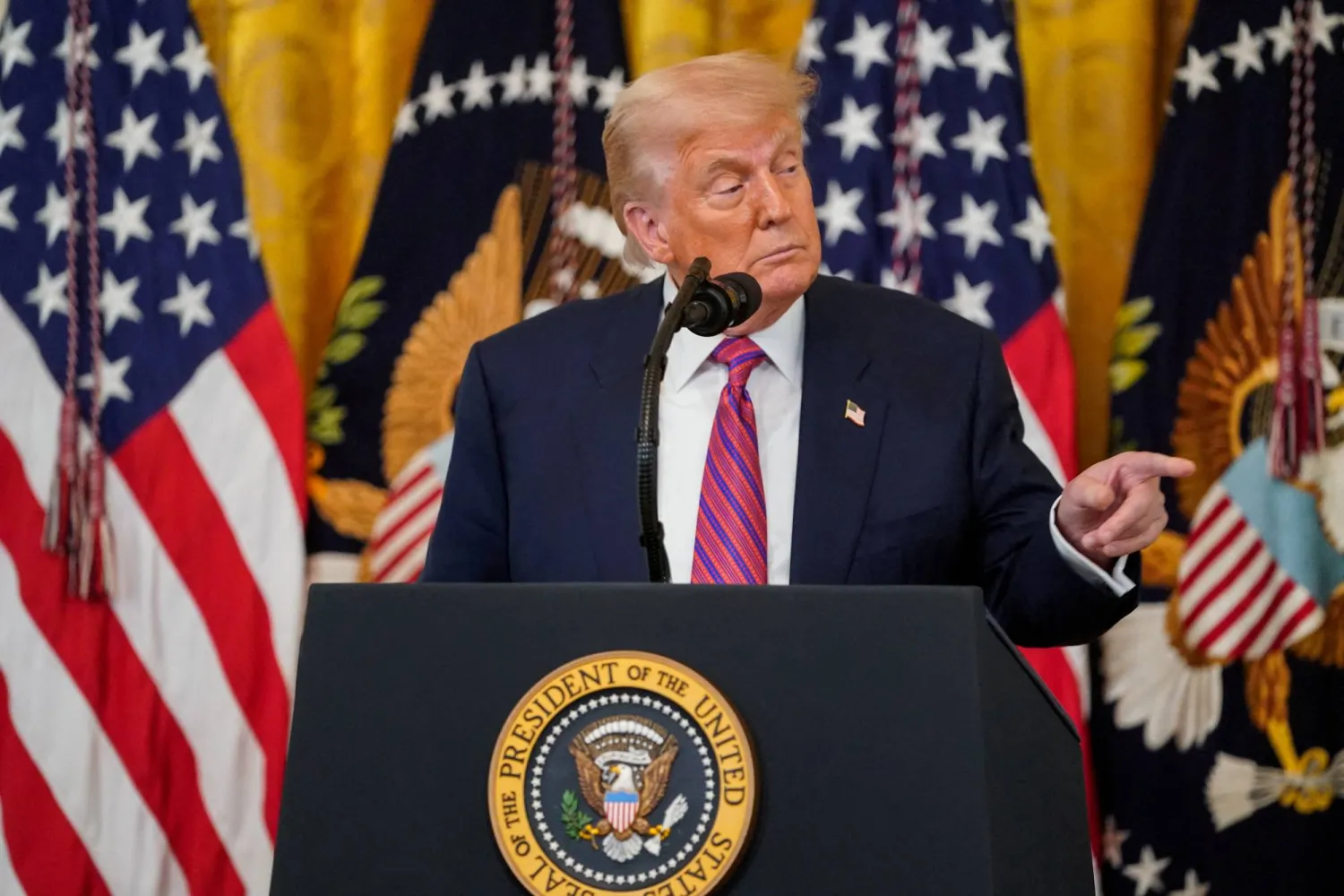
US President Donald Trump speaks before signing the "Genius Act", which will develop regulatory framework for stablecoin cryptocurrencies and expand oversight of the industry, at the White House in Washington, D.C., US, July 18, 2025. REUTERS/Nathan Howard/File Photo
TT

Trump Seeks to Close $1.6 trillion Revenue Gap with Raft of New Tariffs

US President Donald Trump speaks before signing the "Genius Act", which will develop regulatory framework for stablecoin cryptocurrencies and expand oversight of the industry, at the White House in Washington, D.C., US, July 18, 2025. REUTERS/Nathan Howard/File Photo

The Trump administration this week stepped up its ambitious effort to replace about $1.6 trillion in lost tariff revenue that was eliminated by the Supreme Court's decision to strike down a range of the president's import taxes.

Recovering that lost revenue, which the White House was counting on to help offset the steep, multi-trillion dollar cost of its tax cuts, is possible but will be challenging, experts say. The administration has to use different legal provisions to impose new duties, and those provisions require longer, complex processes that US companies can use to seek exemptions. It could be months or more before it is clear how much revenue the replacement tariffs will yield.

“I wouldn't bet against this administration being able to get back on paper the same effective tariff rate they had before," said Elena Patel, co-director of the Urban-Brookings Tax Policy Center. But the new approach will “make it easier for people to contest the tariffs, which is going to put a big asterisk on the revenue until all that is settled.”

On Wednesday, US Trade Representative Jamieson Greer said the administration will investigate 16 economies — including the European Union — over whether their governments are subsidizing excessive factory capacity in a way that disadvantages US manufacturing. The investigation will also cover China, South Korea, and Japan, Greer said.

In addition, he said there would be a second investigation of dozens of countries to see if their failure to ban goods made by forced labor amounts to an unfair trade practice that harms the United States. That investigation will also cover the EU and China, as well as Mexico, Canada, Australia, and Brazil.

Both investigations are being conducted under Section 301 of the 1974 Trade Act, which requires the administration to consult with the targeted countries, as well as hold public hearings and allow affected US industries to comment. A hearing as part of the factory capacity investigation will be held May 5, while a hearing on the forced labor investigation will occur April 28.

It's a far cry from the emergency law that President Donald Trump relied on in his first year in office, which allowed him to immediately impose tariffs on any country, at nearly any level, simply by issuing an executive order.

Moments after the Supreme Court's ruling, Trump imposed a 10% tariff on all imports under a separate legal authority, but that duty can only last for 150 days. The president has said he would raise it to 15%, the maximum allowed, but has yet to do so. Some two dozen states have already challenged the new tariffs. The administration is aiming to complete its Section 301 investigations before the 10% duties expire.

The effort underscores the importance that the Trump White House has placed on tariffs as a revenue-raiser at a time when the federal government is facing huge annual budget deficits for decades into the future. Previous administrations, by contrast, used tariffs more sparingly to narrowly protect specific industries.

Erica York, vice president of federal tax policy at the Tax Foundation, noted that the first investigation covers roughly 70% of imports, while the second would cover nearly all of them.

“That breadth suggests the goal isn’t to address the issues at hand, but instead to recreate a sweeping tariff tool,” she said, The AP news reported.

Trump sees tariffs as a way to force foreign countries to essentially help pay the cost of US government services, even though all recent economic studies find that American companies and consumers are paying the duties, including ones from the Federal Reserve Bank of New York and economists at Harvard University. In his state of the union address last month, Trump even touted his tariffs as a potential replacement for the income tax, which would return the United States’ tax regime to the late 19th century.

Trump also wants tariffs to help pay for the tax cuts he extended in key legislation last year. The tax cut legislation is expected, according to the most recent estimates by the nonpartisan Congressional Budget Office, to add $4.7 trillion to the national debt over a decade, while all Trump's duties, including ones not struck down by the court, were projected to offset about $3 trillion — or two-thirds of that cost.

The court’s ruling Feb. 20 that he could no longer impose emergency tariffs eliminated about $1.6 trillion in expected revenue over the next decade, according to the CBO.

Some of Trump's tariffs remain place, including previous duties on China and Canada that were imposed after earlier 301 investigations. The administration has also slapped tariffs on some specific products, including steel, lumber, and cars. Those, combined with the 10% tariff for part of this year, should yield about $668 billion over the next decade, the Tax Foundation estimates.

“It’s going to take a really big patchwork of these other investigations to make up for the (lost) tariffs,” York said.

The administration's efforts are also unusual because they reflect an overreliance on tariffs to bring in more government revenue. Trump has also said the duties are intended to return manufacturing to the United States, and he has used them to leverage trade deals.

“What makes this really different,” said Kent Smetters, executive director of the Penn Wharton Budget Model, “it is really the first time tariffs have been mainly used as a revenue raiser.”

Patel, meanwhile, argues that raising revenue can be done more reliably and straightforwardly by Congress. Laws like Section 301 are traditionally intended to be used to address specific trade policy concerns in particular countries.

“It’s not supposed to be there to raise revenue,” she said. “If we want to raise revenue through tariffs, then Congress should impose a broad based tariff.”



FII Summit in Miami: Al-Jadaan Says Saudi Economy Resilient, Able to Manage Crises

Future Investment Initiative summit opens in Miami (Asharq Al-Awsat)
TT

FII Summit in Miami: Al-Jadaan Says Saudi Economy Resilient, Able to Manage Crises

Future Investment Initiative summit opens in Miami (Asharq Al-Awsat)

Saudi Arabia’s Vision 2030 took center stage as the Future Investment Initiative (FII) summit opened in Miami, with the kingdom delivering a balanced message that combined strategic caution with investment confidence.

Saudi Finance Minister Mohammed Al-Jadaan warned of geopolitical disruptions that could surpass the economic impact of the COVID-19 pandemic, while stressing the resilience of the Saudi economy and its ability to manage crises.

Meanwhile, Public Investment Fund (PIF) Governor Yasir Al-Rumayyan outlined a new phase of growth driven by an upcoming five-year strategy, saying the kingdom has evolved from building internally to a global platform that invites capital to seize unprecedented opportunities.

Against a backdrop of accelerating global economic and geopolitical shifts, the fourth edition of the FII PRIORITY summit kicked off in Miami on Thursday under the theme “Capital in Motion.”

The event, which runs through Friday and will conclude with remarks by US President Donald Trump, brings together more than 1,500 participants, including business leaders, policymakers, and investors from the United States, Latin America, the Middle East, Europe, Asia, and Africa.

It aims to reshape global capital flows and promote inclusive, sustainable growth.

The summit comes at a time when the world is undergoing what the FII Institute described as a “redistribution, repricing, and reimagining of capital,” adding that understanding and responsibly shaping these shifts is a shared global priority.

Al-Jadaan warns of escalating risks

Speaking during a panel discussion, Al-Jadaan said current geopolitical tensions could trigger global economic consequences more severe than those seen during COVID-19, calling for swift international action to contain the fallout.

“What we saw in the last few weeks is an impact beyond what we have seen even post-COVID, in terms of supply chain disruption, and if this continues, I think we will see even more severe impact,” Al-Jadaan said.

“We really need to make sure we resolve the conflict very quickly and come together to do that for the global economy not to be impacted even more.”

“You will need to mute a lot of the media noise for you to really understand what’s happening on the ground,” al-Jadaan said.

Al-Jadaan added that while oil has dominated media coverage, it is refined products – including fertilizers, steel, and aluminum – that have been most affected.

Long-term investment safeguards energy security

Al-Jadaan highlighted Saudi Arabia’s proactive approach to crisis management and energy security, pointing to the East-West pipeline as a key example.

He said the kingdom invested heavily in the pipeline over 50 years without immediate returns, but it now serves as a vital strategic alternative and secure route for oil supplies.

The pipeline is currently being used efficiently to manage global oil flows and mitigate the impact of the energy crisis, reinforcing Saudi Arabia’s role as a stabilizing force in international energy markets.

He added that the Saudi economy has demonstrated strong crisis management capabilities, supported by solid fiscal buffers and structural flexibility under Vision 2030, positioning it as a model of certainty in a volatile global environment.

A model of certainty and resilience

Al-Jadaan said investors are currently focused on three key factors: certainty, resilience, and growth prospects. He noted that Saudi Arabia offers a distinctive model, backed by financial stability and a proven ability to navigate crises.

Economic resilience, he added, has become a strategic approach embedded in Saudi policy, supported by investment in human capital and advanced technologies, enabling the kingdom to maintain positive growth despite global volatility.

Gulf transformation into an integrated economic force

At the regional level, Al-Jadaan praised the growing coordination and economic resilience among GCC countries, saying they have demonstrated strong adaptability as a unified economic bloc.

“They (GCC states) are a lot more resilient working together,” al-Jadaan said.

The transformation into a unified economic bloc has enhanced investment opportunities across sectors such as logistics, defense, real estate, and technology, making the region more attractive and transparent to investors.

He stressed that global economic stability depends on regional stability and secure supply chains for essential industries, urging international cooperation and noting that economies investing in people and technology will be best positioned for sustainable growth.

Al-Rumayyan: Saudi economy remains robust

Al-Rumayyan said Saudi Arabia’s economy remains “strong, stable and resilient,” as PIF prepares to unveil a new five-year strategy within weeks.

He outlined a strategic shift in the sovereign wealth fund’s approach, moving from predominantly self-funded investments toward a broader model that invites both domestic and international partners.

He emphasized that PIF operates as a long-term investor, measuring returns “not in quarters, but in decades,” while maintaining a diversified and structurally resilient portfolio.

Since its establishment, PIF has undergone several phases, initially focusing on building the national economy and, since 2015, accelerating sector development.

The next phase will involve greater participation from local and international investors, moving beyond a reliance on direct investments.

The governor said the upcoming strategy, expected to be revealed within weeks, will focus on mobilizing third-party capital and creating more opportunities for global investors to participate in Saudi-led projects.

“We put the foundation for many of these investments initially,” the PIF governor said. “Now we are looking in a greater way at how to invite people to come and work with us.”

He noted that major global asset managers, including BlackRock and Franklin Templeton, have already begun establishing funds in partnership with PIF to invest in the Saudi economy.

Al-Rumayyan highlighted the evolution of PIF from its early role as a “nation builder” to its current position as a global investor and ecosystem developer, with a recent increased focus on domestic deployment.

He said the fund is now entering a new phase aimed at “crowding in” private sector participation across key sectors, including infrastructure, real estate, data centers, pharmaceuticals, and renewable energy.

The shift reflects a broader ambition to transform Saudi Arabia into a global investment hub.

“In the past, we tried to bring Saudi to the world,” he said. “Now we are in a stage where we want to bring the world to Saudi.”

Al-Rumayyan pointed to large-scale developments such as Red Sea Global as examples of this approach, noting that the project has already attracted 19 international hotel operators and is expanding partnership models in infrastructure and risk-sharing mechanisms.

He added that “de-risking” projects for investors remains a central pillar of PIF’s strategy, enabling greater participation from private capital.

On artificial intelligence, Al-Rumayyan said Saudi Arabia is “very well positioned” to benefit from the technology, citing strong access to computing infrastructure, energy resources, and a supportive regulatory environment.

He stressed that AI should be viewed as an enabler rather than a standalone product, with its value driven by efficiency gains across industries.

“We see AI as a tool,” he said. “The end product is what our companies deliver, cutting costs and improving efficiency.”

He highlighted partnerships with major US technology firms, including Microsoft, Google, and Oracle, as well as tangible results from companies such as Saudi Aramco, which he said reduced drilling costs by about 20% and improved delivery efficiency by 30% through AI adoption.

Al-Rumayyan also underscored the FII's role as a global platform for building partnerships, stressing that networking and collaboration are key outcomes beyond formal discussions.

“It’s not only the dialogue,” he said. “It’s the relationships and the knowledge that people take away.”

Attias: platform to shape global investment flows

FII Chairman and acting CEO Richard Attias affirmed that the Miami summit serves as a global platform to understand shifts in the international economy amid rapid cross-border flows of capital and technology.

Speaking to reporters, Attias said the summit opened with a session on “the New LATAM Order,” reflecting growing interest in the region. He described Miami as a strategic meeting point between North and South America and a hub for redirecting investments.

Sessions featured business leaders and political officials, as well as closed-door meetings among investors.

Summit agenda

The summit’s agenda covers global investment and economic relations, including discussions on US-Gulf investment partnerships under pressure and the evolving structure of agreements between the United States and Latin America.

It also focuses on technology transitions, particularly artificial intelligence and the digital economy.

Energy and resources are also on the agenda, with sessions on how energy deals will reshape power and profitability, and the race for critical minerals. Other discussions address aviation and tourism, including whether accounting defines competitiveness in the aviation sector and where smart investments in travel infrastructure are headed.

Broader topics include global economic outlooks, the flow of power and capital, and how to address a $3 trillion exit backlog, as well as closed sessions for decision-makers to set investment priorities.


Saudi Arabia Bypasses ‘Hormuz’ Disruption with Transcontinental Network

Vehicles complete crossing procedures on King Fahd Causeway linking Saudi Arabia and Bahrain (SPA)
TT

Saudi Arabia Bypasses ‘Hormuz’ Disruption with Transcontinental Network

Vehicles complete crossing procedures on King Fahd Causeway linking Saudi Arabia and Bahrain (SPA)

As global supply chains face unprecedented strain, and the Strait of Hormuz, one of the world’s most critical chokepoints, is disrupted, Saudi Arabia has positioned its transport system as a vital alternative, helping keep global trade moving.

Under the National Transport and Logistics Strategy launched by Crown Prince Mohammed bin Salman in 2021, the kingdom has built a transcontinental network that is now being tested in real time.

Officials say operational success rates exceed 97% in crisis management and evacuation.

The system, designed to position Saudi Arabia as a hub linking three continents, has been activated through new logistics zones, partnerships with global firms, and faster export and import procedures across air, land, and sea.

This has helped ensure the steady flow of goods, services, and energy, shifting the kingdom’s role from infrastructure developer to a key stabilizing force in times of crisis.

Air response

Logistics expert Hassan Al Helil told Asharq Al-Awsat that air transport now drives emergency response, handling 70% to 80% of rapid evacuations.

Sea transport is used for larger operations involving 500 to 2,000 people, with response times of 24 to 72 hours.

He said operations rely on tight coordination and strict safety protocols, including medical screening and in-transit care, despite challenges such as congested airspace, longer flight times of 20% to 30%, regulatory differences, delays of up to 48 hours, and weak infrastructure in crisis areas that can cut efficiency to 40%.

Even so, Saudi Arabia maintains a success rate above 97%, supported by flexible operations and tested emergency plans.

Red Sea shift

Maritime transport has emerged as a key alternative. Red Sea ports, led by Yanbu, are handling cargo that once passed through the Strait of Hormuz.

Integrated with the East-West pipeline, the system allows exports to be rerouted away from tension zones without disrupting supply.

Crude exports from Yanbu’s northern and southern terminals averaged 4.4 million barrels per day over five days through Tuesday. The kingdom is aiming to raise Red Sea exports to 5 million barrels per day.

Transport costs have dropped 58% as vessels move closer to Saudi ports. Large cargoes, including wind turbines, have been redirected from Jubail to Yanbu to speed delivery.

Smarter routes

Al Helil said diversifying export routes has cut exposure to chokepoints by up to 40%.

This helped absorb global shipping cost increases of up to 50%, alongside added geopolitical risk fees and higher insurance costs.

Despite global delays of three to 10 days, Saudi port efficiency and temporary exemptions for vessels reduced idle time by 25% and limited price volatility.

Land and rail

Saudi Arabia has also become a key land corridor for Gulf trade, backed by more than 500,000 trucks and expanded rail capacity exceeding 2,500 containers a day.

Thousands of trucks have moved goods to Kuwait and Bahrain, underscoring the kingdom’s growing role as a regional distribution hub.

The system has also supported passenger movement, including overland transport of Kuwaiti citizens from Riyadh and Iraqi flights arriving at Arar airport.

Regional links

The Saudi Ports Authority has launched a new trade bridge linking Dammam with Sharjah in partnership with Gulftainer, offering faster multimodal shipping.

A Gulf Shuttle service now connects Dammam’s King Abdulaziz Port with Bahrain’s Khalifa Bin Salman Port.

Saudi Arabia Railways has also launched a freight corridor linking eastern ports with the Al Haditha border crossing, strengthening trade links with Jordan and beyond.

Passengers and crisis response

The system has played a key humanitarian role, facilitating the movement of stranded travelers.

Arar International Airport has received flights from Iraq, while maintaining operational success above 97%.

Authorities have also introduced temporary exemptions for ships, cutting idle time by up to 25% and reducing costs without compromising safety.

This has lowered maritime transport costs by 8% to 18% and reduced price volatility by 10% to 20%.

Food security, shuttle shipping

The system has also supported regional food security.

Land crossings, particularly Abu Samra, have ensured steady supplies to Qatar.

Al Helil said Saudi Arabia has diversified imports from more than 25 countries and maintains strategic reserves of up to 12 months for some goods, with availability exceeding 95%.

Also speaking to Asharq Al-Awsat, logistics specialist Nashmi Al Harbi said rail has become a reliable alternative amid disruptions at sea.

A new freight route linking eastern ports to Al Haditha can carry more than 400 containers per train, cutting shipping time in half.

In February 2026, the Saudi cabinet approved a high-speed rail link between Riyadh and Doha, reducing travel time to two hours and supporting steady goods flows.

Al Harbi said that shuttle shipping, using smaller vessels that move frequently between ports, is reshaping supply chains and costs.

He said a parallel maritime link has eased pressure on the King Fahd Causeway, which handled 4.7 million vehicles in 2025, while supporting intra-Gulf trade nearing $1 billion.

Saudi Arabia is also attracting global logistics firms. DHL is investing 130 million euros to build a regional hub in Riyadh, while Maersk has opened a new bonded warehouse.

These efforts have lifted the kingdom 17 places in the World Bank’s Logistics Performance Index to 38th globally.

Saudi Arabia has moved beyond crisis response to strengthen its position in global trade. With integrated ports, stronger infrastructure and flexible operations, it can reroute trade and energy flows efficiently, turning disruption into opportunity.


Sources: Spain, Algeria in Talks to Increase Pipeline Gas Supply by Up to 10%

Spanish Foreing Affairs Minister Jose Manuel Albares speaks during a press conference after the Cabinet meeting at Moncloa Palace in Madrid, Spain, 24 March 2026.  EPA/CHEMA MOYA
Spanish Foreing Affairs Minister Jose Manuel Albares speaks during a press conference after the Cabinet meeting at Moncloa Palace in Madrid, Spain, 24 March 2026. EPA/CHEMA MOYA
TT

Sources: Spain, Algeria in Talks to Increase Pipeline Gas Supply by Up to 10%

Spanish Foreing Affairs Minister Jose Manuel Albares speaks during a press conference after the Cabinet meeting at Moncloa Palace in Madrid, Spain, 24 March 2026.  EPA/CHEMA MOYA
Spanish Foreing Affairs Minister Jose Manuel Albares speaks during a press conference after the Cabinet meeting at Moncloa Palace in Madrid, Spain, 24 March 2026. EPA/CHEMA MOYA

Spain and Algeria are in talks to increase the supply of natural gas via the Medgaz pipeline from Algeria by as much ⁠as 10%, two ⁠sources familiar with the matter said.

Talks are in advanced stage, one of the ⁠sources said, adding that a preliminary agreement may be reached during Spanish Foreign Minister Jose Manuel Albares's visit to Algiers this week.

The increase would be possible as the ⁠pipeline ⁠between the countries has capacity to increase the flow of gas by around 1 billion cubic meters (bcm) per year, Reuters quoted them as saying.

Spain and Algeria agreed to strengthen their energy partnership, Albares said on Thursday after meeting Algerian President Abdelmadjid Tebboune.

Algeria is "a stable and reliable" supplier of gas, Albares said.

The Iran conflict has upended energy markets and increased volatility, leading some to look elsewhere ⁠for their gas. Spanish power ⁠utility Naturgy's CEO Francisco Reynes said this week the company wanted to strengthen its relationship with its Algerian supplier and shareholder Sonatrach.

Naturgy has gas contracts with the Algerian state oil and gas company for ⁠about 5 billion cubic meters per year, according to figures the Spanish company gave to the market in 2022.

Algerian gas made up more than 29% of Spain's total gas imports in the first two months of the year, according to data from Spanish gas grid operator Enagas.

It comes via the Medgaz pipeline, in which Naturgy is ⁠a minority ⁠partner and Sonatrach holds a 51% stake. Sonatrach also has a stake of about 4% in Naturgy.

Other countries are also asking Algeria for more gas in the face of disruption caused by the conflict in the Middle East.

Italian Prime Minister Giorgia Meloni said she hoped Algeria would send more gas to her country during a visit to Algiers this week.