
Crude Prices Surge, Stocks Sink as Iran Warns of Regional Energy Strikes

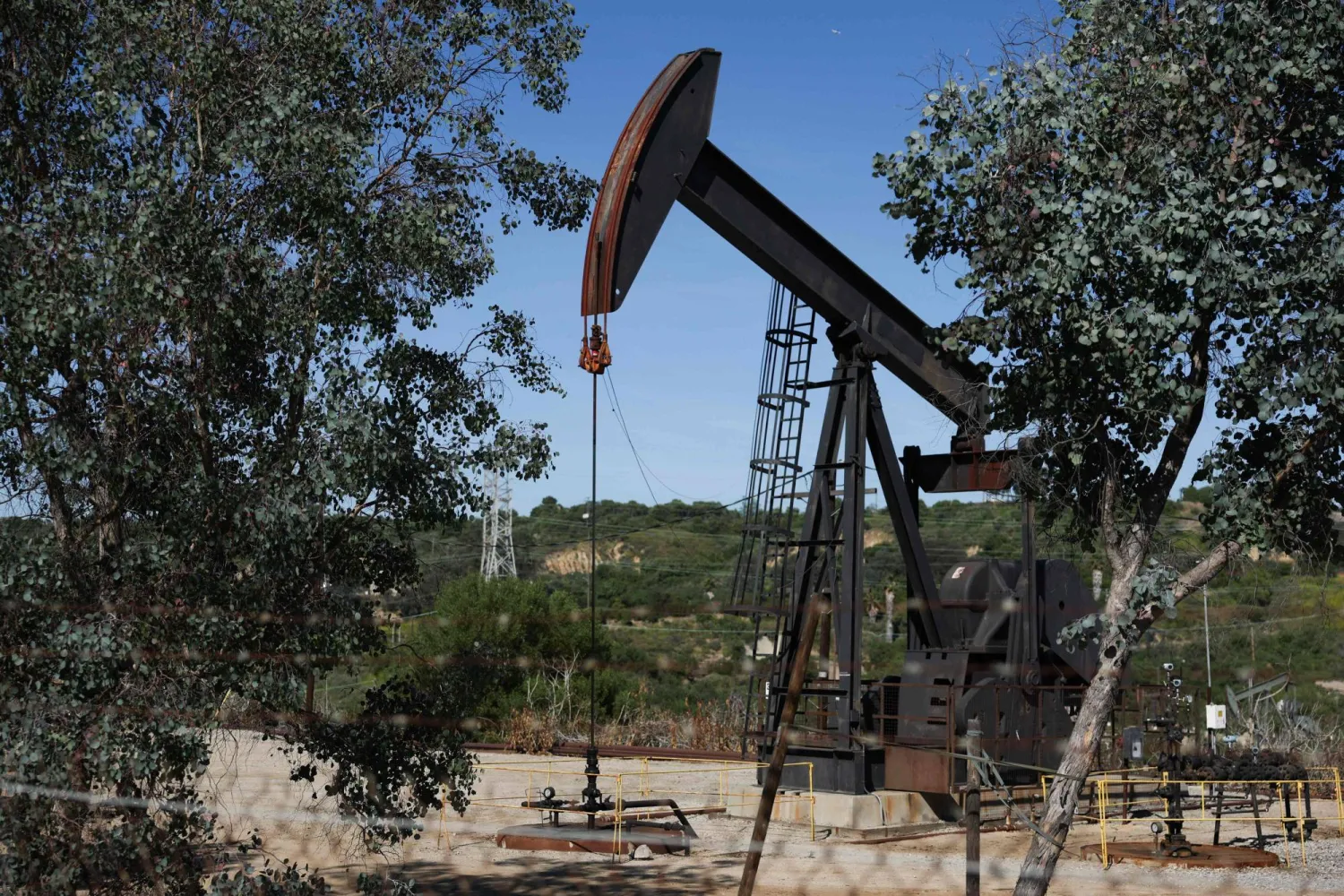
A pumpjack stands at the Inglewood Oil field in Los Angeles, California on March 17, 2026.   (Photo by Patrick T. Fallon / AFP)
A pumpjack stands at the Inglewood Oil field in Los Angeles, California on March 17, 2026. (Photo by Patrick T. Fallon / AFP)
TT

Crude Prices Surge, Stocks Sink as Iran Warns of Regional Energy Strikes

A pumpjack stands at the Inglewood Oil field in Los Angeles, California on March 17, 2026.   (Photo by Patrick T. Fallon / AFP)
A pumpjack stands at the Inglewood Oil field in Los Angeles, California on March 17, 2026. (Photo by Patrick T. Fallon / AFP)

Oil surged more than five percent Thursday and stocks sank as Iran carried out a series of attacks on Gulf energy facilities and warned of more following a strike on one of its key gas fields, while warnings of higher US inflation also soured the mood.

After spending much of Wednesday hovering around $100, crude soared as Tehran threatened to target regional installations in reply to what it said was an Israeli hit on a site serving its massive South Pars field, which it shares with Qatar.

Abu Dhabi later shut down operations at a gas facility due to falling debris from missile interceptions, while Qatar's Ras Laffan site was hit, with QatarEnergy saying emergency teams had been "deployed immediately to contain the resulting fires".

Iranian state television later said Thursday that a missile struck the site again, which QatarEnergy said caused extensive damage.

Qatar has ordered several Iranian diplomats to leave the country.

Meanwhile, the UN nuclear watchdog said Iranian authorities had reported a projectile impact at the country's only operational nuclear power plant but that it caused no damage.

"We warn you once again that you made a big mistake in attacking the energy infrastructure of the Islamic republic," the Revolutionary Guards said in a statement carried by Iranian media.

"If it is repeated again, further attacks on your energy infrastructure and that of your allies will not stop until it is completely destroyed."

And President Masoud Pezeshkian wrote on X that the attacks on South Pars "will complicate the situation and could have uncontrollable consequences, the scope of which could engulf the entire world".

Brent spiked more than five percent to hit a peak of $112.86, while West Texas Intermediate was sitting around $99.

The increased tension hit equities, which had enjoyed a broadly positive start to the week thanks to a fresh rally in tech firms.

Tokyo and Seoul, which had been the best performers between the start of the year and the start of the war, both sank more than two percent.

Hong Kong, Shanghai, Sydney, Singapore, Taipei, Wellington and Jakarta were also well down.

After talks with US President Donald Trump and Qatar's emir, French President Emmanuel Macron said on X: "It is in the common interest to implement without delay a moratorium on strikes targeting civilian infrastructure, particularly energy and water infrastructure."

Markets have been hammered since the US-Israel attacks on Iran on February 28 that sparked a wave of retaliatory strikes across the Gulf by Tehran. The Iranian republic also effectively closed the Strait of Hormuz, through which a fifth of global oil and gas flows.

That has sent crude soaring, stoking fears of another surge in inflation.

And while the White House unveiled new steps Wednesday to try to counter the spike in energy costs prices, waiving a century-old shipping law and easing Venezuela sanctions, observers said the measures were nowhere near enough.

The attacks shook up energy markets, which had seen a period of stability this week helped by Iraq saying it had resumed limited oil exports through Türkiye to avoid the Strait of Hormuz.

The strategic waterway usually sees a fifth of global oil pass through it but Iran has effectively shut it since the outbreak of the war, with attacks on ships.

Expectations that the spike in energy costs would send inflation soaring again has seen traders pare their expectations for central bank interest rate cuts this year.

Those concerns were compounded Wednesday with data showing US wholesale inflation rose more than expected in February.

Later, Federal Reserve Chair Jerome Powell said he expected higher energy prices to boost inflation in the near term but added that little was clear at this point.

"We're right at the beginning of this, and we don't know how big -- you just don't know how big this will be and how long it lasts," he said after the bank held interest rates. Officials would have to "wait and see", he said.

Eyes are also on decisions Thursday by the European Central Bank, the Bank of England and the Bank of Japan.

Australia's central bank hiked its key rate Tuesday, pointing to "sharply higher fuel prices".


European Gas Prices Jump 35% after Strikes on Energy Infrastructure

Notes read “Out of Stock” at the New World Fuel station in Levin, New Zealand, on March 19, 2026. (Photo by Marty MELVILLE / AFP)
TT

European Gas Prices Jump 35% after Strikes on Energy Infrastructure

Notes read “Out of Stock” at the New World Fuel station in Levin, New Zealand, on March 19, 2026. (Photo by Marty MELVILLE / AFP)

European gas prices soared as much as 35 percent on Thursday as fresh strikes hit energy infrastructure in the Middle East.

The Dutch TTF natural gas contract, considered the European benchmark, jumped to 74 euros, before paring gains slightly.

Two waves of Iranian strikes caused "extensive damage" at Ras Laffan in Qatar, the world's largest liquefied natural gas hub, raising fresh concerns over energy supplies.

Oil and gas prices have jumped since the US-Israeli attacks on Iran began.


EU Pitched for Türkiye to Join Its Payments System, Envoy Says

 This photograph shows European flags fluttering outside the EU Commission headquarters in Brussels on March 18, 2026. (AFP)
This photograph shows European flags fluttering outside the EU Commission headquarters in Brussels on March 18, 2026. (AFP)
TT

EU Pitched for Türkiye to Join Its Payments System, Envoy Says

 This photograph shows European flags fluttering outside the EU Commission headquarters in Brussels on March 18, 2026. (AFP)
This photograph shows European flags fluttering outside the EU Commission headquarters in Brussels on March 18, 2026. (AFP)

The European Union pitched to Türkiye last month the idea that the candidate for bloc membership could join a cost-cutting payments system to boost integration efforts and benefit those sending money abroad, the EU envoy to Ankara told Reuters.

Jurgis Vilcinskas, the bloc's chargé d’affaires in Türkiye, said European Commissioner for Enlargement Marta Kos discussed the proposal with Foreign Minister Hakan Fidan, when the two met last month in Ankara.

The EU says its 41-country Single Euro Payments Area (SEPA) makes cross-border ‌euro-currency payments cheaper, ‌faster and more secure. Users in far smaller ‌Balkan ⁠candidates Albania, Moldova, Montenegro ⁠and North Macedonia, which adopted the scheme last year, could save up to 500 million euros, it said.

"SEPA could present a valuable opportunity to strengthen Türkiye's economic integration as a candidate country and a key trade and economic partner of the EU," Vilcinskas told Reuters in a response.

It could generate "significant savings annually for Turkish businesses, ⁠consumers and diaspora by making cross-border transfers in Euros ‌as fast and as cheap as ‌domestic ones," he said.

Ankara's view on the matter is unclear.

A Turkish diplomatic source ‌confirmed that during Kos' February 6 visit an offer had been conveyed ‌to Ankara, adding the SEPA issue was under the jurisdiction and coordination of the Finance Ministry, which did not comment on the matter.

STEPS EYED TO BOLSTER ECONOMIC TIES

Under SEPA, Turkish banks could stand to lose revenues on transfers, which ‌vary widely based on size. A Türkiye-Europe transfer of 1,000 euros to 5000 euros can cost 40 euros, according ⁠to Western ⁠Union.

Europe is Türkiye’s largest trading partner with more than 200 billion euros in volume. With bloc membership talks effectively stalled for years, both say they want to modernize their customs union and move to boost economic ties.

Vilcinskas said Türkiye would need to comply with the EU's Payment Services Directive, including strengthening its anti-money laundering and data protection rules, adding that the Commission was ready to support Türkiye in any SEPA endeavor.

SEPA could bring "significant" savings, especially for the large Turkish diaspora across Europe, a Turkish banking source said.

In an interview this month, Odile Renaud-Basso, president of the European Bank for Reconstruction and Development, said SEPA would "basically make transactions cost-free".


Arab Startups Attract Investors Despite War-Driven Uncertainty

Riyadh, Saudi Arabia (SPA)
TT

Arab Startups Attract Investors Despite War-Driven Uncertainty

Riyadh, Saudi Arabia (SPA)

At a time when geopolitical tensions and regional conflicts cast a shadow over the broader landscape, the Middle East and North Africa's startup ecosystem is showing strong resilience and the ability to attract both local and international capital.

Investment in technology is no longer a complementary option, but a strategic bet, driven by accelerating digital transformation and the stability fostered by leading governments in the region.

“The best time to invest and seize opportunities is when there is fear and uncertainty,” Hassan Haidar, founder and managing partner at Plus VC, told Asharq Al-Awsat.

The firm has backed more than 250 startups across 15 countries in the Middle East and said late last year it plans to fund around 40 startups in 2026, with a focus on deals in Saudi Arabia.

Haidar said the technology and digital services sector continues to benefit, adding that even war cannot halt the region’s rapid shift toward digital services.

Regional tensions have pushed many to rely more on digital tools and online delivery services, creating significant opportunities for startups offering innovative solutions, he said.

Venture capital surge

Startups in the region raised $3.8 billion across 688 deals in 2025, up 74% year on year, according to Magnitt company. Saudi Arabia and the United Arab Emirates took the largest share, with nearly half of the capital coming from international investors.

Haidar said investment is driven not only by current opportunities but also by the ecosystem's growing maturity.

“The past decade was about proving that venture capital can succeed in the region; the next decade will be about proving the scale of these opportunities,” he said.

Structural transformation

Haidar, who began investing in the region in 2010, said the startup landscape has changed fundamentally, from fewer than 100 startups annually across the region about 15 years ago to around 2,000 today.

Markets have become more structured, with governments supporting capital flows and helping establish local and international investment funds. Clearer paths to initial public offerings have emerged, alongside secondary transactions that provide liquidity for investors and founders.

“Markets such as Saudi Arabia and the United Arab Emirates have become regional pillars, belief in the ecosystem is attracting founders, capital and global attention,” he said.

Untapped opportunities

Haidar said the region’s appeal lies in vast untapped opportunities and in key sectors that are still in the early stages of digitization. A generation of ambitious founders with international experience is returning to build technology ventures that address both local and global challenges.

This momentum is backed by clear, strategic government support that gives investors confidence, he said.

Compared with other emerging markets, regions such as Southeast Asia face challenges in exit pathways and liquidity shortages. The Arab region, particularly Saudi Arabia, stands out by offering viable exit channels through public listings and structured secondary transactions.

Trends strengthening competitiveness

Haidar outlined four trends boosting the region’s competitiveness.

First, investors are becoming more financially mature, shifting from development-driven funding to performance-based investment focused on real returns.

Second, exit pathways are becoming more dynamic, supported by strong liquidity, with IPOs and secondary markets offering flexible options to recycle capital.

Third, artificial intelligence is moving beyond hype to real-world applications, addressing complex operational challenges in sectors such as logistics and enterprise software.

Fourth, deep tech and hardware are gaining ground, with a new wave of companies developing advanced solutions to critical issues such as energy security, water and advanced manufacturing, attracting investors willing to back long-term projects.

Challenges and outlook

Despite this progress, access to funding remains a structural challenge. Venture capital still accounts for less than 0.1% of regional GDP, compared with around 1% in the United States, highlighting significant untapped potential.

Still, Haidar expressed strong optimism about the region’s ability to move forward, pointing to the role of governments in maintaining stability.

“We hope for a positive shift and a return to normal conditions, but we strongly believe in our governments’ ability to navigate these difficult times and provide a stable environment that gives us the confidence to continue,” he said.

He said venture capital has moved beyond the stage of doubt.

“We are no longer asking whether startups are important to our economy; we have entered a new strategic phase focused on how to scale and multiply, and on proving the full potential of this ecosystem on the global stage,” he said.