


Czech Central Bank Keeping Options open as Iran War Clouds Rate Prospects

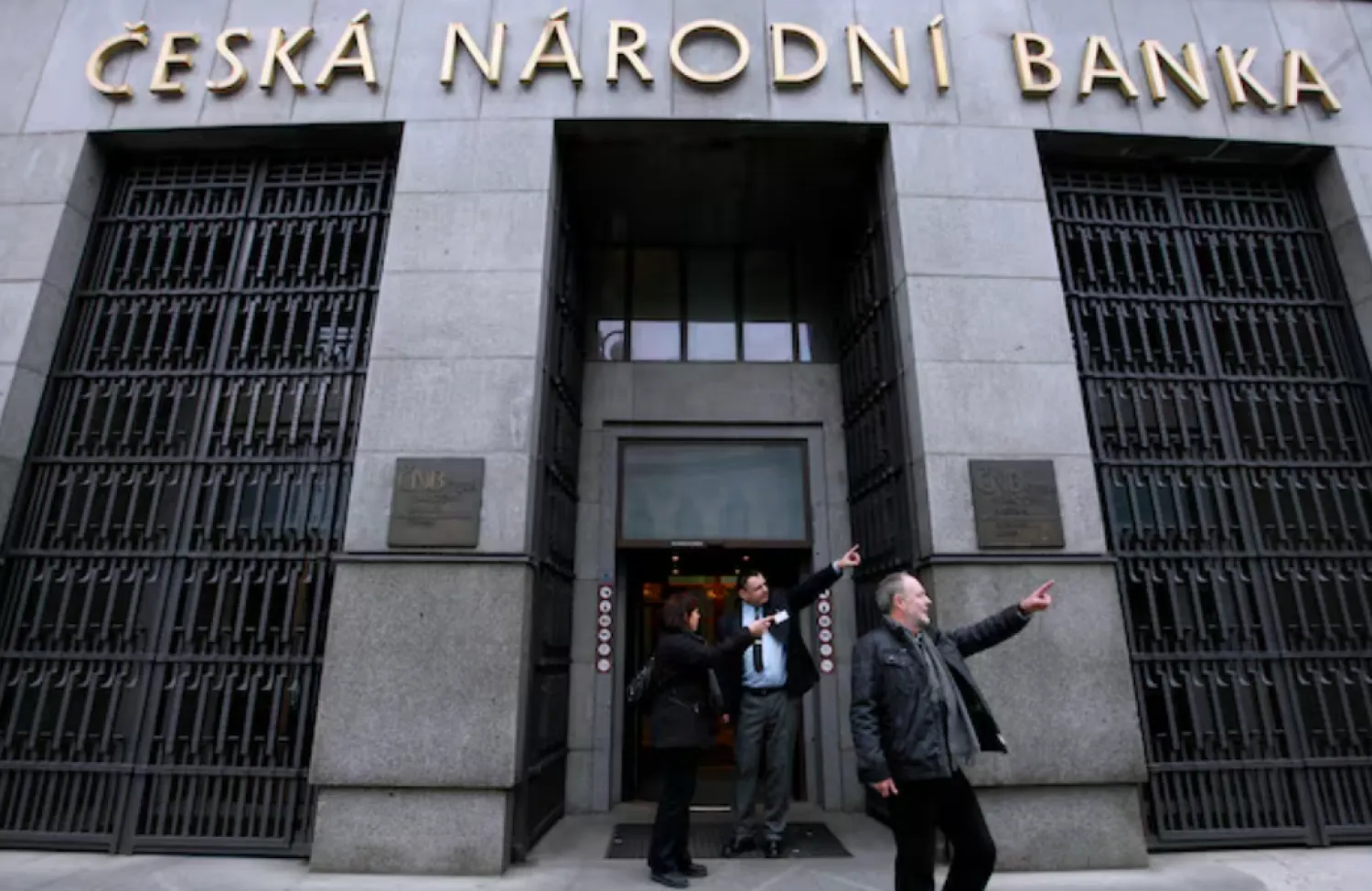
People leave the Czech National Bank building in central Prague December 9, 2011. REUTERS/Petr Josek/File Photo
TT

Czech Central Bank Keeping Options open as Iran War Clouds Rate Prospects

People leave the Czech National Bank building in central Prague December 9, 2011. REUTERS/Petr Josek/File Photo

The Czech National Bank (CNB) held interest rates steady as expected on Thursday and said it was keeping options open as it monitors the economic fallout from the conflict in the Middle East.

Since the United States and Israel launched strikes on Iran on February 28, oil prices have jumped above $100 a barrel, raising global risks of higher inflation and an economic hit.

Czech central bank policymakers voted unanimously to keep the main rate steady at 3.50% on Thursday, in line with forecasts from all 17 analysts in a Reuters poll last week.

The poll's median forecast saw interest rates remaining on hold for the rest of the year, although money markets have priced in chances of a hike. Governor Ales Michl said after the decision that the conditions for fighting inflation are now better than during the previous energy and inflation shock following Russia's invasion of Ukraine in 2022, as policy is now tighter and rates are higher than inflation.

He added that inflation expectations remain anchored, and it was important to keep them low.

"We are acting restrictively in the economy," he said. "On the other hand, we are monitoring the situation, we are keeping all options open."

The Czech crown was a touch weaker after the bank's decision but largely steady on the day, at 24.49 to the euro, and around its lowest levels since September after this month's declines.

INFLATION STILL SEEN STAYING LOW

The central bank had discussed a possible rate cut at its last meeting in February, before the Iran war. It last cut rates in May 2025 as part of a 350-basis-point easing cycle.

Inflation in the Czech Republic has fallen below the bank's 2% target, hitting a headline rate of 1.4% year-on-year in February with help from a government measure to ease energy bills. That provides a cushion to potential shock from higher oil prices, and Michl said inflation should stay below 2% this year, according to updated forecasts partly incorporating higher oil prices, even though core inflation should remain elevated in the quarters ahead.

The central bank will be looking at the secondary impacts of a higher oil price to see if it soaks through to other segments.



China Shipping Giant Cosco Resumes Bookings to Some Gulf Countries

A cargo ship operated by Cosco Shipping is docked at the foreign trade container terminal of Qingdao Port, operated by Shandong Port Group, in China's eastern Shandong province on March 25, 2026. (Photo by CN-STR / AFP)
TT

China Shipping Giant Cosco Resumes Bookings to Some Gulf Countries

A cargo ship operated by Cosco Shipping is docked at the foreign trade container terminal of Qingdao Port, operated by Shandong Port Group, in China's eastern Shandong province on March 25, 2026. (Photo by CN-STR / AFP)

Chinese shipping giant Cosco said on Wednesday that it was resuming new bookings for container shipments to some Gulf countries, after a three-week suspension in response to the Middle East war.

The state-owned, Shanghai-based firm was among several major shipping groups to pause operations in the Strait of Hormuz, a key waterway through which one-fifth of the world's oil and gas passes normally.

Tehran has said several times it was not targeting friendly nations, but transits through the Strait had nevertheless largely ground to a halt.

Iran said in a statement circulated by the International Maritime Organization on Tuesday that "non-hostile vessels" would be granted safe passage through the waterway.

Cosco "resumed new bookings for general cargo containers for shipments" from the "Far East" to the UAE, Saudi Arabia, Bahrain, Qatar, Kuwait, and Iraq "with immediate effect", according to a company statement.

It did not mention shipments travelling in the opposite direction, from the Gulf.

"New booking arrangements and the actual carriage are subject to change due to the volatile situation in the Middle East region," it added.

Cosco, which operates one of the world's largest oil tanker fleets, announced on March 4 that it would suspend new bookings for services for routes through the Strait of Hormuz owing to the "escalating conflicts in the Middle East region and resultant restrictions on maritime traffic".


Qatar Emir Makes Minor Changes to QIA Board

People visit a mall in Doha on March 23, 2026. (Photo by AFP)
TT

Qatar Emir Makes Minor Changes to QIA Board

People visit a mall in Doha on March 23, 2026. (Photo by AFP)

Qatar's Emir Sheikh Tamim bin Hamad Al Thani issued a decree on Wednesday ⁠making minor changes to ⁠the board of the ⁠Qatar Investment Authority, while keeping Sheikh Bandar bin Mohammed bin Saud Al Thani as chairman and Sheikh ⁠Mohammed ⁠bin Hamad bin Khalifa Al Thani as deputy chairman.

The decision stipulated that QIA’s Board of Directors would be restructured as follows: Sheikh Bandar bin Mohammed bin Saud Al Thani as Chairman, Sheikh Mohammed bin Hamad bin Khalifa Al Thani as Deputy Chairman, Ali bin Ahmed Al Kuwari as a member, Saad bin Sherida Al Kaabi as a member, Sheikh Faisal bin Thani bin Faisal Al-Thani as a member, Nasser bin Ghanim Al Khelaifi as a member, and Hassan bin Abdullah Al Thawadi as a member.

The decision is effective starting from its date of issue and is to be published in the official gazette.


Oil Falls More Than 5% and World Shares Gain Over Possible de-escalation of Iran War

A man fills his car with petrol at the petrol station in Port Dickson, Negri Sembilan, Malaysia, 25 March 2026. EPA/FAZRY ISMAIL
TT

Oil Falls More Than 5% and World Shares Gain Over Possible de-escalation of Iran War

A man fills his car with petrol at the petrol station in Port Dickson, Negri Sembilan, Malaysia, 25 March 2026. EPA/FAZRY ISMAIL

Oil prices fell more than 5% and world shares gained on Wednesday over the possibility of a de-escalation of the Iran war and negotiations between the United States and Iran. US futures were up 0.9%.

In early European trading, Britain's FTSE 100 rose 1% to 10,072.60. France's CAC 40 was up 1.4% to 7,855.31, while Germany's DAX was 1.6% higher at 22,989.80.

Tokyo’s Nikkei 225 was up 2.9% to 53,749.62. South Korea’s Kospi gained 1.6% to 5,642.21.

Hong Kong’s Hang Seng rose 1.1% to 25,335.95, while the Shanghai Composite index was 1.3% higher at 3,931.84. Labubu doll maker Pop Mart's Hong Kong-listed shares fell 22.5%, after it announced annual revenue for last year that was largely in line with analysts’ estimates.

Australia’s S&P/ASX 200 climbed 1.9%. Taiwan’s Taiex was up 2.5%.

US President Donald Trump's claims of progress being made from talks with Iran this week and his postponement on Monday of a deadline to “obliterate” Iran’s power plants over the reopening of the Strait of Hormuz have also fueled optimism that an end to the Iran war could come soon.

Trump's administration has offered a 15-point ceasefire plan to Iran, but an Iranian military spokesperson mocked the US’ attempt at a ceasefire deal Wednesday.

With the Strait of Hormuz being a key waterway for crude oil and liquefied natural gas transport, oil and gas prices have spiked and fluctuated in recent days.

Oil prices fell again on growing hopes for a de-escalation. Brent crude, the international standard, fell 5.2% to $94.97 per barrel. It was around $104 on Tuesday.

Benchmark US crude was down 5.3% early Wednesday to $87.44 a barrel.

While Iran has denied negotiations were taking place, and attacks in the Middle East continued, Pakistan has offered to host talks between Washington and Tehran. And as Trump raised optimism of a de-escalation of the war, at least 1,000 more American troops from the 82nd Airborne Division are said to be deployed to the Middle East in the coming days.

On Tuesday, US stocks closed lower. The S&P 500 lost 0.4% to 6,556.37. The Dow Jones Industrial Average edged down 0.2% to 46,124.06, while the Nasdaq composite was 0.8% lower to 21,761.89.

Shares of Estee Lauder sank more than 9%, following confirmation that the US-listed company is in merger talks with Spanish beauty and perfume group Puig.

In other dealings early Wednesday, gold prices resumed its rise after falling earlier. It dropped in part because of rising US Treasury yields over dimming expectations of a Federal Reserve rate cut after the spike in oil prices threatened to fuel global inflation.

The price of gold was up 3.6% early Wednesday to $4,561.90 per ounce. It was above $5,000 earlier this month.

The US dollar was at 158.84 Japanese yen, up from 158.69. The euro was trading at 1.1602, down from $1.1608.