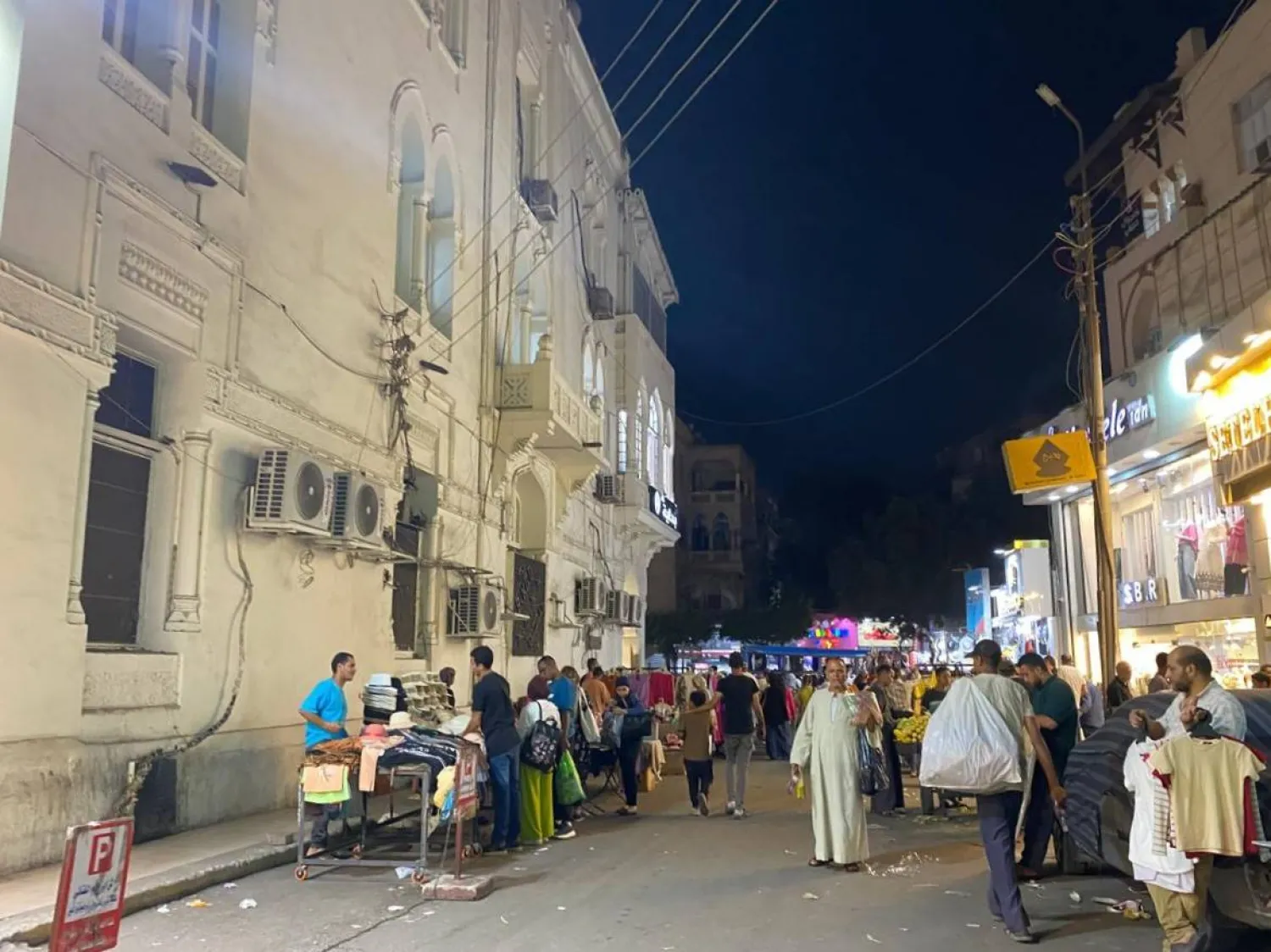
Egypt Imposes Business Curfew to Counter Soaring Fuel Costs

Cairo was forced to raise fuel prices by more than 30 percent, after strikes on regional oil infrastructure and threats against the Strait of Hormuz (File Photo)
TT

Egypt Imposes Business Curfew to Counter Soaring Fuel Costs

Cairo was forced to raise fuel prices by more than 30 percent, after strikes on regional oil infrastructure and threats against the Strait of Hormuz (File Photo)

Egypt has ordered shops, restaurants and shopping malls to close from 9:00 pm from Saturday, hoping to curb energy bills that have more than doubled because of the Iran war.

Prime Minister Mostafa Madbouly announced the curfew and said it would last for a month initially.

"Shops, shopping centers, restaurants and cafes will all close at 9:00 pm on weekdays," he said, adding that on Thursdays and Fridays at the weekend they will be allowed to stay open until 10:00 pm, Reuters reported.

The premier said that before the war, Egypt's monthly energy bill was $560 million. Today, for the same quantity, he said Egypt is paying $1.650 billion.

Madbouly said Cairo must work on the "worst-case scenario" in the face of a war whose outcome is unpredictable.

Tourism Minister Sherif Fathy said the new restrictions "will not affect tourists" or flagship destinations, a statement from his office said.

At the beginning of March, Cairo was forced to raise fuel prices by more than 30 percent, after strikes on regional oil infrastructure and threats against the Strait of Hormuz, the crucial shipping route now virtually paralysed by the war.

Around a fifth of global crude oil and liquefied natural gas passes through the waterway in peacetime.

The rerouting of shipping away from the Suez Canal is also depriving Cairo of a vital source of foreign currency.


South Korea's KEPCO Wins Saudi Jafurah Power Project

The Jafura field (Aramco)
TT

South Korea's KEPCO Wins Saudi Jafurah Power Project

The Jafura field (Aramco)

Korea Electric Power Corp (KEPCO) said it had won a contract to build and operate the second phase of a cogeneration power plant at Saudi Arabia's Jafurah project.

The company expects total revenue of about 2.1 trillion ⁠won ($1.4 billion) from ⁠the project.

KEPCO said in a statement it signed the power and steam sales agreements with Saudi Aramco for the ⁠project and completed a construction contract with Doosan Enerbility.

The plant will have power generation capacity of 331 megawatts and produce about 465 metric tons of steam per hour. It is scheduled to be built by June 2029, after which it ⁠will supply ⁠power and steam for 17 years, KEPCO said.

KEPCO said the project is an expansion of the 317-MW first phase of the Jafurah cogeneration plant, which it won through an international tender in 2022 and expects to complete by the end of June.


Egypt Says Close to Issuing $500 Million Japan Samurai Bond

A minibus moves along a main road underneath new Cairo Monorail track as a train moves above in the Fifth Settlement, a neighborhood of the New Cairo suburb of Cairo, on May 22, 2026. (Photo by Khaled DESOUKI / AFP)
TT

Egypt Says Close to Issuing $500 Million Japan Samurai Bond

A minibus moves along a main road underneath new Cairo Monorail track as a train moves above in the Fifth Settlement, a neighborhood of the New Cairo suburb of Cairo, on May 22, 2026. (Photo by Khaled DESOUKI / AFP)

Egypt is finalizing plans for its first yen-denominated bond sale in three years, Foreign Minister Badr Abdelatty told Reuters on a trip to Japan on Thursday.

The African Development Bank said in December it would partially guarantee Cairo's planned $500 million-equivalent Samurai bonds on the Japanese markets this year.

"We are completing the final ⁠steps," Abdelatty said ⁠on the sidelines of an event in Tokyo, adding that he had been promoting the sale and other investment opportunities while in Japan.

"We had extensive discussions ⁠with our Japanese friends on monetary, fiscal, financial support, especially with regard to budget support and samurai bonds as well."

Egypt's economy has been boosted in recent years by major real estate investments and an $8 billion IMF loan, though the Iran war is piling pressure ⁠on ⁠its finances.

The bond sale would be Egypt's third in the currency, following issuances in 2022 and 2023.

"It will be very important, despite the fact that we've been hit hard with implications of the (Iran) war," Abdelatty said.


Oil Falls as Lebanon and Israel Agree on a Ceasefire

FILE PHOTO: A drone view shows an offshore oil platform in Guanabara Bay in Niteroi, Rio de Janeiro state, Brazil, March 18, 2026.  REUTERS/Pilar Olivares/File Photo
FILE PHOTO: A drone view shows an offshore oil platform in Guanabara Bay in Niteroi, Rio de Janeiro state, Brazil, March 18, 2026. REUTERS/Pilar Olivares/File Photo
TT

Oil Falls as Lebanon and Israel Agree on a Ceasefire

FILE PHOTO: A drone view shows an offshore oil platform in Guanabara Bay in Niteroi, Rio de Janeiro state, Brazil, March 18, 2026.  REUTERS/Pilar Olivares/File Photo
FILE PHOTO: A drone view shows an offshore oil platform in Guanabara Bay in Niteroi, Rio de Janeiro state, Brazil, March 18, 2026. REUTERS/Pilar Olivares/File Photo

Oil prices fell on Thursday as a ceasefire deal between Israel and Lebanon boosted hopes for a broader agreement to end the US-Israeli war with Iran that could lead to a reopening of the Strait of Hormuz.

Brent futures were down 87 cents, or 0.89%, at $96.92 a barrel by 0458 GMT, while US West Texas Intermediate crude fell 78 cents, or 0.81%, to $95.24, paring gains from earlier in the week, said Reuters.

Both Brent and WTI rose about 2% on Wednesday after renewed Middle East hostilities including Iranian attacks on Kuwait ‌and US military strikes ‌near the Strait of Hormuz.

Israel and Lebanon ‌said ⁠late on Wednesday ⁠they had agreed to implement a ceasefire, raising hopes for a deal between Washington and Tehran, which has conditioned any agreement in part on an end to fighting between Israel and Lebanon.

US President Donald Trump suggested on Wednesday that there could be progress in negotiations with Iran as soon as this weekend.

Iranian Foreign Minister Abbas Araghchi on Wednesday said Tehran's ⁠contacts with Washington have not been cut ‌off, but no progress has been made ‌in the negotiations, adding both sides were studying the texts that were exchanged.

In ‌the US, the Republican-led House approved a resolution on Wednesday to ‌block Trump from continuing the war against Iran. To take effect, the resolution would need Senate approval and two-thirds majorities in both chambers to override an almost certain Trump veto.

Meanwhile, US crude stockpiles fell by 8 million barrels to ‌433.7 million barrels in the week ended May 29, the Energy Information Administration said on Wednesday. ⁠That was a ⁠much bigger drop than the 4-million-barrel draw analysts had expected in a Reuters poll.

The International Energy Agency warned on Tuesday that global oil inventories could hit critical levels ahead of peak summer demand if stock draws continue at their current pace, despite Chinese crude imports falling by 6 million barrels a day in May compared to March.

“Inventories have provided a cushion for the oil market. However, even if we see an imminent restart of oil flows through the Strait of Hormuz, the recovery will be slow and gradual,” a note from ING said.

“This suggests inventories are likely to continue to tighten into the third quarter, leaving upside risk to prices.”