

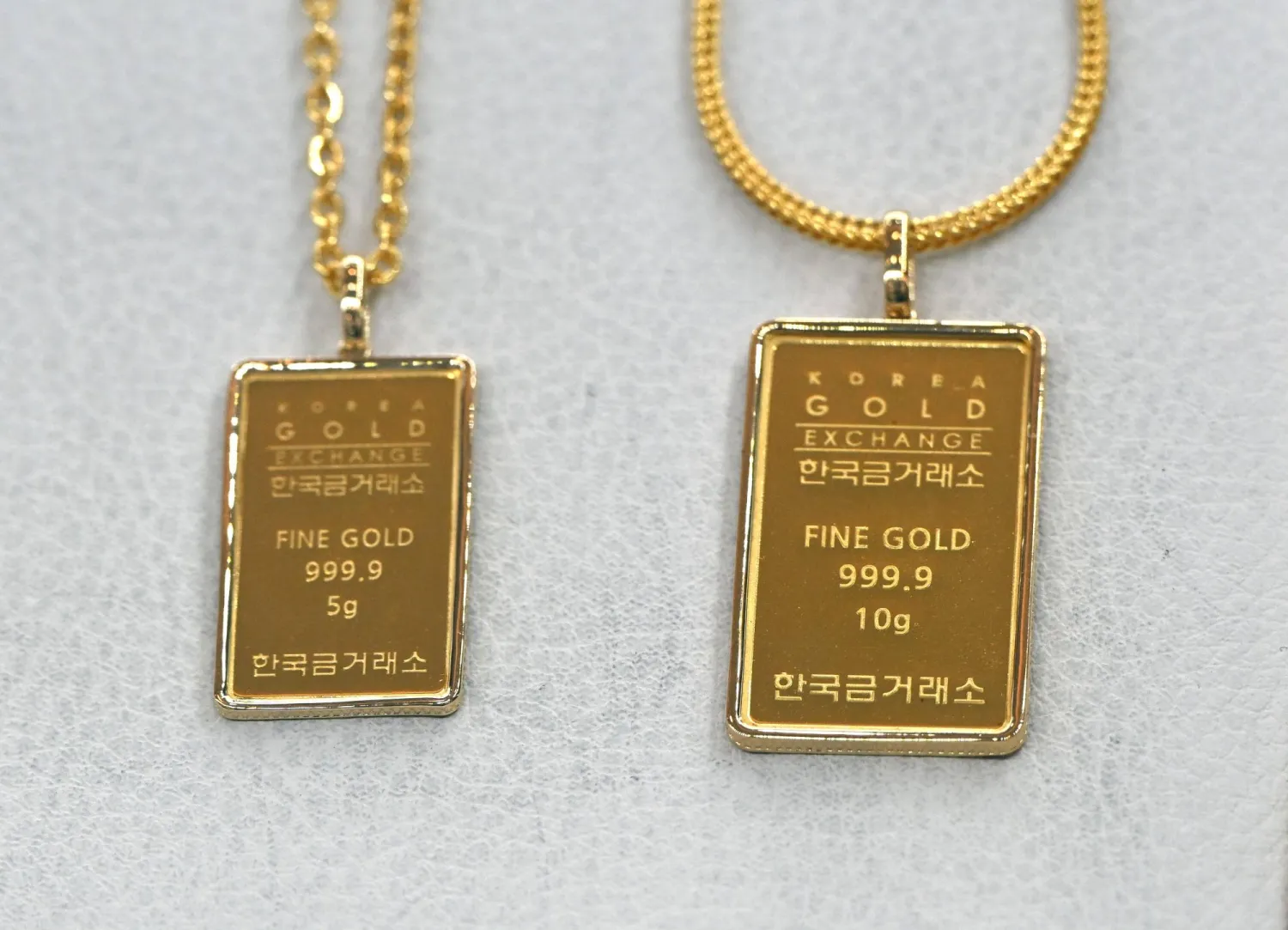

Gold Holds Nearly Steady with Focus on US-Iran Tensions

Gold jewelry in a Korean gold exchange store in Seoul (AFP)
TT

Gold Holds Nearly Steady with Focus on US-Iran Tensions

Gold jewelry in a Korean gold exchange store in Seoul (AFP)

Gold prices were nearly steady on Monday, as market participants stayed cautious and awaited further signals on the evolving US-Iran situation and its impact on global interest rates.

Spot gold was little changed at $4,669.13 per ounce by 9:26 a.m. ET (1326 GMT) after falling 1% earlier in the session. US gold futures rose 0.3% to $4,694.20 per ounce, Reuters reported.

On the eve of a US deadline, the United States and Iran were weighing the framework of a plan to end their five-week-old conflict, even as Tehran pushed back against pressure to swiftly reopen the Strait of Hormuz. President Donald Trump has threatened to rain "hell" on Tehran if it did not make a deal by the end of Tuesday.

"Focus is likely to remain on the war and interest rates. If the conflict drags on, oil will grind higher amid tightening supply conditions, adding to inflationary pressures," said Bart Melek, global head of commodity strategy at TD Securities.

"That leaves central banks, particularly the Federal Reserve, with less room to ease policy and could even revive discussions about higher rates if energy prices rise further, which is negative for gold."

Oil prices fell in choppy trading on Monday, though they have risen sharply since the conflict began.

Gold is widely regarded as a hedge against geopolitical risks and inflation, but because it yields no interest, it tends to be less attractive when interest rates are high. Other items on investors’ radar include minutes of the Fed’s March policy meeting due on Wednesday, US Personal Consumption Expenditures (PCE) data due on Thursday, and the Consumer Price Index (CPI) on Friday.

The US central bank held rates steady last month and a majority of traders now see no chance of the Fed cutting interest rates this year, according to CME’s FedWatch tool. Among other metals, spot silver fell 0.4% to $72.67 per ounce, platinum lost 1% to $1,969.81, and palladium was down 1% at $1,488.58.



China's Economy Beats Forecasts, but War Darkens Outlook

China's exports have helped support the economy but there are concerns about the impact on trade from the Middle East crisis. CN-STR/AFP
TT

China's Economy Beats Forecasts, but War Darkens Outlook

China's exports have helped support the economy but there are concerns about the impact on trade from the Middle East crisis. CN-STR/AFP

China's economy expanded more than expected in the first three months of the year, with official data Thursday indicating resilience in the face of a Middle East crisis that threatens to hit global growth.

The figures came despite a surge in world energy prices caused by the US-Israel war on Iran, which has stymied shipping through the crucial Strait of Hormuz, through which a fifth of the world's oil and natural gas passes.

Analysts say China's diversified energy supply shields it from immediate shocks, though a potential global downturn caused by the war could weaken demand for its exports, which have been propping up the country's economy.

Gross domestic product in the world's second-largest economy expanded 5.0 percent year-on-year in January-March, according to the National Bureau of Statistics (NBS).

The reading was slightly higher than an AFP forecast of 4.8 percent based on a survey of economists.

During the first quarter, China's economy "achieved a strong start to the year, further demonstrating its resilience and vitality", the NBS said in a statement announcing the data.

The reading came days after the International Monetary Fund cut its 2026 global growth projection, warning that the world economy could be "thrown off course" by the Middle East war.

It also reduced its forecast for China to 4.4 percent growth, from a previous estimate of 4.5 percent.

"The global economy is facing this next test of resilience as signs of unevenness lie beneath the surface," it said, noting that China's "domestic activity -- especially in the housing sector -- lags behind exports".

Beijing has set a 2026 target of 4.5-5.0 percent growth -- the lowest in decades.

A years-long crisis in the property sector and a persistent slump in domestic spending have left leaders reliant on exports to meet growth targets.

- Trade headwinds -

Outbound shipments have boomed, exemplified by the country's whopping $1.2 trillion trade surplus last year.

But data this week showed export growth slowed sharply in March, indicating that war in the Middle East was already taking a toll.

Thursday's NBS data also showed retail sales grew 1.7 percent on-year in March, well short of a Bloomberg forecast of 2.4 percent.

Industrial production rose 5.7 percent, the NBS said, beating a Bloomberg estimate of 5.3 percent but well down from the 6.3 percent seen in January and February combined.

The first-quarter acceleration in growth was fueled by exports, Zichun Huang of Capital Economics wrote in a note.

"We think growth will soften a bit over the rest of the year," she said.

"While the Chinese economy is holding up well, it is becoming ever more dependent on external demand," she said, noting that the Iran war "is likely to add to this trend".

A major international trade fair kicked off this week in Guangzhou -- a metropolis in China's southern manufacturing heartland -- where attendees told AFP the war is impacting their business.

Chinese exporters and Middle Eastern buyers at the opening day of the Canton Fair on Wednesday gloomily told AFP the Iran war had pummeled orders and led to price hikes.

Wang Jun, the deputy head of China's customs administration, this week acknowledged "many uncertainties and instabilities in the external environment".

"The impact of international geopolitical conflicts on global industrial and supply chains is still evolving in a complex manner," he said.


Saudi Arabia, US Sign Tax Information Exchange Agreement

Al-Jadaan and Bessent shake hands after signing the Tax Information Exchange Agreement in Washington. (X)
TT

Saudi Arabia, US Sign Tax Information Exchange Agreement

Al-Jadaan and Bessent shake hands after signing the Tax Information Exchange Agreement in Washington. (X)

Saudi Minister of Finance Mohammed Al-Jadaan has held a series of meetings in Washington, D.C. to discuss strengthening bilateral economic cooperation and addressing challenges facing the global economy.

Al-Jadaan began his meetings on Wednesday by holding talks with US Treasury Secretary Scott Bessent. They discussed the latest developments in the global economy and financial issues of common interest.

They signed a Tax Information Exchange Agreement to enhance tax cooperation, as well as facilitate the exchange of knowledge and technical expertise between the two sides.

As part of strengthening European economic relations, Al-Jadaan met with French Minister of the Economy, Finance, and Industrial, Energy, and Digital Sovereignty Roland Lescure.

The two sides discussed economic developments in the world, focusing on exploring new ways to deepen financial and industrial cooperation between the Kingdom and France, in a way that serves common interests.

Regarding relations with Pakistan, the Minister of Finance discussed with both his Pakistani counterpart, Muhammad Aurangzeb, and the Governor of the State Bank of Pakistan, Jameel Ahmad, prospects for financial and economic cooperation.

The discussions addressed ways to support financial stability and enhance joint work between financial institutions in both countries.


Syria’s Baniyas Begins Loading Iraqi Oil Shipments for Re-export

Long convoys of Iraqi diesel-laden tanker trucks line up along the Tartus-Baniyas highway as they wait to unload their cargo at the Baniyas port refinery on the Mediterranean Sea, on April 15, 2026. (Photo by Bakr ALkasem / AFP)
TT

Syria’s Baniyas Begins Loading Iraqi Oil Shipments for Re-export

Long convoys of Iraqi diesel-laden tanker trucks line up along the Tartus-Baniyas highway as they wait to unload their cargo at the Baniyas port refinery on the Mediterranean Sea, on April 15, 2026. (Photo by Bakr ALkasem / AFP)

Syria began loading its first tanker carrying Iraqi oil on Wednesday at the Baniyas port refinery, according to state media.

With maritime traffic through the Strait of Hormuz disrupted, Iraq's exports came to a halt and oil storage tanks began filling up rapidly, forcing Iraqi authorities to largely suspend production.

At the beginning of April, Iraq announced it had started transporting oil by truck through Syria in preparation for re-export by boat.

"The loading of the first oil tanker is underway in Syria today, under the agreement reached with the Iraqi side to transport Iraqi oil to the Baniyas refinery and then to the oil terminal for shipment by sea," Syrian Petroleum Company deputy CEO Ahmed Qubbaji told reporters.

"The quantity that will be loaded onto the tanker is estimated at around 500,000 tons" and the loading operation will take at least three days, he said.

According to Qubbaji, the agreement allows Syria to take "the oil we need for power plants in order to generate electricity, while the surplus is exported.”

The Iraqi oil ministry said in early April that it had begun exporting oil by truck through Syria.