
At a time when geopolitical tensions are disrupting the stability of vital maritime corridors, fundamental questions are emerging about the ability of major economic ambitions in the Gulf to withstand the test of the Strait of Hormuz, which is an indispensable “lifeline” for the global economy, said Roberta Gatti, Chief Economist for the Middle East, North Africa, Afghanistan, and Pakistan at the World Bank.
In remarks to Asharq Al-Awsat, Gatti warned that current geopolitical tensions place the region’s economic diversification ambitions under a real test, while stressing, on the other hand, the central role Saudi Arabia plays in global energy markets through measures aimed at enhancing the reliability of supply chains.
The Kingdom’s efforts extend not only to exporters, but also to inflation, trade, and global growth, she added.
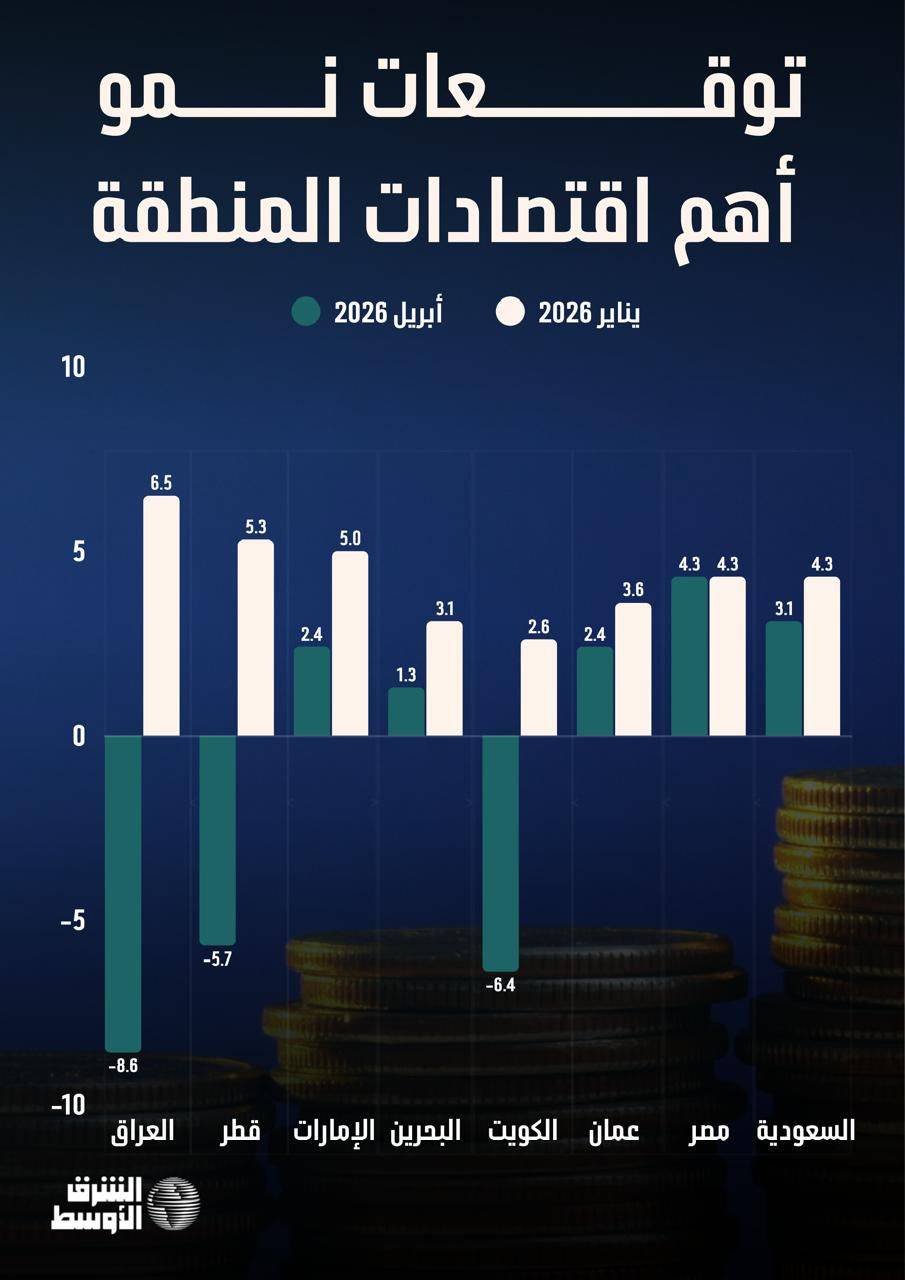
Last week, the World Bank issued a report ahead of the Spring Meetings of the World Bank and the International Monetary Fund, in which it maintained Saudi Arabia at the forefront, with projected growth of 3.1 percent in 2026, highlighting it as the Gulf economy most capable of coping with the repercussions of the current geopolitical crisis, despite sharp revisions affecting regional estimates.
Data in the report also showed that the fiscal deficit is expected to narrow by half to 3 percent, from 6 percent in 2025, alongside a shift in the current account balance from a deficit of -2.7 percent to a surplus of 3.3 percent.

On Monday, the United States imposed a naval blockade on Iranian ports, in an attempt to increase pressure on Iran to reopen Hormuz following the collapse of peace negotiations in Pakistan over the weekend. The negotiations are expected to resume in the coming days.
Gatti stressed: “Saudi Arabia plays a central role in global energy markets, and its efforts to strengthen resilience are especially important at a time of heightened uncertainty around the Strait of Hormuz.”
“Measures that enhance the reliability of energy supply chains - whether through infrastructure investment, alternative export routes, spare capacity, or stronger logistical preparedness - can help reduce the risk that such shocks translate into broader global disruption,” she added.
“These efforts matter not only for reducing volatility in global oil and gas markets for the benefit of the exporters, but also for global inflation, trade, and growth, especially in energy-importing developing countries that are highly vulnerable to volatility of these markets.”
Economic Diversification Under Stress Test
Gatti said the current conflict has directly highlighted the strategic importance of economic diversification, which is a core objective adopted in national development plans across GCC countries. She pointed out that data recorded since February 28 clearly reflects this divergence, stating: “The current conflict has highlighted the importance of economic diversification, an objective mentioned in multiple National Development Plans of GCC countries.”
“Since February 28, relatively more diversified economies, such as the UAE and Bahrain, have seen their forecasts downgraded significantly less than those of less diversified economies, such as Qatar and Kuwait. In addition, these larger forecast downgrades for Qatar and Kuwait reflect their higher reliance on route that goes through the Strait of Hormuz for trade and energy exports and the lack of alternative bypass routes.”
The World Bank expects Qatar’s economy to contract by 5.7 percent, marking a downgrade of 11 percentage points from previous estimates due to damage to liquefied natural gas supplies. Kuwait’s economy is also expected to contract more sharply by 6.4 percent, given its 100 percent reliance on the Strait of Hormuz for oil exports, making any closure of the waterway equivalent to a complete halt of the country’s financial lifeline.
In contrast, the UAE and Oman are expected to grow by 2.4 percent each, while Bahrain is expected to grow by 3.1 percent.
In this context, Gatti said: “The ‘Vision’ strategies remain appropriate and important as they aim to reduce structural dependence on hydrocarbons and promote private sector-led growth, but, as these recent events show, their implementation is sensitive to external shocks and the impacts are likely to be uneven across the region: more diversified economies tend to be more resilient due to stronger fiscal buffers and deeper non-oil sectors.”
“It also matters greatly into which new sectors the economies are diversifying. For example, prolonged instability could dampen investment and further disrupt tourism, aviation, and logistics sectors which have been expanding rapidly in the region. In contrast, sectors like banking and finance have been more insulated,” she explained.
Energy Poverty
Gatti turned to the more severe dimension of energy market volatility, explaining that rising oil prices impose compounded pressures on developing importing countries, as they translate directly into higher electricity costs, more expensive public transportation, and rising food prices linked to increased fertilizer costs.
She noted that these pressures inevitably lead to wider trade deficits and greater strain on public budgets, particularly in poorer countries with limited reserves, which are forced to bear significant fiscal costs if they attempt to subsidize energy prices to ease the burden on citizens.
Gatti further noted that reliable and affordable energy is not merely a service, but a lifeline for both households and firms. In this context, volatility in fuel and gas markets delivers a “double hit” to these economies, as households struggle to meet basic needs while firms face more expensive and less reliable energy, making industrial expansion slower, riskier, and less competitive.
In this sense, sharp short-term price increases may not only have immediate effects, but could also disrupt long-term structural transformation in energy-poor developing economies, she told Asharq Al-Awsat.
“The resilience of economies to withstand oil and gas shocks depends on exposure and vulnerability of their economic structures. Degree of reliance on imported energy matters, and so do reliance on energy-intensive sectors, and how consumers, firms, and government adapt to rising prices,” she remarked.
The 'Cost' of Alternative Energy Routes
Addressing the need to invest in land corridors or pipelines that bypass narrow maritime chokepoints, Gatti said the decision requires a careful balance between economic efficiency and resilience. “Decisions on such investments must balance consideration for economic efficiency and resilience to shocks. The concentration of oil and gas export routes from the Gulf through the Strait of Hormuz suggests that this is likely the most economically efficient option, given geography and other technical and economic considerations. On the other hand, diversifying trade routes brings resilience to shocks.”
For example she highlighted that Saudi Arabia can “divert a portion of their oil exports to the Red Sea port of Yanbu via the East-West pipeline, with 7mbpd capacity. The UAE similarly has Habshan-Fujairah pipeline with 1.5-1.8mbpd capacity to bypass Hormuz.
Conversely, the Kirkuk–Ceyhan pipeline between Iraq and Türkiye can carry only about 0.4 mbpd, well below its 1.5 mbpd intended capacity, because of the delayed repairs needed for the segment within Iraq.”
The End of the 'Efficiency-Only' Era
On supply chain resilience, Gatti said the world is undergoing a severe test that began with the COVID-19 pandemic and has extended to regional conflicts, events that have exposed the fragility of excessive reliance on geographically concentrated production networks.
She stressed that the key lesson from these crises is that “efficiency alone is no longer enough,” as governments and companies increasingly need to build buffers, diversify sources, increase inventories of critical goods, and develop more flexible logistics systems.
She also pointed to the current analytical frameworks and extensive research to support countries in this transition, referring to the World Development Report 2020, which examined the challenges facing developing countries in the era of global value chains.
She also noted an upcoming report titled “Resources to Resilience: Economic Diversification for Oil and Gas Exporters in MENAAP,” which will provide a roadmap for exporters in the Middle East, North Africa, and Asia-Pacific on how to diversify their economic capabilities to navigate disruptions in maritime corridors and sudden shocks.