


Oil Little Changed on Skepticism US-Iran Peace Talks Will Ease Hormuz Disruption

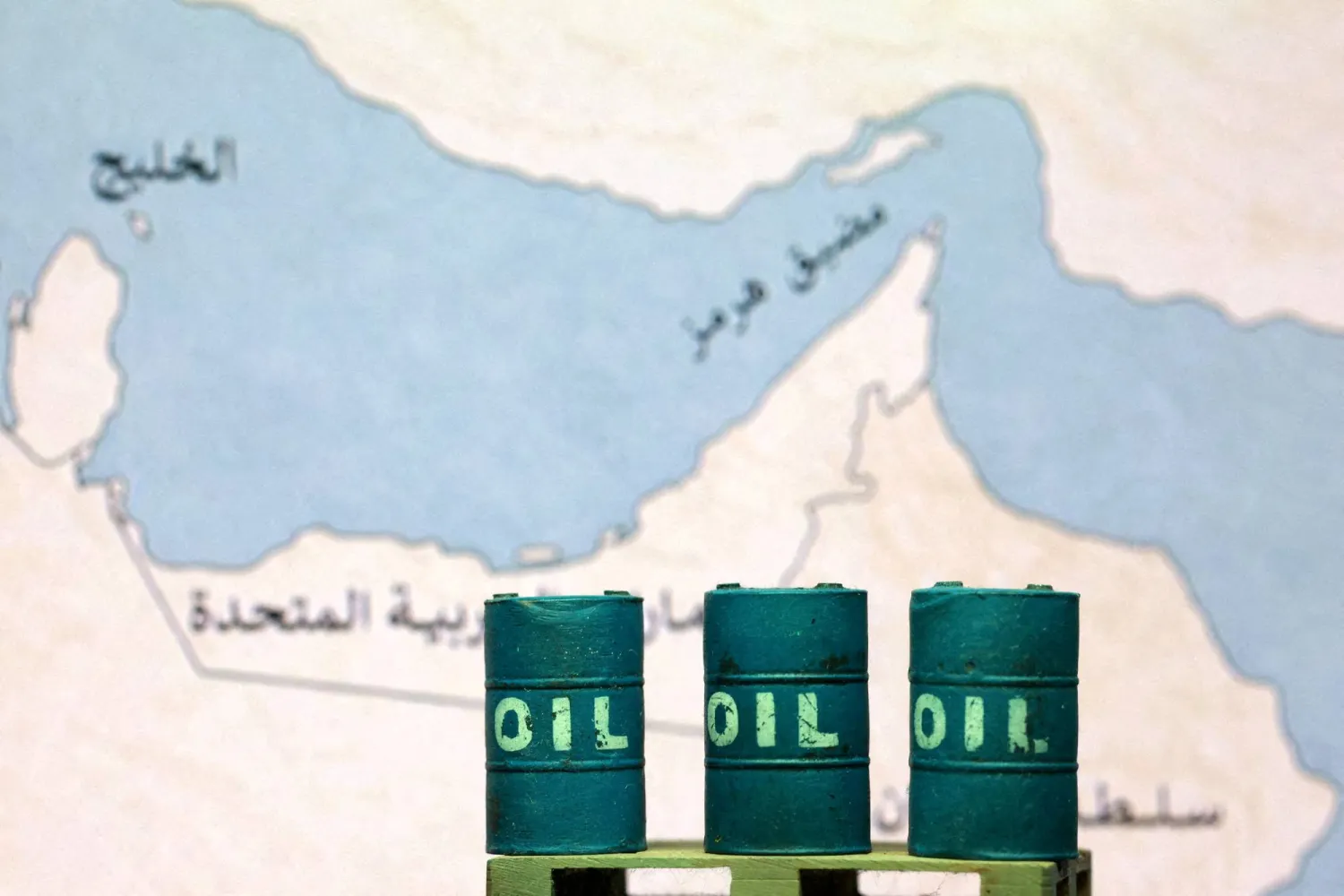
FILE PHOTO: A map showing the Strait of Hormuz, also known as Madiq Hurmuz, and 3D printed oil barrels are seen in this illustration taken March 26, 2026. REUTERS/Dado Ruvic/Illustration//File Photo
TT

Oil Little Changed on Skepticism US-Iran Peace Talks Will Ease Hormuz Disruption

FILE PHOTO: A map showing the Strait of Hormuz, also known as Madiq Hurmuz, and 3D printed oil barrels are seen in this illustration taken March 26, 2026. REUTERS/Dado Ruvic/Illustration//File Photo

Oil prices were little changed on Thursday, reversing earlier declines, on skepticism that peace talks between the US and Iran will reach a deal to end the war that has bottled up oil output from the key Middle East producing region.

Brent crude futures were down 26 cents to $94.67 a barrel at 0611 GMT. US West Texas Intermediate crude futures climbed 14 cents to $91.43 a barrel. Both benchmarks settled little changed on Wednesday but traded in a wide range. The US-Israeli war on Iran has ‌resulted in the ‌largest-ever disruption of global oil and gas supplies due ‌to ⁠Iran's interruption of traffic ⁠through the Strait of Hormuz, which typically carries about 20% of the world's oil and liquefied natural gas flows.

"While there are hopes for de-escalation, many investors remain skeptical, given that US-Iran talks have repeatedly broken down even after appearing to make progress," said Toshitaka Tazawa, an analyst at Fujitomi Securities.

"Until a peace deal is reached and free navigation through the strait is restored, WTI prices are expected to continue fluctuating between $80 and $100," ⁠he added.

Analysts from ING estimate that roughly 13 million barrels ‌per day of oil flow has been disrupted ‌by the closure of the strait, after taking into consideration pipeline diversions and the trickle of ‌tankers that have passed through the gateway, they said in a note on ‌Thursday.

With the US blockade on Iranian ports announced after the collapse of peace talks over the weekend, the disruption could increase.

"The physical market is becoming tighter every day that passes without a restart of oil flows through the Strait of Hormuz," the ING analysts said.

A source ‌briefed by Tehran told Reuters that Iran could consider allowing ships to sail freely through the Omani side of the ⁠Strait of Hormuz ⁠if a deal was reached to prevent renewed conflict after a two-week ceasefire started on April 8.

US and Iranian officials were weighing a return to Pakistan for further talks as early as the coming weekend. Pakistan's army chief arrived in Tehran on Wednesday as a mediator to try to prevent a renewal of the conflict.

US Treasury Secretary Scott Bessent said on Wednesday that Washington will not be renewing the waivers that allowed the purchase of some Iranian and Russian oil without facing US sanctions.

Underscoring the tightness of global crude and oil product supply, US inventories of oil, gasoline and distillate fuels fell last week, the Energy Information Administration said on Wednesday, as imports declined and exports jumped to meet the needs of countries searching for barrels to replace the disrupted flows.



IMF Reaches Agreement with Egypt to Unlock $2.3 Billion in Funds

Egyptian President Abdel Fattah el-Sisi and IMF Managing Director Kristalina Georgieva. (Reuters file photo)
TT

IMF Reaches Agreement with Egypt to Unlock $2.3 Billion in Funds

Egyptian President Abdel Fattah el-Sisi and IMF Managing Director Kristalina Georgieva. (Reuters file photo)

The International Monetary Fund said on Wednesday that it had reached an agreement with Egypt to unlock a disbursement of about $2.3 billion in funds, subject to approval by the IMF's board, as the country nears the end of its $8 billion loan program.

Egypt would receive about $1.5 billion under the IMF's 48-month loan program after completing the final review, along with roughly $800 million under the Resilience and Sustainability Facility.

"The authorities’ successful implementation of their economic reform program and proactive response to the implications ⁠of the Middle East ⁠war have helped preserve macroeconomic stability and supported Egypt’s resilience in the face of a series of external shocks," Reuters quoted the IMF as saying in a statement.

Egypt's program with the IMF was expanded to $8 billion in March 2024.

The global lender said Egypt's economy remained resilient despite heightened regional tensions, with growth reaching 5.1% in the fiscal year ending June 2026, supported by a recovery in Suez Canal and petroleum-related activity and continued strength in manufacturing, tourism and communications.

The fund stressed that exchange-rate flexibility should remain the first line of defense against external shocks, with interventions limited to containing excessive volatility.

Egypt raised interest rates, by 100 basis points, in October for the first time since March 2024, a move welcomed by the IMF as a commitment to price stability amid heightened international oil prices and uncertainty.


Saudi Intercity Buses Carry Over 960,000 Passengers in Q3 2026

A bus parked at Madinah Airport (SPA)
TT

Saudi Intercity Buses Carry Over 960,000 Passengers in Q3 2026

A bus parked at Madinah Airport (SPA)

Saudi Arabia's Transport General Authority (TGA) reported that more than 960,000 passengers traveled on intercity buses during the third quarter of 2026, an increase of 6% compared with the same period last year, according to its quarterly statistical bulletin, SPA reported.

The Makkah region recorded the highest passenger volume at approximately 287,000, followed by Riyadh with 201,000 and the Eastern Province with 123,000.

Asir ranked fourth with around 75,000 passengers, followed by Madinah with 59,000, Jazan with 56,000 and Tabuk with 41,000.

The Northern Borders region recorded 25,000 passengers, Qassim 24,000, Najran 22,000, Hail 18,000 and Jouf 15,000, while Al-Baha registered approximately 9,000 passengers.


CEER Signs SAR2.6 Billion Financial Agreement with Arab National Bank and Riyad Bank

The signing marks a key milestone that unites CEER with two of the Kingdom’s premier financial institutions - SPA
TT

CEER Signs SAR2.6 Billion Financial Agreement with Arab National Bank and Riyad Bank

The signing marks a key milestone that unites CEER with two of the Kingdom’s premier financial institutions - SPA

CEER, Saudi Arabia’s first homegrown automotive brand, signed a financial agreement worth approximately SAR2.6 billion with Arab National Bank (anb) and Riyad Bank to further advance CEER’s strategic objectives in its contribution towards the growth of the Saudi automotive manufacturing industry.

The agreement was signed at CEER’s headquarters in Riyadh by Chief Financial Officer of CEER Joerg Schuessler, Chief Wholesale Bank Officer at Arab National Bank Louai Alzaher, and Chief Corporate Banking Officer at Riyad Bank Mohammed Abu Al-Naja, SPA reported.

The signing marks a key milestone that unites CEER with two of the Kingdom’s premier financial institutions and demonstrates robust private-sector confidence in CEER’s strategic direction, operational readiness, and long-term commercial viability, directly aligning with the industrial diversification objectives of Saudi Vision 2030.

At the signing ceremony, Schuessler said: "This agreement reflects anb and Riyad Bank's confidence in CEER's business model and long-term outlook. Together, we are investing in the future of a Saudi automotive brand built for the Kingdom and its future economic ambitions."

Alzaher added: “We are proud at anb to have led and arranged this agreement for CEER, reflecting the Bank’s commitment to supporting strategic national projects and enabling businesses to execute their strategic plans. This agreement also underscores anb’s role as an active banking partner in supporting promising economic sectors, particularly the automotive manufacturing industry, contributing to strengthening the Kingdom’s industrial sector and advancing the objectives of Saudi Vision 2030.”

Abu Al-Naja stated: “The signing of this financing agreement with CEER reaffirms Riyad Bank’s commitment to supporting national industries and advancing sustainable transport in line with Saudi Vision 2030 and the Saudi Green Initiative.”