From buildings and megaprojects to data centers, demand for air-conditioning and cooling solutions is expanding across Saudi Arabia, driven by rapid construction and accelerating investment in digital infrastructure.
As artificial intelligence and cloud computing enter a period of rapid expansion, data centers are emerging as a new growth driver for the cooling industry, requiring advanced levels of efficiency and reliability and equipment capable of operating under harsh climatic conditions.
The boom extends beyond Saudi Arabia. Globally, the cooling industry is expanding as temperatures rise and demand for data centers grows. The International Energy Agency estimates that global electricity demand for building cooling has risen by about 50% since 2015 to around 2,900 terawatt-hours, while worldwide air-conditioner shipments reached about 200 million units in 2024.
Cooling buildings is placing increasing pressure on power grids, particularly during heat waves, while data centers and AI are adding another layer of demand for advanced cooling technologies.
Global data-center electricity consumption stood at around 415 TWh in 2024 and is projected to reach about 945 TWh by 2030, with cooling and environmental-control systems accounting for a significant share of energy use at these facilities.
The growth comes amid mounting pressure to improve air-conditioning efficiency and reduce its environmental impact. According to the UN Environment Program, global cooling demand could more than triple from current levels by 2050 under existing policies, making equipment efficiency and less energy-intensive technologies increasingly important.
These shifts offer Saudi Arabia an opportunity to expand its domestic air-conditioning and cooling manufacturing base as the Kingdom seeks to increase local content and meet more of its market needs through domestic production.
Nabil Shahin, managing director of the Middle East and North Africa office of the US-based Air-Conditioning, Heating, and Refrigeration Institute (AHRI), told Asharq Al-Awsat that Saudi Arabia accounts for more than half of the Gulf air-conditioning market. He attributed the market’s growth to expanding commercial and construction projects, alongside the boom in data centers.
Data Centers Reshape Cooling Market
The Kingdom is experiencing a “growth boom” in data centers, according to the AHRI executive, fueled by the rapid spread of AI and rising demand for cloud-computing services. He noted that several US and European companies are developing data-center projects in Saudi Arabia.
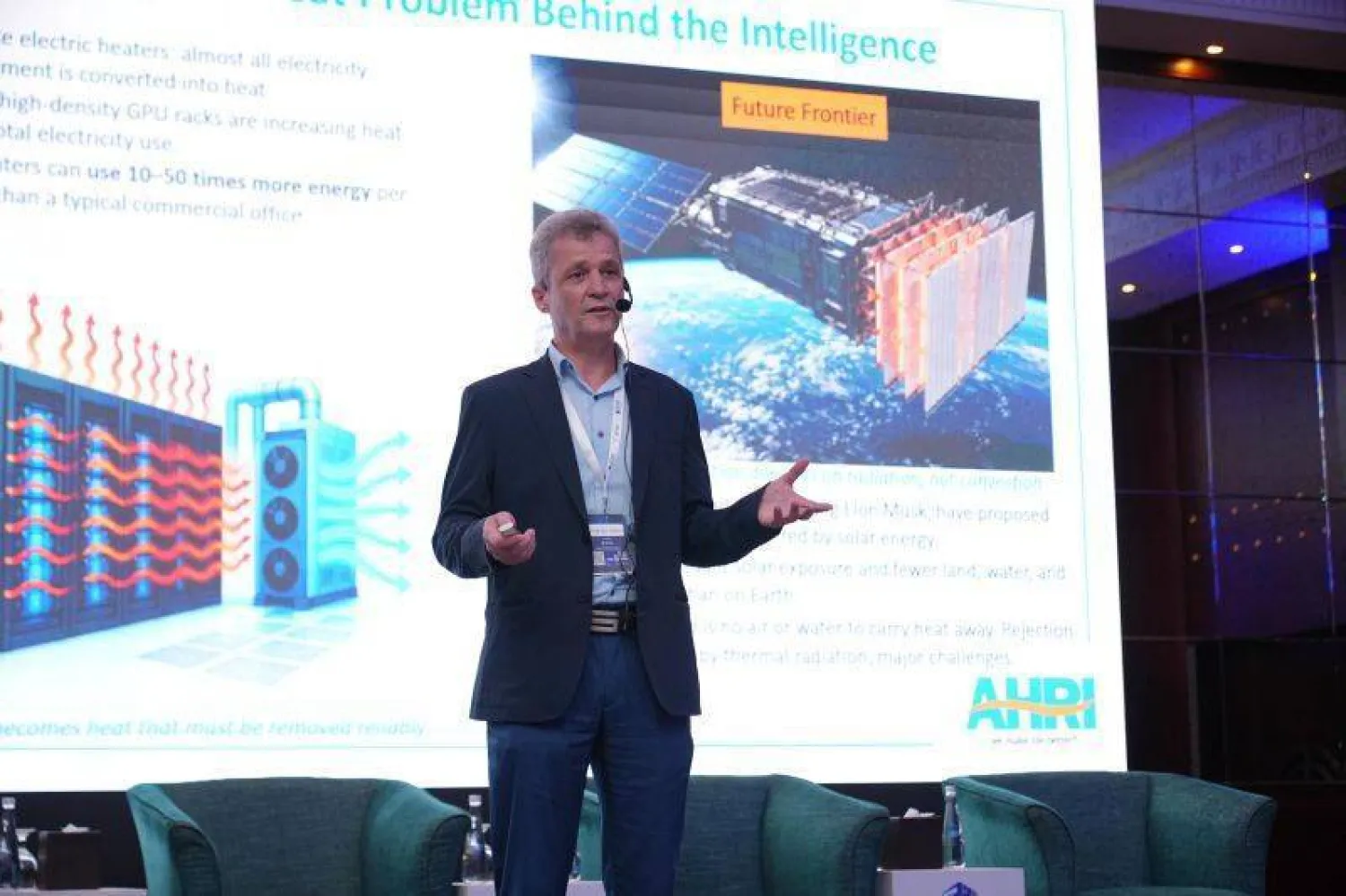
As their cooling requirements increase, AHRI is working with the Saudi Standards, Metrology and Quality Organization (SASO) to develop and modify standards for data-center equipment to reflect the Kingdom’s temperatures, climatic conditions and local requirements.
Saudi Standard for Evaporative Coolers
Shahin noted that SASO had asked AHRI to develop a new standard for evaporative cooling systems, locally known as “desert coolers,” which use water in the cooling process rather than the refrigerants used in conventional air-conditioning systems.
There is currently no unified global standard for such systems, he explained. AHRI is developing the standard for submission to SASO, with the aim of providing a reference for manufacturers in the Saudi market.
The new standard will include energy-efficiency measurement criteria to assess equipment performance and suitability for local conditions.
Improving air-conditioning efficiency is particularly important in Saudi Arabia because of the sector’s high electricity consumption. More efficient systems could reduce power demand and emissions associated with electricity generation.
Saudi Arabia Leads Gulf Market
The AHRI executive estimated Saudi Arabia’s share of the Gulf air-conditioning market at more than 50%, with demand continuing to rise alongside commercial and construction projects, particularly in Riyadh, coastal areas and Makkah.
Some estimates put the Kingdom’s share at about 60%, he noted, but he prefers the more conservative figure of over 50% because no verified official data precisely establish its market share.
The scale of demand has made Saudi Arabia attractive to international companies, several of which have expanded their presence over the past two years by establishing new factories or enlarging existing facilities.
Local manufacturing can give companies an additional advantage by reducing some import costs, which can range from 5% to 12%, according to Shahin. He pointed to three large domestic factories that are expanding their operations.
From Assembly to Component Manufacturing
Localization, however, still faces the challenge of dependence on imported components. Most key air-conditioning components — including electric motors, compressors, copper and refrigerants — continue to come from abroad.
Much of Saudi Arabia’s current manufacturing activity remains focused on assembly, although some components, including heat exchangers, are produced domestically.
The next step, the AHRI official argued, is to move gradually from assembly toward manufacturing a greater proportion of air-conditioning components in the Kingdom, including electronics, circuit boards and electric motors.
He called for additional government incentives and support, including land, industrial space, free zones and investment facilities, to help Saudi factories expand and increase the share of locally manufactured components.