

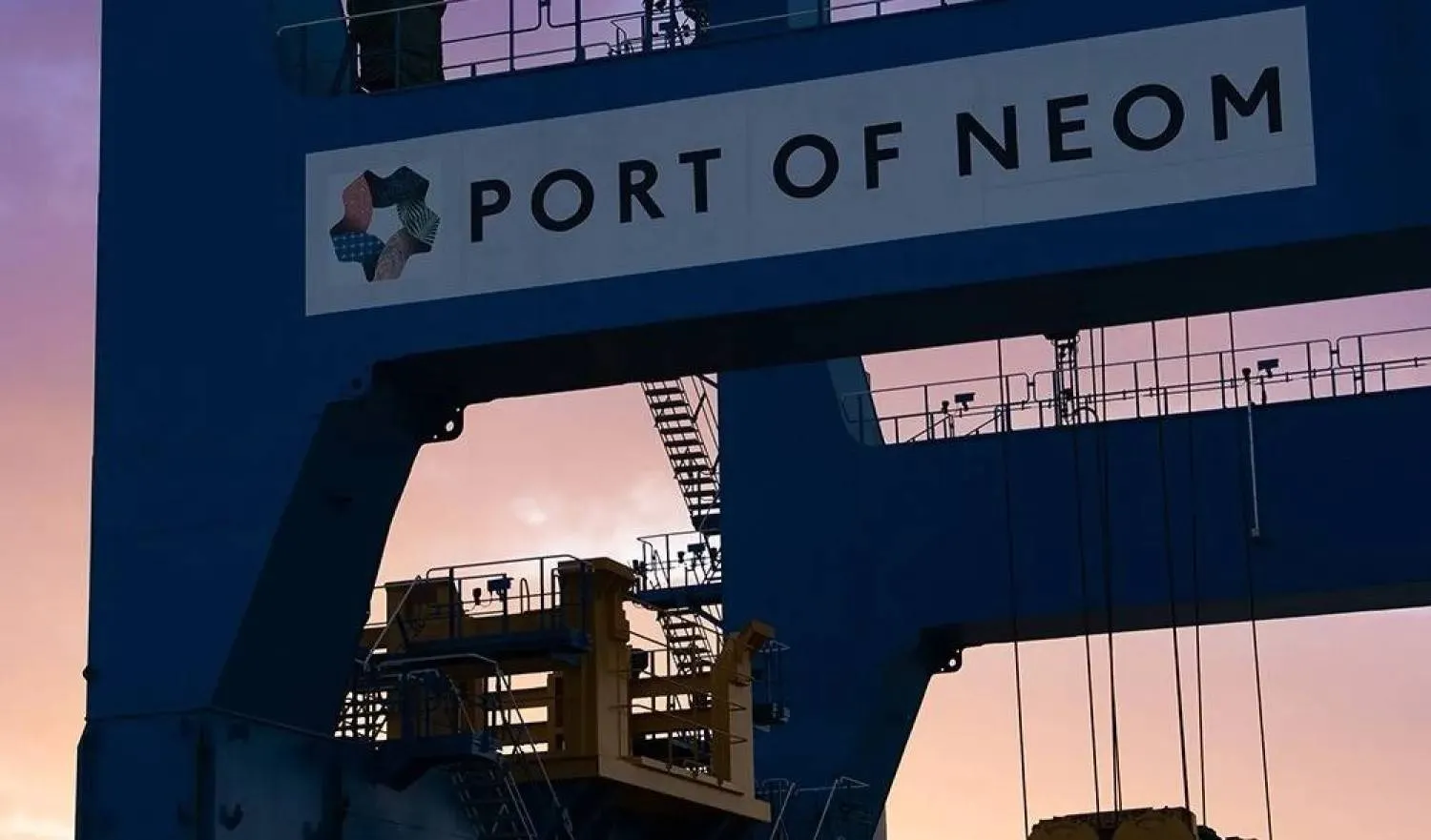

NEOM Port Reshapes Global Trade Routes from Northern Saudi Arabia

NEOM Port in Saudi Arabia (NEOM)
TT

NEOM Port Reshapes Global Trade Routes from Northern Saudi Arabia

NEOM Port in Saudi Arabia (NEOM)

On April 15, Saudi Arabia’s NEOM posted a terse but telling message on X: “Europe- Egypt- NEOM- GCC: your faster route.”

Accompanied by a map, the post traced a corridor linking Europe to Egypt’s ports of Damietta and Safaga, on to NEOM Port, then overland to Kuwait, Iraq, Bahrain, Qatar, the United Arab Emirates and Oman.

It was not a routine update. It signaled that a long-discussed trade route is now operational.

That same day, the Public Investment Fund approved its 2026-2030 strategy, outlining Saudi Arabia’s economic path to the end of the decade. NEOM said it “remains a central pillar” of that transformation, with its designation as an independent system underscoring official commitment.

The timing indicated clear alignment between the port’s rollout and the broader national strategy.

On the ground, progress is moving fast. The main container terminal, built to handle the world’s largest ships, is set to open this year with a capacity of 1.5 million twenty-foot equivalent units.

In June last year, the port received its first fully automated, remotely operated cranes, the first in the Kingdom, in what officials called a milestone for Saudi ports.

In a recent update, NEOM said the port is already operating at full capacity as a Red Sea hub, handling multiple cargo types, supported by advanced infrastructure and high operational standards. It links trade flows from the Americas, Europe and Egypt to Gulf and Iraqi markets.

A new logistics map

Abdullah Abdulrahim Almeer, an assistant professor at King Fahd University of Petroleum and Minerals and a member of the Saudi Economic Association, said NEOM’s location gives it an edge.

Unlike major Saudi ports clustered on the western coast or in the Gulf, NEOM sits at the far northwest, where Europe, the Gulf and northern neighbors converge.

He said the port can act as a “bridge port,” linking the sea and land into a single system. Its proximity to the Suez Canal and its road links to Jordan, Iraq and Gulf states strengthen its role as a future logistics hub.

“NEOM Port is not just competing with Jeddah or Dammam, it is opening a new axis that reshapes regional logistics,” he said, citing tensions in routes such as the Strait of Hormuz.

Logistics consultant Nashmi Al-Harbi said the port complements, rather than competes with, existing Saudi ports. He added that its reliance on renewable energy boosts efficiency and positions it as a sustainability leader.

Faster, leaner supply chains

Almeer said the corridor can cut shipping times by more than half. Cargo that once took 10 to 12 days to reach Gulf destinations can arrive in 4 to 6 days by combining short-sea routes with fast overland transport.

The gains come not just from distance, but from reduced waiting times, simpler procedures and less congestion.

Al-Harbi said the corridor “revolutionizes supply chain efficiency,” offering a reliable alternative amid geopolitical uncertainty.

Both said time-sensitive goods stand to gain most, including fast-moving consumer goods, fresh and refrigerated food, pharmaceuticals, spare parts, high-value electronics and advanced construction materials.

From the trial phase to the real trade

Almeer said the port has moved beyond early testing and can now support real trade flows, though it is still scaling up. He expects it to become a major regional hub as expansion continues.

Al-Harbi said the port reached an advanced operational stage in 2026, with infrastructure capable of handling regional trade, supported by advanced digital systems, automated cranes and modern road links.

Almeer pointed to the involvement of major firms such as Bahri and DFDS as evidence that global players have shifted from watching to operating, though the port is still proving itself at scale.

Al-Harbi said the interest reflects a search for safer, more reliable routes amid disruptions to global supply chains.

Driving diversification

Almeer said the Public Investment Fund’s strategy puts logistics at the heart of economic diversification. NEOM Port and the corridor directly support that goal, linking Europe, Africa and East Asia to Gulf markets by land and sea.

Supporting measures include exemptions from storage fees for up to 60 days, allowing Gulf trucks to enter empty or loaded, and launching regional storage and redistribution initiatives.

He said the impact on Tabuk will be significant, creating direct jobs in port operations and indirect roles in transport, warehousing and logistics, while opening the door for new industrial zones.

NEOM’s location near Iraq, Jordan and Kuwait strengthens its role as a regional gateway, he said, boosting Tabuk’s appeal and placing it at the center of regional and global trade.



Iraq Oil Output Exceeds 5 million bpd

Majnoon oil field near the Iraqi city of Basra (Reuters)
TT

Iraq Oil Output Exceeds 5 million bpd

Majnoon oil field near the Iraqi city of Basra (Reuters)

Iraq produces more than 5 million barrels of oil per day (bpd), Oil Minister Basim Mohammed told state news agency INA on Saturday.

According to Reuters, Iraq is pushing for a higher OPEC production quota as the economic fallout from the Iran war and new investment by oil majors increase pressure on Baghdad to boost output, potentially putting it at odds with the producer group.

The conflict has hit Iraq particularly hard, forcing major export cuts and depriving the state of oil revenue, which accounted for 88% of government income last year.


IMF: Any Slowdown in AI-driven Growth Would be Factor for Central Banks

IMF Managing Director Kristalina Georgieva speaks during the Annual Meetings Plenary at the Annual Meetings of the International Monetary Fund (IMF) and the World Bank Group (WBG) at the Queen Sirikit National Convention Center (QSNCC) in Bangkok on October 16, 2026. (Photo by Lillian SUWANRUMPHA / AFP)
TT

IMF: Any Slowdown in AI-driven Growth Would be Factor for Central Banks

IMF Managing Director Kristalina Georgieva speaks during the Annual Meetings Plenary at the Annual Meetings of the International Monetary Fund (IMF) and the World Bank Group (WBG) at the Queen Sirikit National Convention Center (QSNCC) in Bangkok on October 16, 2026. (Photo by Lillian SUWANRUMPHA / AFP)

Central bankers around the world would need to consider any slowdown in AI-driven growth as they assess steps in their fight against inflation, International Monetary Fund Managing Director Kristalina Georgieva said on Friday.

Georgieva said concerns about dependence on the AI investment boom and high valuations were impacting markets around the world.

"Things are going up and down, and this is likely to continue," she told an audience at IMF headquarters in Washington, adding that the volatility would complicate the job of central banks at a time when risks to price stability had been growing.

A steep rout in technology stocks on Thursday rippled through markets on fears that ⁠the Democrats' victory ⁠in the US midterm elections would increase regulatory scrutiny of AI and slow the data center build-out, sending investors to the safety of bonds.

The political jitters are hitting an AI trade already on shaky footing due to worry about return on massive spending on AI-related infrastructure, with the meltdown spurring margin calls and spooking retail investors and hedge ⁠funds alike.

Georgieva said the AI investment boom was lifting growth in some countries, helping to offset a negative oil-supply shock triggered by the war in the Middle East, but it was also adding to inflationary pressures and financial stability concerns.

The IMF last month flagged significant growth and financial stability risks from a potential ending of the AI investment boom, among other factors, including a prolonged Middle East war. At the time, it warned that a steep drop in AI investment could lead to a sharp fall in asset prices, ultimately cutting global GDP ⁠by 1.1% ⁠by 2028, including a 1.8% drop in US output.

Georgieva did not repeat the downside forecast on Friday, but acknowledged the recent market volatility.

"Should there be a slowdown in the AI-driven growth impulse, it would need to be factored in as central banks assess the necessary steps in the fight against stubborn inflation," she said.

Democrats are planning to unleash a flood of new legislation targeting artificial intelligence systems and data-center development when they take control of the US Congress in January, Reuters reported on Friday, citing congressional aides and advocates.

That would mark a sharp shift from the Republican-led Congress, where lawmakers largely focused on promoting AI development and declined to pass legislation restricting the technology.


World Food Prices Dip in October, but Remain Higher Than a Year Ago

A worker carries loaves of bread for sale at a bakery in the capital city of Cairo, Egypt November 4, 2026. (Reuters)
TT

World Food Prices Dip in October, but Remain Higher Than a Year Ago

A worker carries loaves of bread for sale at a bakery in the capital city of Cairo, Egypt November 4, 2026. (Reuters)

World food prices edged lower in October as weaker import demand contributed to monthly declines in cereal, dairy and meat prices, but were still nearly 6% higher than a year earlier, the United Nations' Food and Agriculture Organization said on Friday.

The FAO Food Price Index, which tracks monthly changes in international prices for a basket of food commodities, ‌averaged 133.9 points ‌in October, down from a revised ‌135.6 ⁠in September.

The index ⁠was 5.9% higher than a year earlier, but remained 16.4% below its March 2022 peak.

FAO's cereal price index fell 4.5% from September and was 12.6% lower than a year ago, as wheat and maize quotations declined. Wheat prices eased on weak import demand ⁠and improved production prospects, especially in Argentina.

"Expectations of ‌easing constraints on Black ‌Sea export flows added to the downward pressure on prices, ‌although continued disruptions to Black Sea logistics limited the decline," ‌FAO said in a statement.

Maize prices also eased after reaching a three-year high in September, pressured by the US harvest, expectations of ample supplies in South America and renewed ‌prospects of easing tensions in the Black Sea region.

Vegetable oil prices edged up 0.3%, ⁠as ⁠higher soybean and sunflower oil prices more than offset a fall in rapeseed oil prices.

Sugar prices rose 6.6%, their fourth straight monthly increase, to the highest level since December 2024, after rainfall disrupted harvesting in Brazil. They were now 28.8% above a year ago.

The dairy index fell 1.1%, as lower butter and cheese prices linked to ample supplies and subdued demand outweighed gains in milk powder.

The meat index declined 1.2%, while still slightly above its year-earlier level, as ovine and bovine meat prices fell.