Trump Auto Tariff Hike Could Cost Germany Nearly $18 Billion in Output, Institute Says

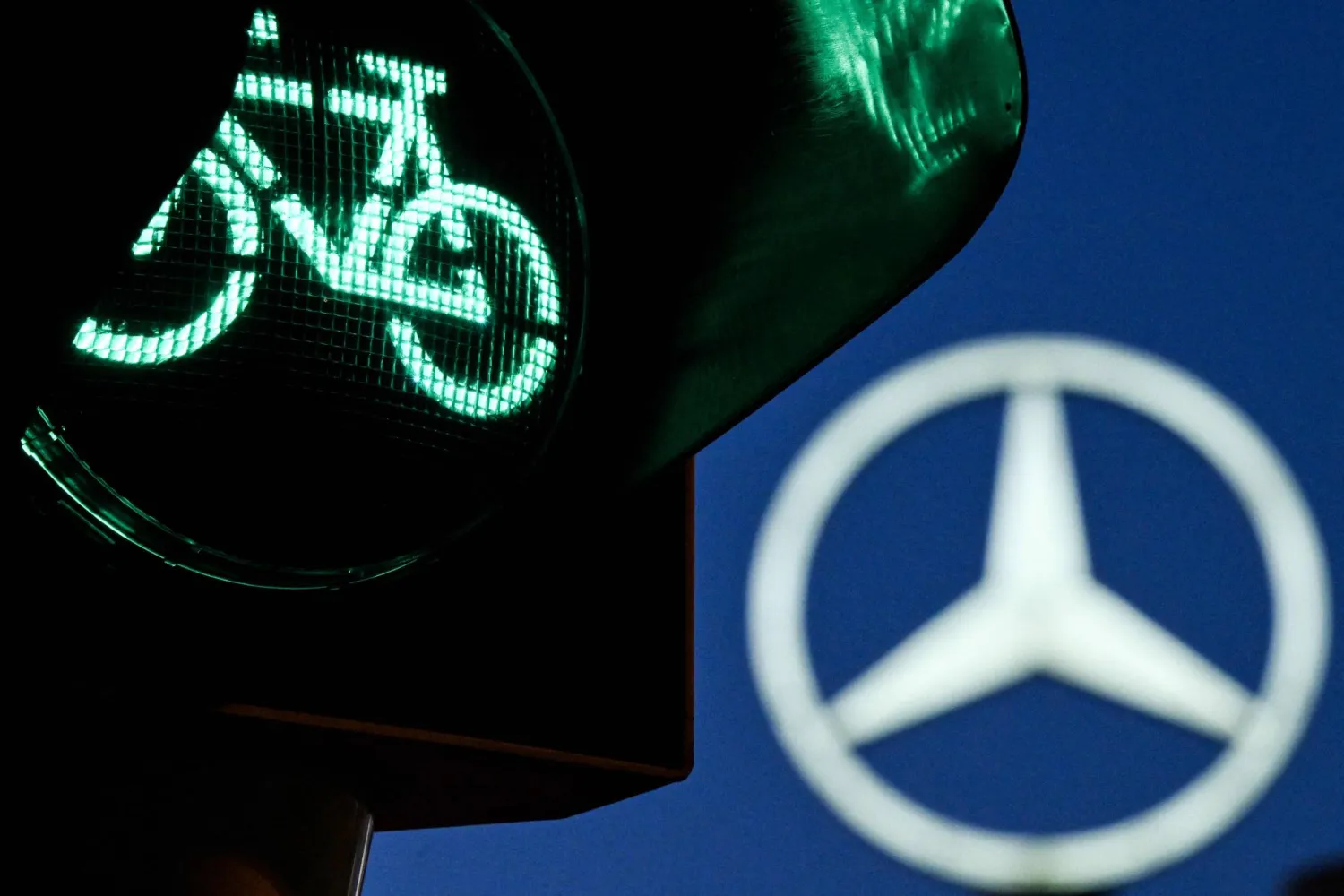
A traffic light for cyclists is pictured in front of a giant logo of German automotive brand Mercedes-Benz is seen atop a Mercedes dealership in Offenbach, western Germany, on April 29, 2026. (AFP)
TT

Trump Auto Tariff Hike Could Cost Germany Nearly $18 Billion in Output, Institute Says

A traffic light for cyclists is pictured in front of a giant logo of German automotive brand Mercedes-Benz is seen atop a Mercedes dealership in Offenbach, western Germany, on April 29, 2026. (AFP)

The tariff ‌hike on cars and trucks from the European Union announced by US President Donald Trump could cost Germany nearly 15 billion euros ($17.58 billion) in output, an economic institute told Reuters on Saturday.

The estimate from the Kiel Institute for the World Economy (IfW) highlights the exposure of the EU's largest economy to US import tariffs, which have already cost the German automotive industry billions.

"The ‌effects would ‌be substantial," IfW President Moritz Schularick ‌said, ⁠with output losses ⁠rising to around 30 billion euros over the longer term, according to the institute's analysis.

Trump said on Friday he would increase the auto tariffs to 25% next week from a previously agreed 15%, saying the bloc had not complied ⁠with its trade deal with ‌Washington.

"Germany's already sluggish ‌growth rate would be hit hard," IfW economist Julian Hinz ‌said.

The institute currently expects the German ‌economy to grow by 0.8% this year.

Other European economies with significant automotive sectors - including Italy, Slovakia, and Sweden - are also likely to suffer significant losses, ‌it added.

The German finance minister's chief adviser advised caution towards ⁠Trump.

"The EU should ⁠simply ⁠wait and see for now," Jens Suedekum told Reuters. "It is well known that Trump is quick to suspend or withdraw his grandiose tariff threats."

The president must explain why he thinks the EU is not complying with the existing trade agreement, Suedekum said, adding that it was also not clear whether there was a legal basis for the latest tariff threat.

"It all seems quite impulsive," the adviser said.


Moody's Affirms its Credit Rating of Saudi Arabia at 'Aa3' with Stable Outlook

The Saudi flag. Asharq Al-Awsat
TT

Moody's Affirms its Credit Rating of Saudi Arabia at 'Aa3' with Stable Outlook

The Saudi flag. Asharq Al-Awsat

The credit rating agency Moody’s has affirmed Saudi Arabia’s credit rating at “Aa3” with a “stable” outlook.

The agency said Friday that the affirmation at Aa3 reflects Saudi Arabia’s large and wealthy economy, supported by its vast hydrocarbon endowment, and highly competitive position in global energy markets, alongside improving institutional and policy effectiveness.

Progress under Vision 2030 has underpinned solid non-hydrocarbon growth, supported by sustained public investment, structural reforms, and gradually improving fiscal and economic transparency.

Moody’s noted that Saudi Arabia’s stable outlook reflects the Kingdom’s resilience against regional geopolitical risks and potential trade disruptions, supported by strong and continued oil exports flexibility through the East-West pipeline and Red Sea terminals.

The agency also expects that the Kingdom’s progress on economic diversification is likely to continue and the momentum will be sustained over the coming years. It is supported by significant progress to date in implementing a broad-based reform agenda, including judicial, business and social reforms that have accelerated the development of the services sector and the broader non-oil economy.

Moody's expects non-hydrocarbon private sector GDP growth to return to around 4-5% after the Middle East conflict subsides, among the strongest rates in the Gulf Cooperation Council (GCC), reflecting ongoing structural reforms, sustained public investment and improving private sector participation.


Morocco Farmers Saw Hope in Rain, but Mideast War Inflates Production Costs

A farmer works in his wheat field in the Sebt Meghchouch region of Morocco, on April 28, 2026. (Photo by Abdel Majid BZIOUAT / AFP)
TT

Morocco Farmers Saw Hope in Rain, but Mideast War Inflates Production Costs

A farmer works in his wheat field in the Sebt Meghchouch region of Morocco, on April 28, 2026. (Photo by Abdel Majid BZIOUAT / AFP)

Like many Moroccan farmers, Mehdi el-Maazi was hopeful that rare heavy rains would yield an abundant harvest this year -- but those hopes were quickly shattered as the Middle East war sent fuel and fertilizer costs soaring.

Morocco, where agriculture employs about a quarter of the working population and where drought had persisted for seven consecutive years, recorded massive rainfalls last February and December.

Across the rural region of Marchouch, about 70 kilometres (43 miles) south of Rabat, landscapes that had long been parched have turned green again, and farmers have taken back to working their fields.

Following the rains this winter, the country expected a strong cereal harvest, with output estimated to reach nearly nine million tonnes -- more than double last year's. Overall agricultural output was also set to rise by about 15 percent from last season.

But the war in the Middle East, which began in late February, has disrupted maritime traffic through the Strait of Hormuz, not only sending global energy markets into a tailspin but also choking fertilizer supplies.

Prior to the war, Maazi would normally spend around 1,200 dirhams ($130) per hectare on diesel to run his tractor. Now, he said, the cost has climbed to 1,800 dirhams.

"We were happy at first about the arrival of the rain," said the 32-year-old lentil farmer. "But with the increase in diesel prices, everything changed."

Farmers also say higher fuel prices are driving up the cost of nearly everything needed to produce crops.

Abdelkader Toukati, another farmer in the area, said he hoped "the price of diesel will fall before the beginning of the harvest season".

High prices have meant that workers' wages have also risen and even "the cost of renting harvesting machines doubled", Toukati added.

Abdelaziz Drissi, who rents out agricultural machinery, also complained that there was little to no financial reward.

"There is no longer any profit," he said. "We are only working to pay for fuel."

Rising energy costs have had a direct impact on key farming supplies, driving up prices for seeds, fertilizers, pesticides and animal feed.

Livestock breeder Abdessadaq el-Fayd said grain feed prices had sharply risen in recent months.

"We used to buy it for 90 dirhams" per sack, he said. "Today, it costs 110 to 120 dirhams."

A recent report by the kingdom's High Commission for Planning projected economic growth of five percent in the first quarter of 2026, up from 4.1 percent in the previous quarter, driven in part by agricultural activity.

In an effort to alleviate rising costs, the Moroccan government in March announced aid for transport operators.

And last month, Prime Minister Aziz Akhannouch pledged to "improve distribution chains so that prices remain at a reasonable level".

But farmers interviewed by AFP said the measures have yet to rein in prices.

Rachid Benali, president of the Moroccan Confederation of Agriculture and Rural Development, said the price hikes "mainly concern fuels and nitrogen fertilizers".

But while the high costs "will have no impact on either volume or quality" of harvests, they "will automatically be reflected" in produce prices at markets, he added.


Dollar Nears Six-week High; Mixed Signals on US-Iran Deal Feed Uncertainty

US dollar banknotes (Reuters)
TT

Dollar Nears Six-week High; Mixed Signals on US-Iran Deal Feed Uncertainty

US dollar banknotes (Reuters)

The dollar traded near six-week highs on Friday, after conflicting signals over a US-Iran peace deal whipped up volatility across financial markets, though investors latched on to hopes of some progress. Washington and Tehran stuck to opposing stances over the latter's uranium stockpile and control of the Strait of Hormuz, although US Secretary of State Marco Rubio said there had been "some good signs" in talks. The dollar rose 0.17% against a basket of six major currencies to 99.37, just shy of six-week highs.

The euro, which was headed for a second weekly loss, was down 0.2% on the day at $1.1594, while the pound was slightly lower at $1.342, having shrugged off data earlier that showed retail sales dropped by the most in nearly a year in April, as consumers felt the pinch of the inflationary effects of the Iran war. The dollar found additional support from US data, which showed weekly jobless claims fell last week while manufacturing activity rose to a four-year high in May, underscoring resilience in the world's largest economy.

"We're coming to the end of week 12, we're six weeks in the ceasefire, and I'm just not really that convinced we're any closer to a resolution between the US and Iran," Tony Sycamore, a market analyst at IG, said of the Middle East war.

"I still feel like the risks are for the US dollar to go higher, because I really just don't see a way out of this situation in the Middle East without them sort of needing to be more forceful."

The US dollar's strength and persistently high oil prices have spelled pain for the yen, which on Friday struggled on the weaker side of 159 per dollar. It was 0.1% lower at 159.09 per dollar. The yen is teetering even after likely intervention from Tokyo just weeks ago to support it. It has given up nearly 75% of its gains from the presumed intervention, which has left traders on alert for further moves by Japanese authorities.

"It's just buying time, really. What they need is a change in fundamentals, and I think the best thing that could happen is a quick deal to end the Iran conflict," said Lee Hardman, a currency strategist at MUFG.

"I don't think you'd see dollar/yen drop too sharply from here, but even if it just got back down into the mid 150s, taking some of the selling pressure off the yen, that would probably be the best they can hope for right now."

The Bank of Japan is only expected to raise borrowing costs gradually while other central banks, including the European Central Bank, are likely to deliver hikes far more quickly, which puts the yen at a disadvantage with investors who seek out extra returns from higher domestic interest rates.

On a trade-weighted basis, the yen is at record lows, which favours its exporters but compounds the energy-price shock, given Japan's reliance on imported goods. Data on Friday showed Japan's core inflation slowed to a four-year low in April, complicating the outlook for BOJ policy.

Currencies in emerging Asia have also come under immense pressure owing to the surge in global oil prices, forcing policymakers to take increasingly urgent and unusual steps to shore up their economies. The Turkish lira hit record lows against the dollar on Friday after a court ruling went against the main opposition party.