


G7 Trade Talks Target Critical Minerals as US-EU Tariff Rift Strains Unity

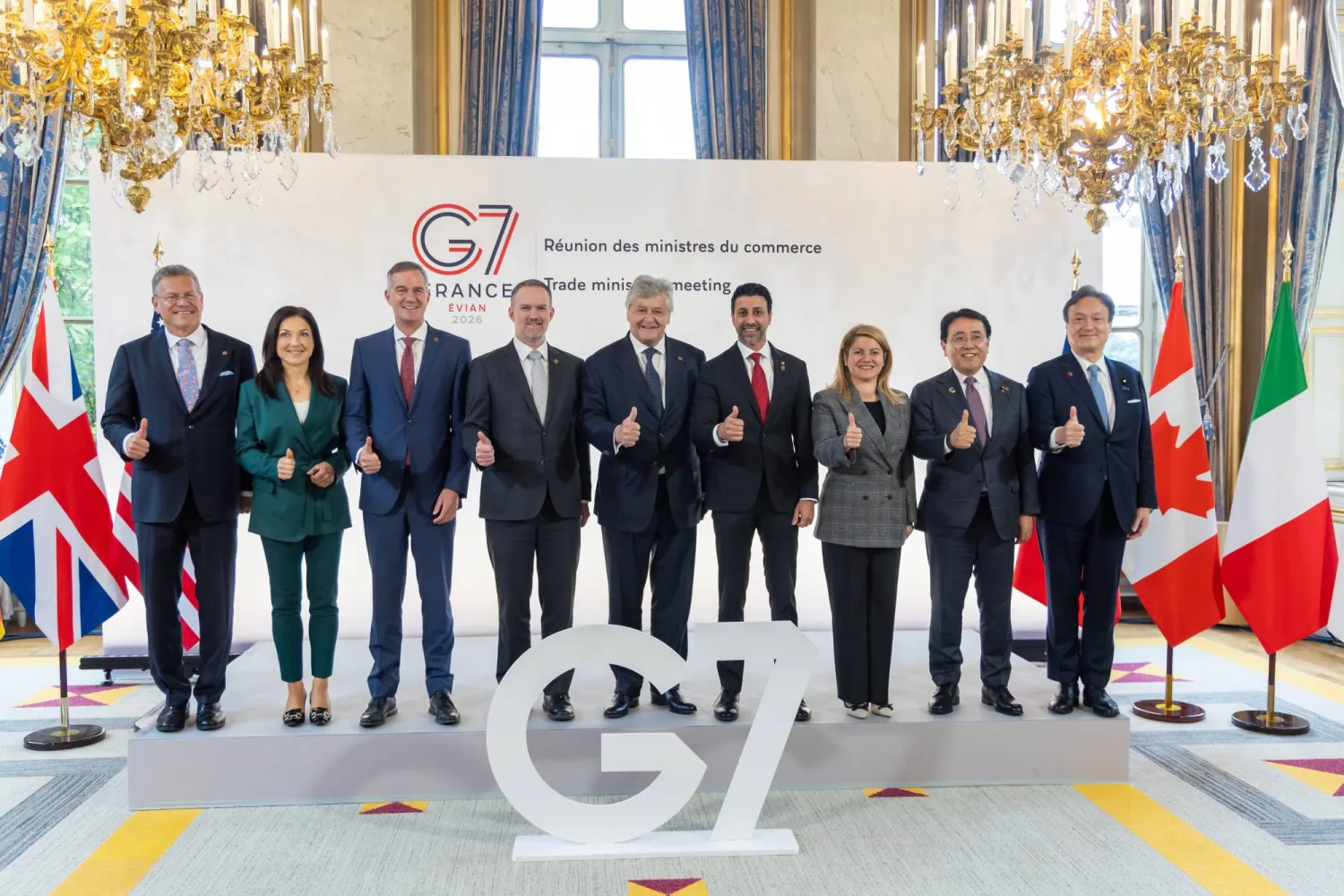
(L-R): EU commissioner for trade and economic security Maros Sefcovic, German Economy and Energy Minister Katarina Reiche, British State Secretary in charge of Trade Peter Kyle, US representative for Trade Jamieson Greer, French minister for trade Nicolas Forissier, Canadian state secretary in charge of international trade Maninder Sidhu, Italian Vice-Minister of Foreign Affairs and International Cooperation Maria Tripodi and Japanese Foreign Affairs delegate Minister Iwao Horii and Japanese Economy and Trade Minister Ryosei Akazawa prepare to pose for a group picture during the G7 Trade ministerial meeting in Paris, France, 06 May 2026. EPA/CHRISTOPHE PETIT TESSON / POOL
TT

G7 Trade Talks Target Critical Minerals as US-EU Tariff Rift Strains Unity

(L-R): EU commissioner for trade and economic security Maros Sefcovic, German Economy and Energy Minister Katarina Reiche, British State Secretary in charge of Trade Peter Kyle, US representative for Trade Jamieson Greer, French minister for trade Nicolas Forissier, Canadian state secretary in charge of international trade Maninder Sidhu, Italian Vice-Minister of Foreign Affairs and International Cooperation Maria Tripodi and Japanese Foreign Affairs delegate Minister Iwao Horii and Japanese Economy and Trade Minister Ryosei Akazawa prepare to pose for a group picture during the G7 Trade ministerial meeting in Paris, France, 06 May 2026. EPA/CHRISTOPHE PETIT TESSON / POOL

Group of Seven trade ministers meeting in Paris on Wednesday sought common ground on securing critical mineral supplies that are dominated by China, but fresh US tariff threats against European Union-made cars risked straining unity.

France wants critical minerals supplies to be among the most concrete deliverables during its G7 presidency as ministers prepare for a leaders' summit in mid-June, Foreign Trade Minister Nicolas Forissier ‌said as ‌he arrived for talks.

"I believe we will ‌make ⁠very concrete progress ⁠on rare earths and critical minerals, securing our supply chains and ensuring we are not held hostage by certain countries," he said.

Officials involved in the discussions said there was broad agreement on the need to reduce reliance on China, but significant differences remained about how to do so, said Reuters.

G7 unity is also being ⁠tested by comments from US President Donald Trump, who ‌said Washington would raise tariffs on ‌EU-made cars to 25% from 15%, arguing that Brussels was ‌not complying with a trade deal that was agreed upon ‌in Turnberry, Scotland, last year.

German Economy Minister Katherina Reiche said that she was in intensive talks with US officials over the tariffs. Germany's export-dependent automotive sector has already been under strain from weakening demand in China, ‌slower global growth and higher input and labor costs.

EU Trade Commissioner Maros Sefcovic said he and ⁠US Trade Representative ⁠Jamieson Greer had discussed the Turnberry agreement at a meeting in Paris on Tuesday and that he would be heading to the European Parliament, where negotiations on EU legislation related to the trade deal will take place later on Wednesday.

"We both clearly concluded that it's important to respect the deal from Turnberry from both sides, so we have to deliver on what was promised in Scotland," Sefcovic said.

The trade ministers are also expected to discuss industrial overcapacity - China being the main source - and reform of the World Trade Organization, Forissier said.


China Rides AI Wave as Exports Surge Past Forecast

Containers and ships are seen at the port in Nanjing, in China's eastern Jingsu province early on June 9, 2026. (AFP)
TT

China Rides AI Wave as Exports Surge Past Forecast

Containers and ships are seen at the port in Nanjing, in China's eastern Jingsu province early on June 9, 2026. (AFP)

China's export growth accelerated in May, buoyed by robust demand for chips, autos and other high-tech goods fueling the global AI boom, providing policymakers some relief as energy price shocks from the Iran conflict weigh on broader demand.

A surge in global AI investment has helped the world's top manufacturer offset the export hit many had expected from the Middle East turmoil. But signs are emerging that stockpiling linked to higher energy costs is fading, with prices rising and overseas buyers starting to run down inventories as they hold out for a ceasefire.

Exports expanded 19.4% from a year earlier in US dollar value terms, customs data showed on Tuesday, outpacing the 14.1% gain in April and a 15% rise tipped by economists.

Imports notched another strong month, climbing 27.4% versus a rise of 25.3% a month prior. Economists had forecast growth of 25%.

"Chip price increases continue to support exports, with memory prices rising 20% month-on-month, pushing integrated circuit export growth to ‌111% for the month," ‌said Xing Zhaopeng, ANZ's senior China strategist.

China's exports of automated data processing equipment soared 66.1% in ‌value ⁠terms year-on-year, high-tech ⁠products rose 50.9% and shipments of cars jumped 39%, the data showed.

"Looking ahead, the AI story is far from over -- chips are rewriting China's trade landscape," Xing added.

The AI boom has driven strong demand for semiconductors powering data centers and advanced electronics, playing to China's manufacturing strengths.

But beyond AI, there are signs of strain in other sectors that suggest momentum may be starting to fade. Furniture exports, for example, rose just 1.9% year-on-year in May, while toy shipments fell 7% and footwear exports dropped 10.4%.

Separate factory activity data also showed a steep drop in new export orders last month from April's two-year peak, when warehouse managers reported "booming" business amid a scramble by foreign factories to lock in supplies.

Strong exports powered ⁠China's $20 trillion economy past forecasts in the first quarter, but pockets of weakness in the export ‌engine have reinforced concerns that fragile domestic demand leaves it exposed to weaker global ‌conditions and increases the likelihood of further policy support.

CHINA'S EXCESS CAPACITY STOKES TRADE FRICTION

Beijing is under growing international pressure to strengthen domestic consumption, as critics ‌warn its heavy reliance on imported inputs and re-exports is distorting trade and squeezing other emerging economies out of higher-value manufacturing.

"Close attention ‌must be paid to the risk of escalation between China and major trading partners such as Europe," said Zhiwei Zhang, chief economist at Pinpoint Asset Management.

The Organization for Economic Cooperation and Development amplified that concern last week, noting in a report that nearly 60% of Chinese firms' "market share gains can be explained by subsidies received."

A new US Federal Reserve paper found that China's trade surplus - measured against global GDP - has topped 1%, well above the peaks ‌Japan and Germany hit in the late 20th century, and shows little sign of narrowing.

China's trade surplus, which topped $1 trillion last year, came in at $105.43 billion in May, up from $84.8 billion ⁠a month prior and from a ⁠forecast of $92.1 billion.

The latest trade figures suggest Chinese industrial overcapacity probably accounts for at least some of the shipments.

Exports to Europe rose 7.6% year-on-year in May, while those to the United States climbed 35.4% and to Southeast Asia increased 24.3%.

Purchases from South Korea surged 83.6%. China is Korea's biggest chips market.

RARE EARTHS FLASHPOINT

China's economic heft is also rippling through oil markets, with the world's top energy buyer surprising traders by holding back purchases. Crude imports in May plunged 29% to their lowest level in eight years, helping temper global prices and partially cushion the energy shock triggered by US President Donald Trump's war in Iran.

A closely watched meeting last month between Trump and Chinese leader Xi Jinping helped cool tensions between the two superpowers but produced no meaningful breakthroughs, whether on tariff disputes or cooperation over ending the Iran conflict.

That said, China's rare earth exports climbed to a four-month high, with the world's top producer shipping 5,490 metric tons of the 17-element group essential for electric vehicles, wind turbines and defense technologies - another flashpoint in Beijing's trade tensions with the West.

China's relative advantages in scale, deep supply chains and industrial capacity leave it well positioned to absorb trade frictions with the West, including proposed US tariff hikes, said Sheana Yue, senior economist at Oxford Economics.

"We still expect exports to be China's primary growth driver in 2026, anchored by continued high-tech and clean-tech products despite war-related headwinds to global demand."


Türkiye, Canada Agree to Launch Exploratory Talks on Free Trade

Türkiye’s Trade Minister Omer Bolat addresses the audience during a signing ceremony in Istanbul, Türkiye, April 29, 2024. (Reuters)
TT

Türkiye, Canada Agree to Launch Exploratory Talks on Free Trade

Türkiye’s Trade Minister Omer Bolat addresses the audience during a signing ceremony in Istanbul, Türkiye, April 29, 2024. (Reuters)

The trade ministers of Türkiye and Canada have agreed to launch exploratory discussions aimed at concluding a free trade agreement, according to a joint ministerial statement on Tuesday.

The statement said ‌Turkish Trade ‌Minister Omer ‌Bolat ⁠and Canada's Minister of ⁠International Trade Maninder Sidhu had met to advance the strong and growing economic partnership between the two countries.

"They ⁠agreed to launch ‌exploratory ‌discussions toward a free trade agreement, ‌a step that ‌reflects the ambition of both countries to unlock the full potential of the ‌commercial partnership," the statement said.

It said they identified ⁠energy ⁠as a promising area for expanded cooperation and agreed to explore opportunities in renewable energy, as well as in nuclear energy, including the potential of Canadian CANDU technology to support Türkiye’s diversification goals.


Saudi Arabia, Russia Ink $1.28 Billion Deals to Boost Key Industries

General view of Riyadh, Saudi Arabia. (SPA)
TT

Saudi Arabia, Russia Ink $1.28 Billion Deals to Boost Key Industries

General view of Riyadh, Saudi Arabia. (SPA)

Saudi Arabia and Russia signed 13 strategic agreements and memoranda of understanding on the sidelines of the St. Petersburg International Economic Forum (SPIEF), the Saudi Press Agency reported on Monday.

The agreements were signed in the presence of Saudi Vice Minister of Environment, Water and Agriculture Eng. Mansour Al-Mushaiti, reflecting the two countries’ commitment to strengthening cooperation across key economic and strategic sectors.

The agreements, valued at $1.28 billion (SAR4.8 billion), aim to expand cooperation and strengthen trade and investment exchange between the two countries.

Al-Mushaiti said the Ministry of Environment, Water and Agriculture has worked to attract leading Russian companies specializing in vital and food-related sectors. He noted that the forum witnessed the signing of a package of high-quality agreements and partnerships between government entities and major private-sector companies from both countries.

The agreements support the Kingdom’s efforts to enhance food security, localize advanced biotechnology, and strengthen supply chain sustainability in line with the objectives of Saudi Vision 2030.

He explained that the agreements and memoranda of understanding signed during the Kingdom’s participation as a guest of honor at the forum covered several strategic sectors, including the manufacturing and localization of veterinary vaccine production to support animal health and biosecurity; the development and propagation of broiler breeds to enhance self-sufficiency and the sustainability of domestic production; securing feed inputs and supply chains to support the stability and growth of the livestock sector.

The agreements also focused on expanding exports of Saudi fish products through strategic partnerships for shrimp and fish exports, in cooperation with Russian companies specializing in import and international distribution.

Al-Mushaiti added that the forum also witnessed the signing of agreements to market and export camel milk and its derivatives to Russian and international markets, promote and export Saudi coffee products, and enhance cooperation and exchange in the soft drinks sector.

He stressed that the Kingdom’s participation in SPIEF reflects the importance of the strategic partnership between Saudi Arabia and Russia and provides an opportunity to exchange expertise and explore investment opportunities in the environment, water, and agriculture sectors.
