


Oil Jumps, Stocks Fall as US-Iran Clashes Spark Peace Talks Fears

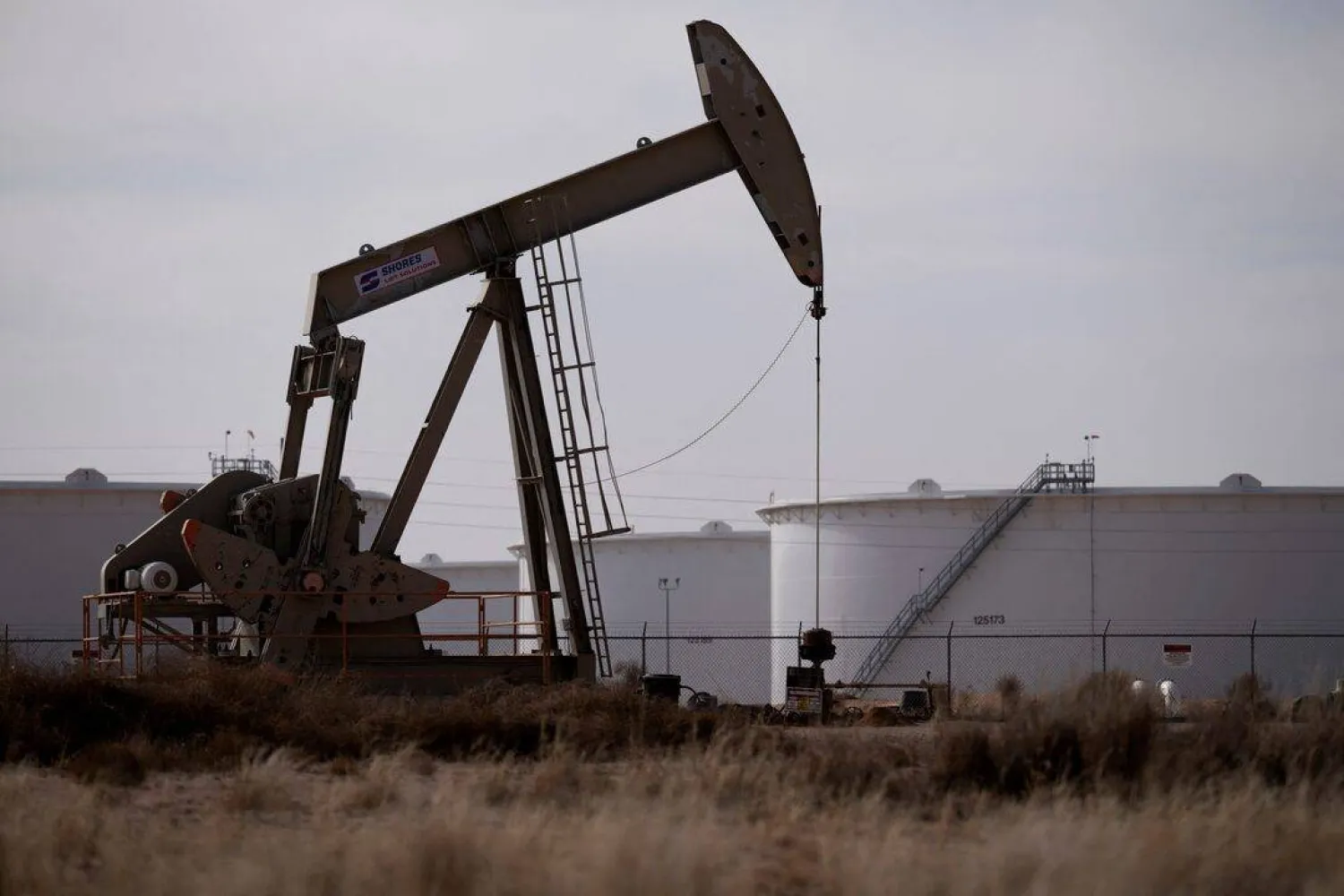
An oil rig operates in the Permian Basin oil field in Texas, USA (Reuters)
TT

Oil Jumps, Stocks Fall as US-Iran Clashes Spark Peace Talks Fears

An oil rig operates in the Permian Basin oil field in Texas, USA (Reuters)

Stocks sank and oil prices jumped Friday as US-Iran clashes in the Strait of Hormuz jolted hopes for a deal to end the war and reopen the crucial waterway.

Markets across the world have enjoyed a strong run this week on growing optimism that the 10-week conflict -- which has sent oil prices soaring -- will be concluded soon.

However, the risk-on mood was tempered Thursday following news that US forces had carried out strikes on Iranian military targets in response to an attack on three American destroyers in the Strait, threatening a month-old ceasefire.

For its part, Iran's central military command accused the United States of violating the ceasefire by attacking an oil tanker and another ship.

Following the clashes, Donald Trump wrote on his Truth Social platform: "We'll knock them out a lot harder, and a lot more violently, in the future, if they don't get their Deal signed, FAST!"

But when asked in Washington if the truce was still on, the US president said: "Yeah it is. They trifled with us today. We blew them away."

The clash came a day after Trump said an agreement could be near and as Tehran considered a one-page US proposal to end the conflict and reopen the Strait, through which a fifth of world oil and gas usually passes.

Also, the Wall Street Journal said the White House was considering restarting an operation to help commercial ships through the Strait, which Trump dropped after just a day earlier this week.

"Project Freedom" had caused anger in Iran and led it to carry out attacks on the United Arab Emirates.

Oil prices, which fell around 10 percent over the past three days, rose more than one percent Friday.

And equity markets retreated at the end of a week that saw a strong rally across Asia, helped by a surge in tech firms linked to artificial intelligence.

Seoul was off more than one percent after hitting multiple records this week, while Tokyo, Hong Kong, Sydney, Shanghai, Singapore, Wellington, Taipei, Manila and Jakarta were also down.

The losses followed a retreat on Wall Street, where the S&P 500 and Nasdaq came down from all-time highs, though analysts pointed out that losses were not surprising after the recent run-up.

"Once again, the news flow on the geopolitical front has shown that the path towards a lasting agreement is anything but linear," said Chris Weston at Pepperstone.

He added that "traders have had to rethink the assumptions on the trajectory of the conflict and the normalization of vessel flows through Hormuz that had been made over the last couple of sessions".

Sterling weakened against the dollar as investors kept a check on local elections in the United Kingdom, where the ruling Labour Party is expected to suffer hefty losses that could amplify calls for Prime Minister Keir Starmer to resign or face a leadership challenge.

Meanwhile, Japanese media reported that authorities had spent around $64 billion since last week propping up the yen.

The market interventions reportedly began on April 30 when the currency weakened to near 160 per dollar, the lowest in almost two years.

Since then there have been several spikes in the value of the yen, sparking speculation of further moves by the government. On Friday it was trading close to 157.

Atsushi Mimura, Japan's top currency official, on Thursday declined to comment, local media reported.

Investors are also awaiting the release of US jobs data due later in the day, hoping for an idea about the impact of the war and rising prices on the economy.




China Rides AI Wave as Exports Surge Past Forecast

Containers and ships are seen at the port in Nanjing, in China's eastern Jingsu province early on June 9, 2026. (AFP)
TT

China Rides AI Wave as Exports Surge Past Forecast

Containers and ships are seen at the port in Nanjing, in China's eastern Jingsu province early on June 9, 2026. (AFP)

China's export growth accelerated in May, buoyed by robust demand for chips, autos and other high-tech goods fueling the global AI boom, providing policymakers some relief as energy price shocks from the Iran conflict weigh on broader demand.

A surge in global AI investment has helped the world's top manufacturer offset the export hit many had expected from the Middle East turmoil. But signs are emerging that stockpiling linked to higher energy costs is fading, with prices rising and overseas buyers starting to run down inventories as they hold out for a ceasefire.

Exports expanded 19.4% from a year earlier in US dollar value terms, customs data showed on Tuesday, outpacing the 14.1% gain in April and a 15% rise tipped by economists.

Imports notched another strong month, climbing 27.4% versus a rise of 25.3% a month prior. Economists had forecast growth of 25%.

"Chip price increases continue to support exports, with memory prices rising 20% month-on-month, pushing integrated circuit export growth to ‌111% for the month," ‌said Xing Zhaopeng, ANZ's senior China strategist.

China's exports of automated data processing equipment soared 66.1% in ‌value ⁠terms year-on-year, high-tech ⁠products rose 50.9% and shipments of cars jumped 39%, the data showed.

"Looking ahead, the AI story is far from over -- chips are rewriting China's trade landscape," Xing added.

The AI boom has driven strong demand for semiconductors powering data centers and advanced electronics, playing to China's manufacturing strengths.

But beyond AI, there are signs of strain in other sectors that suggest momentum may be starting to fade. Furniture exports, for example, rose just 1.9% year-on-year in May, while toy shipments fell 7% and footwear exports dropped 10.4%.

Separate factory activity data also showed a steep drop in new export orders last month from April's two-year peak, when warehouse managers reported "booming" business amid a scramble by foreign factories to lock in supplies.

Strong exports powered ⁠China's $20 trillion economy past forecasts in the first quarter, but pockets of weakness in the export ‌engine have reinforced concerns that fragile domestic demand leaves it exposed to weaker global ‌conditions and increases the likelihood of further policy support.

CHINA'S EXCESS CAPACITY STOKES TRADE FRICTION

Beijing is under growing international pressure to strengthen domestic consumption, as critics ‌warn its heavy reliance on imported inputs and re-exports is distorting trade and squeezing other emerging economies out of higher-value manufacturing.

"Close attention ‌must be paid to the risk of escalation between China and major trading partners such as Europe," said Zhiwei Zhang, chief economist at Pinpoint Asset Management.

The Organization for Economic Cooperation and Development amplified that concern last week, noting in a report that nearly 60% of Chinese firms' "market share gains can be explained by subsidies received."

A new US Federal Reserve paper found that China's trade surplus - measured against global GDP - has topped 1%, well above the peaks ‌Japan and Germany hit in the late 20th century, and shows little sign of narrowing.

China's trade surplus, which topped $1 trillion last year, came in at $105.43 billion in May, up from $84.8 billion ⁠a month prior and from a ⁠forecast of $92.1 billion.

The latest trade figures suggest Chinese industrial overcapacity probably accounts for at least some of the shipments.

Exports to Europe rose 7.6% year-on-year in May, while those to the United States climbed 35.4% and to Southeast Asia increased 24.3%.

Purchases from South Korea surged 83.6%. China is Korea's biggest chips market.

RARE EARTHS FLASHPOINT

China's economic heft is also rippling through oil markets, with the world's top energy buyer surprising traders by holding back purchases. Crude imports in May plunged 29% to their lowest level in eight years, helping temper global prices and partially cushion the energy shock triggered by US President Donald Trump's war in Iran.

A closely watched meeting last month between Trump and Chinese leader Xi Jinping helped cool tensions between the two superpowers but produced no meaningful breakthroughs, whether on tariff disputes or cooperation over ending the Iran conflict.

That said, China's rare earth exports climbed to a four-month high, with the world's top producer shipping 5,490 metric tons of the 17-element group essential for electric vehicles, wind turbines and defense technologies - another flashpoint in Beijing's trade tensions with the West.

China's relative advantages in scale, deep supply chains and industrial capacity leave it well positioned to absorb trade frictions with the West, including proposed US tariff hikes, said Sheana Yue, senior economist at Oxford Economics.

"We still expect exports to be China's primary growth driver in 2026, anchored by continued high-tech and clean-tech products despite war-related headwinds to global demand."


Türkiye, Canada Agree to Launch Exploratory Talks on Free Trade

Türkiye’s Trade Minister Omer Bolat addresses the audience during a signing ceremony in Istanbul, Türkiye, April 29, 2024. (Reuters)
TT

Türkiye, Canada Agree to Launch Exploratory Talks on Free Trade

Türkiye’s Trade Minister Omer Bolat addresses the audience during a signing ceremony in Istanbul, Türkiye, April 29, 2024. (Reuters)

The trade ministers of Türkiye and Canada have agreed to launch exploratory discussions aimed at concluding a free trade agreement, according to a joint ministerial statement on Tuesday.

The statement said ‌Turkish Trade ‌Minister Omer ‌Bolat ⁠and Canada's Minister of ⁠International Trade Maninder Sidhu had met to advance the strong and growing economic partnership between the two countries.

"They ⁠agreed to launch ‌exploratory ‌discussions toward a free trade agreement, ‌a step that ‌reflects the ambition of both countries to unlock the full potential of the ‌commercial partnership," the statement said.

It said they identified ⁠energy ⁠as a promising area for expanded cooperation and agreed to explore opportunities in renewable energy, as well as in nuclear energy, including the potential of Canadian CANDU technology to support Türkiye’s diversification goals.


Saudi Arabia, Russia Ink $1.28 Billion Deals to Boost Key Industries

General view of Riyadh, Saudi Arabia. (SPA)
TT

Saudi Arabia, Russia Ink $1.28 Billion Deals to Boost Key Industries

General view of Riyadh, Saudi Arabia. (SPA)

Saudi Arabia and Russia signed 13 strategic agreements and memoranda of understanding on the sidelines of the St. Petersburg International Economic Forum (SPIEF), the Saudi Press Agency reported on Monday.

The agreements were signed in the presence of Saudi Vice Minister of Environment, Water and Agriculture Eng. Mansour Al-Mushaiti, reflecting the two countries’ commitment to strengthening cooperation across key economic and strategic sectors.

The agreements, valued at $1.28 billion (SAR4.8 billion), aim to expand cooperation and strengthen trade and investment exchange between the two countries.

Al-Mushaiti said the Ministry of Environment, Water and Agriculture has worked to attract leading Russian companies specializing in vital and food-related sectors. He noted that the forum witnessed the signing of a package of high-quality agreements and partnerships between government entities and major private-sector companies from both countries.

The agreements support the Kingdom’s efforts to enhance food security, localize advanced biotechnology, and strengthen supply chain sustainability in line with the objectives of Saudi Vision 2030.

He explained that the agreements and memoranda of understanding signed during the Kingdom’s participation as a guest of honor at the forum covered several strategic sectors, including the manufacturing and localization of veterinary vaccine production to support animal health and biosecurity; the development and propagation of broiler breeds to enhance self-sufficiency and the sustainability of domestic production; securing feed inputs and supply chains to support the stability and growth of the livestock sector.

The agreements also focused on expanding exports of Saudi fish products through strategic partnerships for shrimp and fish exports, in cooperation with Russian companies specializing in import and international distribution.

Al-Mushaiti added that the forum also witnessed the signing of agreements to market and export camel milk and its derivatives to Russian and international markets, promote and export Saudi coffee products, and enhance cooperation and exchange in the soft drinks sector.

He stressed that the Kingdom’s participation in SPIEF reflects the importance of the strategic partnership between Saudi Arabia and Russia and provides an opportunity to exchange expertise and explore investment opportunities in the environment, water, and agriculture sectors.