


Asia Gets First Mexican Fuel Oil Cargo in 9 Months

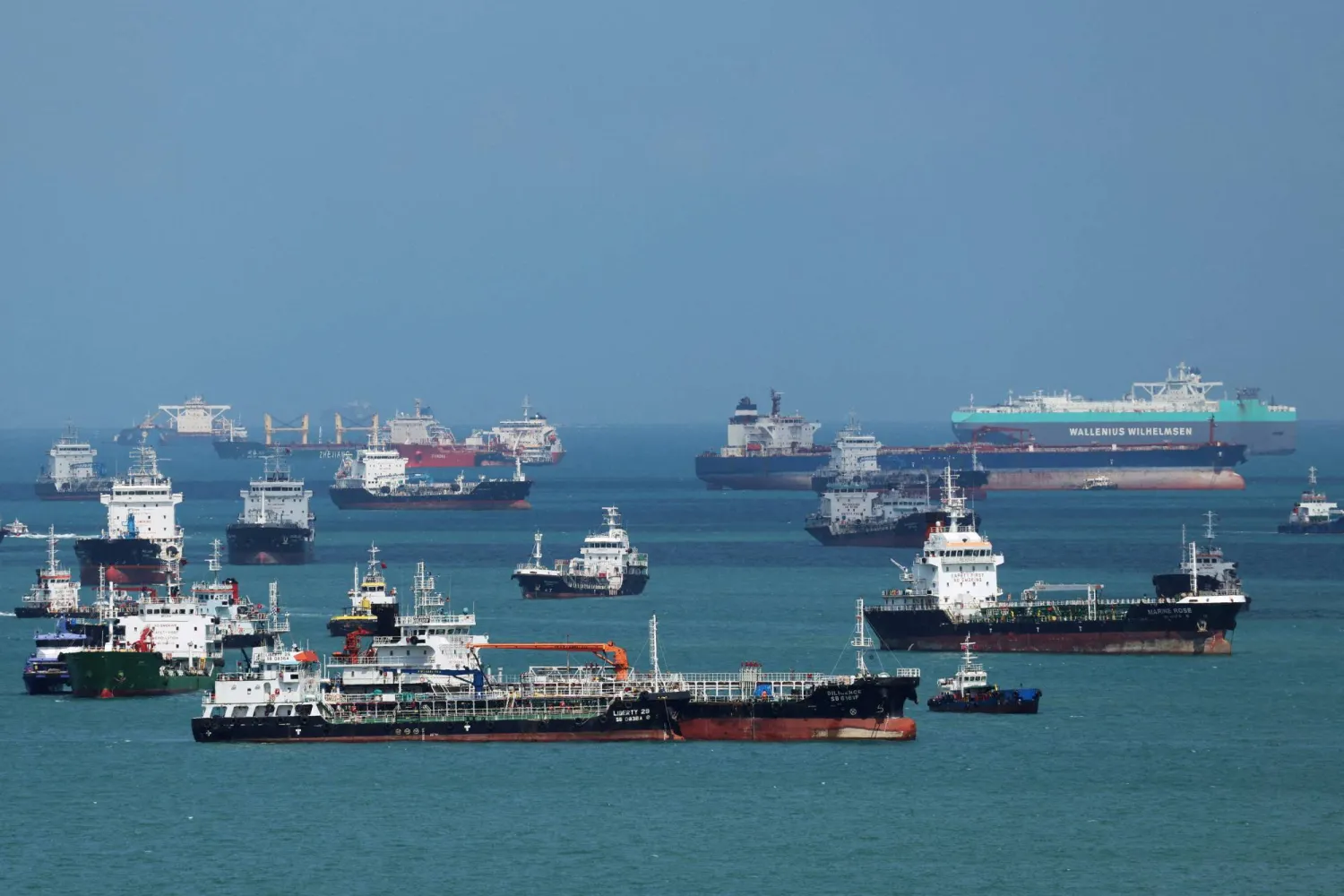
FILE PHOTO: Oil tankers in the Singapore Strait in Singapore March 17, 2026. REUTERS/Edgar Su/File Photo
TT

Asia Gets First Mexican Fuel Oil Cargo in 9 Months

FILE PHOTO: Oil tankers in the Singapore Strait in Singapore March 17, 2026. REUTERS/Edgar Su/File Photo

Asia received its first fuel oil cargo from Mexico in nine months on Thursday, with more to follow, as higher Asian prices draw supply after the loss of Middle East cargoes due to the Iran war, according to industry sources and shipping data.

The incoming cargoes from Mexico will ease some concerns about declining inventories in Asia's trading and bunkering hub Singapore, after the Iran conflict choked off most fuel oil supplies from key exporters in the Middle East like Iraq and ⁠Kuwait via the Strait of Hormuz, according to Reuters.

Suezmax tanker Orion, carrying about 160,000 metric tons (1 million barrels) of Mexican high-sulphur fuel oil (HSFO) loaded from the Salina Cruz refinery on the Pacific coast, reached Singapore on May 7, according to traders and ship-tracking data from Kpler.

PMI, the trading arm of Mexican state energy company Pemex, offered another 150,000-ton HSFO cargo to Asia for June delivery via a tender that closed on May 6 with bids valid until May 8, a Singapore-based trader familiar with the matter said. PMI is expected to award the tender later on Friday.

Fuel oil traders said that strong Asian prices are pulling cargoes to Asia while there is ⁠excess supply in the Americas.

“Mexican fuel barrels have to search for more optimal economics due to an influx of Venezuelan oil into the US Gulf Coast,” said Emril Jamil, senior analyst for crude and fuel oil at LSEG.

Most of Mexico's fuel oil exports typically land in the US or the Caribbean Islands, Kpler data showed.

Neither Pemex nor its trading ⁠arm immediately responded to a request for comment.

Traders in Asia have been looking for more arbitrage supplies from the West after the Middle East supply disruption.

The arbitrage is open with front-month 380-cst HSFO East-West spread at near $60 a ton this week, ⁠more than double the level before the conflict, LSEG data showed.

The spread breached $80 a ton on March 9 following the Middle East war, the data showed, a level last seen in September 2019.

A wider East-West price ⁠spread, which measures the price difference between Asian fuel oil versus supply from the Americas and Europe, typically makes it more attractive for cargoes to be shipped from the West to Asia.



Iraq Exports 2.6 million bpd from Southern Ports

An oil field in the Dibs area on the outskirts of Kirkuk, Iraq (Reuters)
TT

Iraq Exports 2.6 million bpd from Southern Ports

An oil field in the Dibs area on the outskirts of Kirkuk, Iraq (Reuters)

Iraq is exporting around 2.6 million barrels of oil per day from its southern ports so far in September and producing more than 3 million bpd from its southern oilfields, Bassem Abdul Karim, head of Iraq's Basra Oil Company, said on Thursday.

Abdul Karim, speaking at an energy conference in Basra, added that Iraq is transporting around 250,000 bpd of Basra crude to Kirkuk for exports via Ceyhan in Türkiye.

On September 16, Iraq launched a pilot operation to transport crude oil by road from its southern oilfields to a Kirkuk storage facility in an effort to boost supplies to the northern export system and potentially increase shipments through Türkiye's Ceyhan port.

The initiative forms part of broader Iraqi efforts to increase flows through the northern export route after the US-Israeli war on Iran disrupted Iraq's shipments through the Strait of Hormuz, its main export route.


Oil Gains on Little Sign of Progress in US-Iran Talks

Gas prices at a Shell gas station above $6 a gallon for regular gasoline and $8 a gallon for diesel are displayed across from a US flag outside of the Marathon Petroleum Corp. (Photo by Patrick T. Fallon / AFP)
TT

Oil Gains on Little Sign of Progress in US-Iran Talks

Gas prices at a Shell gas station above $6 a gallon for regular gasoline and $8 a gallon for diesel are displayed across from a US flag outside of the Marathon Petroleum Corp. (Photo by Patrick T. Fallon / AFP)

Oil prices rose more than 1% on Thursday as diplomatic talks between the US and Iran showed little sign of progress, while investors focused on uncertainty about a potential US ban on diesel exports.

Brent crude futures were up $1.63, or 1.58%, at $104.71 a barrel at 1200 GMT, while West Texas Intermediate futures were up $1.34, or 1.49%, at $93.53 a barrel.

Brent rose to as high as $106.50 earlier in the day, following reports suggesting Iran gave the US one week to meet its publicly stated demands, such as lifting the US naval blockade, Reuters reported.

Iran and the US remain divided over how to end their conflict, but diplomacy must continue, a senior Iranian official told Reuters on Wednesday, after Iran's president told the UN General Assembly that Tehran would never surrender to US pressure.

The official said Tehran was reviewing Washington's response to its peace proposals, which prioritise lifting the US naval blockade on Iranian ports and reopening the Strait of Hormuz.

European diesel futures came off all-time highs on Thursday amid uncertainty about a potential US ban on diesel exports. A White House official on Wednesday denied a report that said the US is preparing a 90-day ban of diesel exports.

A European Commission spokesperson said on Thursday that the EU was concerned about the reported US plans, as such a move would risk a negative impact on both sides.

Analysts and market watchers have warned a US diesel export ban would do little to ease high energy prices and could worsen global supplies and further disrupt economies.

The physical market for oil is nowhere near a fully normalised situation, said Priyanka Sachdeva, head of market insights at Phillip Nova.

"Brent retains a larger geopolitical and sea-route premium because international crude is more directly exposed to Middle East and Hormuz disruption, while WTI benefits more from relatively insulated US supply," Sachdeva added.

US distillate stockpiles, including diesel and heating oil, fell 428,000 barrels to 107.4 million barrels last week, Energy Information Administration data showed.

Meanwhile, US crude inventories rose 3 million barrels to 426.4 million barrels last week, though analysts polled by Reuters had expected a 641,000-barrel draw.


Saudi Aramco Chief: Any Interruption Can be Fixed 'Within Days'

Aramco President and CEO Amin Nasser speaks during a press conference. Reuters file photo
TT

Saudi Aramco Chief: Any Interruption Can be Fixed 'Within Days'

Aramco President and CEO Amin Nasser speaks during a press conference. Reuters file photo

Saudi Aramco can restore disrupted operations within days and is looking at building alternative oil export routes, its President and CEO Amin Nasser said.

Nasser told Nikkei Asia in Tokyo on Thursday that Aramco was studying "a fourth and a fifth route" for crude oil exports in addition to its three primary routes.

Nasser added that the company is considering expanding overseas storage capacity, including in Japan, to strengthen its ability to withstand disruptions.

He stated that Aramco's operations are built with abundant flexibilities in place to continue serving its customers even during disruptions.

He added that observers often assumed Aramco had only two major export pathways, through the Strait of Hormuz or the Bab el-Mandeb Strait at the southern entrance to the Red Sea after using the East-West pipeline. In reality, Nasser said, the company could also access the 320km Sumed pipeline, which carries crude from the Red Sea to the Mediterranean through Egypt.

"People think about interruptions in Hormuz, interruptions in Bab-el Mandeb, [but] we never stopped. We continue to supply our customers," he said. "The only thing you do [is] shift more vessels, one way or the other. ... We do have this multiple optionality that allows us to meet our customers' demand."

The chief executive said that the company was also keen to add more optionality in its oil supplies, including building up additional storage capacities abroad to meet short-term disruptions, as well as "a fourth and a fifth route" for exporting crude.

The company was in discussions with the relevant ministry and its partners in Japan on expanding its storage capacity in the country, as well as "doing the engineering and the feasibility and all of the work that is required" for the additional export routes, Nasser said.