


Shipping Industry Fears Fuel Shortages as Iran War Squeezes Bunker Fuel Supply

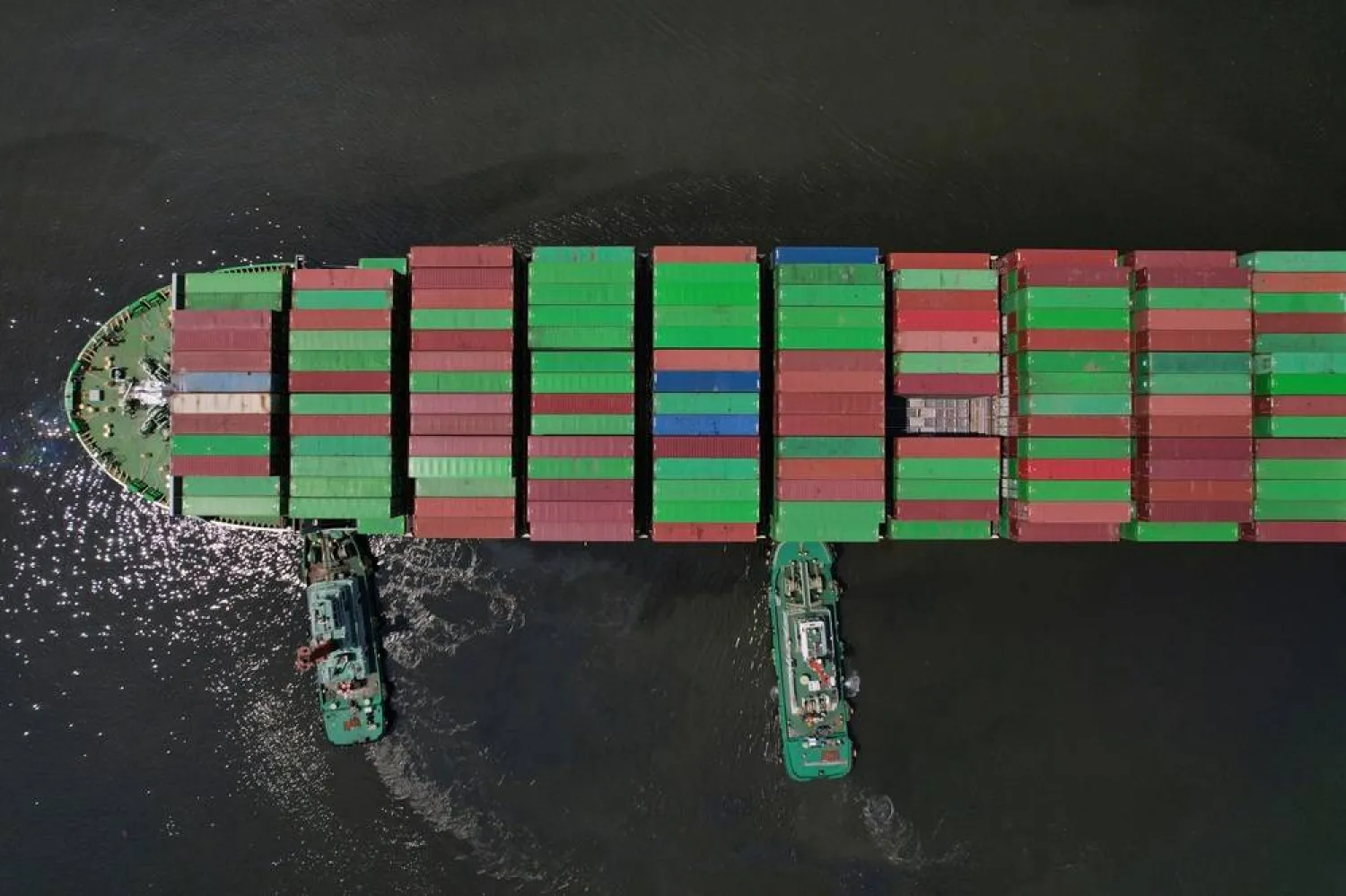
Tugboats assist a container ship as it prepares to dock at the Manila International Container Terminal at the Philippine capital April 8, 2025. (AP)
TT

Shipping Industry Fears Fuel Shortages as Iran War Squeezes Bunker Fuel Supply

Tugboats assist a container ship as it prepares to dock at the Manila International Container Terminal at the Philippine capital April 8, 2025. (AP)

Ship operators rely on a sludgelike substance known as bunker fuel to keep vessels running. The Iran war's closure of the Strait of Hormuz has choked off the supply of this fuel that powers the global maritime industry and its largest refueling hub in Asia.

Bunker fuel is a literal bottom of the barrel product — heavier and dirtier than the more expensive kinds of refined crude oil used by other vehicles like cars and airplanes — it sinks to the bottom of storage containers.

But it helps move the 80% of globally traded goods that are transported by sea, and experts say that means a shortage of bunker fuel will translate to higher shipping costs, increase consumer prices and hurt the bottom lines of businesses worldwide.

That will be an issue first in Asia, which relies heavily on Middle Eastern oil. In Singapore, the world’s biggest refueling hub for bunker fuel, reserves are dwindling and prices are spiking.

Shipping companies are trying to adapt to the energy shock, reducing vessel speeds and revising schedules to cut costs in the short term while making plans to acquire ships that can run on alternative fuels.

But some companies won’t survive this triage for long, according to Henning Gloystein of the Eurasia Group consultancy firm, who warned that the pain will spread beyond Asia through global supply chains.

Southeast Asia turns to ‘energy triage’

Asia, which was hit first and hardest by the energy shock, has adopted various forms of “energy triage " to cope, increasing its use of coal, buying more crude oil from Russia and reviving plans to develop nuclear power.

But Asia is bracing for further impacts as energy reserves dwindle and government subsidies dry up.

More than half of global seaborne trade moved through Asian ports in 2024, according to United Nations data, so what happens there will have global consequences.

For now, Singapore's supplies of bunker fuel have held up even as the price races up.

But the prolonged cutoff from major sources of the heavier crude oil needed for bunker fuel, like Iraq and Kuwait, will cause shortages, said Natalia Katona of the commodity site OilPrice.

“We just see the price in Singapore going up, up, up,” Katona said.

Before the war, bunker fuel in Singapore cost about $500 per metric ton ($450 per US ton). That went up to more than $800 ($725 per US ton) as of early May.

Fuel shortages drive consumer costs Shipping companies are absorbing the brunt of the costs for now, said June Goh, an oil analyst for market intelligence firm Sparta Commodities, but this may soon "pass on to the customers.”

The daily cost of the Iran war for the global shipping industry is 340 million euros (nearly $400 million), according to the European Federation for Transport and Environment.

“Bunker fuel shortages tend to feed through to shipping costs more quickly than many other cost pressures,” said Oliver Miloschewsky of risk consultancy firm Aon.

Individual product impact may appear incremental but the cumulative effect of higher shipping costs “can ripple across supply chains and ultimately influence consumer prices across a broad range of sectors," he said.

Singaporean consumers are also feeling the pinch in other ways as local ferries increase fares and luxury cruise liners tack on fuel surcharges.

Ship operators face limited options

Shippers have limited choices to deal with the situation, Miloschewsky said. They can pay more for fuel or implement fuel-saving measures like slowing shipping or suspending voyages.

The average speed of bulk carriers and container ships has slowed globally by around 2% since the war began on Feb. 28, industry group Clarksons Research reported.

High prices are also driving more interest in green fuels, said Håkan Agnevall of marine and energy technology manufacturer Wartsila.

The good news is the technology to create lower-emitting fuels exists, he said. The bad news is production isn't yet at scale and greener fuels are often more expensive.

Though US President Donald Trump derailed efforts to shift global shipping away from fossil fuels in 2025, Agnevall said the current conflict could prompt strategically minded companies and countries to renew their push toward greener alternatives.

Rising fossil fuel prices are narrowing the cost gap. “That improves the business case for green fuels,” he said.

The Caravel Group owns one of the world’s largest ship management companies, Fleet Management Limited, which oversees more than 120 shipbuilding projects.

About a third of ships that the company is managing the construction of will be “dual fuel capable,” meaning they can run on both conventional bunker fuel and alternatives such as liquified natural gas, CEO Angad Banga told The Associated Press.

Ship owners are willing to pay a premium to have vessels that can switch between fuels because “in a volatile environment optionality has a measurable economic value,” he said.

Alternative fuels are not yet as flexible as conventional fuel bunkering, Banga said. While there are more than 890 LNG-fueled vessels in operation globally, a lack of supporting infrastructure has created bottlenecks for them.

But the industry is catching up and limits on bunker fuel are driving even more interest in LNG-capable ships, he said, “that progress is real.”



Trump Threatens 100% Tax on European Imports if Countries Impose Tax on Digital Services

US President Donald Trump speaks at a rally to kick off the 16-day Great American State Fair as part of Washington, DC's celebration of the nation's 250th birthday, on the National Mall in Washington, DC, USA, 24 June 2026. (EPA)
TT

Trump Threatens 100% Tax on European Imports if Countries Impose Tax on Digital Services

US President Donald Trump speaks at a rally to kick off the 16-day Great American State Fair as part of Washington, DC's celebration of the nation's 250th birthday, on the National Mall in Washington, DC, USA, 24 June 2026. (EPA)

President Donald Trump on Friday threatened a 100% tax on imports from any country that imposes a tax on digital services from United States companies.

In a post on social media, Trump took aim at European countries that he said are discussing “imminent” implementation of taxes on American companies.

“Please let this statement serve to represent that any Country that imposes such a Tax will immediately be met with a 100% TARIFF on any and all Goods sent to the United States of America,” Trump wrote.

He added that the new tax would supersede any previously negotiated trade deals. Trump said the penalty would apply to any country that moves forward with such a tax, but he singled out European nations in his post.

Trump has repeatedly pushed against foreign efforts to tax or regulate American tech giants. Last year he threatened new tariffs on any country that moved to do so. A post from last August said that digital taxes and regulation “are all designed to harm, or discriminate against, American Technology.”


US Goods Trade Deficit Hits 14-month High in May as Imports Surge

APM Terminals' facility at the Port of Los Angeles in California. (Reuters)
TT

US Goods Trade Deficit Hits 14-month High in May as Imports Surge

APM Terminals' facility at the Port of Los Angeles in California. (Reuters)

The US trade deficit in goods swelled to a 14-month high in May as businesses boosted imports, likely to avoid shortages and higher prices related to the Middle East conflict, suggesting trade remained a drag on economic growth in the second quarter.

The sharp deterioration in the goods trade deficit reported by the Commerce Department on Friday also reflected a decline in exports.

Recent business surveys have shown front-loading of orders by firms. Sponsors of the surveys attributed the behavior to the US-led war against Iran, which raised commodity prices, including for oil and fertilizers, and disrupted shipping in the Strait of Hormuz.

But after the United States and Iran last week signed a preliminary peace deal, shipments through the strait have picked up, driving oil prices sharply lower. Even if supply chains returned to normal, economists warned that the trade deficit would likely remain elevated because of an artificial intelligence investment boom that is largely reliant on imports.

"The widening trade deficit is bad news for national income growth, and it suggests that net exports might drag down real GDP growth too," said Carl Weinberg, chief economist at High Frequency Economics. "The AI boom had better generate a corresponding increase in services exports to offset the influx of equipment. If it doesn't, then this AI bubble is a losing proposition for the economy."

The goods trade gap increased 27.4% to $105.8 billion last month, the highest level since March 2025, the Commerce Department's Census Bureau said. Economists polled by Reuters had forecast the deficit at $85.0 billion.

Imports of goods increased $10.9 billion, or 3.6% to $313.4 billion, also a 14-month high. They were driven by a 6.3% surge in imports of automotive vehicles. Imports of consumer goods soared 5.7%. Despite high inflation, mostly stemming from the Iran war, consumer spending has remained strong, thanks to large tax refunds this year and a stock market rally.

BROAD INCREASE IN IMPORTS

Imports of industrial supplies, which include petroleum, increased 4.8%. Capital goods imports rose 0.4%. They surged 41.9% on a year-on-year basis, reflecting the AI spending spree.

Imports of foods, feeds and beverages increased 4.3%, while those of other goods advanced 11.5%. Overall imports have remained high despite tariffs imposed by the Trump administration.

Goods exports dropped $11.8 billion, or 5.4%, to $207.7 billion in May. They were weighed down by a 9.2% plunge in exports of consumer goods. Industrial supplies exports tumbled 7.0%, while those of capital goods dropped 5.0%. Exports of other goods decreased 6.8%. But food, feed and beverage exports increased 3.9%. Automotive vehicle exports rose 0.5%.

"Imports are moving sharply higher and this will subtract from GDP growth this quarter," said Christopher Rupkey, chief economist at FWDBONDS. "The import drag on domestic economic growth is back because factories here cannot make it here no matter how Washington economic officials try to spin it."

Trade had been a drag on gross domestic product for two straight quarters. Growth estimates for the second quarter were converging around a 2.5% annualized rate before the trade data.

The economy grew at a 2.1% annualized rate last quarter after expanding at a 0.5% pace in the October-December quarter.


Gold Gains as Dollar Weakens; Still on Track for Fourth Straight Weekly Loss

British gold bars and sovereign coins on display in a London shop. (Reuters)
TT

Gold Gains as Dollar Weakens; Still on Track for Fourth Straight Weekly Loss

British gold bars and sovereign coins on display in a London shop. (Reuters)

Gold edged higher on Friday as the dollar weakened and expectations of US interest rate hikes eased slightly following inflation data, though prices were still on track for a fourth consecutive weekly decline. Spot gold was up 0.51% to $4,046.70 per ounce by 9:39 a.m. EDT (1339 GMT).

US gold futures for August delivery rose 0.35% to $4,061.40 per ounce.

The US dollar eased from recent highs after the release of the Fed's preferred inflation gauge on Thursday. The US Personal Consumption Expenditures Price Index surged 4.1% in the 12 months through May, matching economists' forecasts in a Reuters poll. Traders are pricing in about a 60% chance of a US rate hike in September, lower than an earlier expectation of 64%, according to CME Group's FedWatch Tool.

Gold is seeing a modest rebound after coming under selling pressure earlier this week, said Jim Wyckoff, a market analyst at American Gold Exchange. Higher interest rates and tighter monetary policy reduce the appeal of non-yielding bullion, as they tend to boost bond yields and increase returns on interest-bearing assets. Spot gold hit more than a seven-month low earlier this week and prices were down 2.6% for the week.

TD Securities said in a note that, given gold's inverse relationship with both higher oil prices and a stronger US dollar, sustained strength in energy markets could put further downward pressure on the precious metal in the months ahead. Gold started trading at a premium in India this week for the first time in a month and a half, as a price correction lifted buying, while demand stayed subdued in China, the top consumer. Among other precious metals, spot silver rose 0.42% to $58.1109 per ounce.

Platinum gained 0.21% to $1,604.45 and palladium jumped 1.25% to $1,199.25.
