

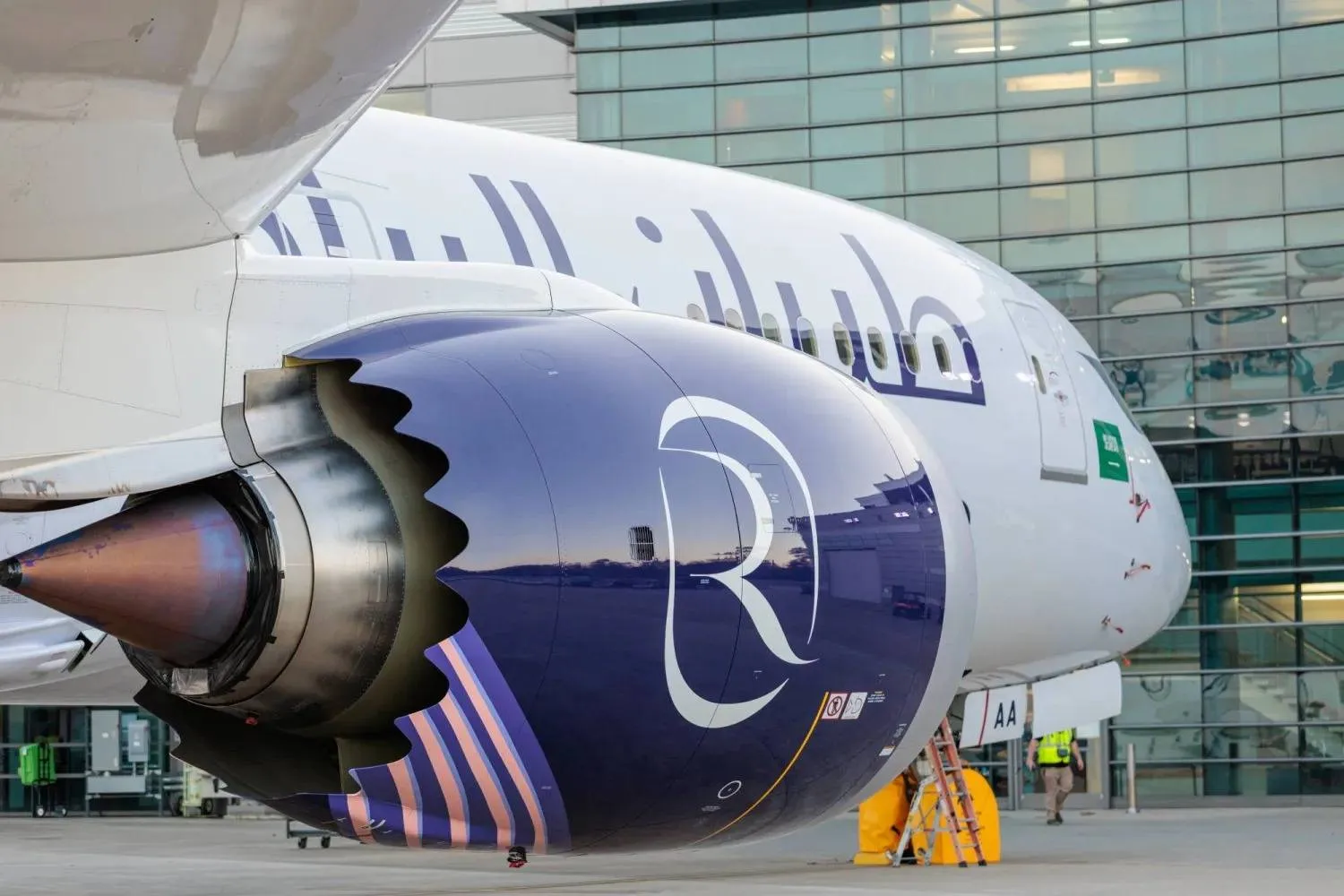

Boeing Dreamliner to Fly Riyadh Air's First Passengers in July

A Riyadh Air aircraft flies over the Saudi capital, Riyadh (Public Investment Fund)
TT

Boeing Dreamliner to Fly Riyadh Air's First Passengers in July

A Riyadh Air aircraft flies over the Saudi capital, Riyadh (Public Investment Fund)

Riyadh Air, Saudi Arabia’s new national carrier wholly owned by the Public Investment Fund, is moving onto the global aviation stage through London, with an ambition that goes beyond conventional air travel.

The carrier, which reflects the Kingdom’s view of aviation as a strategic industry and economic driver, said it would open tickets to the public for direct flights between King Khalid International Airport and Heathrow Airport on its new Boeing 787-9 Dreamliner fleet from July 1, 2026.

The move is part of plans to connect Saudi Arabia to more than 100 destinations by 2030.

It follows the airline’s launch last year of its first daily flights to Heathrow, when tickets were initially available to selected groups of passengers and Riyadh Air employees under an operational program designed to ensure full readiness before the carrier receives its first aircraft from Boeing.

The program also allowed the airline to use its newly allocated operating slots at Heathrow.

Riyadh Air said bookings would open from Tuesday through its website, official app and approved travel service providers.

Travel classes

Chief Executive Tony Douglas said the launch of flights on the new aircraft marked a “milestone” for Riyadh Air and reflected its vision to redefine air travel and connect Riyadh to the world through comfort, innovation and Saudi hospitality.

The airline said its Boeing 787-9 Dreamliner aircraft would feature four travel classes, Business Elite, Business, Premium Economy and Economy. The two business cabins will include seats that convert into fully flat beds.

Passengers will also have access to advanced entertainment systems through Panasonic Avionics’ Astrova platform, with 4K screens, Bluetooth connectivity and a library of more than 500 films and 600 television series.

Riyadh Air said its hospitality offering would include products from Kayanee, children’s kits in cooperation with Disney, varied menus and bedding from John Horsfall.

The airline also announced the launch of Sfeer, its loyalty program, offering benefits including a “best offer guarantee,” no expiry of points, free in-flight internet and exclusive privileges for founding members.

Aviation specialists said opening ticket sales to passengers marks a new phase for Saudi Arabia’s aviation sector.

The government has set a national strategy to turn the Kingdom into a global aviation logistics hub by doubling capacity to 330 million passengers, linking it to 250 international destinations and raising air cargo capacity to 4.5 million tons by 2030.

Tourism and business traffic

Tourism media expert Mohammed al-Abdulkarim told Asharq Al-Awsat that Riyadh Air’s announcement of the start date for its first commercial flights, along with the official launch of ticket sales from July, was a pivotal step in the transformation of Saudi aviation.

He said it reflected faster implementation of the national aviation strategy under Vision 2030.

Abdulkarim said choosing July 1 for the entry into service of the carrier’s first new B787-9 aircraft showed Riyadh Air was ready to move from building and preparation into actual operations.

The start of ticket sales through the airline’s official platforms, he said, reflected operational confidence and early readiness to enter the international aviation market.

He said launching the first route between Riyadh and London carried major strategic and economic significance. London is one of the world’s biggest centers for business, tourism and air transit, he said, and the route shows Saudi Arabia’s early focus on a high-yield international network directly linked to major global markets.

Raising capacity

Abdulkarim said Riyadh Air’s ownership of four B787-9 aircraft now in the final stages of operational certification showed a push to build a modern fleet focused on efficiency, passenger experience and advanced technology.

That, he said, is essential for competing in the global aviation market, especially after the rapid changes the sector has seen since the pandemic.

He said the entry of a new national carrier of this scale would strengthen Saudi Arabia’s capacity, raise the competitiveness of its air transport sector regionally and internationally, and support tourism, investment, logistics and supply chains.

“The Kingdom is not only targeting higher passenger numbers, but is working to reshape its position as a global aviation hub linking three continents,” he said.

“With new airport projects, expanded air connectivity and the launch of modern carriers, Saudi Arabia is moving toward becoming one of the region’s most important transport and travel hubs in the coming years.”

Competing with major airlines

Aviation expert Al Motaz Al-Mirah said the launch of Riyadh Air’s first tickets showed Saudi Arabia’s strong confidence in the future of aviation.

He said the project is starting with a global vision and modern services aimed at competing with major international airlines, while choosing London as the first destination gives the new carrier a strong presence on one of the world’s most important international travel routes.

Speaking to Asharq Al-Awsat, Al-Mirah said the move was a practical step toward achieving Saudi Arabia’s aviation strategy.

It was not only about adding destinations and flights, he said, but about building an integrated travel experience that strengthens Riyadh’s position as a global air transport hub.

He said the move was expected to support tourism and investment and raise the kingdom’s competitiveness in aviation in the coming years.



QatarEnergy Buys Stakes in Uruguay Offshore Blocks from Shell Subsidiary

3D-printed oil pump jacks and the QatarEnergy logo appear in this illustration taken March 2, 2026. REUTERS/Dado Ruvic/Illustration
TT

QatarEnergy Buys Stakes in Uruguay Offshore Blocks from Shell Subsidiary

3D-printed oil pump jacks and the QatarEnergy logo appear in this illustration taken March 2, 2026. REUTERS/Dado Ruvic/Illustration

QatarEnergy has acquired interests in three offshore exploration blocks in Uruguay from a subsidiary of Shell, marking its first entry into the South American country's upstream energy sector, the state-owned company said on Wednesday without disclosing financial details.

The Qatari energy giant's South American exploration expansion also strengthens its strategic alliance with Shell, one of its key partners in energy projects within Qatar and elsewhere.

The company, the world's largest single LNG producer before the US-Israeli war on ⁠Iran forced production ⁠halts and resulted in damage to some facilities, has been building up an upstream portfolio over several years, including interests in Brazil, Cyprus, Egypt and elsewhere.

Under the agreements, QatarEnergy took 30% stakes in block OFF-2 and block OFF-7, where Shell ⁠is the operator and holds 70% and 40% respectively. QatarEnergy also acquired an 18% interest in block OFF-4.

APA Corporation operates block OFF-4, in which it holds a 50% stake and Shell holds 32%. In block OFF-7, Chevron holds the remaining 30% interest, QatarEnergy said.

"We are pleased to strengthen our relations with our strategic partner Shell through these agreements, which mark our first entry into Uruguay’s ⁠upstream sector," ⁠Reuters quoted QatarEnergy CEO Saad Sherida Al-Kaabi as saying in the statement.

The three blocks are located off Uruguay’s Atlantic coast in water depths ranging from 40 to 4,000 meters. They cover areas of between 11,155 and 18,227 sq km, the company said.

No commercial oil and gas discoveries have yet been struck in Uruguay, but companies hope to replicate the massive recent discoveries made in Namibia, on the direct opposite side of the Atlantic, because of their shared geological history.


Dollar Steady Near Six-Week Highs on Rate-Hike Bets, War Uncertainty

 A man counts US dollar currency notes at a foreign exchange office in Hyderabad on May 16, 2026. (AFP)
A man counts US dollar currency notes at a foreign exchange office in Hyderabad on May 16, 2026. (AFP)
TT

Dollar Steady Near Six-Week Highs on Rate-Hike Bets, War Uncertainty

 A man counts US dollar currency notes at a foreign exchange office in Hyderabad on May 16, 2026. (AFP)
A man counts US dollar currency notes at a foreign exchange office in Hyderabad on May 16, 2026. (AFP)

The US dollar was steady near a six-week high on Wednesday as investors come to terms with the possible need for higher interest rates to tackle inflation due to the Iran war, pushing the Japanese yen back into the intervention zone.

The uncertainty over when the Middle East war may end has weighed on sentiment, fanned inflation fears and triggered a global bond selloff, with the yield on the US 30-year Treasury bond hitting its highest level since 2007.

President Donald Trump said the United States may need to strike Iran again, but suggested Iran wants a deal to end the war that has roiled markets and sent energy prices soaring.

The euro last bought $1.16025, having touched its lowest level since ‌April 8 in ‌the previous session. The British pound was at $1.34, not far from a ‌six-week ⁠low it touched earlier ⁠this week.

The Australian dollar, often seen as a barometer for risk sentiment, was subdued at $0.7105, while the New Zealand dollar fetched $0.5834. Both were near five-week lows.

Against a basket of currencies, the dollar was steady at 99.306. The index is up more than 1% in May due to safe-haven demand and markets pricing in chances of the Federal Reserve hiking interest rates by the end of the year.

Traders are now pricing in an over 50% chance of a hike in December, CME FedWatch showed, in a sharp reversal from two rate cuts expected before ⁠the war. Investor focus will be on the minutes of the Fed's last ‌meeting due later in the day.

Carol Kong, currency strategist ‌at Commonwealth Bank of Australia, expects the minutes to be hawkish, pushing the dollar up further, noting that more Fed ‌policymakers have warned about high US inflation since the last Fed meeting in April.

"We continue to expect ‌the FOMC to start a tightening cycle in December," Kong said.

The fragile ceasefire agreed in April has mostly held, although markets remain worried as the Strait of Hormuz - a key route for global supplies of oil and other commodities - is still effectively closed.

Brent crude futures were at $110.46 per barrel, well above the levels before the war started at the end ‌of February.

The hawkish repricing of higher rates has cast a long shadow on struggling emerging-market currencies. The Indian rupee and Indonesian rupiah sank further on ⁠Wednesday to record lows.

YEN ⁠VIGIL RETURNS

The dollar's rise has pushed the yen back near the 160-per-dollar level that led to Japanese officials last month launching their first currency market intervention in nearly two years.

Tokyo had stepped in to stem the yen's slide in several bouts of intervention at the end of April and early May, sources told Reuters, but the yen's strength did not last long.

It was last a touch firmer at 158.93 per dollar as investors digested comments from US Treasury Secretary Scott Bessent that may help clear political hurdles for the Bank of Japan to hike rates next month.

Bessent told Reuters on Tuesday he was confident BOJ Governor Kazuo Ueda would do "what he needs to do" if granted sufficient independence by Japan's government, signaling Washington's desire for further rate hikes by the central bank.

"Near term, excessive volatility is key while 160/161 remains the line to watch," said Christopher Wong, currency strategist at OCBC.

"Intervention risk should make markets more cautious about chasing dollar/yen higher, but unless US Treasury yields and the broad USD soften, official action may only temporarily slow the move rather than reverse it," he said.


China Says It Will Buy 200 Boeing Jets, Seek Extension of US Trade Truce

Signage is displayed above The Boeing Company booth at Special Operations Forces (SOF) Week at the Tampa Convention Center on May 19, 2026 in Tampa, Florida. (Getty Images/AFP)
TT

China Says It Will Buy 200 Boeing Jets, Seek Extension of US Trade Truce

Signage is displayed above The Boeing Company booth at Special Operations Forces (SOF) Week at the Tampa Convention Center on May 19, 2026 in Tampa, Florida. (Getty Images/AFP)

China on Wednesday said it will buy 200 Boeing jets and seek an extension of a trade truce struck with the US that is set to expire this November.

The statement marked Beijing's first confirmation of the Boeing order, though it did not elaborate on the types of planes China would buy.

If finalized, the orders would mark Boeing's first major Chinese deal in nearly a decade, after the US planemaker was largely shut out of the world's second-largest aviation market amid trade tensions between Beijing and Washington.

US President Donald Trump visited China last week ‌for a summit ‌with President Xi Jinping, in a trip that produced ‌a series ⁠of trade pledges ⁠including the Boeing purchase and agricultural market access.

Trump said after the Beijing summit that the Boeing purchases could rise to as many as 750 planes, adding that they would be fitted with GE Aerospace engines.

The US will provide China with supply guarantees for aircraft engine parts and components under the Boeing deal, the Chinese ministry said.

TRADE TRUCE

The two sides will seek reciprocal tariff cuts on $30 billion or more worth of goods each, the ⁠ministry said, adding that US tariffs on China must not ‌exceed the level set under an arrangement reached ‌last year.

China and the US reached an agreement in Kuala Lumpur before a Trump-Xi meeting in ‌South Korea in October that extended their tariff truce for a year.

The deal ‌included US tariff reductions on Chinese products and a pause in Beijing's new restrictions on rare earth minerals and magnets, which are vital for technologies like consumer electronics, electric vehicles and defense.

The statement came after US Treasury Secretary Scott Bessent told Reuters that the Trump administration ‌was "not in a rush" to extend the tariff and critical minerals trade truce with China, signaling more trade talks with Beijing ⁠in the coming months ⁠to renew it.

Both sides will work together to address each other's concerns on export controls, the ministry said, adding that Beijing reviews export license applications for critical minerals including rare earths that are intended for civilian uses.

The White House said in a fact sheet released on Sunday that China would purchase at least $17 billion of US agricultural products from 2026 to 2028, excluding the existing soybean commitment.

The Chinese commerce ministry statement did not confirm the number, but said the two sides achieved "positive results" in the agricultural sector and reached agreements on mutual market access.

Beijing will restore registration of eligible US beef exporters and resume imports of some US poultry products, the ministry said.

The US has pledged to remove or make progress on several non-tariff barriers affecting Chinese agricultural exports, with steps that would facilitate exports of Chinese dairy products, it added.