


Oil Gains, Stocks Slip on Uncertain Mideast Peace Prospects

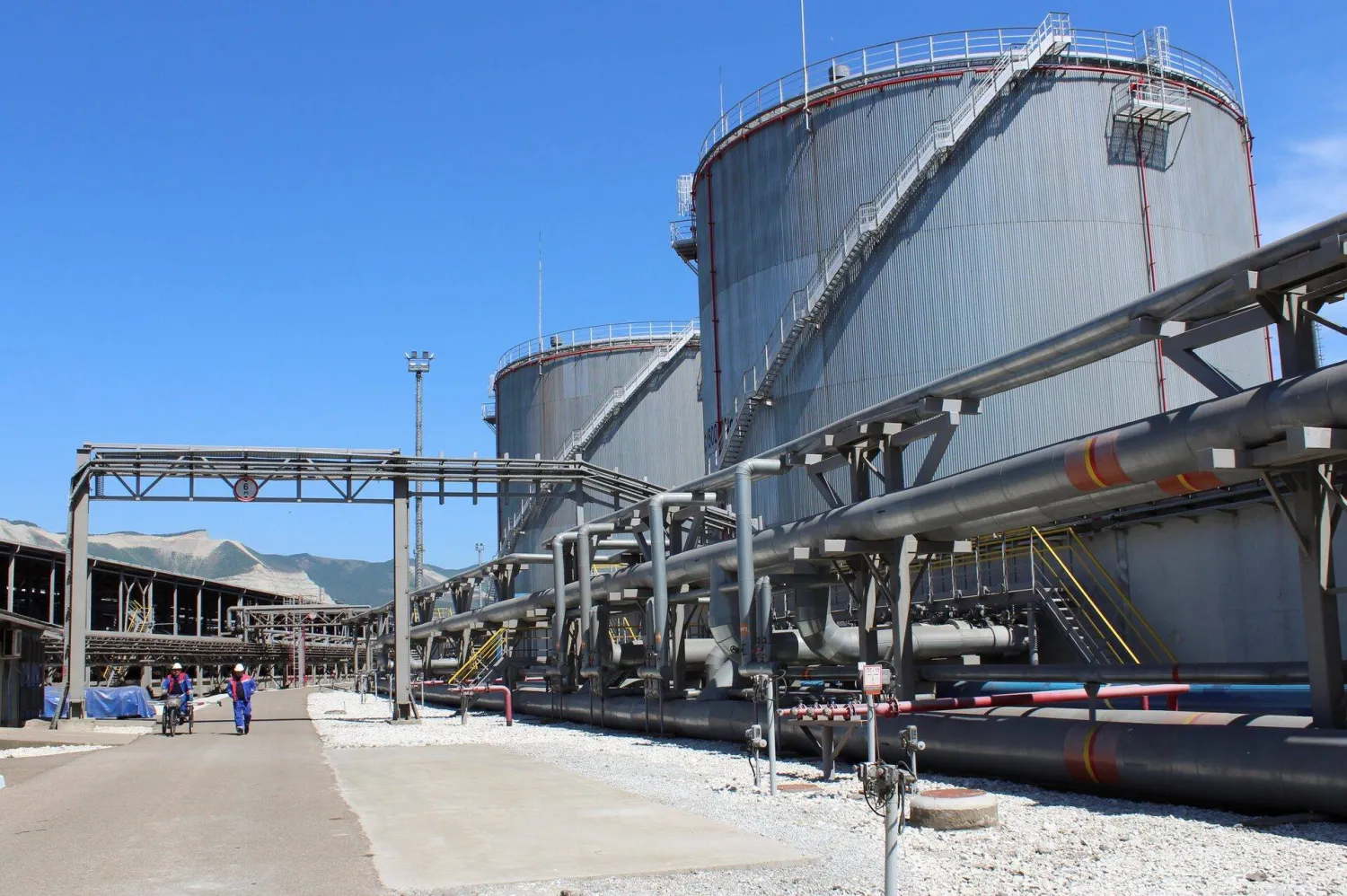
A fuel storage facility at Russia's main oil export hub in the Black Sea port of Novorossiysk (Reuters)
TT

Oil Gains, Stocks Slip on Uncertain Mideast Peace Prospects

A fuel storage facility at Russia's main oil export hub in the Black Sea port of Novorossiysk (Reuters)

Oil prices jumped while stock markets mostly retreated and the dollar firmed Thursday as hopes of a Middle East peace accord faded on conflicting headlines on the state of talks.

US President Donald Trump has described the latest discussions as being on the "borderline" between a deal and renewed strikes.

Pakistan's army chief was due in Iran on Thursday, Iranian media reported, with Islamabad mediating as Tehran examines a new US proposal to end the war, AFP reported.

"Markets pulled back across Europe as the waiting game to end the Iran war rumbled on," said Dan Coatsworth, head of markets at AJ Bell.

Wall Street's main indices also dipped at the open.

There were earlier big gains for technology stocks in Asia after chip giant Nvidia posted record quarterly revenue of $81.6 billion, blowing past analyst forecasts on the voracious demand for artificial intelligence hardware.

Sentiment was also boosted by Elon Musk's filing for a public sale of SpaceX shares, which could be the largest initial public offering in history as the rocket and satellite company seeks to raise up to $75 billion.

"This could be a blockbuster summer for IPOs with OpenAI also expected to list in the coming weeks," said Kathleen Brooks, research director at XTB.

"How the market absorbs these new listings will be crucial for the future of the AI trade, as both companies are at the heart of the AI revolution," she said.

South Korea's benchmark Kospi index surged 8.4 percent, helped by Samsung Electronics shares after unions paused a 18-day strike.

Japan's Nikkei index ended with a gain of 3.1 percent.

But despite the group's profit growth, Nvidia shares failed to get a boost as they have in previous quarters, gaining 0.2 percent after trading got underway in New York.

With tech shares, whose staggering rises helped drive markets to record highs in recent months, now considered by many investors to be overvalued, investment analyst Bret Kenwell at eToro said there were worries that a pullback was in store.

"While geopolitical risks could still flare up, the more pressing issue appears to be macro-related," he said, pointing to the recent rise in sovereign bond yields and the prospect of central banks raising interest rates.

The yields demanded by investors to lend to governments by buying their bonds have peaked in recent days, indicating weakening confidence in their economies and inflation fears.

After tech gains in Asia, attention turned to US-Iran war developments and the potential fallout for economies on the continent, sending European stocks lower.

The EU warned Thursday that eurozone growth would be less than expected this year and inflation significantly higher than forecast, as the Mideast war and subsequent energy shock take their toll.

It came as a key survey revealed that business activity in the eurozone contracted further in May, weighed down by weak demand caused by a conflict.

British private-sector activity also unexpectedly contracted this month, marking the first decline in output in over a year, S&P Global added.

"The UK economy is facing a perfect storm, as rising political uncertainty adds to the growing impact from the war in the Middle East," said Chris Williamson, chief business economist at S&P Global Market Intelligence.

In other corporate news, French video game giant Ubisoft saw its shares plunge around 11 percent after it reported disappointing annual results and forecast further pain in the coming year.

The "Assassin's Creed" and "Rayman" developer had warned in January of the likely impact, with seven games cancelled and six delayed.



Euro Zone Consumers Cut Inflation Bets for the Next Year

FILE PHOTO: A view of the European Central Bank (ECB) headquarters in Frankfurt, Germany, March 6, 2025. REUTERS/Jana Rodenbusch//File Photo
TT

Euro Zone Consumers Cut Inflation Bets for the Next Year

FILE PHOTO: A view of the European Central Bank (ECB) headquarters in Frankfurt, Germany, March 6, 2025. REUTERS/Jana Rodenbusch//File Photo

Euro zone consumers cut their near term inflation expectations in May and kept them steady for longer horizons, a European Central Bank survey showed on Friday, suggesting that the bank is not under pressure to quickly raise interest rates again.

The ECB raised its deposit rate earlier this month to combat surging inflation and some policymakers have said that more policy tightening is needed to temper price expectations, but the debate over ⁠the timing of ⁠any further move is wide open.

Consumers cut their price growth expectation for the next year to 3.5% in May from 4.0% a month earlier while expectations for three and five years ahead were steady at ⁠2.9% and 2.4% respectively, Reuters quoted the ECB as saying in its Consumer Expectations Survey.

"Uncertainty about inflation expectations over the next 12 months decreased but remained at a higher level than before the start of the war in the Middle East," the bank said based on its survey of 19,000 adults in 11 euro zone nations.

As usual, consumers in lower income groups reported ⁠higher inflation ⁠perceptions and expectations while younger people reported lower inflation perceptions and expectations.

Financial markets are pricing between one and two more rate hikes and the next move is not fully priced in until the autumn.

Consumer also turned less pessimistic about growth prospects, predicting overall growth of minus 1.7% in the year ahead after seeing a 2.2% contraction a month earlier.

Income expectations also rose slightly but bets on unemployment also increased.


US Economy Expanded at Solid 2.1% Pace in January-March, Government Says

President Donald Trump stands on stage after speaking at the opening of the Great American State Fair on the National Mall, Wednesday, June 24, 2026, in Washington. (AP Photo/Julia Demaree Nikhinson)
TT

US Economy Expanded at Solid 2.1% Pace in January-March, Government Says

President Donald Trump stands on stage after speaking at the opening of the Great American State Fair on the National Mall, Wednesday, June 24, 2026, in Washington. (AP Photo/Julia Demaree Nikhinson)

The US economy expanded at a solid and unexpected 2.1% annual pace from January through March, the Commerce Department reported Thursday in its final estimate of first-quarter growth.

The growth in gross domestic product — the nation’s output of goods and services — marked a rebound from a sluggish 0.5% in the last three months of 2025 when a 43-day federal government shutdown weighed on the economy. Thursday’s numbers were an upgrade from of Commerce’s previous first-quarter estimate of 1.6% growth, The Associated Press reported.

Business investment surged, probably reflecting an investment boom in artificial intelligence. But consumer spending, which accounts for around 70% of US economic activity, fell sharply from fourth-quarter 2025 and from Commerce’s previous estimate in a sign that consumers may be cutting back in the face of higher gasoline prices caused by the war with Iran.

“It was unsettling to see consumer spending revised even lower,” Heather Long, chief economist at Navy Federal Credit Union, said in a commentary.

"Spending is likely to tick up in (the second quarter), but it’s worth watching carefully... It’s been a tough few months for American consumers, but most have been able to make it through. The question is how much relief is coming” as the US and Iran continue talks toward a resolution of the conflict.

Excluding housing, private investment jumped 10.6%, up from 2.4% in fourth-quarter 2025. In a sign of the AI boom, investment in information-processing equipment jumped at a 39.9% pace as companies scrambled to outfit their data centers. But Michael Reid, head of US economics at RBC Capital Markets, said before Thursday’s report came out that “unfortunately, it’s not a sustainable path.’’ He expects data center investment to lose momentum going forward.

Residential investment, weighed down by high interest rates, dropped 7.8% from January through March, biggest fall since late 2022 and the fifth straight quarterly decline.

The federal government's spending and investment rose at a 9.4% clip in the first quarter after dropping 16.6% in October-December 2025 largely because of the government shutdown.

Imports, which are subtracted from GDP, grew at a slower pace than last estimated from January through March. They still subtracted 1.49 percentage points from first-quarter growth, but that was down from a 2.59 percentage-point hit in the previous estimate and was a major factor in Thursday's upgrade.

The US economy — the world’s biggest — has continued to chug along despite the Iran energy shock. The American job market has proven especially resilient. Employers added an average 188,000 jobs a month from March through May after adding fewer than 10,000 a month in 2025 amid uncertainty over President Donald Trump’s trade and immigration policies.

Thursday’s report was the Commerce Department’s third and final estimate of first-quarter GDP growth. The first look at second-quarter economic growth is due July 30.


Baghdad Urges OPEC to Raise Iraq's Production Quota

A handout picture released by Iraq's Prime Minister's Press Office on January 2, 2025, shows a partial view of the oil refinery of Baiji north of Baghdad, during the inauguration ceremony of the fourth and fifth units. (Iraq's Prime Minister's Press Office / AFP)
TT

Baghdad Urges OPEC to Raise Iraq's Production Quota

A handout picture released by Iraq's Prime Minister's Press Office on January 2, 2025, shows a partial view of the oil refinery of Baiji north of Baghdad, during the inauguration ceremony of the fourth and fifth units. (Iraq's Prime Minister's Press Office / AFP)

Baghdad has urged OPEC to increase Iraq's oil production quota, taking into account the damage done to its industry by its history of conflicts and the recent regional war, its oil ministry said Thursday.

Like other oil producers, Iraq, a founding member of OPEC, was greatly affected by the Middle East war, as it is hugely dependent on oil exports, which make up about 90 percent of its budget revenues.

Iraq's oil ministry said that reassessing production baselines was important "to ensure they are aligned with the sustainable production capacities of member countries", and with respect to "Iraq's unique security and economic circumstances".

OPEC has "responded by launching a process to reassess" its member states' capacities, the ministry said.

Following reports of a possible Iraqi exit from OPEC, oil ministry spokesperson Salim al-Rikabi told AFP that Iraq "has no intention of withdrawing from the organization and remains committed to its mechanisms".

But he added that the cartel "has to raise Iraq's production quota. Otherwise, a decision will have to be made about whether to stay or leave the organization".

Iraq has started increasing its production "in line with its capacities and needs", he said.

The ministry said that "reports suggesting that Iraq is considering ending its membership in OPEC do not reflect" the government's position.

Iraq's ministry said that any change would be decided within OPEC's existing framework, but noted there was a "high level of understanding" among members regarding Iraq's situation after decades of wars, sanctions, and recent attacks on the sector during the Middle East War.

All of these challenges will be considered to "ensure that Iraqi oil production reaches a fair level".

The Middle East war and Iran's blockade of the Strait of Hormuz choked off shipments and prompted production cuts in key oil-producing countries including Iraq, shaking world energy markets.

During the conflict, several Iraqi oil fields were struck by drones mostly launched by pro-Iran armed groups.

Before the war, Iraq produced around four million barrels per day (bpd), and exported an average of 3.5 million bpd, mostly via Hormuz.

After the recent deal between Washington and Tehran to end the fighting, Iraq now hopes to return within two months to its previous production levels.

A former oil ministry official, who requested anonymity, warned against Iraq's exit from OPEC.

A "withdrawal would not serve the interests of Iraq", which is exclusively dependent on the oil sector, he said.

"I don't think that Iraq has really the incentives to leave OPEC," said Jorge Leon, an analyst at Rystad Energy.

Instead, he added, Iraq might be trying to apply pressure to "the capacity review exercise that the group is currently doing", which will serve as the basis for the 2027 quota.