


Is the $1.8 Trillion Private Credit Market Headed for a ‘Credit Winter’?

Raindrops hang on a sign for Wall Street outside the New York Stock Exchange in Manhattan in New York City, New York, US, October 26, 2020. (Reuters)
TT

Is the $1.8 Trillion Private Credit Market Headed for a ‘Credit Winter’?

Raindrops hang on a sign for Wall Street outside the New York Stock Exchange in Manhattan in New York City, New York, US, October 26, 2020. (Reuters)

Could private credit become the next global financial crisis? The question is gaining urgency across financial and regulatory circles after years of explosive growth in lending outside the traditional banking system created a market worth more than $1.8 trillion, much of it operating beyond close regulatory scrutiny.

The concerns sharpened after JPMorgan Chase CEO Jamie Dimon warned that losses in the sector could exceed expectations once the credit cycle turns, citing deteriorating lending standards and rising leverage.

Regulators are beginning to respond. The Financial Stability Board, which includes G20 central bank governors and finance ministers, has urged national regulators to tighten oversight of private credit markets. At the same time, the European Central Bank identified private credit as one of the leading threats to financial stability alongside elevated asset valuations.

In its Financial Stability Review released in late May, the ECB highlighted two major vulnerabilities within the sector. The first was what it described as a “snowball effect,” with some funds struggling to liquidate assets while facing rising redemption requests from investors, increasing the risk of distressed sales.

The second was the rise of “double leverage,” as private credit funds increasingly borrow from traditional banks to finance their own lending activity, creating deeper links between banks and nonbank lenders.

Mohammed Farraj, senior executive for asset management at Arbah Capital, explained that the sector’s rapid expansion was rooted in structural shifts that followed the 2008 global financial crisis. As banks pulled back from lending to small and medium-sized companies under stricter Basel III capital and liquidity regulation, private credit funds moved in to fill the financing gap.
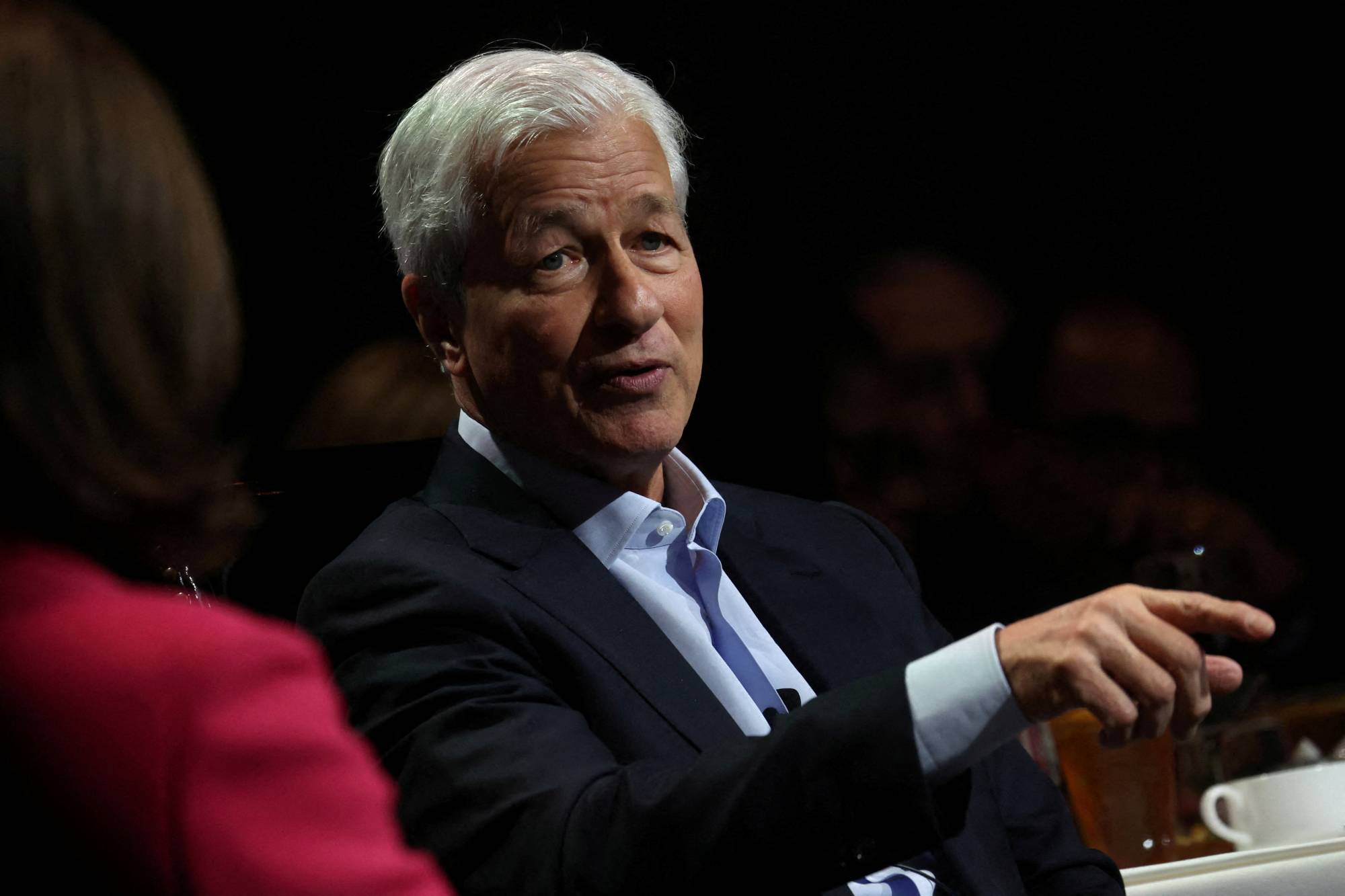
Jamie Dimon, Chairman and Chief Executive officer (CEO) of JPMorgan Chase & Co. (JPM) speaks to the Economic Club of New York in Manhattan in New York City, US, April 23, 2024. (Reuters)

“Their flexibility and ability to move quickly outside conventional banking restrictions allowed them to capture significant market share,” Farraj told Asharq Al-Awsat.

Private credit refers to direct lending to companies through nonbank financial institutions without using banks or public debt markets. Unlike traditional banks, which rely on short-term deposits and operate under strict liquidity requirements, private credit funds are financed by long-term institutional capital from pension funds, insurers, and sovereign wealth funds.

The sector encompasses a wide range of financing tools, including direct lending, mezzanine financing, distressed debt investing, startup financing, and asset-backed lending tied to real estate, equipment, or intellectual property.

Years of ultra-low interest rates after 2008 accelerated institutional demand for private credit as investors searched for higher yields. More recently, higher global interest rates have made the sector even more attractive because many private credit loans carry floating rates that rise automatically with central bank tightening.

Farraj argued that the current environment offers annual returns ranging from 10 percent to 15 percent, well above those available in traditional fixed-income markets.
The company logo and trading information for BlackRock is displayed on a screen on the floor of the New York Stock Exchange (NYSE) in New York, US, March 30, 2017. (Reuters)

However, he cautioned that higher borrowing costs are also placing growing pressure on heavily indebted companies, increasing the risk of defaults, particularly among businesses with fragile balance sheets.

Transparency remains one of the sector’s biggest weaknesses. Private credit assets are not priced daily in public markets but are instead valued periodically using internal models, potentially delaying the recognition of losses and creating a misleading impression of stability.

Concerns intensified earlier this year after a BlackRock private credit fund cut its net asset value by nearly 19 percent because of deteriorating technology-sector loans, prompting closer scrutiny from US regulators.

Despite mounting concerns, Farraj maintained that private credit differs fundamentally from the 2008 mortgage crisis because losses are concentrated among sophisticated institutional investors rather than bank depositors.

Still, he warned that hidden systemic risks could emerge through the growing ties between banks and private credit funds.

He expected the sector to surpass $3 trillion in the coming years, driven by institutional demand and the expanding use of artificial intelligence in credit analysis and risk assessment.



Saudi Industry Minister Discusses Mining Investment Opportunities with Kazakh Companies

Saudi Minister of Industry and Mineral Resources Bandar Alkhorayef held a series of bilateral meetings in Astana on Friday with leaders of several Kazakh mining and metals companies. (SPA)
TT

Saudi Industry Minister Discusses Mining Investment Opportunities with Kazakh Companies

Saudi Minister of Industry and Mineral Resources Bandar Alkhorayef held a series of bilateral meetings in Astana on Friday with leaders of several Kazakh mining and metals companies. (SPA)

Saudi Minister of Industry and Mineral Resources Bandar Alkhorayef held a series of bilateral meetings in Astana on Friday with leaders of several Kazakh mining and metals companies, in the presence of Vice Minister for Mining Affairs Eng. Khalid Almudaifer, the Saudi Press Agency reported.

Discussions focused on opportunities for cooperation in the mining sector, particularly in strategic minerals and rare earth elements. The talks also covered mineral exploration, geological surveying, and sustainable mining.

Participants included representatives of Tau-Ken Samruk National Mining Company, KAZ Minerals, and Kazatomprom.

The meetings are part of the Kingdom’s efforts to strengthen international partnerships and attract high-quality investments in the mining and minerals sector, in line with the goals of Saudi Vision 2030.


SpaceX Leveraged Fund Providers Hit by Day-one Launch Setback, Sources Say

The SpaceX logo and a rising stock graph in this illustration, taken June 11, 2026. REUTERS/Dado Ruvic/Illustration
TT

SpaceX Leveraged Fund Providers Hit by Day-one Launch Setback, Sources Say

The SpaceX logo and a rising stock graph in this illustration, taken June 11, 2026. REUTERS/Dado Ruvic/Illustration

Asset managers eager to roll out leveraged exchange-traded funds tied to SpaceX on its first trading day have been told to delay the launch until Monday, four sources familiar with the matter said.

The setback denies speculators and traders a chance to capture what many expect could be a strong first-day pop in the shares of the blockbuster IPO, while managers will have to wait for the influx of capital into their products, Reuters said.

"We had really wanted to be out on Friday," said Matt Markiewicz, head ‌of product and ‌capital markets at Tradr ETFs, declining to comment on the ‌delay. ⁠The firm's 2x ⁠long and 2x short ETFs will now debut Monday on Cboe Global Markets .

"There is a lot at stake; these products could end up holding a total of more than $10 billion" in assets, Markiewicz added.

Asset managers seeking SEC approval to launch the ETFs had hoped to trade in lockstep with SpaceX's market debut, several of the issuers said.

Instead, exchanges told them on Wednesday the listings would need to be pushed to the first trading day following ⁠the IPO, according to four sources. The exchanges cited SEC concerns ‌that coupling the ETF launches with leveraged products could complicate ‌the SpaceX debut, three sources said.

The SEC did not respond to requests for comment. ‌A spokesman for the Nasdaq Stock Market, which will be home to the SpaceX IPO ‌as well as some of the ETFs, declined comment. Cboe Global Markets and the New York Stock Exchange could not immediately be reached for comment.

While there is no precedent for leveraged funds - introduced in the US less than four years ago and surging in number over the past ‌12 months - to launch alongside an underlying stock, asset managers had hoped to gain an edge in what analysts say could be ⁠a multibillion-dollar race ⁠for assets in the first weeks of trading.

"There are billions at stake in the first few weeks alone," said Todd Sohn, an ETF analyst at Strategas.

Major players in the leveraged stock arena, including Direxion, GraniteShares, ProShares and Defiance, plan to roll out 2x leveraged long ETFs as soon as they are permitted to do so, according to their filings and advertisements on investment forums and social media sites.

"Investors will have multiple options; they will be able to get SpaceX exposure because of early entry on the part of passive index providers, or through the stock itself, or through the leveraged (ETF) ecosystem, which adds up to a pretty robust mechanism for price discovery," said Simeon Hyman, global investment strategist at ProShares.

He said his firm had no plans to launch early and was comfortable waiting until Monday. "The intent of everybody is to have this (IPO) work smoothly."


Türkiye Central Bank Commits to Continued Disinflation Path

 A man carries goods on his shoulder on a hot day in Istanbul, Wednesday, June 3, 2026. (AP)
A man carries goods on his shoulder on a hot day in Istanbul, Wednesday, June 3, 2026. (AP)
TT

Türkiye Central Bank Commits to Continued Disinflation Path

 A man carries goods on his shoulder on a hot day in Istanbul, Wednesday, June 3, 2026. (AP)
A man carries goods on his shoulder on a hot day in Istanbul, Wednesday, June 3, 2026. (AP)

Turkish Central Bank Governor Fatih Karahan said on Friday that price stability remains the top priority and that the disinflation process will continue despite recent ‌geopolitical tensions.

The ‌governor said ‌policy ⁠tools and strong ⁠reserves provide the means to sustain disinflation, and that a rebalancing in domestic demand is ⁠expected to continue ‌supporting ‌the process.

Governor said ‌the central bank ‌will continue to monitor all factors affecting the inflation outlook.

Loan ‌growth is moving toward a more ⁠balanced ⁠path, the governor said, citing the latest policy measures.

Strong reserves alongside policy tools act as buffers against geopolitical risks to disinflation.