


Gulf Investors Shape Wall Street’s Biggest-Ever IPO

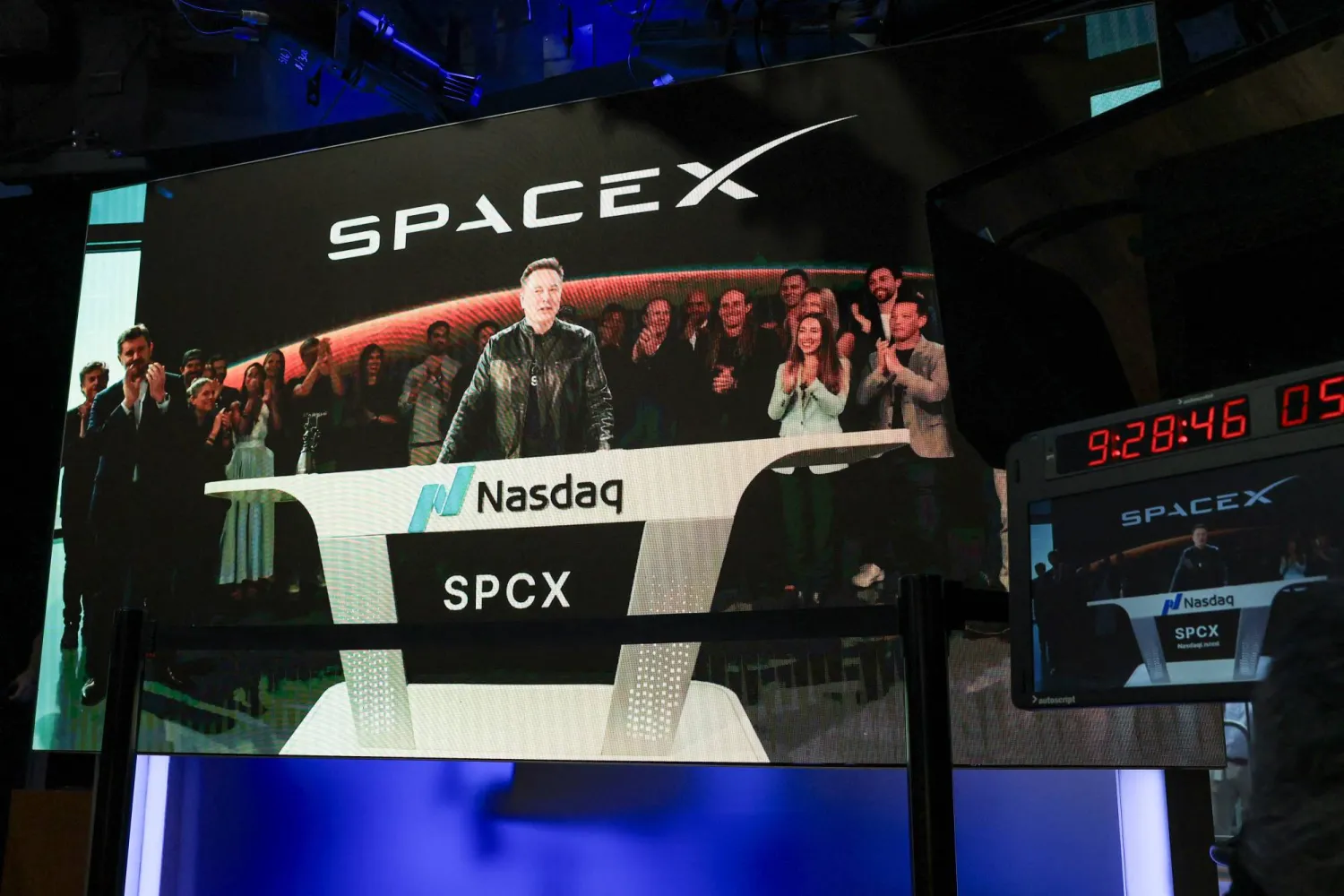
SpaceX CEO Elon Musk, displayed on a screen remotely from SpaceX headquarters in Starbase, Texas, speaks before the launch of SpaceX's initial public offering (IPO) at the Nasdaq MarketSite in New York on June 12, 2026. (Photo by TIMOTHY A. CLARY / AFP)
TT

Gulf Investors Shape Wall Street’s Biggest-Ever IPO

SpaceX CEO Elon Musk, displayed on a screen remotely from SpaceX headquarters in Starbase, Texas, speaks before the launch of SpaceX's initial public offering (IPO) at the Nasdaq MarketSite in New York on June 12, 2026. (Photo by TIMOTHY A. CLARY / AFP)

SpaceX shares began trading on Nasdaq at a market value of $1.78 trillion, turning Gulf capital's role from market speculation into a documented fact.

Last-minute disclosures and the IPO prospectus revealed a striking economic reality: sovereign wealth funds and investors from Gulf Cooperation Council countries were not peripheral participants.

They were the backbone of the largest fundraising exercise in financial market history. This $75 billion deal made the Gulf a historic partner in shaping the future of space and artificial intelligence.

Global hedge funds saw their orders sharply cut after demand topped $250 billion. But Britain’s Financial Times, citing people familiar with the order book, reported that sovereign funds and family offices were given priority. SpaceX placed Gulf funds at the front of its list of strategic subscribers.

According to the newspaper, the official Gulf allocation put the region among the biggest subscribers.

Saudi Arabia’s Public Investment Fund, the Qatar Investment Authority and the Kuwait Investment Authority each received final allocations worth more than $1 billion. Those figures approached the scale of the $5 billion stake sought by US asset management giant BlackRock.

The rush was also driven by “fast-entry” rules approved by global index providers such as Nasdaq and FTSE Russell.

These rules allow shares to be added to major indexes, including the Nasdaq 100, within five to 15 trading days. For funds, securing stock from the first book became a preemptive fight.

The rise of the Kingdom’s stake

The case of Prince Alwaleed bin Talal and Kingdom Holding Co. offers the clearest example of how Gulf investors booked historic paper gains through long-standing strategic ties with Elon Musk.

It also gave practical meaning to Musk’s 2024 pledge, when he wrote on his platform: “Loyalty deserves loyalty,” promising priority to long-term investors.

The relationship began in 2011, when Prince Alwaleed invested $300 million in Twitter, now X. When Musk acquired the platform in 2022, Kingdom Holding and its chairman, Prince Alwaleed bin Talal, made a decisive call: they rolled over the stake instead of cashing out.

Later, as Musk merged X with his artificial intelligence startup xAI and then folded the combined entity under SpaceX, that historic holding was converted into direct equity in the rocket and satellite communications company, according to IPO documents.

The result was a dramatic paper gain. Kingdom Holding said in a separate official filing to the Saudi stock exchange that the estimated value of its joint stake with Prince Alwaleed had risen to more than $10.6 billion, based on the final IPO price of $135 a share.

The effect was not confined to the company’s books. The valuation quickly moved into the market, sparking a rally that sent Kingdom Holding shares on Saudi Arabia’s Tadawul exchange to their highest level in a decade.
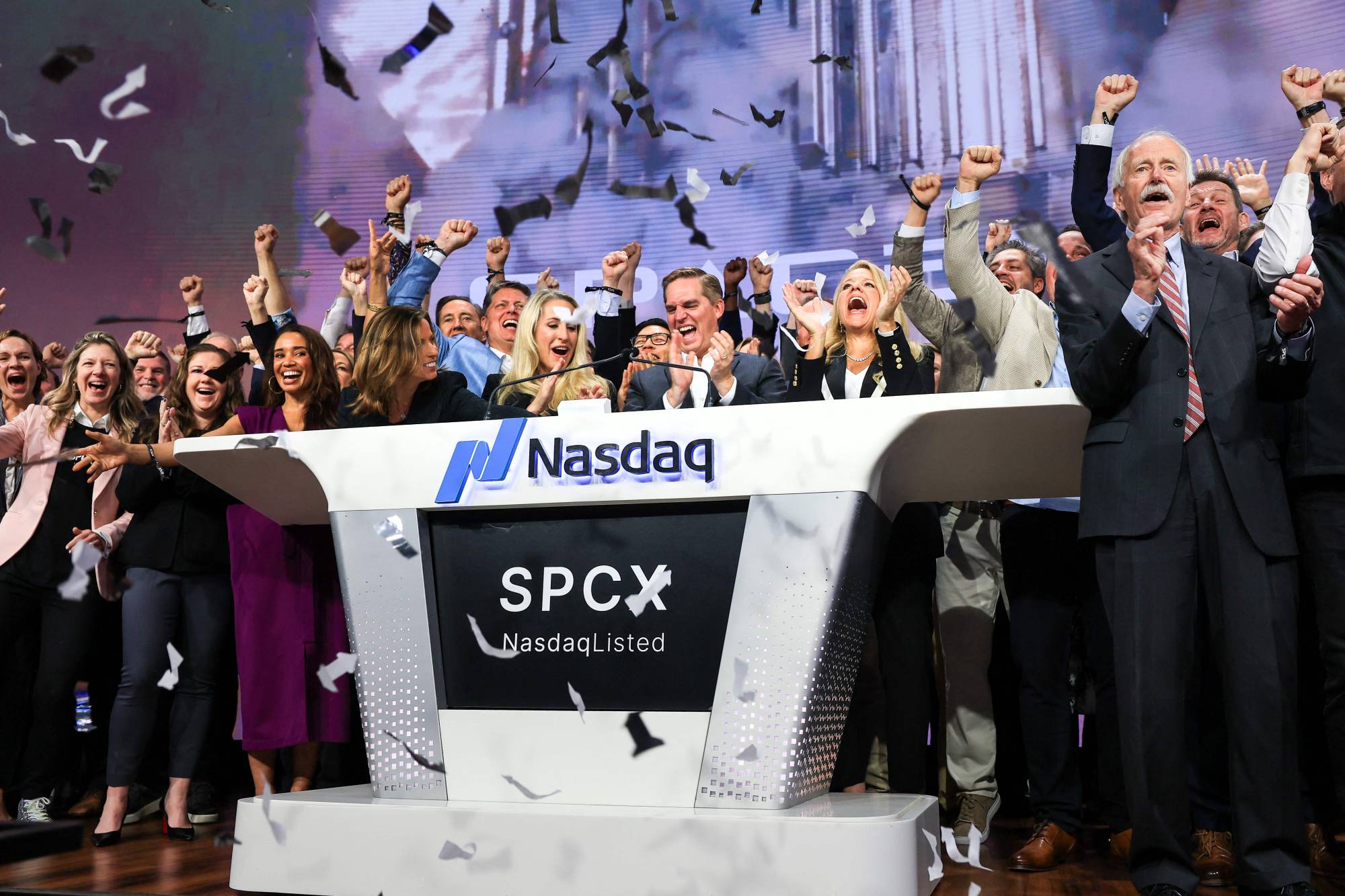
Bret Johnsen (C), SpaceX Chief Financial Officer, and Gwynne Shotwell (center R), SpaceX President and Chief Operating Officer, celebrate as they ring the opening bell at the Nasdaq MarketSite to celebrate the launch of SpaceX's initial public offering (IPO) in New York on June 12, 2026. (Photo by TIMOTHY A. CLARY / AFP)

The AI equation

The gains tell only part of the story. Published operating data and SpaceX’s combined deals show Gulf investors have shifted the rules of the traditional investment game.

Regional capital is no longer silent money waiting for dividends. It has become a strategic force, demanding the localization of advanced technology and the construction of computing and artificial intelligence infrastructure on Arab soil. The goal is knowledge transfer and digital sovereignty, not merely returns captured in Silicon Valley.

HUMAIN enters the picture

That strategy is clearest in the moves of Saudi Arabia’s HUMAIN, a company wholly owned by the Public Investment Fund and focused on providing comprehensive artificial intelligence capabilities globally.

According to the company’s official statement, HUMAIN invested $3 billion in xAI’s Series E funding round. The investment came just before SpaceX’s larger acquisition and merger in early February.

Under that transaction, HUMAIN’s stake was converted into declared, direct equity in the parent company, SpaceX, making it a significant minority shareholder with strategic weight.

The statement shows the partnership was not improvised. It followed a broad agreement signed in November 2025 during the US-Saudi Investment Forum.

Under the agreement, HUMAIN and xAI committed to jointly developing next-generation artificial intelligence infrastructure and data centers with more than 500 megawatts of computing capacity, while localizing and deploying advanced Grok models in Saudi Arabia.

At the time, HUMAIN Chief Executive Tareq Amin said the investment showed the company’s ability to deploy major capital behind exceptional technology platforms that combine technical excellence with long-term vision.

He said the merger of xAI with SpaceX’s vast infrastructure created a unique platform for accelerated growth and long-term investment value across four areas: next-generation technology centers, hyperscale cloud, advanced models and transformative AI solutions.

The United Arab Emirates built its own technology alliance along similar lines. Abu Dhabi secured a strategic seat through its specialized technology arm, MGX, in Musk's merged entities, in cooperation with G42.

At the same time, it moved ahead with a large data center complex in Abu Dhabi, supported by parallel strategic partnerships, including a $15.2 billion investment commitment from Microsoft for Khazna, the group’s data center company.

NEW YORK, NEW YORK - JUNE 12: SpaceX employees celebrate the market close of the SpaceX initial public offering (IPO) at the Nasdaq Marketsite on June 12, 2026, in New York City. Spencer Platt/Getty Images/AFP

Financial engineering and the space bet

Official data cited by Britain’s Financial Times set out the spending plan for the IPO proceeds. SpaceX will immediately use $20 billion of the gross proceeds to repay a bridge loan the group drew in March.

The loan covered debt tied to the integration of Musk’s artificial intelligence and social media businesses, xAI and X, under SpaceX’s financial umbrella.

The remaining liquidity, backed significantly by cash flows and Gulf billions from the top of the order book, will fund the next stage of growth.

At the center of those plans is a project Musk disclosed to the head of JPMorgan during the IPO roadshow and which the British newspaper reported: building artificial intelligence data centers in outer space.

The plan involves launching giant satellites with 70-meter wingspans as a strategic solution to the limits of Earth's electricity resources.

Steel-like confidence

The scale of the Gulf position has drawn attention on Wall Street because SpaceX’s current numbers defy traditional market equations.

The company went public with a financial commitment that included repaying a $20 billion loan before the offering to cover obligations from the merged xAI and X businesses under SpaceX’s unified structure.

Its valuation was even more striking: 92 times annual revenue of $19 billion. In simple terms, standard market practice usually ties large-company valuations to current revenue. SpaceX’s market value therefore places it in a rare position among the world’s largest technology groups relative to the size of its existing business.

Even so, banking circles described the approach of Gulf sovereign wealth funds and family offices as a strategic vision that looked past conventional market concerns. Investment managers told the Financial Times they had offered Gulf clients financial hedging options as a standard precaution when trading began. All rejected hedging outright.

That stance reflects a more mature regional investment mindset. Gulf investors are no longer relying only on immediate readings and short-term indicators. They are trying to seize future monopolistic opportunities.

That view draws on forecasts by Goldman Sachs, the lead IPO manager, which predicted a 100-fold jump in SpaceX’s artificial intelligence revenue to $322 billion by 2030, allowing it to dominate a targeted global market worth $28.5 trillion.

In the end, SpaceX’s historic IPO showed that the region’s funds have become strategic partners with the power to impose operational conditions, localize future technology and shape a new financial geopolitical landscape stretching from the deserts of the Middle East to outer space.



Focus Turns to Building Stronger Institutions in Africa to Speed Shift to Renewable Energy

A solar power plant in Burkina Faso (Reuters)
TT

Focus Turns to Building Stronger Institutions in Africa to Speed Shift to Renewable Energy

A solar power plant in Burkina Faso (Reuters)

Africa’s biggest clean energy challenge is shifting from building projects to building the institutions, markets and regulatory systems needed to deliver them at scale, experts say.

That challenge is emerging even as clean energy reaches a historic milestone globally.

Renewables generated 34% of the world’s electricity in 2025, overtaking coal’s 33% share. Together with nuclear power, renewables are expected to provide half of global electricity by 2030.

As industrialization, artificial intelligence and electrification push demand higher, experts say the bottleneck in transitioning to cleaner energy has shifted from technology to the systems supporting it, including funding.

Overcoming such obstacles is vital for securing access to power for the 600 million people in Africa who are yet to be connected.

“Clean energy is now cheaper than fossil fuels in virtually every part of the world,” former New York City Mayor Michael R. Bloomberg, the UN Secretary-General’s Special Envoy on Climate Ambition and Solutions, said in late June while announcing a new $285 million Bloomberg Philanthropies initiative to strengthen clean energy industries in emerging and developing economies.

“But fixable obstacles are still slowing down deployment, and with energy demand rising at an unprecedented speed, we can’t allow those obstacles to continue standing in the way,” The Associated Press quoted him as saying.

Rather than financing solar farms or wind projects directly, the initiative will invest in strengthening market design, regulatory capacity, technical expertise and industry institutions, areas increasingly viewed as essential for attracting private investment and accelerating use of renewable energy.

It reflects a growing consensus that Africa’s energy transition is constrained less by a lack of renewable resources or viable technologies than by the institutional capacity needed to turn those advantages into financially viable projects and electricity on the grid.

Many projects remain delayed by weak market design, limited grid planning, slow permitting processes and fragmented regulatory systems.

“What has been missing is not the potential, but the institutional infrastructure and capabilities to unlock it,” said Saliem Fakir, executive director of the African Climate Foundation.

“Philanthropy that targets those gaps directly is the kind of intervention that can shift the trajectory of a continent’s energy system.”

Across Africa, renewable energy costs have fallen sharply while investment appetite continues to grow. However, investors say policy uncertainty, slow permitting processes and limited regulatory capacity are hindering projects.

Wangari Muchiri, founder and chief executive of RE.Think Energy, said the commitment signals that “the next phase of the energy transition is not about proving clean energy works, it’s about removing the barriers preventing it from scaling fast enough.”

The Bloomberg initiative is looking beyond ambitious renewable energy targets to focus on helping projects attract long-term investments and connect to national grids.

“The next chapter of Africa's renewable energy story will not be only by the projects it builds, but the institutions that make these projects possible,” Muchiri said.


Volkswagen CEO Looks to Avoid Plant Closures as Automaker Moves to Cut Costs

FILE PHOTO: Oliver Blume, CEO of Volkswagen AG and Porsche AG, speaks during the annual Volkswagen Group press conference in Wolfsburg, Germany March 11, 2025. REUTERS/Liesa Johannssen/File Photo
TT

Volkswagen CEO Looks to Avoid Plant Closures as Automaker Moves to Cut Costs

FILE PHOTO: Oliver Blume, CEO of Volkswagen AG and Porsche AG, speaks during the annual Volkswagen Group press conference in Wolfsburg, Germany March 11, 2025. REUTERS/Liesa Johannssen/File Photo

Volkswagen's CEO indicated in comments published Sunday that he's trying to avoid closing plants as he seeks to turn around the automaker's performance.

The Wolfsburg, Germany-based company faces pressure to cut costs at home and increasingly intense competition in the lucrative Chinese market, in particular.

Last week, Volkswagen said its “fundamental realignment” over the past three years had reached its next phase, announcing plans to streamline the model lineup by up to half.

It didn't provide specifics, and questions remain over how else it will cut costs. There has been renewed speculation about the future of several plants in Germany.

“There are more intelligent solutions than closing plants,” CEO Oliver Blume told the Bild am Sonntag newspaper, according to The Associated Press.

He added that a cost-cutting program in Germany already is producing effects. “We were able to improve our factory costs in Germany by an average 20% last year alone,” he said, describing that as “strong progress.”

Blume argued that Volkswagen's products are very popular, but “we just earn too little money with them. So we must continue to reduce our costs. In all kinds of costs.”


While Global Oil Demand Drops, US Drivers Keep Buying More Gas

A man stands near his car at a gas station in Austin, Texas - July 10, 2026 (AFP)
TT

While Global Oil Demand Drops, US Drivers Keep Buying More Gas

A man stands near his car at a gas station in Austin, Texas - July 10, 2026 (AFP)

While global oil demand is set to decline this year due to the US-Iran conflict, gasoline consumption in the United States increased in the second quarter of 2026.

Gasoline prices surpassed $4.50 on average for a gallon of regular in the US in May, rising more than 50% since the start of the war, according to AAA data.

But that didn’t stop drivers from hitting the road; in fact, gasoline consumption rose in the US during the second quarter of the year, according to AP.

One reason may be because the percentage of household income spent on gasoline in the US has been declining for years, said Daniel Sternoff, senior fellow at the Center on Global Energy Policy at Columbia University. Plus, many people have been transitioning from remote work to in-office jobs, he added.

“Even though it’s a really political price that people pay a lot of attention to, if you are in the higher quintiles of income in the US, you might grumble about it, but you’re not really driving less just because of that increase in prices,” Sternoff said.

Jim Burkhard, vice president and head of crude oil research at S&P Global Energy, said, “The future of Hormuz is probably more uncertain today than it was at the beginning of the war.”

Burkhard said Iran is still trying to control the strait, while the US has not been able to fully restore normal operations, making a return to prewar conditions unlikely.

Global oil demand averaged just 97.9 million barrels per day in May, down 5.3 million barrels per day from a year earlier. Much of the decline was in Asia, which relies heavily on oil from the Middle East.

According to a report from the International Energy Agency Global, oil demand is set to decline this year for the first time since the height of the COVID-19 pandemic in 2020.

The drop, which the agency expects to amount to about 1 million barrels per day in 2026, is due to higher oil prices and disruptions to physical supply that weighed heavily, but unevenly, on various parts of the world, the report said.

The supply disruptions were caused by the war between the US and Iran, which left ships loaded with crude oil stranded in the Arabian Gulf for more than three months, unable to safely travel through the Strait of Hormuz, a major route for oil and gas shipments.

But the main exception to the global slump in oil usage was in the US, where gasoline use increased in the second quarter of 2026, despite the fact that pump prices were about 50% above their prewar levels in May, the report said.