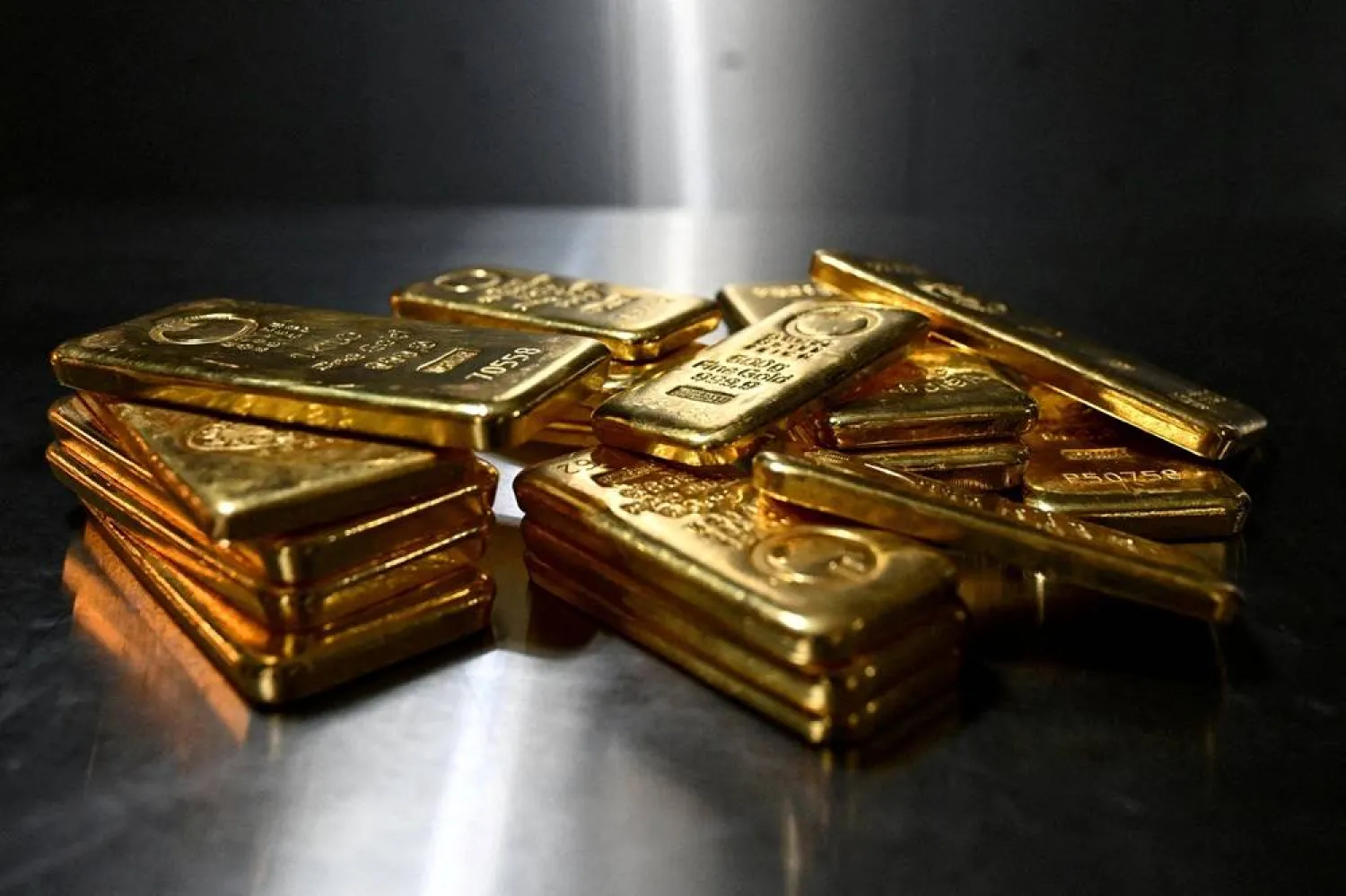
Gold Extends Gains After US, Iran Reach Peace Deal

Gold bars of various values are stored in a safe deposit room in Munich, Germany, January 28, 2026. (Reuters)
TT

Gold Extends Gains After US, Iran Reach Peace Deal

Gold bars of various values are stored in a safe deposit room in Munich, Germany, January 28, 2026. (Reuters)

Gold rose more than 2% on Monday after US and Iran officials said they had reached an initial agreement to end their war, pushing oil prices lower and easing concerns about inflation and higher interest rates.

Spot gold climbed 2.5% to $4,322.87 per ounce by 0312 GMT, hitting its highest level since June 9 and extending gains for a third straight session. US gold futures ‌for August delivery ‌rose 2.5% to $4,344.80.

US and Iranian officials said on ‌Sunday ⁠they had agreed ⁠on a framework to end their war, halt the US blockade of Iran and reopen the Strait of Hormuz.

The pact will be officially signed on Friday in Switzerland, Pakistani Prime Minister Shehbaz Sharif said in a post on X.

The US dollar fell to a 10-day low, making greenback-priced bullion cheaper for other currency holders, while oil prices slipped more than 4%.

"Lower ⁠oil prices and a softer dollar, stemming from ‌reduced geopolitical risk and the anticipated reopening ‌of the Strait of Hormuz, are helping to calm inflation expectations," said Tim Waterer, ‌chief market analyst at KCM Trade.

"This combination is providing the ‌precious metal with its best tailwind in recent weeks, though sustainability will depend on how durable the peace agreement proves to be."

Gold prices have fallen about 20% since the start of the US-Israeli war against Iran in late February. The ‌effective closure of the Strait of Hormuz has led to a sharp increase in global oil prices, stoking ⁠inflation concerns ⁠and raising expectations of interest rates staying higher for longer.

Bullion loses appeal in a high-interest-rate environment as it is a non-yielding asset.

Markets have scaled back expectations for a US rate hike in December to 48% after the peace deal, down from 69% last week, according to the CME FedWatch tool.

Investors now await the Federal Reserve policy decision and remarks, the first under Chair Kevin Warsh, on Wednesday, with rates widely expected to remain unchanged.

"Currency debasement concerns, fiscal risks and ongoing geopolitical fragmentation continue to underpin long-term demand (for gold). A moderation in energy-led inflation could help these themes regain traction," OCBC said in a note.

Spot silver rose 3.6% to $70.39 per ounce, platinum gained 3.3% to $1,773.70 and palladium climbed 3.3% to $1,324.75.


Fitch Affirms Saudi Arabia at 'A+', Outlook Stable

A view of the Saudi capital, Riyadh. (SPA)
TT

Fitch Affirms Saudi Arabia at 'A+', Outlook Stable

A view of the Saudi capital, Riyadh. (SPA)

Fitch Ratings has affirmed Saudi Arabia's Long-Term Foreign-Currency Issuer Default Rating (IDR) at "A+" with a Stable Outlook, the agency said on Friday.

The rating reflects strong fiscal and external balance sheets, with government debt/GDP and sovereign net foreign assets (SNFA) considerably stronger than the "A" and "AA'" medians, and significant fiscal buffers in the form of deposits and other public sector assets, it added.

"Oil dependence and World Bank Governance Indicators (WBGI) have improved but remain weaknesses. Geopolitical risk is high, but the economy and public finances have been resilient to the US-Iran war," it stressed.

"Fitch forecasts real GDP growth will slow to 0.6% in 2026 due to disruption to trade caused by the closure of the Strait of Hormuz," it continued.

"Flows through the East-West pipeline supported oil production during the war and we expect output to be ramped up to meet external demand following the reopening of the Strait and to rebuild domestic stocks, but at an annual average of 9m b/d it will be below the 2025 level," it said.

"Non-oil growth will be hit by an inability to export petrochemicals during the closure of the Strait, but consumer spending held up and business confidence is recovering."

"Growth will rebound in 2027 as the normalization of flows through the Strait allows higher oil and petrochemicals production, before easing to 2.9% in 2028 The phased opening of gigaprojects (many of which have launched initial operations), the proximity of key events and guidance that the Public Investment Fund will keep domestic spending largely unchanged in its new five-year plan, will also support growth," Fitch noted.

The King Fahd Industrial Port in Yanbu, Saudi Arabia (SPA)

"The fiscal deficit is projected to narrow in 2026 owing to higher oil revenues, as prices will offset lower volumes. Spending will also rise, reflecting the impact of the war, but much of the jump in 1Q was the precautionary frontloading of spending from later in the year," it said.

Fitch forecasts that lower oil revenues will widen the deficit to 4.7% in 2027, consistent with a fiscal breakeven oil price of USD94/b.

Spending is expected to decline in 2027, due to an easing of war-related pressures, lower capex and ongoing efforts to reduce rigidities in current spending. Expenditure adjustment will allow the deficit to narrow in 2028 despite a projected further fall in oil prices.

"Our fiscal projections are consistent with a further increase in debt/GDP, which we project at 41.3% at end-2028 (projected peer median of 58.1%), from 31.8% at end-2025. based on deposits remaining around 10% of GDP," said Fitch.

"Fitch forecasts a small current account surplus for 2026 due to higher oil export revenues. Lower oil prices and ongoing domestic demand growth that has a heavy component of imported goods, services and labor, will lead to a deficit of 5% of GDP by 2028. Current account deficits will be financed by external borrowing and the ongoing reorientation of public assets to domestic from foreign investments," it continued.

"Banks have been resilient to the war and did not require any support measures from the central bank," it stressed. "At end-1Q, non-performing loans were 1.1% and the Tier 1 capital ratio 19.2%, both improved from end-2024. Credit growth has slowed, particularly mortgages, in response to policy measures, and is being outpaced by deposit growth."

Fitch maintained its mid-year 2026 sector outlook for Saudi banks at "neutral".


China Temporarily Bans Helium Exports as US-Iran Tensions Flare Again

Ships and containers at a Chinese port (Reuters)
TT

China Temporarily Bans Helium Exports as US-Iran Tensions Flare Again

Ships and containers at a Chinese port (Reuters)

China announced on Friday a temporary export ban on helium, effective immediately, as resumption of military conflict in the Middle East threatens to trigger new shortages of the gas critical for chip manufacturing.

Earlier this year, the US-Israeli war on Iran led to helium shortages, disrupting companies globally, including in China, where the AI industry increasingly relies on domestic chips for training and ⁠running AI models. Helium is essential for heat management in semiconductor production.

The helium ban is the latest example of Beijing seeking to prevent domestic shortages of critical materials by curbing exports. It has previously imposed similar measures on fuel, fertilizers and sulfuric acid.

China is also looking to boost domestic chip manufacturing capacity and reduce the industry's dependence on cutting-edge Nvidia semiconductors that fall under US export controls.

China is heavily ⁠dependent on overseas helium despite efforts to expand domestic production.

Still, the export ban could squeeze global supply further because Chinese companies have increasingly acted as intermediaries, importing Russian helium and re-exporting some volumes to overseas markets, including Europe.

According to Reuters, analysts ⁠estimate China imports around 85% or more of its helium requirements. Qatar accounts for a major share of global helium output and has supplied more than half ⁠of China's imports in recent years.

Helium is extracted from natural gas fields with unusually high helium concentrations and cannot be quickly manufactured from ⁠other industrial processes.

In chipmaking, it is used for wafer cooling, plasma etching, chemical vapor deposition, atomic layer deposition, lithography support and leak detection.


IEA Says Global Oil Demand Picks Up Despite War Fears

FILE PHOTO: A drone view of three berths able to load vessels with oil is seen after their construction at Westridge Marine Terminal, the terminus of the Canadian government-owned Trans Mountain pipeline expansion project in Burnaby, British Columbia, Canada, April 26, 2024. REUTERS/Chris Helgren/File Photo
TT

IEA Says Global Oil Demand Picks Up Despite War Fears

FILE PHOTO: A drone view of three berths able to load vessels with oil is seen after their construction at Westridge Marine Terminal, the terminus of the Canadian government-owned Trans Mountain pipeline expansion project in Burnaby, British Columbia, Canada, April 26, 2024. REUTERS/Chris Helgren/File Photo

The International Energy Agency said Friday that "a recovery" in global oil demand had started as supplies tentatively start moving through the strategic Strait of Hormuz again and prices ease.

"A recovery in world oil demand is underway, with consumption set to rise from its May nadir," AFP quoted the IEA's monthly report as saying.

The agency had in June predicted a fall in demand of 1.1 million barrels a day (mbd) through 2026 because of the Middle East war, which strangled traffic through the strait. It now expects a one million barrel a day fall.

"Global oil supply rebounded by a sharp 4.1 mbd to 98.8 mbd in June, as a resumption of flows through the Strait of Hormuz underpinned a partial recovery in Gulf production. World output was nevertheless some 9.4 mb/d below pre-war levels," it said.

"Total Gulf oil exports, including volumes bypassing the Strait, surged by 6.5 mbd in June, to 16.1 mbd - a big jump but still well below the 24 mbd average before the war started."

According to the IEA, world supply improved to 102.6 mbd in June and would continue to get better if there was "a swift de-escalation of renewed hostilities".

"If transit volumes improve, oil supply will expand by 7.5 mbd next year," the agency added.

The agency said world oil reserves increased for the first time since the US-Israeli attacks on Iran on February 28 set off the war.

It added that stocks in the richest nations had fallen as their oil imports remained low despite the rise in volumes being transported by sea.

While oil prices fell dramatically in June, fresh fighting between US and Iranian forces this week "clouds the outlook", the IEA said.

"Renewed exchanges of fire in the Gulf this week highlight the risks of not reaching a lasting peace agreement, which is a must for the normalization in oil markets," it commented.