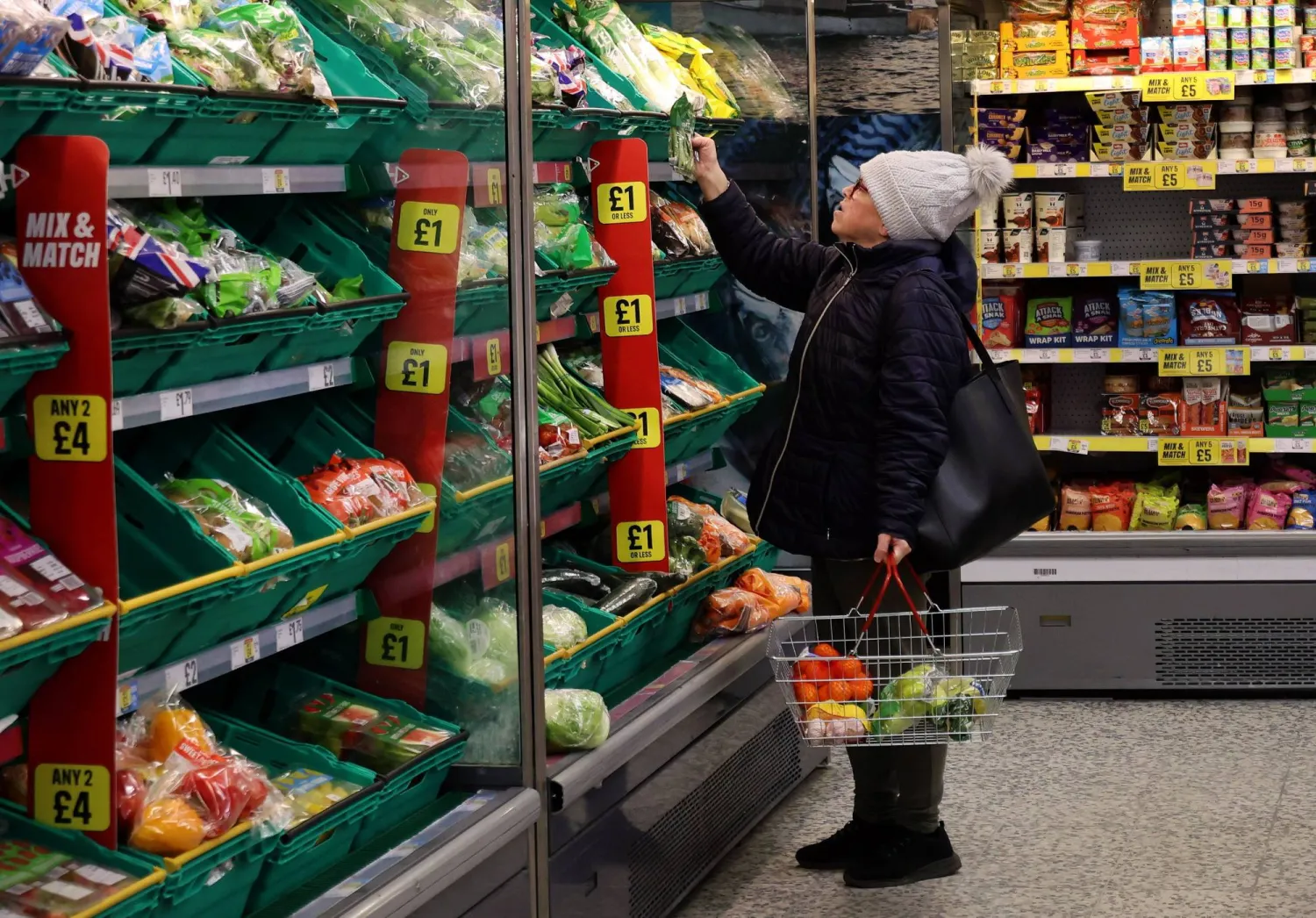
UK Inflation Holds Steady at 2.8% Ahead of Bank of England Decision

A shopper in a London supermarket (EPA)
TT

UK Inflation Holds Steady at 2.8% Ahead of Bank of England Decision

A shopper in a London supermarket (EPA)

British inflation unexpectedly held at 2.8% for May, unchanged from the 13-month low reached in April, official figures showed on Wednesday, a day before the Bank of England will announce its next interest rate decision.

Sterling weakened a little against the US dollar after the data and investors slightly trimmed their expectations for a rate rise later this year.

Economists polled by Reuters had forecast a rise to 3.0% for May, as the US-Iran war kept British inflation almost a percentage point higher than the BoE had forecast in February.

Lower prices than in April for meat, ⁠vegetables and dairy products ⁠as well as domestic heating oil helped offset a jump in airfares and petrol, the Office for National Statistics said.

Inflation has been above the BoE's 2% target for most of the past five years.

In April, the BoE said it was likely to rise above 3.5% by the end of the year and potentially exceed 6% early next year under the most adverse of three scenarios.

However, ⁠financial markets this week have drawn comfort from an interim agreement between the US and Iran which promises to reopen the Strait of Hormuz, a major corridor for oil exports, and is due to be signed in Switzerland on Friday.

"Today's data strengthens the case for a continued cautious approach from the Bank of England," Yael Selfin, chief economist at KPMG, said.

"Underlying inflationary pressures have yet to show clear signs of strengthening, which is likely to underpin a majority decision within the Monetary Policy Committee to hold interest rates at Thursday's meeting," she said.

Economists polled by Reuters expect the BoE's Monetary Policy Committee to vote 7-2 to keep rates on hold at 3.75%.

While Governor Andrew Bailey says ⁠the BoE has ⁠time to wait to assess the impact of the conflict, some policymakers worry businesses will use it to raise prices more broadly, or that it could dent households' confidence in the BoE inflation target.

Britain has been more affected than most Western countries by the conflict due to its reliance on imported natural gas and manufacturers reported an 8.7% annual rise in their raw material costs for May, the biggest since February 2023.

Services price inflation - which the BoE views as a guide to underlying price pressures - rose to 3.7% in May from 3.2% in April, in line with economists' forecasts.

The rise in services inflation partly reflected a 10.3% monthly jump in airfares, which are volatile. High Easter prices were not captured in April 2026 data but were in 2025.

Core inflation, which excludes food, energy, alcohol and tobacco prices, rose slightly less than expected to 2.6% from 2.5%.


Oil Prices Ease 3% on Optimism for Qatari-Led Talks on Ending Iran War

A flare burns off methane and other hydrocarbons as oil pumpjacks operate in the Permian Basin in Midland, Texas, on Oct. 12, 2021. (AP)
TT

Oil Prices Ease 3% on Optimism for Qatari-Led Talks on Ending Iran War

A flare burns off methane and other hydrocarbons as oil pumpjacks operate in the Permian Basin in Midland, Texas, on Oct. 12, 2021. (AP)

Oil prices slipped more than 3% on Monday after Iranian and Qatari officials held a third straight day of talks aimed at pushing for a deal to end the US-Israeli war on Iran.

Brent crude futures fell $3.68, or 3.2%, to $109.75 a barrel by 0407 GMT while US West Texas Intermediate crude was at $100.69 a barrel, down $3.43, or 3.3%.

Brent ended October at its highest in ‌six months amid concerns ‌that the US-Iran conflict could escalate again ‌after Tuesday's ⁠US midterm elections.

"Oil ⁠is seeing a technical pullback this morning after last week’s strong gains," said Tim Waterer, chief market analyst at KCM Trade.

"Lingering hopes of some form of diplomatic progress, combined with the absence of any meaningful military escalation over the weekend, have taken some of the immediate heat out of prices for now."

However, the market remained alert to the ⁠possibility that rhetoric around Iran could be ratcheted higher ‌and push Brent toward $120 after the midterm ‌elections, Waterer said.

Iranian Foreign Minister Abbas Aragcchi said on Sunday that the ‌purpose of the "ongoing and progressing" talks was to continue consultations with ‌the Qatari mediators, adding Tehran was prepared for "both defense and diplomacy".

The talks come amid attacks on oil tankers transiting the Strait of Hormuz that are driving up global energy and shipping costs.

"The price ⁠action in oil in recent weeks reflects a market increasingly bracing for the potential for more hostilities between the US and Iran," ING analysts said in a client note.

"If the midterms pass with neither strikes nor a deal, the key question is whether the market continues to price in a substantial geopolitical risk premium or whether that premium gradually begins to unwind."

The Organization of the Petroleum Exporting Countries and allies including Russia, or OPEC+, kept December production targets steady on Sunday, confirming expectations that more policy adjustments will not occur until next year, as the group continues to struggle with export disruptions from the Iran war.


Saudi Economy Relies on Non-Oil Growth Engines to Absorb External Shocks

Oil fields operated by Saudi Aramco (Aramco)
TT

Saudi Economy Relies on Non-Oil Growth Engines to Absorb External Shocks

Oil fields operated by Saudi Aramco (Aramco)

Saudi Arabia's economic indicators show a growing ability to withstand external shocks, supported by an expanding non-oil sector that has continued to grow despite geopolitical tensions and disruptions to regional trade and energy routes.

Although gross domestic product (GDP) contracted by 3.8% year on year in the third quarter of 2026, the pace of decline slowed from a 4.7% contraction in the second quarter. Non-oil activities grew by 1.9%, accelerating from 0.9% in the previous quarter, while oil activities declined by 20.4%.

The significance of this performance is particularly evident given the exceptional circumstances of the third quarter, including disruptions to shipping through the Strait of Hormuz and the temporary shutdown of the East-West Pipeline in September.

Seasonally adjusted real GDP also grew by 1.3% compared with the second quarter, indicating an improvement in economic activity on a quarterly basis and reflecting the ability of certain sectors to continue expanding despite the sharp contraction in oil activities.

Annual and Quarterly Performance

According to data from the General Authority for Statistics, oil activities were the main driver of the GDP contraction, contributing a negative 4.7 percentage points, while government activities subtracted 0.4 percentage points.

By contrast, non-oil activities made a positive contribution of 1.1 percentage points, while net taxes on products added approximately 0.1 percentage points.

The data also showed an improvement in economic performance on a quarterly basis, with seasonally adjusted real GDP increasing by 1.3% in the third quarter compared with the second quarter of this year.

The growth was driven by a 5.7% increase in oil activities and a 0.6% rise in non-oil activities, while government activities declined by 1.2%.

Last month, the International Monetary Fund (IMF) noted that Saudi Arabia's available fiscal buffers and alternative oil export facilities were helping limit the economic damage caused by the war. The Fund considered the Kingdom better positioned than its Gulf peers to contain the fallout from the disruptions.

The IMF projected a strong recovery in the Saudi economy in 2027, forecasting growth of 7.9% amid expectations of a rebound in oil activities and improvements in trade and shipping.

These projections are particularly significant in light of Saudi government estimates that the economy will contract by 3.6% in 2026, with the projected budget deficit rising to 4.9% of GDP.

The contrasting performance of oil and non-oil activities underscores the importance of the structural transformation underway in the Saudi economy.

Non-oil activities are no longer merely an additional contributor to GDP. They are playing an increasingly important role in absorbing shocks and limiting the transmission of volatility in the energy sector to the broader economy.

Promising Sectors

Since the launch of Vision 2030, the Saudi government has pursued a clear strategy to diversify income sources and broaden the economic base by accelerating non-oil growth and developing promising sectors.

These include information technology and artificial intelligence, transportation and logistics, tourism, entertainment and quality of life, renewable energy and sustainability, as well as mining, manufacturing and other targeted industries.

These efforts have helped diversify sources of economic activity and strengthen the contribution of non-oil sectors, giving the Saudi economy greater flexibility to withstand external fluctuations by diversifying sources of value added and expanding the role of domestic businesses and the private sector.

Consumer Spending

In this context, Dr. Abdullah Al-Mir, Assistant Professor of Economics at King Fahd University of Petroleum and Minerals, told Asharq Al-Awsat that the contraction in the Saudi economy during the third quarter was not broad-based. Instead, it was concentrated largely in oil activities, which declined by approximately 20%.

Non-oil activities, meanwhile, continued to grow by 1.9%, playing an important role in cushioning the impact of the sharp decline in the oil sector.

According to Al-Mir, government spending and private sector activity are two key pillars of this resilience. Continued consumer spending by households and the private sector helps sustain domestic demand in trade, retail, hospitality, services and transportation, all labor-intensive activities directly linked to the non-oil economy.

He noted that the Riyad Bank Purchasing Managers' Index (PMI) reached 55.3 in September 2026, remaining in expansion territory for the sixth consecutive month, reflecting continued improvement in non-oil private sector activity.

Al-Mir explained that the importance of non-oil activities becomes even clearer when the energy sector slows. Sustained activity in services, entertainment and domestic tourism helps small and medium-sized enterprises remain operational, preserves local supply chains and supports employment opportunities.

He emphasized the importance of strengthening the resilience of the non-oil private sector against external volatility.

Al-Mir added that one of the most significant signs of Saudi Arabia's economic transformation was the increase in the share of non-oil activities to 57.3% of the economy, describing it as a historic level that reflects a structural shift in the country's economic composition.

He linked this transformation to the decline in the unemployment rate among Saudi nationals to 6.5%, highlighting the potential impact of expanding non-oil activity on the labor market.

Al-Mir noted that sectors such as tourism, entertainment, technology and manufacturing continued to expand despite geopolitical disruptions that affected oil production and shipping, further demonstrating the structural transformation of the Saudi economy.

"Non-oil activities have a greater capacity to withstand shocks, while sustained investment momentum associated with Vision 2030 provides an alternative source of growth," he said.



Saudi Arabia Records 6,484 Franchise Registrations, Up 53%

A consumer goods store in Saudi Arabia (SPA)
TT

Saudi Arabia Records 6,484 Franchise Registrations, Up 53%

A consumer goods store in Saudi Arabia (SPA)

Commercial franchise registrations in Saudi Arabia grew by 53% during the first nine months of 2026, reaching 6,484, compared with 4,227 at the end of 2025, according to the Ministry of Commerce.

The ministry said the food and beverage, fuel and petroleum, and fashion and apparel sectors accounted for the highest number of franchise registrations in the Kingdom.

It explained that the Commercial Franchise Law aims to regulate and develop the sector, enhance transparency, protect the rights of all parties involved, and create an attractive investment environment.

It also seeks to improve the quality of goods and services and support the sustainability, growth and expansion of commercial activities.