


Oil Prices Sink Further as Trump Signs Deal to Reopen Hormuz

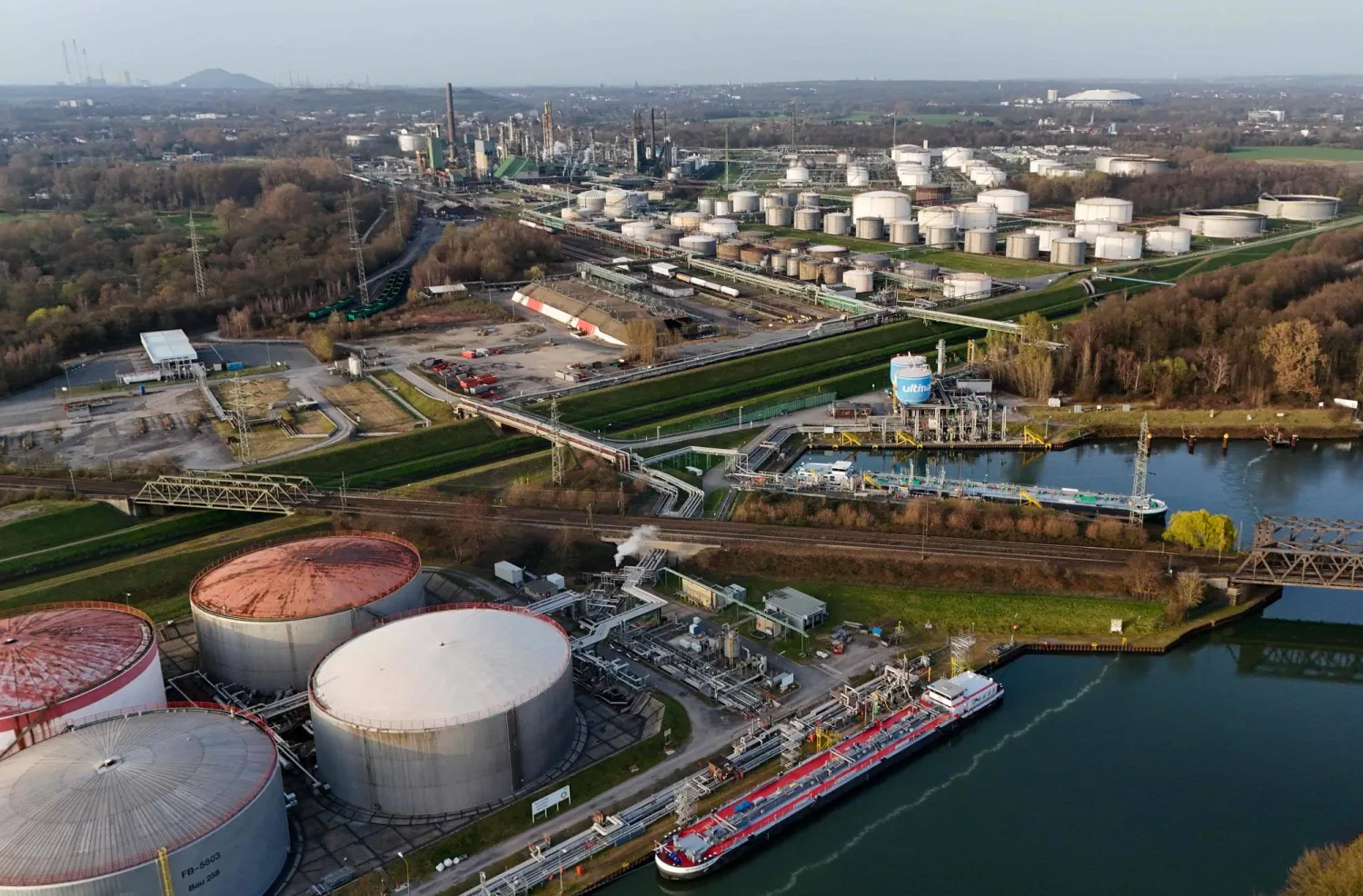
(FILES) This aerial view shows the fuel depot of Aral at the Ruhr Oel petroleum refineries of BP Gelsenkirchen GmbH in Gelsenkirchen, western Germany on March 9, 2026. (Photo by Ina FASSBENDER / AFP)
TT

Oil Prices Sink Further as Trump Signs Deal to Reopen Hormuz

(FILES) This aerial view shows the fuel depot of Aral at the Ruhr Oel petroleum refineries of BP Gelsenkirchen GmbH in Gelsenkirchen, western Germany on March 9, 2026. (Photo by Ina FASSBENDER / AFP)

Oil prices tumbled again Thursday after US President Donald Trump and his Iranian counterpart signed off on a deal to end their war and reopen the Strait of Hormuz.

The news boosted optimism for a lasting peace between the two nations after more than three months of war that has rattled energy markets and fueled a fresh spike in inflation.

However, the upbeat mood on trading floors was tempered by expectations the US Federal Reserve will hike interest rates before year's end, after its new boss held his first policy meeting and acknowledged "persistently high prices are a burden for the American people", reported AFP.

Trump put his signature to the memorandum of understanding in Versailles after a G7 summit, telling reporters: "Just signed it."

Iranian foreign ministry spokesman Esmaeil Baqaei, quoted by state news agency IRNA, said the document "was finalized with the signatures of the presidents".

All eyes are now on the strait, through which a fifth of world oil normally passes and which Tehran effectively closed after the United States and Israel launched their war on Iran on February 28.

"As a first step, Islamic Republic of Iran will instantly reopen the Strait of Hormuz and the United States of America will immediately lift the naval blockade," Pakistan's Prime Minister Shehbaz Sharif, whose officials mediated the agreement, said on X.

The deal will see Washington commit to immediately waive oil sanctions and facilitate the release of a $300 billion reconstruction fund, while Tehran agrees to dilute its enriched uranium as talks on a longer-term agreement are held.

Crude fell more than three percent Thursday, extending the losses sustained since news broke at the weekend. Both main contracts have plummeted more than 15 percent since last week, when talk of an agreement began swirling.

"A signed MOU and a faster path toward reopening the Strait of Hormuz should pull some of the panic premium out of crude," wrote Stephen Innes at SPI Asset Management.

"That matters because oil was not just trading war risk. It was trading the possibility that reserve drawdowns and blocked Gulf flows would create an energy cliff."

Equities were mixed as they struggled to maintain the positive momentum seen this week.

Seoul was again at the forefront of the gains, ploughing past 9,000 points for the first time thanks to another surge in chip titans Samsung and SK hynix as the AI boom continues apace.

"South Korea supplies around 80 percent of the world's memory chips, and artificial intelligence is expected to continue growing for at least another decade," Kim Dae-jong, a professor at Sejong University, told AFP.

"Semiconductors account for roughly half of South Korea's industrial output, and this is seen as the biggest reason why Kospi broke through the 9,000-point mark."

Tokyo, Singapore, Taipei, Mumbai and Manila also rose but Hong Kong, Shanghai, Sydney, Wellington, Bangkok and Jakarta fell along with London. Paris was flat while Frankfurt rose.

The mixed performance followed the Fed's latest policy meeting that saw it hold rates as expected but indicate it could hike in the next six months.

The gathering was the first for new boss Kevin Warsh, who flagged the fact that inflation has been well above the bank's two percent target for years but vowed to "deliver price stability".

"Persistently high prices are a burden for the American people, but the recent past need not be prologue," he said after the meeting at which he also wanted wide-ranging reforms at the bank.

Warsh was appointed by Trump, who has launched an unprecedented assault on the Fed's independence and called previous boss Jerome Powell incompetent for not cutting rates enough.

Analysts pointed out that the Fed's post-meeting statement did not make mention of an easing bias, as it had done previously.

The fact there was more emphasis on prices rather than jobs was also noted.

Data this month has shown inflation at a three-year high, while the labor market remains healthy.

"While there is no suggestion the Fed's dual mandate has shifted away from unemployment as well as price stability, markets have been left with a view (that) the emphasis appears to have shifted to the latter for now," wrote National Australia Bank's Gavin Friend.



Riyadh Opens the Way for Driverless Parcel Delivery

One of the autonomous trucks (Asharq Al-Awsat)
TT

Riyadh Opens the Way for Driverless Parcel Delivery

One of the autonomous trucks (Asharq Al-Awsat)

As the mobility landscape within Saudi cities continues to evolve, Riyadh is preparing to embark on a new experience in which no driver sits behind the wheel and the success of a journey does not depend on a driver's ability to navigate the road. By mid-November, 24 autonomous trucks are expected to begin trial operations on the capital's roads, opening the door for the technology to move from passenger transport into parcel and freight delivery.

The move follows the General Transport Authority's sponsorship in May of a memorandum of understanding between Abdul Latif Jameel Motors and China's Zeelos Technology, a company specializing in autonomous driving technologies, with the aim of adopting and enabling autonomous mobility solutions in the Kingdom.

The trucks expected to operate in Riyadh represent one of the practical applications of this cooperation. The first phase will focus on testing the ability of autonomous vehicles to transport parcels within the capital, paving the way for an assessment of their performance and efficiency before moving to broader stages of operation.

Ammar Baterdok, General Manager of Mobility Solutions Projects at Abdul Latif Jameel Motors, told Asharq Al-Awsat that the pilot operation will begin after the completion of geospatial mapping and the training of autonomous driving systems on local roads.

He explained that the fleet allocated to the first phase comprises 24 trucks of different sizes and models. Four have already arrived in the Kingdom, while another 20 are currently in transit, amid logistical challenges affecting shipments from China due to developments in the region.

The trucks have payload capacities of 0.5 tons, 1.5 tons, and 2.5 tons. The fleet includes refrigerated and non-refrigerated models, with the remaining batches expected to arrive successively during October and November.

Free Trials with SPL

Abdul Latif Jameel Motors is carrying out the pilot phase in cooperation with Saudi Post | SPL to transport parcels from the main center to neighborhood centers in Riyadh. The service will be provided free of charge throughout the trial period.

Baterdok said the company is prepared to extend the pilot period for several months if necessary in order to collect sufficient operational and investment data to assess the fleet's performance and economic viability before making a decision on commercial expansion.

The phase will allow the company to test the vehicles under actual driving conditions within the capital, including their ability to navigate local roads and traffic, while also measuring their performance during different operating hours.

Millions Invested to Test Viability

The cost of the pilot phase amounts to millions of riyals, according to Baterdok, covering the purchase of vehicles, customs clearance, fees, and taxes. He explained that the investment is not intended to generate a direct financial return, but rather to test the technology's economic and technical viability and collect the data needed before decisions are made regarding commercial expansion and the size of the future fleet.

Illustrative photo of the inside of the truck (Asharq Al-Awsat)

Operating Savings Could Exceed Truck Costs

The company is banking on autonomous trucks being able to reduce operating costs compared with conventional vehicles. Baterdok explained that the price of an autonomous truck is approximately half that of a conventional fuel-powered truck, whether gasoline or diesel.

The cost gap becomes wider during operation due to lower labor and maintenance expenses, in addition to the possibility of operating the trucks around the clock, except for the periods required for recharging.

In an analysis, logistics expert Hassan Al Halil told Asharq Al-Awsat that the most significant economic impact would come from reducing operating costs and improving supply-chain efficiency. He noted that autonomous trucks could increase fleet utilization, improve route planning, and allow for longer operating periods, particularly on repetitive and defined routes.

Al Halil added that it is too early to establish a fixed percentage for reductions in logistics costs in Saudi Arabia, given that savings vary depending on the type of shipment, distance, and operating model. He said that "the greatest opportunities for savings lie in operating labor costs, increasing truck utilization, reducing waiting times, improving fuel consumption, and maintenance," adding that "the economic value will come from increasing fleet productivity and completing more trips efficiently."

Baterdok, meanwhile, said the absence of a driver allows supply and delivery operations to be shifted to nighttime hours, increasing the efficiency of fleet utilization in major cities such as Riyadh by taking advantage of periods when road traffic is less dense.

According to company estimates, electricity costs account for only about 20 percent of the cost of conventional fuel, while maintenance expenses decline due to the absence of conventional engines and transmissions. Routine servicing therefore focuses to a greater extent on components such as brakes and tires.

The trucks rely on sensors and radar systems for autonomous driving, enabling them to operate in nighttime driving conditions without relying on human vision.

Road Readiness Determines the Path to Expansion

Despite these advantages, Al Halil believes that large-scale operation of autonomous trucks in Riyadh requires more than well-maintained roads. It requires highly accurate maps that are continuously updated, reliable communications systems, smart infrastructure, and coordination among the relevant authorities.

He pointed out that the main challenges within cities include congestion, sudden changes in routes, roadworks, unexpected behavior by some vehicles, dusty conditions, and the handling of loading and unloading points. He said that "the most realistic starting point will be defined, repetitive roads and logistics routes before moving to more complex urban operations."

From Passenger Transport to Parcel Delivery

The truck trial comes as Saudi Arabia expands its testing of autonomous mobility applications, as the technology moves from passenger transport into freight and delivery.

Last year, Saudi Arabia launched autonomous passenger vehicles and is currently operating more than five routes, including the Roshn area, Princess Nourah bint Abdulrahman University, and the route connecting Riyadh Gallery and Hayat Mall.

The service has transported more than 3,100 passengers across 1,600 trips under the supervision of the General Transport Authority, as part of efforts to test autonomous driving technologies in the Saudi urban environment.

The expansion of these applications into the freight sector opens a new field for testing the impact of autonomous driving on the efficiency of delivery operations within cities, at a time when e-commerce is expanding and supply chains are seeing growing demand for more efficient and flexible solutions.

From Roads to the Sky

Abdul Latif Jameel Motors' plans do not stop at ground transportation. The company has begun studying the market for drone-based goods delivery in preparation for entering the field once the necessary regulatory frameworks are in place.

Baterdok expects the process of developing regulations governing goods delivery by drones to take between one and a half and three years. He noted that the company is in discussions with global suppliers of trucks and drones designed to transport goods and individuals.

In evaluating these solutions, the company is focusing on technical readiness, range, speed, the ability of vehicles and aircraft to operate under different weather conditions, and resistance to wind, with the aim of achieving operational readiness as soon as official licenses are issued.

Accordingly, Abdul Latif Jameel Motors' plan is not limited to testing autonomous trucks in Riyadh. It extends to developing a broader system of autonomous mobility solutions, beginning with ground transportation and eventually reaching air-based goods delivery, while testing the technical and economic viability of each solution before moving from trials to commercial expansion.


Strait of Hormuz Ship Crossings Remain in Single Digits

FILE PHOTO: Vessels near the Strait of Hormuz, as seen from Musandam, Oman, September 2, 2026. REUTERS/Stringer/File Photo
TT

Strait of Hormuz Ship Crossings Remain in Single Digits

FILE PHOTO: Vessels near the Strait of Hormuz, as seen from Musandam, Oman, September 2, 2026. REUTERS/Stringer/File Photo

Vessel transits through the Strait of Hormuz remained in the single digits at four on Tuesday, down from seven a day earlier, preliminary shipping data showed on Wednesday, falling well short of the 10-day average of 18.

The drop in traffic through the waterway that handled one-fifth of the world's oil and liquefied ⁠natural gas supply before ⁠the Iran war comes after attacks in the region intensified.

Of the total on Tuesday, two ships were exiting and two were entering, according to the data.

No very large crude carriers ⁠or liquefied natural gas tankers were involved.

Some ships may be sailing through the waterway with their transponders turned off and they are therefore not counted.

One very large gas carrier, Salute, carrying around 470,000 barrels of liquefied petroleum gas exited via the Iranian route, while Panamax-sized tanker Nautilus, carrying around 510,000 barrels of naphtha, exited ⁠via ⁠an unknown dark route, Reuters reported.

The two ships that entered were both laden, with one being a short-range dirty products tanker and the other a dry bulk carrier. Both entered via the Iranian route.

Meanwhile, the number of ships sailing through the Bab el-Mandeb Strait was at 22, little changed on Tuesday compared with a day ago at 24.


Türkiye 2027 Inflation Target Realistic, Minister Says

People shop at the Eminonu district of Istanbul, Türkiye, April 25, 2025. (Reuters)
TT

Türkiye 2027 Inflation Target Realistic, Minister Says

People shop at the Eminonu district of Istanbul, Türkiye, April 25, 2025. (Reuters)

Türkiye's 2027 inflation target in its medium-term program is regarded as realistic by markets, provided that the Iran war does not continue next year, Finance Minister Mehmet Simsek said in an interview with broadcaster Haberturk on Wednesday.

Türkiye should normally operate a floating ‌exchange rate regime, ‌as it provides the ‌basis ⁠for responding correctly ⁠to shocks, Simsek said.

Türkiye has always provided wage increases of at least the rate of inflation for all public workers and retirees, and will continue to do so, ⁠he added.

Once inflation ‌falls to ‌single digits, mandatory export proceeds sales requirements could ‌be lifted in favor of ‌a freer regime, he also said.

Conditions for removing the mandatory export sales requirement have not yet been met and ‌Türkiye will review the matter when they arise.

The government expects ⁠inflation ⁠to slow to 28.4% this year and to 21% in 2027 before dropping to single digits in 2029 — about two years later than previously predicted.

The US-sanctioned Golden Global Yatirim bank is small and poses no systemic risk, Simsek also said, calling on other banks to comply with international regulations and strengthen compliance.